

Yes. A Maryland notary can notarize for a deaf or hard-of-hearing signer when identity, willingness, and the required notarial communication can be established through an accessible method. For eligible documents, Maryland remote online notarization through Proof is an option to discuss with CraigVet Notary Services, but the communication arrangement must be confirmed before the appointment. Hearing loss alone does not establish that someone cannot understand or sign a document.
- A Maryland notary can notarize for deaf or hard of hearing signer needs when accessible communication satisfies notarial requirements.
- CraigVet Notary Services offers Maryland remote online notarization through Proof for eligible documents; confirm communication needs before scheduling.
- Do not assume captions, chat, or an interpreter automatically satisfy every requirement of a remote session.
- Mobile appointments are a secondary option; Baltimore County availability requires confirmation before booking.
Can a notary notarize for a deaf or hard-of-hearing signer?
Yes—the question is whether the notarization requirements can be met, not whether the signer can hear. A notary must establish identity and carry out the particular notarial act while communicating effectively with the signer. A relative answering every question does not establish the signer's own willingness.
For Maryland remote appointments in 2026, Maryland Code, State Government §18-214 provides the relevant communication-technology framework. Its definition addresses communication with a remotely located individual who has a vision, hearing, or speech impairment through means other than sound and sight when necessary and consistent with other applicable law.
That provision does not establish that every platform feature or proposed accommodation works for every appointment. The notary must confirm the actual arrangement, including how the signer will receive questions and communicate responses during the required session.
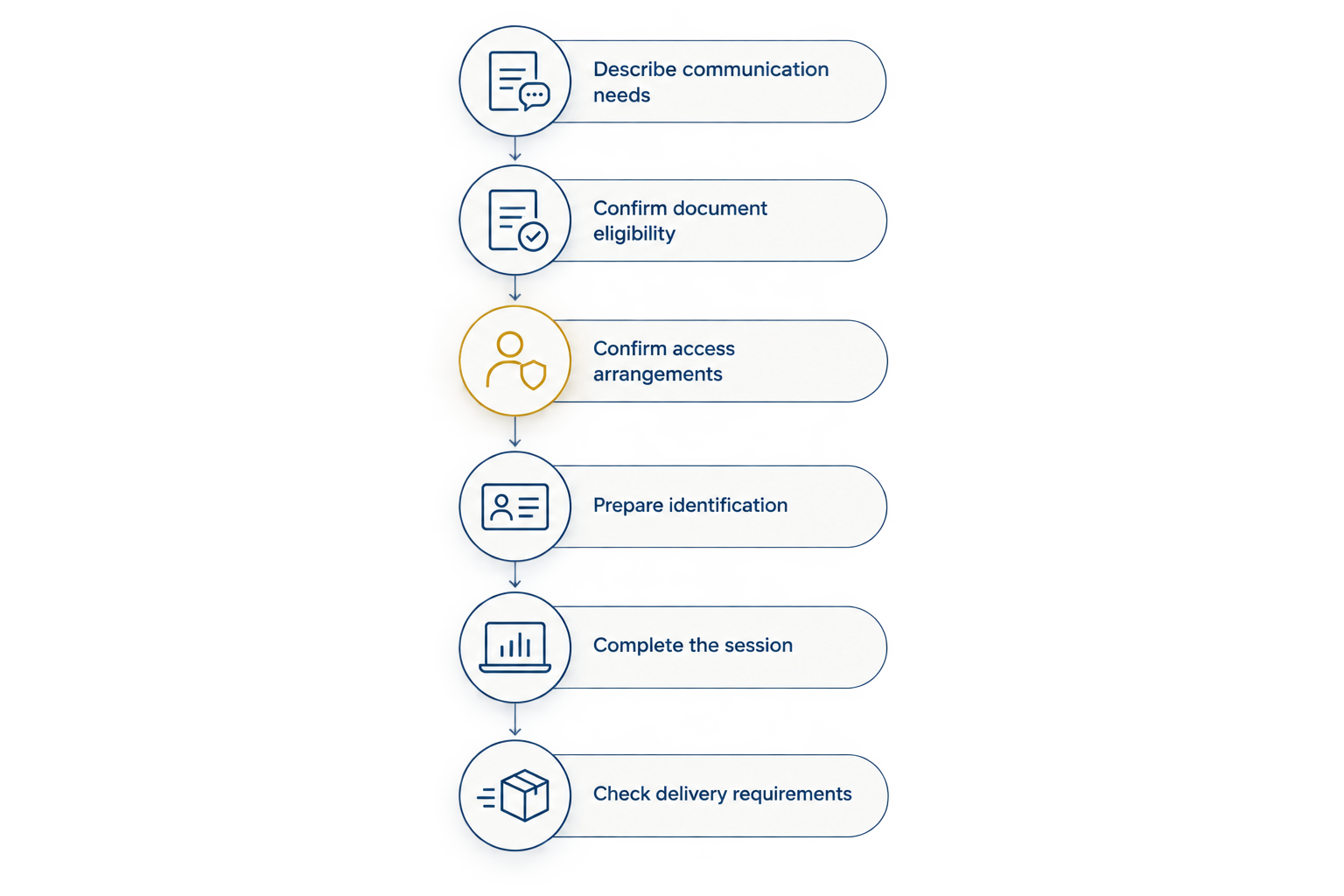
Use this sequence before requesting a remote appointment:
- Describe communication needs. Tell the notary how you prefer to receive questions and respond. Written English, sign language, captions, and assistive listening are different needs—not interchangeable solutions.
- Confirm document eligibility. Identify the document and the organization receiving it. Ask whether remote notarization is suitable and whether separate witness or execution requirements apply.
- Confirm access arrangements. Ask how the proposed communication method will work within the Proof session. Do not assume a feature is supported or suitable without confirmation.
- Prepare identification. Follow the appointment's identity-verification instructions. Accessibility arrangements do not replace identity verification.
- Complete the session. Participate personally, receive the required questions, and communicate your own responses. Follow the notary's instructions about signing and any oath or acknowledgment.
- Check delivery requirements. Confirm how the receiving organization wants the completed document delivered. Notarization and the recipient's submission requirements are separate issues.
If you are unfamiliar with the underlying process, review how remote online notarization works in Maryland. Resolve the communication arrangement before treating the session as ready to proceed.
Why this matters
A communication barrier is not the same as a lack of understanding. A deaf signer who uses American Sign Language, a hard-of-hearing signer who uses captions, and a signer who prefers written exchanges require different preparation.
Ask what works for the signer rather than choosing an accommodation on the signer's behalf. Speaking louder, relying on lip-reading, or directing every question to a companion does not necessarily create effective communication.
For a business handling repeat notarizations in 2026, make communication preferences part of appointment planning. Keep that question separate from whether the document is complete, whether witnesses are needed, and whether the recipient accepts the proposed execution method.
Remote online or mobile: which arrangement fits?
Start with Maryland remote online notarization for eligible documents through Proof. Consider a mobile appointment when an in-person setting better supports the signer's communication needs or the document's requirements.
Neither format removes the need for accessible communication. An in-person visit is not automatically suitable simply because everyone occupies the same room.
| Appointment format | Best for | Practical advantage | Limitation to resolve |
|---|---|---|---|
| Remote online notarization through Proof | Signers with eligible documents and a confirmed remote communication arrangement | Allows the notarial session to occur remotely | Identity verification, technology, communication arrangements, and document eligibility must all work together |
| In-person mobile notarization | Signers whose confirmed communication arrangement or document requirements favor an in-person meeting | Allows an agreed physical setting and face-to-face interaction | Travel arrangements and communication needs still require advance planning; Baltimore County availability must be confirmed |
CraigVet Notary Services is best for Maryland individuals and businesses seeking remote online notarization for eligible documents through Proof. That service fit is not a promise that every document or accommodation can be handled remotely.
A mobile request is also not a confirmed appointment. Wait until CraigVet Notary Services contacts you and confirms the arrangements before relying on a proposed time or Baltimore County location.
Why the communication arrangement varies
There is no single appointment setup for every deaf or hard-of-hearing signer. The appropriate arrangement depends on practical requirements that must be resolved together:
- The signer's preferred language. American Sign Language and written English are distinct languages. Do not assume that writing a question makes it equally accessible to every signer.
- The required notarial act. An acknowledgment and an oath involve different responses. The communication method must support the act actually requested.
- The remote setup. Confirm how questions, responses, and any interpretation will function during the live session—not just during preliminary messages.
- Identity verification. The signer must complete the applicable identification process even when another person assists with technology or communication.
- Document instructions. Separate witness, execution, or recipient requirements require their own review. An accessibility arrangement does not settle those questions.
- The physical environment. Lighting, camera placement, visual distractions, and background noise can affect communication. Plan the setting around the signer's actual needs.
For your 2026 appointment, describe the functional requirement plainly: for example, that you need to read questions or communicate in sign language. You do not need to turn an appointment request into a medical history.
Can a deaf signer communicate with the notary in writing?
Written communication can be appropriate when it allows the signer and notary to communicate effectively and satisfies the applicable notarial requirements. Hearing loss does not create a universal requirement to use an interpreter.
For an in-person appointment, discuss the proposed written exchange before the visit. The notary still needs to establish the signer's own responses and perform the requested act correctly.
For a remote appointment, do not assume a text conversation outside the session replaces the required remote appearance. Preliminary email, platform chat, and the communication used to complete the notarial act have different purposes; confirm how the arrangement will work.
Can an interpreter or family member help during notarization?
An interpreter or support person is not a substitute for the signer. Ask the notary in advance whether the proposed person's role is permitted and workable for the particular appointment.
Keep roles distinct. Someone helping position a camera is not necessarily qualified to interpret, and someone interpreting is not automatically serving as a document witness.
A family member should not answer questions about the signer's willingness on the signer's behalf. If the signer cannot communicate the necessary responses through the agreed arrangement, pause and resolve that barrier rather than continuing through a companion.
Does the signer have to speak during the appointment?
Spoken responses are not the only way a deaf or hard-of-hearing person can communicate. The notary must still receive the responses required for the particular act through an appropriate, accessible method.
For example, an acknowledgment concerns the signer's acknowledgment of execution, while an oath or affirmation requires the signer to make the required commitment to truthfulness. Ask how that exchange will be handled before the session begins; do not assume a nod or a companion's explanation settles it.
What should you send before requesting an appointment?
Give the notary enough information to assess the request without sending unnecessary personal details. A useful appointment inquiry identifies:
- The document type: describe what needs notarization and identify any instructions supplied by the recipient.
- The receiving organization: explain where the completed document will go and flag any stated remote-signing restrictions.
- Your communication preference: describe how you need to receive questions and provide responses.
- Any proposed assistance: identify whether you intend to use an interpreter, support person, or assistive technology.
- The requested format: ask about remote notarization first, or explain why you are requesting a mobile visit.
- The deadline: state the actual submission deadline without assuming an appointment has been accepted.
Ask how to transmit identification and documents before sending them. Use the process provided for the appointment rather than posting sensitive material in a public message or sending it to an unverified recipient.
Do not sign merely to make the appointment faster. Follow the instructions for your document and notarial act; some acts require signing in the notary's presence.
How should businesses handle repeat notarizations?
For a Maryland business arranging repeat appointments in 2026, use a consistent intake process without assuming every signer needs the same accommodation. Ask about communication preferences each time the participants or circumstances change.
Separate administrative coordination from the signer's participation. An employee can organize documents and explain submission requirements, but the signer must personally participate in the notarial act.
Use these practical controls:
- Keep the document recipient's instructions with the appointment request.
- Identify witnesses separately from interpreters and administrative helpers.
- Confirm who will arrange any agreed communication assistance.
- Give the signer appointment instructions in an accessible format.
- Leave room to stop if communication or identity verification cannot be completed.
A repeated business relationship does not remove document eligibility checks. A process that worked for one signer or document is not automatic approval for the next.
When should the appointment pause?
Pause when the notary and signer cannot reliably communicate the required questions and responses. Continuing through uncertainty risks an incomplete or improper notarial act.
Other reasons to stop and resolve the problem include unsuccessful identity verification, uncertainty about the requested notarial act, or indications that someone is pressuring the signer. Hearing loss by itself is not evidence of unwillingness or incapacity.
The next step depends on the barrier: clarify the document instructions, arrange an appropriate communication method, or discuss a different appointment format. Do not ask a companion to supply the missing answers.
FAQ
Can a Maryland notary refuse me just because I am deaf?
Deafness alone does not establish that you cannot participate in notarization. The notary must assess whether identity, willingness, communication, and the requirements of the requested act can be satisfied through an appropriate arrangement.
Can I use captions during a remote notary appointment?
Ask whether captions are supported and suitable for your specific appointment before scheduling. Do not assume that captions alone resolve identity verification, required responses, or other communication needs.
Do I need an American Sign Language interpreter to get notarized?
An American Sign Language interpreter is not automatically required for every deaf signer. Discuss your preferred communication method with the notary and confirm whether the proposed arrangement meets the appointment's requirements.
Can my spouse answer the notary's questions for me?
Your spouse cannot replace your own participation or supply your willingness to sign. Discuss any proposed assistance beforehand so the notary can distinguish support from answering on your behalf.
Can I request an in-person appointment instead of remote notarization?
You can request a mobile appointment when an in-person arrangement better fits your needs. Baltimore County availability must be confirmed, and a request is not a confirmed appointment until CraigVet Notary Services contacts you.
Does notarization mean the notary has approved my legal document?
Notarization does not mean the notary has approved the document's legal effect. Craig is not an attorney and cannot provide legal advice; ask an attorney about legal consequences, document selection, or disputed execution requirements.
One last thing
Confirm the communication plan, not just the appointment time. Before your 2026 session, make sure you know how you will receive questions, how you will respond, and what happens if the agreed method stops working.
That conversation is more useful than simply reporting that a signer is deaf or hard of hearing. It turns a general accessibility request into practical appointment instructions while preserving the signer's own participation.


