

Yes—a notary can notarize a document without a separate witness when the document, applicable law, and receiving organization do not require one. In Maryland, an eligible document can also be notarized remotely through an authorized online process, but the signer must still appear before the notary by the required method. A required document witness cannot simply be omitted, and an ordinary video call does not replace a compliant remote notarization.
- Can a notary notarize a document without a witness present? Yes, when no separate document witness is required.
- Maryland remote online notarization requires proper appearance and identity verification; it does not eliminate witness requirements.
- CraigVet Notary Services is best for Maryland individuals and businesses seeking eligibility review before a remote notarization appointment.
- Confirm witness requirements with the document preparer or receiving organization before arranging your appointment.
Why this matters
A notary and a document witness perform different jobs. Confusing those roles can leave you with a notarized signature on a document that still lacks a required witness signature.
For Maryland remote online notarization in 2026, CraigVet Notary Services uses Proof for eligible documents. Mobile appointments are a secondary option, with Baltimore County availability confirmed before booking. Submitting an appointment request does not confirm an appointment; wait for the business to contact you.
Can a notary notarize a document without a witness present?
Yes, if no separate document witness is required. The notary must still complete the requested notarial act properly, including the applicable appearance, identification, acknowledgment, or oath requirements.
The practical distinction is between a witness to the document and the notary performing the notarial act. A document witness observes or attests to signing as required for that document. The notary performs the act described in the notarial certificate under Maryland notarial requirements.
| Situation | Is a separate witness needed? | Best for | Main limitation |
|---|---|---|---|
| Acknowledgment without a separate witness requirement | Not solely because an acknowledgment is requested | Confirming that the signer acknowledges the signature | The signer must still appear before the notary through an authorized method |
| Verification on oath or affirmation without a separate witness requirement | Not solely because this notarial act is requested | A statement requiring an oath or affirmation | The signer must complete the required oath or affirmation and signing procedure |
| Document with a separate witness requirement | Yes, unless an applicable rule permits another procedure | Documents whose execution requires witness participation | Notarization does not replace the required witness |
| Remote appointment for an eligible document | Depends on the document and applicable requirements | Completing an eligible notarization without meeting in person | Remote notarization does not automatically authorize remote document witnessing |
The table separates the notarial act from the document's execution requirements. It is not permission to choose a certificate or remove a witness line yourself. If the instructions are unclear, ask the document preparer or receiving organization what is required before scheduling.
How to prepare for Maryland remote online notarization
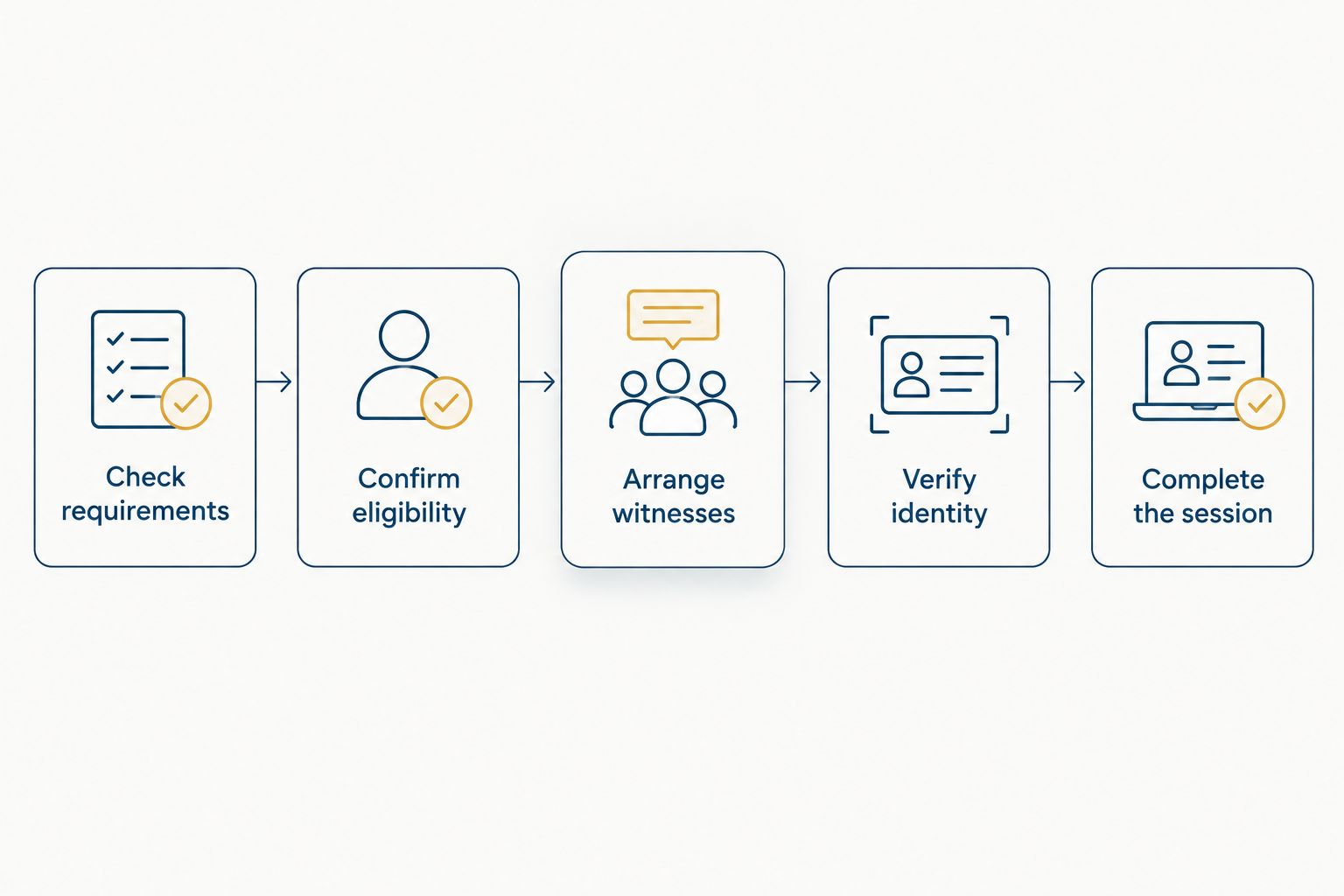
Use this 5-step preparation sequence for a 2026 appointment. It puts eligibility and witness questions before the online session, where an unresolved requirement can interrupt completion.
- Check requirements. Identify the document, its receiving organization, and any instructions about notarization or witnesses. Ask whether the recipient accepts remote online notarization for that document.
- Confirm eligibility. Ask whether the document can proceed through Maryland remote online notarization using Proof. Flag witness lines, multiple signers, attachments, and any special recipient instructions.
- Arrange witnesses. If separate witnesses are required, establish who must participate and how they must appear. Do not assume the notary supplies witnesses or that an online witness is acceptable.
- Verify identity. Follow the identity-verification instructions for the appointment. Keep the required identification ready and resolve discrepancies before proceeding.
- Complete the session. Follow the notary's instructions for appearance, acknowledgment, oath or affirmation, and signing. Ask how the completed document will be provided and what you must send to the recipient.
The order matters. Learning that a required witness is absent after the session begins does not remove the requirement; it leaves a preparation problem that needs resolving.
Have the complete document available for review of appointment requirements. Do not send only the signature page when other pages contain witness instructions, execution language, or conditions the recipient expects you to follow.
Request an eligibility review
Ask about Maryland remote online notarization, witness requirements, and appointment preparation.
An acknowledgment does not automatically require a separate witness
An acknowledgment generally requires the signer to appear before the notary and acknowledge signing the document. The signature can already be on the document; an acknowledgment is not necessarily a requirement to sign again in front of the notary.
That distinction answers a common source of confusion. A notary does not need a separate document witness merely because the signature was made earlier, but the signer must still satisfy the acknowledgment procedure.
For a Maryland appointment in 2026, do not interpret that rule as permission to send a signed document to the notary without appearing. An existing signature does not eliminate the signer's required appearance.
If the document also requires witness signatures, those requirements remain separate. Ask the preparer how the document must be executed rather than treating the acknowledgment as a replacement for missing witnesses.
An oath or affirmation adds a different requirement
A verification on oath or affirmation is not interchangeable with an acknowledgment. The signer must swear or affirm the truthfulness of the statement and follow the applicable signing procedure before the notary.
A separate document witness is not automatically required just because an oath is involved. However, a witness requirement elsewhere in the document or applicable law still needs to be addressed.
Do not sign a sworn statement early on the assumption that every notarization works like an acknowledgment. Tell the notary whether the document is already signed and follow the instructions for the requested notarial act.
The benefit of identifying the act in advance is practical: you arrive prepared for the right procedure. The limitation is equally important—the notary cannot choose legal requirements for you or advise which act best protects your interests.
A required witness cannot be replaced by a notarial seal
When a document requires witnesses, a notarial seal does not supply their participation. A notarized signature and a properly witnessed document are different requirements, even when both appear on the same page.
Some estate-planning and authority documents have execution rules beyond ordinary notarization. Do not assume that a will, power of attorney, or similar document follows the same procedure as a routine acknowledgment.
A witness line is a reason to ask questions, not a reason to guess. Conversely, the absence of a printed witness line does not establish that no witness is legally required.
Before proceeding, give the preparer or receiving organization these 3 questions:
- Does this document require a separate document witness?
- Who qualifies to serve, and how must that person participate?
- Does the required procedure permit remote participation for this document?
Obtain legal guidance when the answer depends on the document's legal effect. Craig is not an attorney and cannot provide legal advice.
Why witness requirements vary
For a 2026 appointment, start with the document's requirements rather than a general rule about notarization. These factors determine what needs clarification:
- Document type. Different documents have different execution requirements; notarization alone does not establish that every requirement is satisfied.
- Applicable law. The law governing the document can impose witness requirements beyond the notarial act.
- Notarial act. An acknowledgment and a verification on oath or affirmation require different actions from the signer.
- Recipient instructions. The organization receiving the document can specify submission and acceptance requirements you need to check beforehand.
- Participation method. Permission to notarize remotely does not, by itself, answer whether a required document witness can participate remotely.
- Witness qualifications. Where witnesses are required, confirm any eligibility restrictions instead of assuming any available adult qualifies.
Keep those answers with the appointment instructions. A clear record helps everyone prepare for the same procedure, particularly when a business coordinates several signers or sends documents to different recipients.
Remote online notarization or a mobile appointment?
Use Maryland remote online notarization for eligible documents when the required participants and recipient requirements support it. Its practical benefit is avoiding an in-person meeting with the notary; its limitation is that eligibility, identity verification, and required participation still need to be satisfied.
A mobile appointment brings the notary to an agreed location. That can suit an in-person signing arrangement, but travel does not remove witness requirements or resolve questions about the document's legal execution.
CraigVet Notary Services offers Maryland remote online notarization through Proof and in-person mobile appointments. For mobile service, confirm Baltimore County availability before booking; do not treat a requested location or time as accepted until the business contacts you.
For either method, explain witness needs before selecting an appointment. Choosing an in-person meeting solely because you are unsure about witnesses does not answer who must attend or what they must do.
Practical guidance for businesses with repeat notarizations
For repeat notarizations in 2026, use a document-specific preparation checklist rather than one rule for every signing. A procedure that works for an acknowledgment without witnesses does not establish the requirements for another document.
Record the following for each document type:
- The document name and receiving organization.
- The required notarial act, as supplied by the appropriate preparer or recipient.
- Whether separate witnesses are required and how they must participate.
- Whether the recipient accepts remote online notarization.
- The signers' appointment instructions and confirmation status.
This checklist supports coordination; it does not replace legal review. Assign someone to resolve unclear instructions before asking employees, customers, or family members to attend.
Avoid circulating copies of identification or sensitive documents more widely than necessary. Follow the appointment's submission instructions rather than assuming an ordinary email thread is the right place for every document.
What if I already signed the document without a witness?
An existing signature does not automatically prevent an acknowledgment, but a missing required document witness is a separate issue. Tell the notary what happened and ask the preparer or receiving organization whether the document needs to be signed again under the correct procedure.
Can someone witness my signature over a video call?
A video call alone does not establish that remote witnessing is permitted. Confirm the rules for the specific document and distinguish document witnessing from Maryland remote online notarization.
Can the notary also serve as my document witness?
Do not assume the notary can fill both roles. Whether that arrangement is permitted depends on the document, applicable requirements, and the acts involved; resolve the question before the appointment.
FAQ
Can a notary notarize a document without a witness present?
Yes, when no separate document witness is required. The notary must still satisfy the requirements for the notarial act, including the signer's required appearance and identity verification.
Do I need a witness for Maryland remote online notarization?
You need a separate witness only when the document or applicable requirements call for one. Remote online notarization does not remove that requirement or automatically authorize remote document witnessing.
Can I email a signed document to a notary and skip the appointment?
Emailing a signed document does not replace the signer's required appearance before the notary. An eligible remote notarization requires an authorized online process, not merely an emailed signature.
Can the notary choose whether my document needs witnesses?
A notary cannot provide legal advice about your document's execution requirements. Ask the document preparer, receiving organization, or a qualified attorney to resolve unclear witness requirements.
Can my business use online notarization for repeat documents?
Your business can request Maryland remote online notarization for eligible documents. Confirm recipient acceptance, signer preparation, and any separate witness requirements for each document type.
Does requesting an appointment mean my booking is confirmed?
An appointment request is not a confirmed booking. Wait for CraigVet Notary Services to contact you, and confirm Baltimore County availability before booking a mobile appointment.
Should I sign my document before the notary appointment?
Follow the instructions for the required notarial act rather than signing automatically. An acknowledgment can involve an existing signature, while a verification on oath or affirmation requires the applicable oath and signing procedure.
One last thing
Ask about the document, not just the stamp. Before your 2026 appointment, state whether the document has witness instructions, whether anyone has already signed, and who will receive it.
That short explanation helps separate the notary's responsibilities from the document's other requirements. It is the most useful preparation you can make before choosing a remote or mobile appointment.


