

To prepare for a mobile notary appointment, confirm the meeting arrangements, gather the complete document and identification, check signature instructions, and arrange any required witnesses before the visit. First consider Maryland remote online notarization through Proof for eligible documents; if you need an in-person appointment, confirm Baltimore County availability and wait for CraigVet Notary Services to contact you before treating the appointment as confirmed.
- How do I prepare for a mobile notary appointment? Gather documents, identification, signature instructions, and any required witnesses.
- CraigVet Notary Services offers Maryland remote online notarization through Proof for eligible documents, with mobile appointments as another option.
- Requesting an appointment does not confirm it; wait for direct contact before making arrangements.
- Craig is not an attorney and cannot provide legal advice or choose legal documents for you.
How do I prepare for a mobile notary appointment?
Prepare the document, the signer, and the meeting location—not just the signature page. For your 2026 appointment, use the steps below to identify questions before the notary arrives. Start with CraigVet Notary Services to discuss whether remote notarization through Proof or an in-person mobile appointment fits your document.
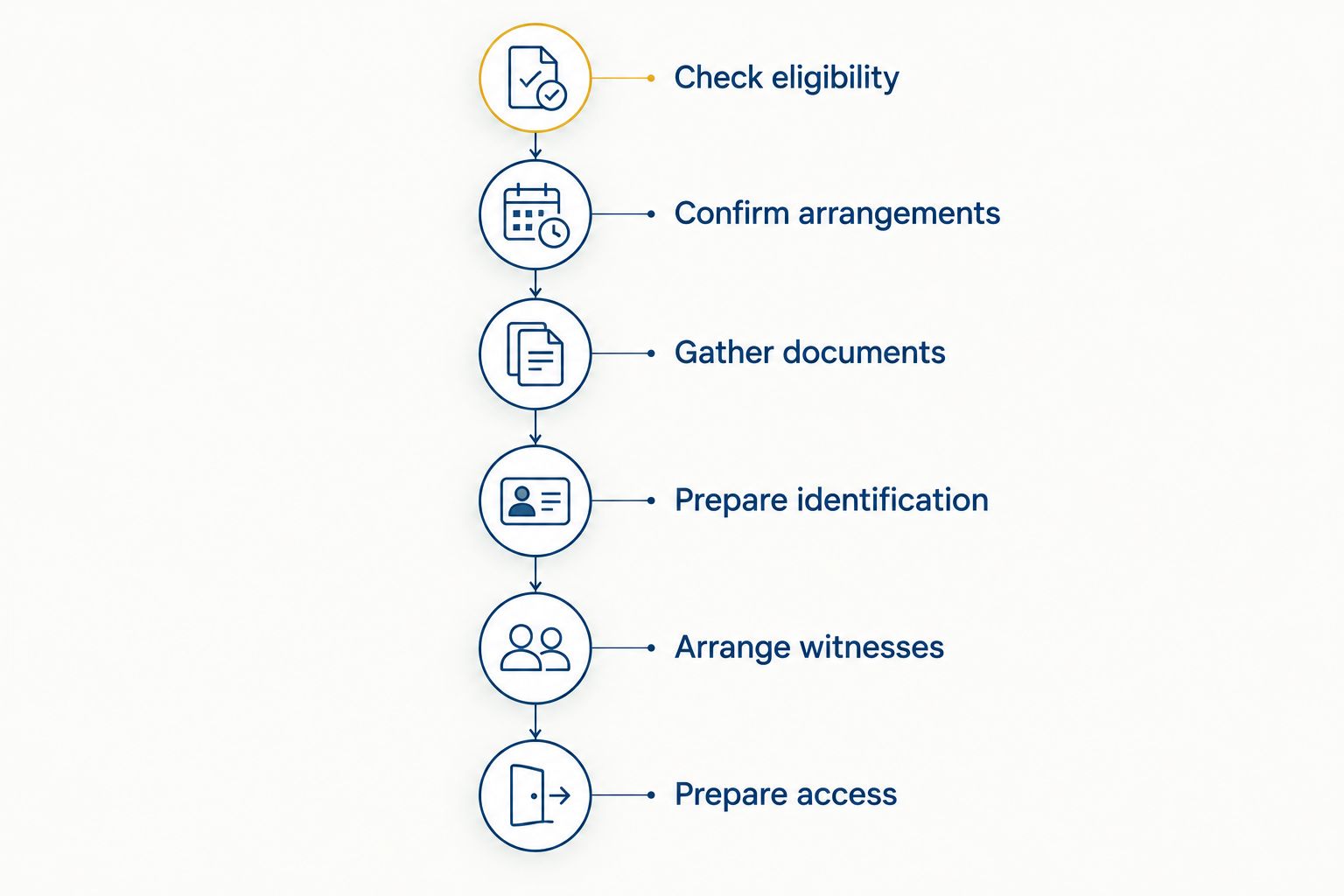
1. Check eligibility
Ask whether your document is eligible for Maryland remote online notarization through Proof. Remote notarization involves identity verification and an online session; it is not simply sending a signature by email.
Tell the notary what type of document you have and whether the receiving organization has supplied notarization instructions. Do not assume that every document can be notarized remotely or that the recipient accepts every signing format.
2. Confirm arrangements
For a mobile appointment, provide the proposed address, the document type, and who needs to sign. Baltimore County availability must be confirmed before booking.
A request is not a confirmed appointment. Wait for direct contact and agreement on the meeting arrangements before coordinating other people's attendance or assuming the notary will arrive at a particular time.
3. Gather documents
Have the complete document ready, including its notarial certificate and any instructions supplied by the receiving organization. A loose signature page does not show the same context as the full document.
Review the document for missing pages and unanswered fields. Ask the document preparer or receiving organization how to handle blanks; do not guess, cross out substantive terms, or ask the notary to decide what the document should say.
4. Prepare identification
Ask which identification is acceptable for your appointment and have the original identification ready for an in-person visit. Tell the notary beforehand if the name on your identification differs from the name in the document.
For remote notarization, follow the Proof identity-verification instructions provided for your session. Do not assume that an identification method used for a previous appointment will resolve a different document or name issue.
5. Arrange witnesses
Check whether your document requires witnesses in addition to notarization. If it does, confirm the witness requirements with the document preparer, receiving organization, or your attorney, then discuss attendance with the notary.
Do not assume that the notary supplies witnesses or can serve in every role your document requires. Resolve those questions before arranging the visit, particularly when several people need to attend.
6. Prepare access
Choose a meeting place where the signer and notary can communicate clearly and review the document without interruption. Provide practical access information, such as building entry instructions or the appropriate reception contact.
Keep the document, identification, and instructions together. Ask about signing timing before signing: an acknowledgment and a witnessed signature do not involve identical procedures, so a blanket rule to sign everything beforehand is not appropriate.
Why this matters
A mobile appointment brings the notary to an agreed location, but it does not remove the document's requirements. Missing identification, an absent signer, or unresolved witness instructions can prevent the planned notarization from proceeding.
For a business preparing appointments in 2026, the useful distinction is between scheduling readiness and document readiness. You need both. An agreed meeting time does not establish that the document, signer, or requested notarial act is ready.
CraigVet Notary Services is best for Maryland clients seeking remote notarization for eligible documents or an in-person mobile appointment. The choice still depends on document eligibility, recipient instructions, identity verification, and confirmed arrangements.
Remote notarization through Proof or a mobile appointment?
Start by asking whether your eligible document can be handled through Maryland remote online notarization on Proof. Choose the format after checking the requirements, rather than assuming travel is necessary or that an online session will work for every document.
| Appointment format | Best for | What you prepare | Benefit | Limitation |
|---|---|---|---|---|
| Maryland remote online notarization through Proof | Eligible documents when the required process can be completed online | Document, identity-verification materials, and equipment suitable for the session | No shared physical meeting location | Document eligibility and online identity verification still apply |
| In-person mobile notarization | Documents and circumstances suited to an in-person meeting at an agreed location | Complete document, acceptable identification, signer attendance, and any required witnesses | The notary travels to the agreed meeting location | Baltimore County availability and appointment arrangements require confirmation |
Neither format replaces legal advice or the receiving organization's instructions. For either service, ask about unresolved requirements before making signing arrangements.
Why mobile notary preparation varies
Preparation depends on what the notarization requires, not merely where the appointment takes place. These factors explain why a checklist that worked previously is not enough for every document:
- Document instructions: The receiving organization can specify how it expects the document to be completed and returned. Review those instructions before signing.
- Identity verification: Name differences or questions about identification need attention before the appointment. Do not leave them for the arrival time.
- Signer attendance: Identify every person whose signature needs notarization. One person's appointment request does not establish that everyone required will attend.
- Witness requirements: Witnesses and a notary perform different functions. Confirm whether your document needs both and who will arrange attendance.
- Meeting access: A private residence, office, or managed building can require different entry arrangements. Give clear access information without assuming the notary can enter automatically.
The practical rule is simple: disclose anything that changes who must attend, what they must bring, or how the meeting will happen.
What should I have ready before the notary arrives?
Have the complete document, acceptable identification, recipient instructions, and any required witnesses ready before the notary arrives. Keep unsigned areas available for the procedure the notary directs, and raise any existing signatures beforehand.
Use this 2026 appointment checklist as a final review:
- The document includes all pages and the supplied notarial wording.
- You understand the document or have obtained advice from an appropriate professional.
- Identification questions and name differences have been raised.
- Every required signer knows the meeting arrangements.
- Witness requirements have been checked and attendance arranged where needed.
- The appointment has been confirmed through direct contact.
- Building access and the meeting location are clear.
Do not treat the checklist as permission to alter the document. If wording, blanks, or signature instructions remain unclear, refer those questions to the organization that prepared or will receive it.
Should I sign my document before the appointment?
Ask about signature timing before signing your document. Some notarial acts involve witnessing the signature, while an acknowledgment concerns acknowledging a signature; the correct procedure depends on the requested act.
Tell the notary if you have already signed. Do not erase a signature, add another one, or change a date simply to make the document look ready.
Can a business prepare several notarizations together?
A business can organize several documents for discussion when requesting an appointment, but it should confirm the scope before scheduling people. Provide the document types, signer details, witness questions, and any recipient instructions together.
Do not assume that documents from the same business have identical requirements. A repeat appointment still needs a review of the actual documents and the people involved.
A repeatable process for local businesses
For businesses arranging repeat notarizations in 2026, appoint an internal coordinator. That person can collect scheduling information and document instructions without deciding legal questions on the signers' behalf.
Build a document packet
Keep each document with its instructions and identify who must sign it. Separate unresolved questions from routine scheduling details so the appropriate person can answer them before the appointment.
If your organization regularly uses a particular form, retain the receiving organization's instructions with that form. Recheck instructions when the document or recipient changes rather than relying on a colleague's memory.
Confirm each person's role
Distinguish the signer, any witnesses, the scheduling coordinator, and the document recipient. One person can coordinate attendance without being authorized to answer every substantive question about the document.
Give participants clear instructions about what to bring and when to attend. Avoid circulating unnecessary copies of identification or sensitive documents merely to simplify scheduling; ask how requested information should be provided.
Track confirmation separately
Keep an appointment request separate from a confirmed appointment in your internal calendar. This prevents staff from treating a proposed visit as settled before direct contact establishes the arrangements.
For mobile appointments, include the agreed location and access contact once confirmed. For eligible remote appointments, have participants follow the instructions for their Proof session rather than substituting an ordinary video meeting.
Questions to resolve before requesting a visit
A useful request explains the task without asking the notary to make legal decisions. State the document type, proposed location, signer attendance, and whether remote notarization is an option you want to discuss.
Raise these questions early:
- Is the document eligible for Maryland remote online notarization through Proof?
- What identification should each signer prepare?
- Does the document include instructions about witnesses or signature timing?
- Is the proposed Baltimore County mobile location within the available appointment arrangements?
- What remains to be confirmed before the appointment is settled?
If a deadline applies, state it when discussing the request. A deadline does not replace confirmation or remove any notarial requirement.
Know what the notary cannot decide
Notarization does not replace reviewing the document's legal effect. The notary's role is not to tell you whether an agreement protects your interests, which legal form to use, or what terms to accept.
Craig is not an attorney and cannot provide legal advice. Direct legal questions to your attorney and document-completion questions to the appropriate preparer or receiving organization.
For your 2026 appointment, resolve those questions before the signing session. The aim is to arrive ready for the requested notarial procedure, not to use the appointment to determine what the document should accomplish.
FAQ
What do I need to bring to a mobile notary appointment?
Have the complete document, acceptable identification, recipient instructions, and any required witnesses ready. Confirm identification and attendance requirements before the appointment rather than assuming a previous checklist applies.
Can I use remote notarization instead of a mobile notary?
Maryland remote online notarization through Proof is an option for eligible documents. Check document eligibility, recipient instructions, and identity-verification requirements before choosing the format.
Should I sign my paperwork before the mobile notary arrives?
Ask about signature timing before signing your paperwork. The procedure depends on the requested notarial act; tell the notary if a signature is already present.
Does requesting a mobile appointment mean it is booked?
Requesting a mobile appointment does not mean it is confirmed. Wait for CraigVet Notary Services to contact you and confirm the arrangements, including Baltimore County availability.
Will the mobile notary bring witnesses for my document?
Do not assume that a mobile notary supplies witnesses. Check your document's witness requirements with the appropriate preparer, recipient, or attorney, and discuss attendance before the appointment.
What if the name on my identification is different from my document?
Raise a name difference before the appointment so the identification question can be addressed. Do not alter the document or assume that another form of identification will automatically resolve the issue.
Can Craig tell me which legal document or notarization I need?
Craig is not an attorney and cannot provide legal advice or choose legal documents for you. Ask your attorney, document preparer, or receiving organization to resolve the relevant document requirements.
One last thing
Confirm the receiving organization's instructions before focusing on the meeting location. A convenient visit does not resolve an unclear signature requirement, missing witness arrangement, or question about whether the recipient accepts the chosen format.
Before your appointment, read the document instructions once more and write down anything unresolved. Bringing the right questions forward early is better preparation than arriving with a neatly organized packet that still needs a decision.


