

For a car title transfer in 2026, first confirm whether the title or supporting paperwork actually requires notarization; a standard Maryland title assignment does not automatically need a notary. If notarization is required, request a total quote for the eligible document and appointment method before booking. Notary service is separate from vehicle taxes, title charges, registration, and any other requirements imposed by the receiving motor vehicle agency.
- For notarize car title transfer cost questions, confirm the receiving motor vehicle agency’s requirements before requesting a quote.
- Craigvetnotary offers Maryland remote online notarization through Proof for eligible documents; acceptance must be checked before scheduling.
- Remote online notarization does not replace title processing, vehicle registration, or the receiving agency’s document requirements.
- Mobile appointments are a secondary option; Baltimore County availability requires confirmation before booking.
How much does it cost to notarize a car title transfer?
There is no single total that applies to every car title notarization appointment. The document, required notarial acts, and appointment method determine what you need quoted. Start with the receiving agency’s instructions rather than assuming every vehicle sale needs a notarized signature.
Craigvetnotary provides Maryland remote online notarization through Proof for eligible documents, with mobile appointments as a secondary service. A service inquiry is not a confirmed appointment; wait for direct contact before making arrangements around a requested time.
Ask for a quote that clearly separates the notarial service from other applicable appointment charges. Keep the vehicle transaction itself outside that comparison: notarizing a signature does not pay title charges, register the vehicle, or submit your transfer application.
| Item to clarify | What to ask | Why it matters |
|---|---|---|
| Required notarization | Which signature or supporting form needs a notarial act? | The title and its supporting documents can have different instructions. |
| Remote appointment | Is this exact document eligible through Proof and acceptable to the recipient? | Remote notarization is not suitable for every title-related document. |
| Mobile appointment | What does the total include, and is the location serviceable? | Travel arrangements need confirmation before booking. |
| Additional paperwork | Are any separate affidavits or authorizations included? | A quote for the title alone does not describe the entire packet. |
| Vehicle processing | Which title, tax, or registration obligations remain? | Those obligations are separate from notarization. |
Why this matters
A notary verifies identity and performs the required notarial act. A notary does not decide whether a vehicle transfer satisfies every motor vehicle agency requirement, establish ownership, or resolve a dispute between buyer and seller.
For a 2026 vehicle transaction, the useful question is not simply what someone charges to stamp a title. Ask which document needs notarization, which format the recipient accepts, and what the complete appointment includes. Resolve eligibility before comparing appointment methods.
Maryland residents also handle titles issued elsewhere. Your location alone does not establish the instructions for an out-of-state title or the requirements of the jurisdiction receiving the transfer.
Remote online notarization through Proof
Best for: eligible documents when the receiving agency accepts the completed electronic format. Maryland remote online notarization through Proof lets the signer appear remotely for the notarial appointment instead of arranging an in-person meeting. Identity verification and the required remote appearance remain part of the process.
The benefit is avoiding an in-person meeting for an eligible document. The limitation is acceptance: do not assume a paper vehicle title can be replaced by an uploaded scan, an electronic signature, or a printed copy of an electronically notarized file.
Before requesting this method, ask the receiving agency whether it accepts the exact document in the proposed format. Describe whether you hold an original paper title, an electronic record, or a separate title-related form. These are not interchangeable descriptions.
Craigvetnotary is best for Maryland signers seeking remote online notarization through Proof for eligible documents. That recommendation does not establish eligibility for a particular vehicle title. Review the guidance on notarizing a car title transfer online in Maryland before choosing a remote appointment.
Mobile notarization for paper documents
Best for: documents that require an in-person notarial act or a paper workflow accepted by the recipient. A mobile appointment brings the notary to an agreed location. It does not change the document’s signing instructions or remove identity verification requirements.
The benefit is an in-person meeting without requiring you to travel to the notary’s location. The limitation is coordination: the location, required participants, document readiness, and appointment arrangements must all be settled.
Treat mobile service as the secondary route after checking whether remote notarization fits the document. Baltimore County availability must be confirmed before booking. Do not treat a submitted request as an accepted appointment.
| Method | Best for | Practical benefit | Main limitation |
|---|---|---|---|
| Remote through Proof | Eligible documents accepted electronically | Avoids an in-person meeting | Requires document eligibility, identity verification, and recipient acceptance |
| Mobile appointment | Documents requiring an accepted in-person paper workflow | Brings the notary to an agreed location | Requires location and appointment confirmation |
Choose the method the document and recipient support—not the method that sounds simplest. Neither option completes the title transfer on its own.
How do I prepare for a title-related notary appointment?
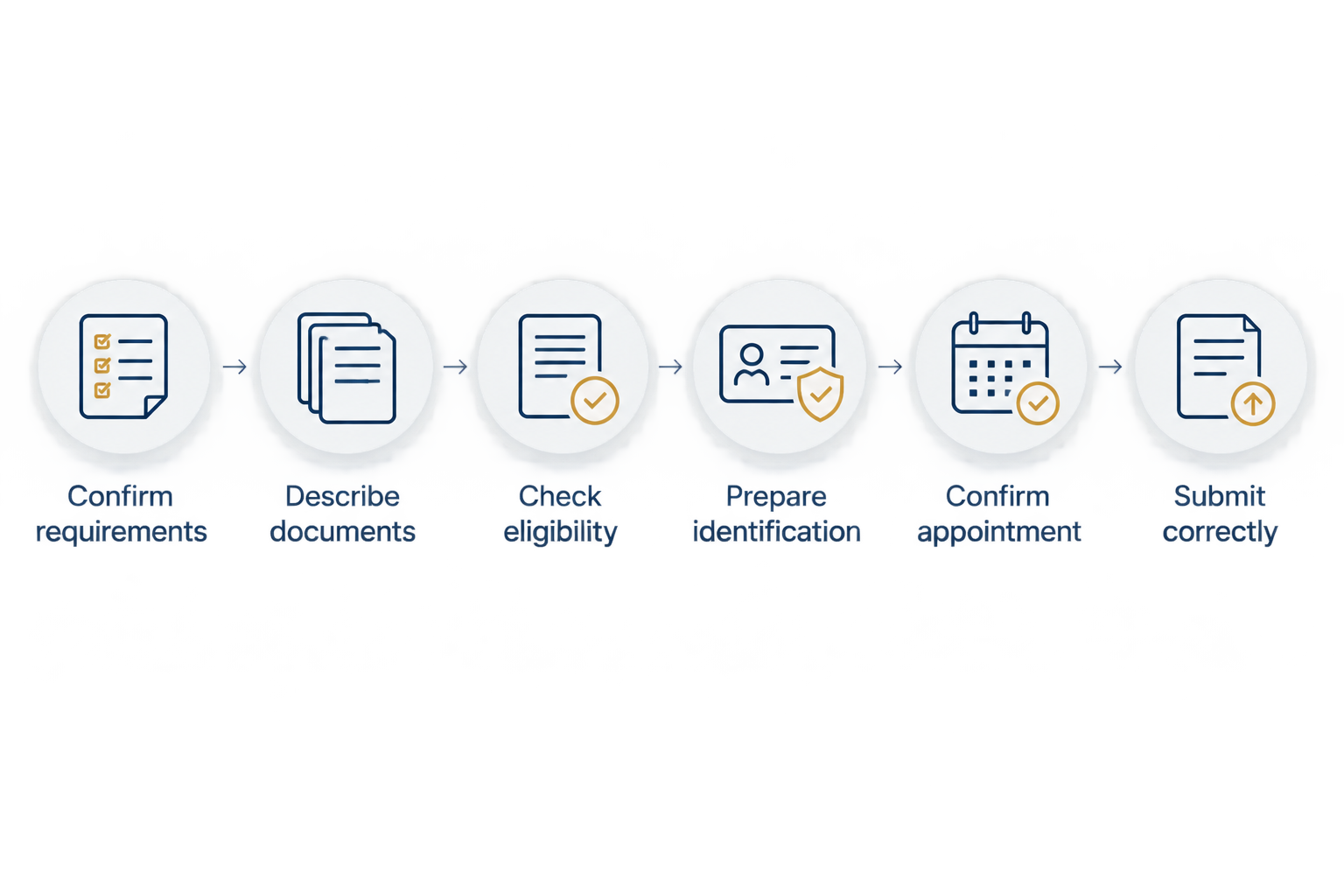
Use this sequence for a 2026 appointment. It puts the acceptance check ahead of document preparation and scheduling, where it belongs.
- Confirm requirements. Ask the receiving motor vehicle agency which document needs notarization and whether it requires an original paper document. Identify the issuing jurisdiction as well as the jurisdiction processing the transfer.
- Describe documents. Tell the notary whether the request concerns the title itself, a supporting affidavit, an authorization, or another form. Explain which signatures require notarization without sending unnecessary personal information in an initial inquiry.
- Check eligibility. For remote service, confirm suitability through Proof and acceptance of the completed format. For mobile service, confirm the meeting location and Baltimore County availability before booking.
- Prepare identification. Follow the identification instructions provided for your appointment. For Proof, complete the required identity verification steps; having a photograph of an ID does not by itself establish that verification is complete.
- Confirm appointment. Wait for direct contact, review the quoted scope, and confirm who must participate. Follow the notary’s instructions about signing and have the required documents ready.
- Submit correctly. After notarization, follow the receiving agency’s delivery and filing instructions. A completed notarial act is not confirmation that the agency has accepted or processed the transfer.
Keep the recipient’s written instructions available during preparation. If the title contains an error, an unexplained alteration, or conflicting ownership information, ask the issuing or receiving agency how to proceed rather than attempting a correction yourself.
Why the total for title notarization varies
Compare the same scope when reviewing quotes in 2026. A title-only request and a packet containing separate notarized forms are different assignments.
- Document scope. Identify every form requiring a notarial act, rather than describing the entire packet as “a title transfer.”
- Required participants. Explain which signers need notarization and whether the document instructions call for witnesses. Do not assume everyone involved in the sale must attend the same notarial appointment.
- Appointment method. Remote service through Proof and a mobile visit involve different arrangements. Ask what is included in the total for the selected method.
- Mobile location. Provide the proposed meeting location so service coverage and travel arrangements can be confirmed.
- Recipient requirements. Original-paper instructions or electronic-format restrictions determine which appointment method is appropriate.
Ask about these factors before agreeing to service. Do not assume that a legally permitted notarial fee describes the entire appointment or that a quoted appointment total includes government processing charges.
What should I send when requesting a quote?
Give the notary enough information to assess the request without guessing. Start with the document name, issuing state, receiving agency, number of signers needing notarization, and whether you hold an original paper document.
State whether you prefer Maryland remote online notarization through Proof. If you need a mobile appointment, provide the proposed Baltimore County location and ask for availability confirmation. Mention any submission deadline without treating it as a guaranteed appointment time.
Request confirmation of:
- The documents and notarial acts covered by the quote.
- Any separate platform or travel charges that apply.
- Identification and participation instructions for each required signer.
- The accepted document format and how you will receive the completed document.
- The appointment time after the request has been reviewed.
Use the document-sharing method the notary provides. Vehicle titles and identification contain sensitive information; an initial scheduling message should not become an unnecessary distribution of complete personal records.
Does a Maryland car title always need notarization?
No—do not assume a standard Maryland title assignment requires notarization. Check the Maryland Motor Vehicle Administration’s instructions for the particular transfer and review any supporting forms separately.
An out-of-state title, a gift-related form, or an authorization can raise different requirements. Describe the actual transaction to the receiving agency rather than relying on a general statement about vehicle sales.
Can I sign the title before the appointment?
Follow the document instructions and the notary’s direction before signing. Some notarial acts require signing in the notary’s presence, while others involve acknowledging an existing signature; the required act determines the procedure.
Do not add a signature simply to make the packet look ready. If you already signed, disclose that before the appointment instead of concealing it or making an unauthorized alteration.
Can a dealership use the same process repeatedly?
A dealership can standardize intake, but each document still needs its own eligibility and acceptance check. For repeat work, use a consistent checklist covering the issuing jurisdiction, receiving agency, document format, required signers, and notarial instructions.
Keep scheduling and document review separate. A familiar form does not establish that every future transaction has identical requirements, and an earlier successful remote appointment does not establish acceptance for a different recipient.
FAQ
What determines the cost to notarize a car title transfer?
The document scope, required notarial acts, and appointment method determine the quote. Ask for the complete appointment total and keep vehicle taxes, title charges, and registration separate.
Can I notarize my car title transfer online in Maryland?
Only eligible documents can proceed through Maryland remote online notarization, and the receiving agency must accept the completed format. Confirm the exact title or supporting form before arranging a Proof appointment.
Does a Maryland title transfer automatically require a notary?
No, a standard Maryland title assignment does not automatically require notarization. Check the Maryland Motor Vehicle Administration’s instructions for your transaction and review supporting forms separately.
Is mobile notarization better than remote notarization for a car title?
Mobile notarization fits documents requiring an accepted in-person paper workflow; remote notarization fits eligible documents accepted electronically. The recipient’s requirements determine the appropriate method.
What identification should I prepare for a Proof appointment?
Follow the identification instructions provided for your Proof appointment and complete the required identity verification process. Ask about identification concerns before scheduling rather than assuming a particular document will be accepted.
Is my appointment confirmed after I submit a request?
No, a request is not a confirmed appointment. Wait for Craigvetnotary to contact you, and confirm Baltimore County availability before booking mobile service.
Can the notary tell me how to transfer ownership or fix a title?
The notary cannot provide legal advice or resolve ownership questions. Craig is not an attorney and cannot provide legal advice; ask the motor vehicle agency about its procedures and an attorney about legal questions.
One last thing
A correctly notarized document is not the same as a completed vehicle transfer. Before your 2026 appointment, ask the recipient how the finished document must be delivered and whether the original must be surrendered. That answer determines whether your planned workflow reaches the agency in an acceptable form.
Keep the vehicle transfer instructions with your appointment notes. The notary handles the notarial act; you remain responsible for completing the receiving agency’s submission requirements.


