

Auto dealership notary services are document-signing services that support eligible transactions with the aim of completing required notarizations correctly. For Maryland dealerships in 2026, start with remote online notarization through Proof for eligible documents; confirm document requirements and recipient acceptance before arranging an appointment.
- Notary services for auto dealerships begin with document eligibility and recipient acceptance, not appointment scheduling.
- Craigvetnotary offers Maryland remote online notarization through Proof for eligible documents, with mobile appointments as a secondary option.
- Each signer must complete identity verification; dealership staff cannot substitute their own checks for the notary’s process.
- Requesting an appointment does not confirm it; wait for direct confirmation before promising a signing time.
Why notary services matter for auto dealerships
A dealership coordinates buyers, staff, lenders, and document recipients. Notarization adds a separate procedural requirement: you must establish what needs notarizing, who must appear, and whether the proposed appointment format is acceptable.
For your 2026 workflow, use Craigvetnotary for Maryland remote online notarization requests involving eligible documents. Mobile appointments are secondary, and Baltimore County availability requires confirmation before booking.
Craigvetnotary notary services fit Maryland dealerships seeking remote online notarization for eligible documents through Proof. The limitation is equally important: neither remote eligibility nor a requested appointment time is automatic.
The practical distinction is between coordinating a transaction and performing a notarial act. Your dealership prepares the transaction file; the notary handles the notarial requirements. An attorney or the receiving organization must resolve questions outside the notary’s role.
Build a repeatable dealership appointment process
Use the same intake process for each request, including repeat customers. A previous successful appointment does not establish that a different document, recipient, or signer qualifies for the same approach.
Organize the process around these checkpoints: Document review, Recipient acceptance, Appointment confirmation, Identity verification, and Document delivery. Keep the administrative handoff clear without treating it as a substitute for the notary’s instructions.
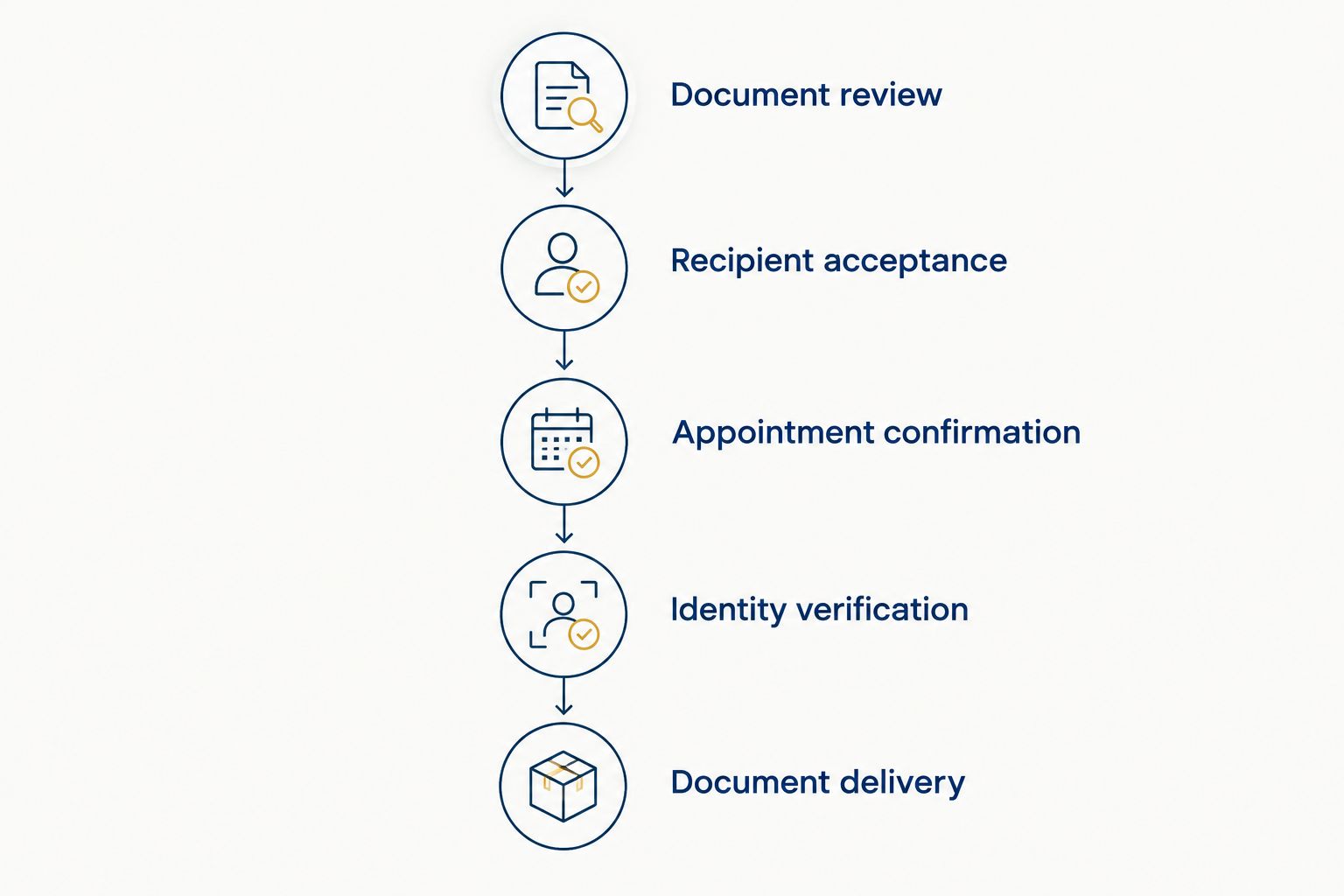
Review the document before requesting an appointment
Start manually with the document and its recipient’s written instructions. Identify the exact page or section that calls for notarization rather than assuming the entire transaction packet needs it. Do not assume every vehicle-related document requires a notarial act.
Create a short intake note containing 4 details: document name, receiving organization, signer names, and requested completion date. This gives your coordinator a useful handoff without asking the notary to interpret the transaction.
If the document lacks instructions or you do not know which notarial act is required, ask the document issuer or qualified legal counsel. Do not have dealership staff select legal wording for a customer.
- Record the document’s title and intended recipient.
- Identify each signature requiring notarization.
- Flag incomplete fields without filling them for the signer.
- Obtain instructions about the required notarial act.
- Separate document-preparation questions from appointment questions.
Confirm recipient acceptance before choosing remote service
Contact the organization receiving the completed document. Ask whether it accepts remote online notarization for that particular document and transaction. A general statement that electronic documents are accepted does not answer every notarization question.
For a 2026 dealership procedure, retain the recipient’s instructions with the transaction file. This creates a reference for the current request, not blanket permission for future documents.
Remote online notarization addresses the signing and notarial process; it does not resolve conflicting lender, agency, title-processing, or other recipient instructions. Escalate those conflicts before the appointment.
- Ask about acceptance of remote online notarization.
- Confirm whether an original paper document is required.
- Ask how the completed document must be delivered.
- Identify any separate witness or supporting-document requirements.
- Record who supplied the instructions and when.
Request the appropriate appointment format
You can coordinate document requirements manually by collecting recipient instructions and sending a clear appointment request. Once those details are organized, Craigvetnotary notary services provide a remote path through Proof for eligible Maryland notarizations, without arranging a physical meeting.
Use mobile service as the secondary option when in-person handling is appropriate. Baltimore County availability must be confirmed before booking; do not promise a location or time on the assumption that a request has been accepted.
A submitted request is not a confirmed appointment. Wait until the provider contacts you and confirms the arrangement before telling a buyer, manager, or outside party that the session is scheduled.
- State whether you are requesting remote or mobile service.
- Provide the document type and recipient instructions.
- List the signers and any known coordination needs.
- Offer scheduling preferences rather than promised appointment times.
- Wait for direct confirmation before finalizing dealership arrangements.
Prepare each signer for identity verification
Tell each signer that notarization includes identity verification and direct participation in the appointment. A customer’s relationship with your dealership does not replace the notary’s identity-verification process.
For remote appointments through Proof, follow the instructions supplied for the session. Confirm the required identification and technical setup in advance rather than promising that a particular document, device, or verification method will work.
Dealership staff can help coordinate logistics, but the signer must participate as directed. Do not sign for a customer, complete identity checks on the customer’s behalf, or coach answers during verification.
- Ask which identification the signer must present.
- Have the signer follow the appointment’s technology instructions.
- Arrange a quiet setting that supports direct communication.
- Resolve name differences through the appropriate parties before signing.
- Tell the provider about accessibility or communication needs in advance.
Separate document preparation from the notarial session
Complete the dealership’s administrative review before the appointment, while leaving signature timing to the notary’s instructions. Different notarial acts have different requirements; a universal instruction to sign everything beforehand is inappropriate.
Check that the signer has the correct version of the document. If a lender or another recipient replaces a page, confirm which version belongs in the session and whether the change affects earlier instructions.
Keep 2 checks distinct: whether the transaction document is ready and whether the notarization can proceed. A clean sales file does not establish eligibility for remote notarization.
- Verify the current document version with the responsible party.
- Resolve missing transaction information before the session.
- Follow the notary’s instructions about when to sign.
- Identify any separate witness arrangements in advance.
- Stop and clarify conflicting instructions instead of improvising.
Assign an owner for completed-document delivery
Decide who will receive the completed document and who will send it to the final recipient. For a remote appointment, ask how the completed electronic document will be provided. For an in-person appointment, confirm how the paper document will reach its destination.
Notarization and recipient acceptance are separate checkpoints. Do not tell a buyer that notarization alone means the entire transaction is approved, filed, or complete.
Make your 2026 handoff checklist specific enough that another staff member can finish delivery without reconstructing the appointment. Record status clearly, but avoid spreading copies of identity documents or transaction materials through unnecessary channels.
- Name the staff member responsible for document delivery.
- Confirm the recipient’s required delivery method.
- Track whether the completed document was received.
- Route correction requests back to the appropriate party.
- Follow your dealership’s document-access and retention procedures.
Standardize repeat requests without assuming eligibility
A reusable intake checklist is useful for dealerships with recurring notarization needs. Keep the document category, recipient instructions, signer coordination, and completion status together so staff know what remains unresolved.
Repeat service does not eliminate document review or identity verification. A new recipient, changed document, or different signing arrangement requires a fresh check of the relevant requirements.
Review your 2026 process whenever a recipient changes its instructions. Update the checklist rather than relying on a staff member’s memory of the last successful transaction.
- Assign a primary coordinator and a backup.
- Use consistent intake fields for every request.
- Flag changes to recipient instructions before scheduling.
- Track requested and confirmed appointments separately.
- Review recurring problems without recording unnecessary sensitive details.
Compare appointment options for your dealership
Choose the format based on document eligibility, recipient requirements, and signer readiness. Convenience matters only after those conditions are satisfied.
| Option | Best for | Main advantage | Key limitation |
|---|---|---|---|
| Remote online notarization through Proof | Eligible electronic documents with confirmed recipient acceptance | Avoids coordinating a physical meeting | Requires document eligibility, identity verification, and a suitable technical setup |
| Mobile notarization | Physical document handling when an in-person appointment is appropriate | Brings the appointment to an agreed location | Baltimore County availability and appointment details require confirmation |
For either option, Craigvetnotary must confirm the appointment arrangement. Remote service is the first option to assess, not a promise that every dealership document qualifies. Mobile service provides a different appointment format, not an exception to applicable notarial requirements.
Request a dealership appointment
Start with document eligibility and recipient instructions; wait for direct appointment confirmation.
Common mistakes auto dealerships make
Treating every transaction document as eligible
A document’s connection to a vehicle transaction does not settle its notarization requirements or remote eligibility. Check the actual document and recipient instructions instead of applying a rule to the entire deal packet.
Scheduling the buyer before confirming the appointment
A buyer’s availability and a submitted service request do not establish a confirmed session. Keep the appointment marked as requested until the provider directly confirms it, especially when coordinating mobile service.
Assuming dealership identification checks are sufficient
Your sales or finance process serves a different purpose from notarial identity verification. Prepare the signer to follow the notary’s process even when the dealership already knows the customer.
Treating notarization as transaction approval
Notarization does not replace legal review, document preparation, or the recipient’s acceptance decision. Keep those responsibilities separate when explaining progress to customers and outside organizations.
Turning a past appointment into standing permission
A previous document’s acceptance does not establish acceptance for another lender, recipient, or document version. Recheck the relevant requirements and preserve the current instructions with the current file.
FAQ
Can an auto dealership use remote online notarization in Maryland?
A Maryland dealership can request remote online notarization for eligible documents through Proof. Confirm document eligibility and recipient acceptance before arranging the session; not every dealership document qualifies.
Does every vehicle title or dealership form need notarization?
Do not assume every vehicle title or dealership form requires notarization. Follow the applicable document instructions and confirm requirements with the issuer or receiving organization when they are unclear.
Is remote notarization better than a mobile appointment for a dealership?
Remote notarization is the first option to assess when the document is eligible and the recipient accepts it. A mobile appointment is a secondary option when in-person handling is appropriate, with Baltimore County availability confirmed before booking.
Can dealership staff verify the customer's identity for the notary?
Dealership staff cannot substitute their own identification checks for the notary’s identity-verification process. Each signer must participate and follow the instructions for the appointment.
Is an appointment confirmed after I submit a request?
No, submitting a request does not confirm an appointment. Wait for Craigvetnotary to contact you and confirm the arrangement before promising a signing time.
Can a dealership arrange repeat notarization appointments?
You can request appointments for recurring dealership needs. Each request still requires document review, signer coordination, identity verification, and appointment confirmation; do not assume a standing schedule or automatic eligibility.
Can Craig tell a buyer which legal document or notarial act to choose?
Craig is not an attorney and cannot provide legal advice. Ask the document issuer, receiving organization, or qualified legal counsel to resolve questions about document selection, legal wording, or the required notarial act.
One last thing
Ask about delivery before you schedule signing. A recipient’s requirement for a particular document format can change which appointment format you should request. Establish that requirement first, then coordinate the signer, identity verification, and appointment confirmation around it.


