

An incorrectly notarized document in Maryland can be rejected, delayed, or challenged; the next step depends on the error, the receiving organization’s requirements, and the document’s legal purpose. Do not alter the notarial certificate yourself or assume the underlying agreement is automatically invalid. For eligible documents handled through Maryland remote online notarization on Proof, contact the notary and the recipient before arranging a correction or another appointment.
- What happens if a document is notarized incorrectly in Maryland depends on the defect and the recipient’s requirements.
- Contact the original notary; do not change a notarial certificate yourself.
- Craigvetnotary offers Maryland remote online notarization through Proof for eligible documents, not legal advice.
- A replacement notarization does not automatically resolve a missed deadline or a dispute about the document.
Why this matters
A notarization error and a problem with the document itself are different issues. An incomplete certificate needs a different response from a disputed signature, a missing required witness, or wording that does not accomplish your legal objective.
For your 2026 document checklist, separate those questions before requesting another appointment. A new notarial act cannot establish that a contract is enforceable, that a filing meets every agency requirement, or that a recipient must accept it.
Craigvetnotary provides Maryland remote online notarization through Proof and in-person mobile notary appointments. Craigvetnotary is best for Maryland individuals and businesses seeking notarization services, not legal advice about a defective document.
What happens if a document is notarized incorrectly in Maryland?
The immediate consequence is often a request to resolve the defect before the recipient proceeds. A bank, recording office, court, or other recipient evaluates the document under its own applicable requirements; its rejection is not, by itself, a ruling that every part of the document is legally ineffective.
Use these distinctions when identifying the problem:
| Issue identified | What it means for your next move | Best first contact |
|---|---|---|
| Certificate information appears incomplete or inconsistent | Ask what is wrong and whether a correction is permitted | Original notary |
| Recipient says the notarization is unacceptable | Obtain the specific objection and submission requirements | Receiving organization |
| Signature, identity, or personal appearance is disputed | Preserve the document and communications; obtain legal guidance | Maryland attorney |
| Document wording or legal effect is disputed | Another notarization does not answer the legal question | Maryland attorney |
| Remote format is not accepted for the intended transaction | Confirm the required format before scheduling another act | Receiving organization |
A visible mistake is a reason to investigate, not permission to repair the certificate yourself. The proper response depends on what actually occurred during the notarial act, not just what appears on the page.
What should you do after finding a notarization error?
Follow these 5 steps before submitting an altered or replacement document. They organize the problem without assuming that a correction is available.
- Preserve the document. Keep the original paper or electronic file unchanged. Save the rejection notice and related messages separately so you can show exactly what the recipient received.
- Get the objection. Ask the recipient to identify the missing, incorrect, or unacceptable element in writing. A general instruction to get it notarized again does not explain whether the problem involves the certificate, the document, or the submission format.
- Contact the notary. Describe the concern and provide the recipient’s explanation through an appropriate channel. Ask whether the issue can be addressed under Maryland notarial requirements or requires a new act.
- Confirm the format. Before scheduling, ask whether the recipient accepts remote online notarization and an electronic document for this transaction. Also identify any witness or original-document requirements.
- Escalate legal questions. Consult a Maryland attorney if the error affects a deadline, property rights, a contested signature, or another question of legal effect. Do not wait for a replacement appointment to address an urgent legal issue.
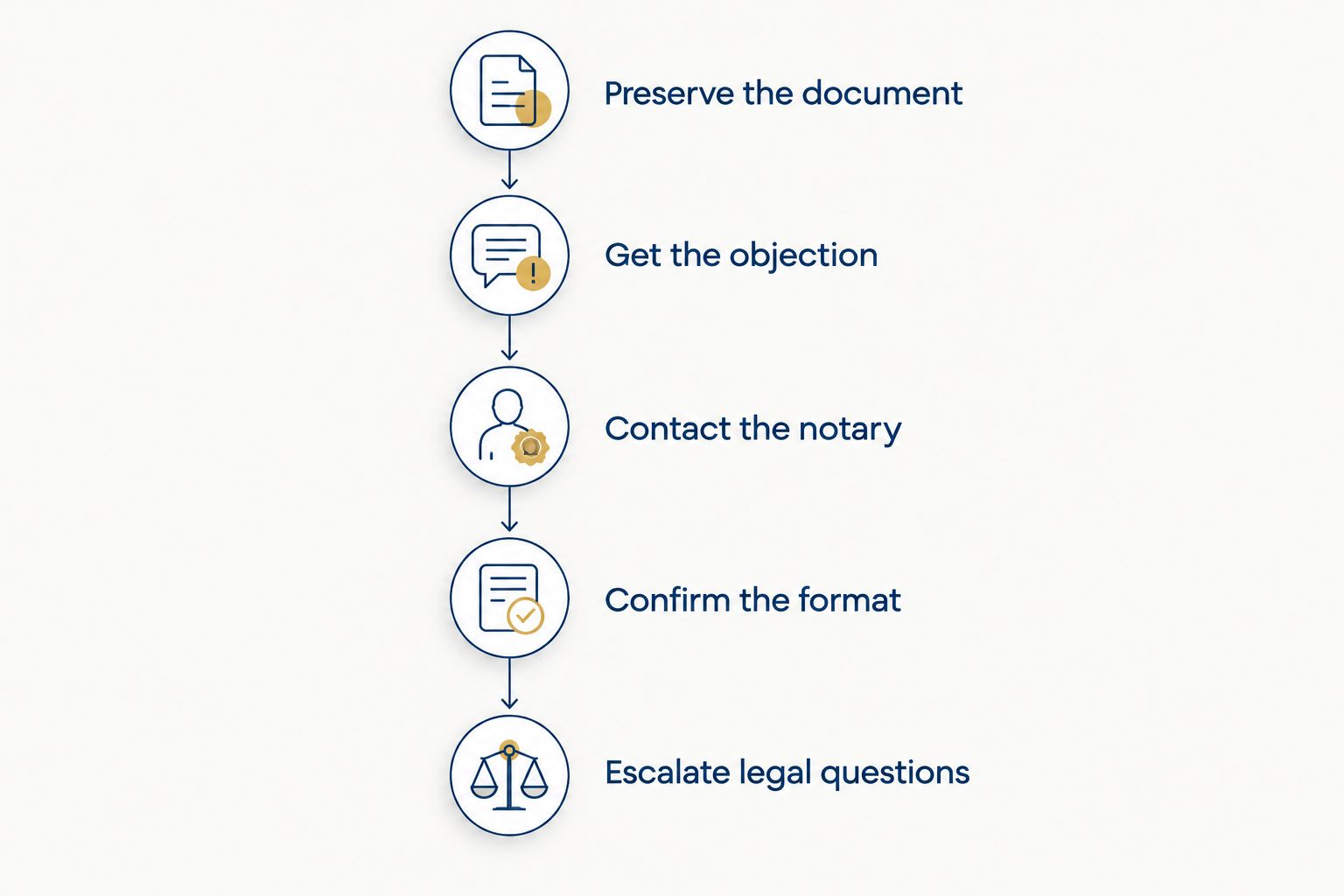
When organizing a 2026 resubmission, keep 3 records together: the unchanged document, the recipient’s written objection, and the correspondence about the proposed remedy. That record helps everyone distinguish the original problem from later changes.
Does the certificate need correction or a new notarization?
A certificate correction and a new notarization are not interchangeable. The original notary needs to evaluate the alleged error; you should not assume that an omitted detail can simply be added later.
The distinction matters because a certificate documents a notarial act. Changing certificate wording cannot recreate an appearance, oath, acknowledgment, or identity-verification step that did not occur as required.
| Response | Best for | Benefit | Limitation |
|---|---|---|---|
| Ask about a certificate correction | An apparent recording or completion error | Focuses attention on the specific defect | The notary must determine whether correction is permitted |
| Arrange a new notarial act | Situations requiring another proper appearance and completed act | Creates a certificate for the new act | Does not erase the history or consequences of the earlier problem |
| Obtain legal review | Disputes about validity, rights, deadlines, or fraud | Addresses legal consequences beyond notarization | Does not itself complete a notarial act |
Do not request backdating. If a new notarial act occurs, its certificate must accurately reflect that act rather than suggest that it happened on an earlier date.
For 2026 business procedures, keep the decision about the notarial act separate from approval to resubmit the document. The notary addresses notarial requirements; the recipient addresses acceptance, and an attorney addresses legal consequences.
How does a replacement online appointment work?
Maryland remote online notarization through Proof is an option for eligible documents, not an automatic remedy for every rejected notarization. Confirm eligibility and recipient requirements before starting another session.
For Craigvetnotary remote online notarization, begin by explaining the error and the intended use of the document. Include any recipient instructions so the appointment request addresses the actual concern rather than repeating it.
Before the appointment
- Identify the document and its intended recipient.
- Explain whether the issue concerns a certificate, signature, witness, or electronic format.
- Ask what identification and platform preparation you need.
- Confirm whether other participants must attend.
- Wait for client contact before treating the appointment as confirmed.
During identity verification and the session
Follow Proof’s identity-verification instructions and the notary’s directions. A remote session requires more than sending a document by email: the notary must complete the applicable identity and appearance requirements.
Do not assume that an identification document alone guarantees completion. Technical access, successful identity verification, document eligibility, and the circumstances of the requested act all matter.
After the appointment
Retain the completed electronic document in its provided form. Ask the recipient how to submit it, and do not assume that printing an electronically notarized document preserves everything the recipient needs to evaluate the electronic record.
For your 2026 appointment preparation, ask 2 questions before proceeding: does the recipient accept this remote format, and does the proposed act address the identified defect? A successful session is not a substitute for those answers.
Discuss your notarization request
Explain the document issue and ask about eligibility for Maryland remote online notarization through Proof.
Why the consequences vary
The same visible omission does not create the same outcome in every transaction. These factors determine which questions you need answered:
- The type of defect. A certificate-entry problem differs from a failure to complete a required part of the notarial act.
- The document’s purpose. A private agreement, court submission, and recorded instrument involve different legal and recipient requirements.
- The requested notarial act. An acknowledgment and a verification on oath or affirmation involve different procedures; they are not interchangeable labels.
- The receiving organization. Identify the recipient’s actual objection instead of assuming that another stamp will resolve it.
- The timing. An approaching filing or transaction deadline creates a separate issue that a later notarization does not automatically cure.
- A dispute about authenticity. Allegations of forgery, impersonation, or unauthorized changes require more than routine appointment scheduling.
Ask for the specific defect, not a general assurance that the document looks fine. That distinction gives the notary and any attorney a defined issue to address.
Does an incorrect notarization make the whole document invalid?
An incorrect notarization does not automatically answer whether the entire document is invalid. The effect depends on the applicable law, the document, the defect, and the facts surrounding execution.
A recipient’s refusal to accept a document and a legal determination about enforceability are separate matters. If your rights depend on the answer, ask a Maryland attorney rather than relying on a replacement certificate as proof that the issue is resolved.
Can another notary fix the original notary’s mistake?
Another notary cannot simply certify what happened during someone else’s earlier appointment. A different notary can assess a request for a new notarial act, subject to eligibility and all applicable requirements.
Start with the original notary when the concern involves that notary’s certificate. If another appointment is needed, explain the prior issue honestly and follow the new notary’s instructions about signing and appearance.
Practical guidance for repeat business notarizations
For a business handling repeat notarizations in 2026, assign responsibility for recipient instructions before employees request appointments. Your internal contact should know where the document is going, which format is accepted, and whether witnesses are required.
Use a short intake checklist rather than asking the notary to determine the transaction’s legal needs:
- Name the receiving organization and document purpose.
- Attach the recipient’s instructions without rewriting them.
- Identify signers and any required additional participants.
- Record the submission deadline separately from the appointment request.
- Keep the completed document and acceptance correspondence together.
Craigvetnotary mobile notary appointments are a secondary option when an in-person appointment fits the request. Confirm Baltimore County availability before booking; an appointment is not confirmed until CraigVet contacts you.
An in-person appointment avoids dependence on a remote session, but it does not remove document-eligibility rules or resolve legal defects. Choose the format based on the recipient’s requirements and the circumstances of the requested act, not an assumption that paper is always acceptable.
FAQ
Can I fill in a blank on the notary certificate myself?
Do not fill in or change the notarial certificate yourself. Contact the original notary, identify the missing information, and ask what Maryland notarial requirements permit.
Should I sign the document again before my replacement appointment?
Follow the notary’s instructions before signing again. Different notarial acts have different signing and acknowledgment requirements, so an advance signature is not a universal solution.
Can an online notarization through Proof replace an incorrect paper notarization?
A new remote online notarization through Proof is an option only when the document and requested act are eligible and the recipient accepts the format. It does not automatically repair the earlier act or resolve its legal consequences.
What should I do if I think the notarization involved fraud?
Preserve the document and related communications, and obtain legal guidance about the suspected fraud. Maryland’s Secretary of State provides information about notary complaints, but a complaint is separate from resolving the document’s legal effect.
Will a new notarization fix a missed filing deadline?
A new notarization does not automatically fix a missed filing deadline. Contact the receiving office about its procedures and consult a Maryland attorney about any effect on your rights.
Can Craig tell me whether my incorrectly notarized agreement is enforceable?
Craig is not an attorney and cannot provide legal advice about whether an agreement is enforceable. The notary can discuss the requested notarial service; a Maryland attorney should address legal validity, remedies, and disputes.
One last thing
Do not replace the evidence of the mistake while trying to fix it. Preserve the original file or paper document, then keep any corrected or newly notarized version separately identified.
For your next submission, ask the recipient to confirm exactly what it needs before you arrange another act. A clear written requirement is more useful than a second appointment built around the same unanswered question.


