

Title company notary services are document-signing services that support identity verification and required notarial acts with the aim of completing accepted transaction documents. This 2026 guide explains how to assess Maryland remote online notarization through Proof, prepare eligible documents, and coordinate appointments with CraigVet Notary Services without treating notarization as legal review or a guarantee of closing acceptance.
- CraigVet Notary Services suits title companies seeking Maryland remote online notarization through Proof for eligible documents.
- Choose notary services for title companies by document eligibility, recipient acceptance, identity verification, and appointment requirements.
- Use mobile notarization as a secondary option; confirm Baltimore County availability before booking.
- A submitted appointment request is not confirmed until CraigVet Notary Services contacts you.
Why notarization matters for title companies
A title company's notarization workflow involves more than finding someone to witness a signature. You need the correct document version, an acceptable signing method, prepared signers, and a clear route for returning completed files. A notarial act does not replace those controls.
For your 2026 procedure, start with a document-specific decision: does this transaction permit remote online notarization, and will the intended recipient accept the resulting document? Maryland requirements, document instructions, and recipient requirements are separate checks. Do not treat one approval as proof that all three are satisfied.
CraigVet Notary Services is best for title companies seeking Maryland remote online notarization through Proof for eligible documents. Its mobile appointments provide a secondary route, with Baltimore County availability confirmed before booking. Neither service should be treated as a promise that every closing package qualifies.
For repeat business, consistency matters. A documented handoff lets your staff identify unresolved questions before a signer joins an appointment, rather than asking the notary to resolve transaction instructions during the session.
How to organize a title company notarization
Define the transaction requirements
Start manually with a document list and the instructions from the parties responsible for accepting the completed package. Separate documents requiring notarization from documents requiring signatures only. Flag any uncertainty for your title team's appropriate reviewer before selecting an appointment method.
Assign 1 coordinator per file as an internal operating rule. That person should hold the current instructions and resolve conflicting messages; the rule is a recommendation, not a Maryland notarial requirement. One clear contact also gives the notary somewhere to direct procedural questions without choosing between competing instructions.
- Identify every document requiring a notarial act.
- Record the intended recipient and applicable submission instructions.
- Mark any witness or original-document questions for review.
- Name the coordinator responsible for the current package.
- Escalate legal questions to the appropriate attorney.
Confirm remote eligibility before scheduling
Ask the receiving party whether remote online notarization is acceptable for the specific documents and transaction. Then obtain confirmation that the requested service can proceed under applicable Maryland notarial requirements. An electronic file alone does not establish remote eligibility.
In your 2026 intake checklist, distinguish permission to use an electronic signature from permission to complete a remote notarial act. Those are different decisions. If an instruction is unclear, seek clarification rather than passing an unresolved assumption to the signer.
Use 3 checkpoints per package as your working checklist: document eligibility, recipient acceptance, and appointment readiness. These checkpoints organize your process; they do not replace the notary's assessment or the recipient's requirements.
- Confirm acceptance of the proposed notarization method.
- Identify documents that require separate handling.
- Resolve questions about witnesses before scheduling.
- Provide the signer's location for eligibility review.
- Keep the acceptance instructions with the transaction file.
Request the appropriate appointment
For eligible documents, request Maryland remote online notarization through Proof with CraigVet Notary Services. Include enough information to assess the request: document type, signer count, signer location, requested timing, and any special instructions. Ask how to submit documents securely rather than placing sensitive material into an unconfirmed communication channel.
The remote route removes the need to arrange an in-person meeting for the notarial session, but it still requires eligibility review, identity verification, and signer participation. Do not describe it to clients as an automatic or unattended signing process.
For a mobile appointment, ask about Baltimore County availability before booking. A request is not a confirmed appointment until the business contacts you. Keep your closing schedule provisional until the appointment details are settled.
- State whether you are requesting remote or mobile service.
- Describe the documents without including unnecessary sensitive information.
- Disclose all expected signers and their locations.
- Ask how to provide the package securely.
- Wait for contact before representing the appointment as confirmed.
Prepare signers for identity verification
Explain the process before sending your client into an appointment. For remote notarization through Proof, the signer must follow the identity-verification and session instructions provided for that appointment. Do not promise that uploading a document or presenting identification will automatically complete verification.
Ask the signer to review the supplied technical and identification instructions in advance. A title employee should not answer identity-verification questions for the signer or attempt to bypass a failed check. If an issue occurs, follow the notary's directions about the next permissible step.
Collect 2 contact methods per signer when appropriate and permitted by your privacy procedures. This is a coordination recommendation, not a platform requirement; limit access to staff who need the information.
- Ask signers to review the appointment instructions themselves.
- Confirm access to the required device and connection.
- Tell signers to prepare the identification requested in the instructions.
- Provide a contact for procedural difficulties.
- Keep sensitive identity information out of unnecessary email threads.
Finalize the package and signing instructions
Use a shared checklist or your existing transaction-management process to identify the approved document version. The service request should point to that version, not a chain of drafts. If a document changes after review, tell the notary before the session and ask whether the change affects the appointment.
Separate transaction guidance from notarial duties. Your title team or appropriate legal adviser must address questions about rights, obligations, document selection, or substantive changes. Craig is not an attorney and cannot provide legal advice.
For your 2026 workflow, document who can authorize replacement pages and who must receive notice. That avoids asking a signer or notary to decide whether a revised package is acceptable.
- Identify the final package clearly.
- Provide recipient instructions through the agreed channel.
- Resolve substantive document questions before the session.
- Confirm any witness arrangements with the relevant parties.
- Communicate replacements and revised instructions promptly.
Coordinate the appointment without directing the notarial act
Give the signer a concise appointment reminder that distinguishes the meeting instructions from the transaction deadline. Tell the signer whom to contact if access fails or a document question arises. Your coordinator should remain reachable without interfering with identity verification or the notary's independent responsibilities.
A business deadline does not remove notarial requirements. If verification, willingness, document completeness, or another procedural issue prevents completion, pause and follow the notary's instructions. Do not pressure the signer or suggest that the notary overlook an unresolved issue.
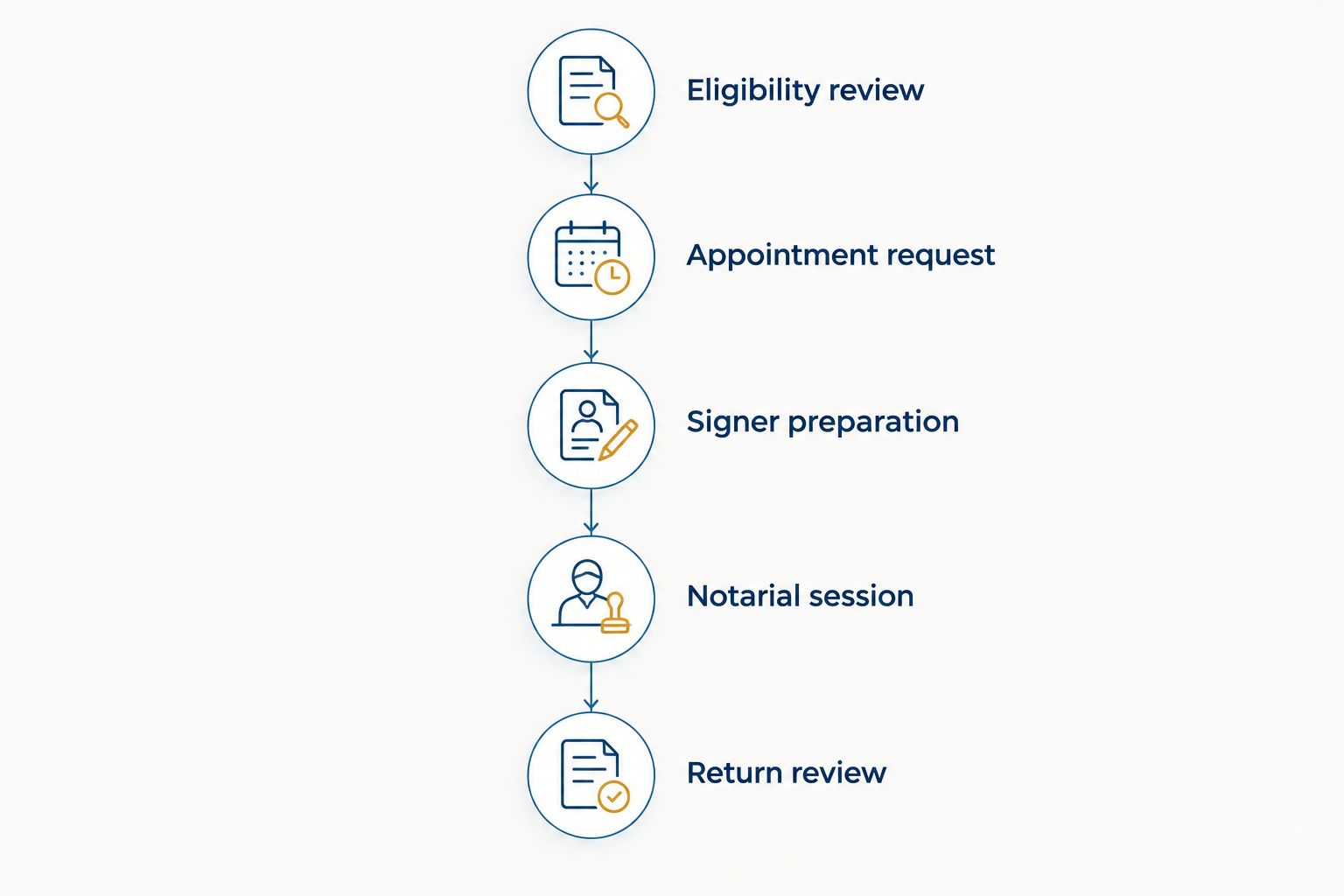
Use this handoff sequence to keep responsibilities clear:
- Eligibility review
- Appointment request
- Signer preparation
- Notarial session
- Return review
Review the return and improve repeat requests
After completion, use your title company's approved review procedure to check the returned package against the transaction instructions. Notarization does not establish that the recipient has accepted the package or that every closing condition has been met. Keep those milestones separate in your file status.
If you find a discrepancy, report it through the agreed process. Do not alter a completed notarial certificate yourself or assume that a replacement page can be inserted without further review. Ask the responsible party how the issue must be addressed.
For repeat notarizations, improve the intake template rather than assuming that yesterday's eligibility decision applies to today's documents.
- Confirm receipt of the expected documents.
- Check the return against the approved package instructions.
- Route discrepancies to the appropriate responsible party.
- Follow your organization's retention and access policies.
- Update intake instructions when a recurring coordination issue appears.
Compare appointment options for title companies
For 2026 planning, choose the method that satisfies the document requirements and recipient instructions first. Convenience comes after eligibility. Each option below solves a different coordination problem, and none makes legal review unnecessary.
| Option | Best for | Practical advantage | Key limitation |
|---|---|---|---|
| Maryland remote online notarization through Proof | Eligible documents with confirmed recipient acceptance | Lets the signer participate without arranging an in-person notarial meeting | Depends on eligibility, identity verification, technical readiness, and acceptance |
| Mobile notary appointment | Documents or circumstances requiring an in-person appointment | Brings the notarial appointment to an agreed location | Requires location and scheduling coordination; Baltimore County availability must be confirmed |
| Your organization's authorized in-house notary | Repeat work your business can handle internally under applicable requirements | Keeps routine coordination within your team | Depends on a qualified, available notary and appropriate procedures for the requested act |
Use remote notarization when eligibility and acceptance are established; use an in-person route when the transaction requires it. Do not choose a method solely because it worked for another file.
CraigVet Notary Services offers the first two routes, not a substitute for your title team's transaction responsibilities. Before sending an entire closing package, clarify the requested scope. A notarization appointment should not be represented as legal document preparation, settlement representation, or a broader closing service unless separately established.
Request an eligibility review
Describe your documents and preferred method. Wait for contact before treating the appointment as confirmed.
Common mistakes title companies make
Treating remote acceptance as a blanket approval
One accepted remote notarization does not establish acceptance for every document or recipient. Keep approval tied to the actual transaction. When instructions change, revisit the method before asking the signer to proceed.
Sending a package without defining the service
A request to notarize documents is not the same as a request to manage every aspect of a closing. State which notarial acts you need, who explains the transaction, and who receives questions. Clear scope protects both the signer and your workflow.
Promising a time before the appointment is confirmed
A requested slot is not an agreed appointment. Avoid telling a borrower, seller, or colleague that the notary is booked before confirmation. For mobile service, confirm Baltimore County availability and the meeting location before arranging dependent activities.
Asking the notary to resolve legal uncertainty
Do not ask a notary to select the legally appropriate document, interpret transaction terms, or advise a signer about whether to sign. Craig is not an attorney and cannot provide legal advice. Route those questions to the appropriate legal adviser before the appointment.
Reusing a package after an unnoticed revision
A last-minute replacement can make earlier instructions inaccurate. Maintain version control and tell the notary what changed. The practical fix is a documented handoff, not an assumption that a similarly named file contains the same material.
FAQ
What's the best notarization option for a title company in Maryland?
Maryland remote online notarization through Proof is an appropriate option when the documents are eligible and the intended recipient accepts the method. Use an in-person appointment when the transaction requirements call for one.
Can every title company document be notarized online?
No, every title company document should not be assumed eligible for remote notarization. Confirm document eligibility, Maryland notarial requirements, and recipient acceptance before scheduling.
Does requesting a notary appointment confirm the booking?
No, an appointment request is not confirmed until CraigVet Notary Services contacts you. Keep the proposed time provisional until the appointment details are agreed.
What should a title company send with a notarization request?
Provide the document type, signer count, signer location, requested timing, and relevant recipient instructions. Ask how to submit sensitive documents securely before sending the package.
What happens if a signer cannot complete identity verification?
The signer must follow the notary's instructions about the next permissible step. A title company employee should not answer verification questions for the signer or attempt to bypass the process.
Are mobile notary appointments available in Baltimore County?
Mobile appointments are a secondary service, with Baltimore County availability confirmed before booking. Request the location and timing you need rather than assuming a visit is available.
Can Craig explain the legal effect of closing documents?
No, Craig is not an attorney and cannot provide legal advice. Direct questions about legal rights, obligations, document selection, or transaction terms to the appropriate attorney.
One last thing
A completed notarial act and an accepted closing package are different milestones. Build both into your 2026 file checklist: one records completion of the requested notarial service; the other records acceptance under the transaction's instructions.
Before your next repeat request, review your intake template with the people who prepare, approve, and receive the documents. Give each unresolved question an owner. That is more useful than sending a longer appointment reminder after the package has already reached the signer.


