

Real estate agents’ notarization support is the coordination of required notarial acts with the aim of keeping transaction documents ready for their next recipient. This 2026 guide explains Maryland remote online notarization through Proof for eligible documents, identity verification, and when to discuss an in-person mobile appointment instead.
- CraigVet Notary Services offers notary services for real estate agents seeking Maryland remote online notarization for eligible documents.
- Confirm document eligibility and recipient acceptance before requesting a remote appointment through Proof.
- Prepare each signer for identity verification; a submitted request is not a confirmed appointment.
- Treat mobile notarization as a secondary route, with Baltimore County availability confirmed before booking.
Why notarization matters for real estate agents
A real estate deadline does not establish whether a document is eligible for remote notarization. You need the intended recipient’s instructions, the correct document, and a signer prepared to complete the required identity verification.
CraigVet Notary Services is best for real estate agents seeking Maryland remote online notarization for eligible documents. Mobile appointments are a secondary service; confirm Baltimore County availability before booking.
For your 2026 transaction workflow, separate appointment coordination from legal review. A notary performs the requested notarial act under applicable requirements; notarization does not replace advice about ownership, contractual obligations, or the legal effect of a document.
Remote notarization also does not establish that a lender, title company, settlement provider, or recording office will accept the resulting document. Ask the party responsible for receiving or processing it before selecting an appointment format.
Arrange the appointment without adding transaction confusion
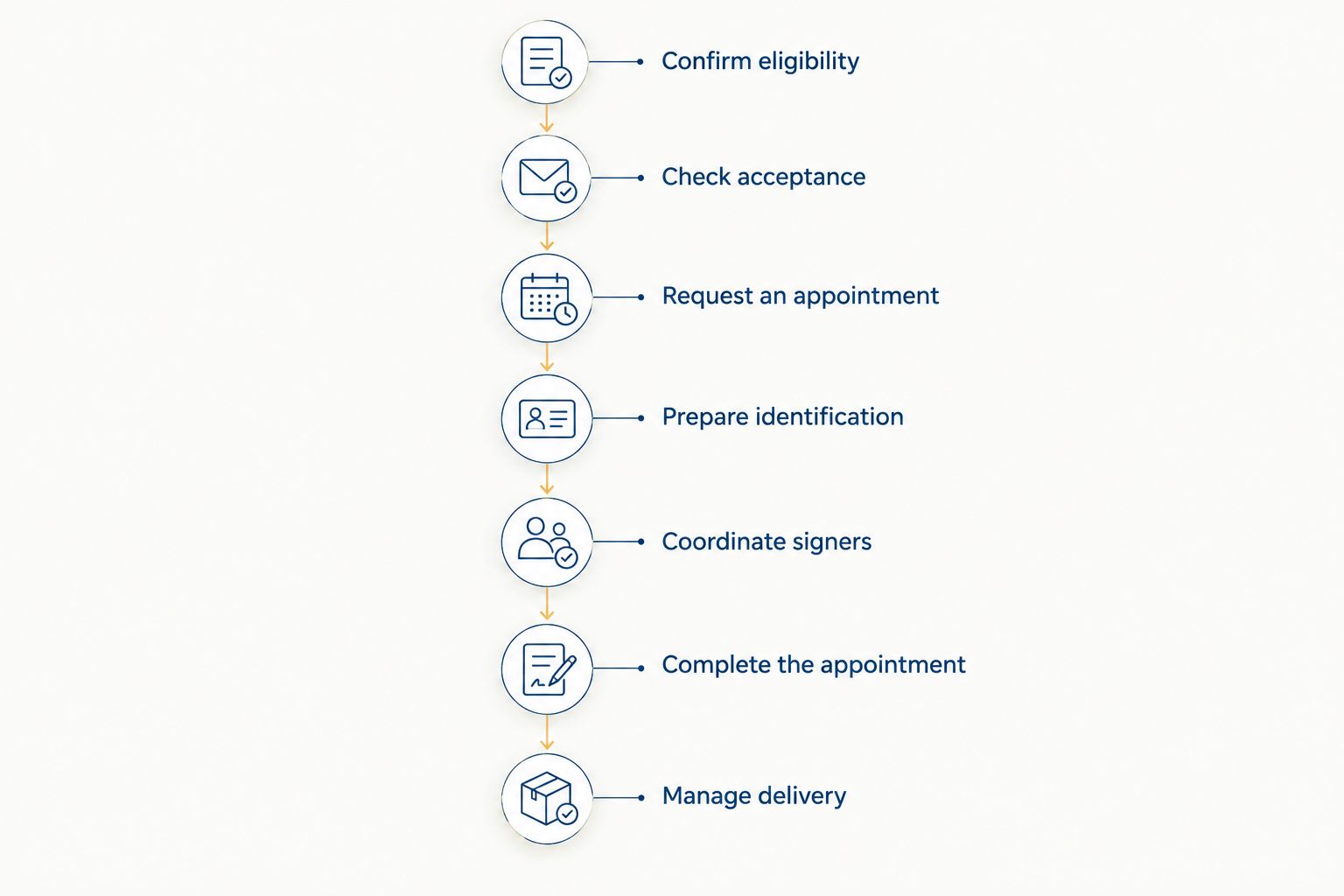
Use the following sequence for an individual client or a repeat business workflow. Start with the document and its destination, not the appointment calendar. Keep legal questions with the appropriate attorney and transaction requirements with the party responsible for the transaction.
Confirm eligibility
Identify the exact document requiring notarization and the instructions supplied with it. A transaction packet can contain documents with different signature, witness, delivery, and notarization requirements; do not treat the entire packet as one interchangeable task.
Begin manually: review the instructions and ask the document provider to clarify anything unresolved. Do not choose a notarial act for your client when that choice requires legal advice. Craig is not an attorney and cannot provide legal advice.
Use 3 checkpoints before requesting an appointment: the document, the requested notarial act, and the intended recipient. Record the answers in your transaction notes so another team member can understand what has been confirmed.
- Identify the specific document requiring notarization.
- Locate the supplied notarial certificate or instructions.
- Ask the document provider to resolve missing instructions.
- Confirm whether additional signers or witnesses are required.
- Ask about remote eligibility without assuming approval.
Check acceptance
Contact the intended recipient before routing the document into a remote appointment. For a real estate transaction, that recipient can be a title company, settlement provider, lender, or another party named in the instructions.
A simple email provides a useful starting point: identify the document and ask whether the recipient accepts remote online notarization for that particular use. Retain the response with the transaction records rather than relying on a general statement about electronic documents.
CraigVet Notary Services offers Maryland remote online notarization through Proof, but that service does not replace the recipient’s acceptance requirements. For your 2026 files, document eligibility and recipient acceptance should be separate entries, each with a clear answer.
- Name the document in your acceptance request.
- Identify who will receive or process the completed document.
- Ask specifically about remote online notarization.
- Clarify electronic delivery or original-document requirements.
- Save the response with the transaction instructions.
Request an appointment
Once eligibility and acceptance questions are resolved, submit the appointment request with the information needed to discuss the service. Explain the document type, the number of signers, and the relevant transaction deadline without sending unnecessary personal information.
An appointment request is not a confirmed appointment. Wait for CraigVet to contact you before telling your client that the appointment is booked. Distinguish your requested time from the time actually agreed upon.
Choose between 2 appointment formats: remote online notarization for eligible documents, or an in-person mobile appointment when that route fits the requirements and availability. Do not promise either route to a client before the relevant details have been confirmed.
- Provide the document type and intended use.
- State how many people need to sign.
- Explain the deadline without treating it as confirmed availability.
- Request the appropriate appointment format.
- Wait for direct confirmation before notifying the client.
Prepare identification
For a remote appointment through Proof, follow the identity-verification instructions supplied for the session. Do not substitute your personal knowledge of the client for the process the appointment requires.
Start with the practical preparation you control: ask the signer to review the instructions, prepare the requested identification, and check the equipment needed for the session. Avoid circulating identification copies through a group transaction email merely to make coordination easier.
CraigVet Notary Services uses Proof for Maryland remote online notarization; the signer must follow the applicable session instructions. If a signer cannot complete a required step, raise the issue before the scheduled appointment rather than promising an exception.
- Review the identity-verification instructions with each signer.
- Prepare the identification requested for the appointment.
- Check the camera, microphone, and internet connection.
- Use the instructed channel for sensitive information.
- Report access or verification difficulties before the session.
Coordinate signers
Assign 1 coordinator to maintain the appointment details and communicate changes. For a repeat business account, that role can stay with the person already responsible for transaction scheduling; it does not require a new system.
Confirm which people must participate and what each person needs to do. Do not assume that one signer’s preparation covers another signer, or that a witness can be added without checking the document and appointment requirements.
Keep your coordination record concise. It should identify participants, confirmation status, unresolved questions, and the delivery instructions—not duplicate identification records or collect unnecessary personal details.
- List every required signer.
- Confirm witness requirements with the appropriate source.
- Share the confirmed appointment instructions with participants.
- Track unresolved questions in one coordination record.
- Notify the notary when participants or documents change.
Complete the appointment
During the appointment, the signer follows the notary’s instructions for the required notarial act. As the agent, support logistics without answering identity questions for the signer or interpreting the document’s legal consequences.
Do not tell a client to sign in advance unless the appointment instructions permit it for the required act. Different notarial acts involve different procedures; a blanket instruction to sign everything beforehand creates avoidable confusion.
If the session reveals a document issue, stop and obtain the appropriate clarification. A transaction deadline is not a reason to alter the certificate, bypass verification, or ask the notary to resolve a legal question.
- Follow the notary’s instructions for signing.
- Let each signer answer their own verification questions.
- Keep unrelated participants out of sensitive discussions.
- Refer legal questions to the appropriate attorney.
- Resolve document changes before continuing as instructed.
Manage delivery
After the appointment, follow the recipient’s instructions for delivering the completed document. Completion of the notarial act and completion of the transaction are separate events; do not mark the entire transaction finished because notarization is complete.
Check the operational details you are responsible for, including the intended recipient and delivery method. If the recipient identifies a problem, ask what correction is required rather than changing the notarized document yourself.
For repeat notarizations in 2026, maintain a reusable checklist but review each new document independently. The same client, recipient, or transaction category does not establish that the next document has identical requirements.
- Follow the agreed delivery instructions.
- Check that the intended document is being transmitted.
- Record delivery and outstanding recipient questions.
- Escalate correction requests to the appropriate party.
- Recheck requirements before reusing a previous workflow.
The sequence keeps decisions in order: eligibility and acceptance come before scheduling, and signer preparation comes before the appointment. Delivery follows the completed notarial act, not the original booking request.
Compare the routes available to your client
Choose the route that meets the document’s requirements, not simply the route that appears easiest to schedule. Remote and mobile describe appointment formats. A settlement workflow describes broader transaction coordination and should not be treated as an interchangeable notary appointment.
| Option | Best for | Practical advantage | Key limitation |
|---|---|---|---|
| Maryland remote online notarization through Proof | Eligible documents whose intended recipient accepts remote notarization | Allows the signer to participate remotely | Requires the applicable identity-verification process and session preparation |
| In-person mobile notarization | Clients whose document requirements or circumstances call for in-person participation | Brings the appointment to an agreed location | Baltimore County availability must be confirmed before booking |
| Transaction-directed settlement workflow | Documents managed under a title company’s, lender’s, or settlement provider’s instructions | Keeps notarization aligned with the wider transaction process | An outside appointment must not conflict with those instructions |
Remote notarization removes travel from the appointment, but it does not remove preparation. Mobile notarization provides in-person participation, but it introduces location coordination and requires confirmed availability.
A standalone notary appointment also does not establish that the provider will handle a full loan-signing package, explain loan terms, or conduct settlement. Clarify the scope required by the transaction before requesting service.
Request an eligible-document appointment
Discuss Maryland remote notarization through Proof. An appointment is confirmed only after CraigVet contacts you.
Common mistakes real estate agents make
Treating every closing document as remotely eligible
Do not send an entire transaction packet with the instruction to notarize everything remotely. Identify the actual notarial requirements and confirm acceptance for the relevant documents. A recipient’s approval of one document is not approval of every document in the transaction.
Confusing notarization with legal approval
A completed notarial act does not answer whether a client should sign a deed, affidavit, power of attorney, or another instrument. Keep questions about legal meaning, authority, and consequences with an attorney. Craig is not an attorney and cannot provide legal advice.
Promising an appointment before confirmation
Avoid telling a client that a requested session is booked. Communicate the status accurately: requested, awaiting contact, or confirmed. For a mobile appointment, confirm Baltimore County availability and the agreed location before treating the visit as arranged.
Assuming ordinary notarization includes settlement services
A request to notarize a document is not automatically a request to manage a closing package. Identify the scope your title company or settlement provider requires, then confirm what the appointment covers. Do not promise document explanation, package handling, or settlement coordination without an explicit agreement.
Reusing an old checklist without reviewing the new document
A repeat client still needs a document-specific review. Update your 2026 coordination checklist when the recipient, signer, document, or delivery instructions change. Reuse the process, not an assumption that the requirements remain the same.
FAQ
Can a Maryland real estate client notarize documents online?
Eligible documents can be notarized through Maryland remote online notarization, subject to the applicable requirements. Confirm document eligibility and the intended recipient’s acceptance before requesting an appointment through Proof.
What should a real estate agent check before requesting a notary?
Check the document, requested notarial act, required participants, and intended recipient’s instructions. Resolve legal questions with an attorney rather than asking the notary to select or interpret documents.
Is remote notarization better than a mobile appointment?
Remote notarization fits eligible documents when the recipient accepts it and the signer can complete the required process. Mobile notarization is an alternative when in-person participation fits the requirements, with Baltimore County availability confirmed before booking.
Does submitting an appointment request mean my client is booked?
No, a submitted request is not a confirmed appointment. Wait for CraigVet to contact you before communicating a confirmed time to the client.
Can the notary explain whether my client should sign?
Craig is not an attorney and cannot provide legal advice. Direct questions about a document’s legal meaning, consequences, or suitability to the appropriate attorney.
Can I arrange recurring notarizations for my real estate business?
You can discuss repeat notarization needs with CraigVet Notary Services. Confirm each document’s eligibility, recipient acceptance, participant requirements, and appointment availability rather than assuming recurring requests are automatically approved.
Does a notary appointment include a full real estate closing?
A notary appointment does not automatically include a full real estate closing or loan-signing package service. Confirm the required scope with the title company, lender, or settlement provider before arranging an outside appointment.
One last thing
Before requesting the next appointment, identify who decides whether the completed document is acceptable. That question directs you to the right instructions before scheduling creates expectations.
For your 2026 real estate workflow, keep appointment status and document status separate. An appointment can be confirmed while recipient instructions remain unresolved; a notarization can be complete while delivery remains outstanding. Track both, and give your client the next verified action rather than a promise the process does not support.


