

Property managers’ notary services provide identity verification and notarial acts for eligible documents, with the aim of keeping property-related paperwork moving. In Maryland, start by checking whether remote online notarization through Proof fits the document and recipient’s requirements, especially when owners, tenants, or authorized representatives are in different locations.
- Notary services for property managers start with document eligibility, signer identity, and the receiving party’s requirements.
- CraigVet Notary Services offers Maryland remote online notarization through Proof for eligible documents.
- Use mobile notarization when an in-person appointment fits; confirm Baltimore County availability before booking.
- A request is not a confirmed appointment; wait for direct confirmation before coordinating signers.
Why notarization matters for property managers
Property managers coordinate paperwork among people with different roles: owners, residents, contractors, business representatives, and document recipients. The person arranging an appointment is not always the person signing, and the person signing is not always the person authorized to decide what the document requires.
For your 2026 workflow, separate those responsibilities before scheduling. A notary handles the requested notarial act; the document’s recipient or your attorney should resolve questions about required forms, legal effect, and acceptance.
CraigVet Notary Services provides Maryland remote online notarization through Proof and in-person mobile appointments. Remote service is for eligible documents, while Baltimore County mobile availability requires confirmation before booking.
A complete appointment request is more useful than an urgent request with unresolved document questions. Give the notary enough procedural information to assess the appointment without asking the notary to make legal decisions.
Set up a repeatable notarization process
You can start with a shared checklist and an internal tracking sheet. No specialized property-management system is necessary to organize the request, although the remote appointment itself uses the designated platform.
Build your process around these stages: Check eligibility, Identify signers, Request an appointment, Prepare verification, Complete the appointment, and Track delivery. Keep the stages separate so an unanswered document question does not become a last-minute scheduling problem.
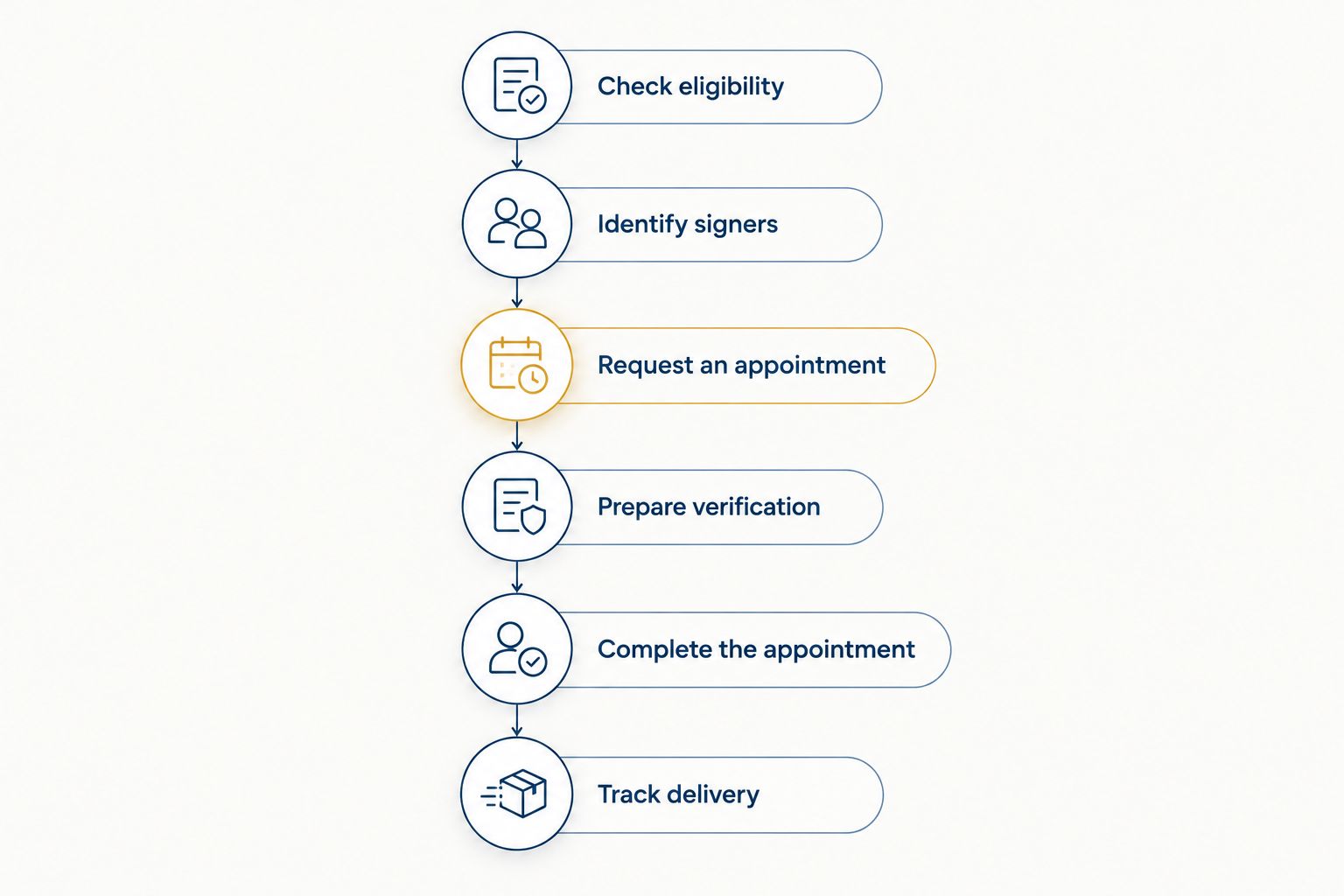
Check eligibility
Begin with the document recipient, not the calendar. Ask whether notarization is required, what completed document the recipient expects, and whether the recipient accepts remote online notarization for that particular transaction. Do not assume that every lease, owner authorization, affidavit, or vendor form needs notarization simply because it concerns a property.
For your 2026 checklist, use 3 checkpoints: document requirements, recipient acceptance, and appointment suitability. These are planning checks, not a substitute for legal review. If the document lacks clear instructions, ask the issuing party or an attorney to resolve the uncertainty before requesting an appointment.
- Identify the exact document and its intended recipient.
- Ask the recipient whether remote notarization is acceptable.
- Check whether the packet calls for witnesses or supporting materials.
- Refer legal questions and unclear certificate instructions to the appropriate professional.
- Leave signatures requiring the notary’s involvement untouched until instructed.
Identify signers
List everyone who must participate and the capacity in which each person signs. An owner signing personally presents a different coordination task from an employee signing for a management company or a representative signing for an entity.
Your role is to collect accurate appointment information, not to decide whether someone has legal authority. Have the document’s issuer, recipient, or attorney resolve authority questions. This matters when your office coordinates the paperwork but an owner or representative must appear for the notarial act.
Assign 1 coordinator to gather answers and communicate updates. That person keeps the request consistent without replacing the signer’s participation or identity verification.
- Record each signer’s name as it appears in the document.
- Identify the signer’s stated role or representative capacity.
- Confirm which people actually need to attend.
- Flag witness requirements for discussion before scheduling.
- Give the coordinator a way to reach each participant.
Request an appointment
First, prepare a short request using your own checklist: document type, number of signers, requested timing, and any recipient instructions. Avoid sending unnecessary sensitive information in an initial inquiry; ask how the documents should be submitted.
For eligible documents, CraigVet Notary Services offers Maryland remote online notarization through Proof. Present remote notarization as the first option to review, not as a guarantee that the document qualifies. If an in-person appointment is needed, ask about mobile service and confirm Baltimore County availability before booking.
Submitting a request does not confirm an appointment. Wait for direct contact and confirmation before telling an owner or resident that the session is scheduled.
- State whether you are requesting remote or mobile service.
- Describe the document without adding unnecessary personal details.
- Provide the expected signer and witness arrangements.
- Explain any recipient deadline without assuming immediate service.
- Wait for confirmation of the appointment and its requirements.
Prepare verification
For a remote appointment, follow the Proof instructions provided for the session and complete the required identity-verification process. The person coordinating the appointment should not assume that knowing a tenant or having an owner’s identification on file replaces the notary’s verification requirements.
Ask each signer to review the appointment instructions directly. Check the device, camera, microphone, and internet connection before the session, and arrange a private setting where the signer can communicate clearly. Do not distribute identity documents through an office-wide email thread merely to simplify coordination.
Preparation reduces preventable interruptions; it does not guarantee that verification will succeed or that the notarial act can proceed.
- Ask what identification and verification steps apply.
- Follow the platform’s document-submission instructions.
- Test the equipment needed for the remote session.
- Keep sensitive materials within the designated submission process.
- Tell the notary about accessibility or communication needs in advance.
Complete the appointment
During the appointment, let the notary direct the notarial process. Property managers can assist with coordination, but the signer must participate as required. Avoid answering identity or willingness questions on someone else’s behalf.
Keep document revisions out of the live session whenever possible. If an owner changes instructions or a recipient requests different wording, pause and resolve the document issue with the appropriate party. A notary is not a substitute for a lawyer reviewing a lease, interpreting an authorization, or selecting legal language.
For a mobile appointment, follow the confirmed meeting arrangements rather than treating a requested address or time as accepted.
- Have the correct document version ready.
- Follow the notary’s instructions about signing.
- Make required participants available as directed.
- Raise document discrepancies instead of working around them.
- Ask how you will receive the completed notarized document.
Track delivery
Notarization and delivery are separate tasks. Your property-management file needs to show which document was completed, where it was sent, and whether the recipient identified any outstanding issue. Do not mark a transaction complete solely because the appointment ended.
Use 1 tracking row per document so similar owner names, property addresses, or revised packets do not blur together. For your 2026 records, distinguish the requested appointment date from the confirmed appointment and the completed document’s delivery status.
Store documents according to your organization’s access and retention requirements. An internal tracking sheet should help staff find the authorized record, not become another uncontrolled copy of sensitive paperwork.
- Record the document name and version.
- Note completion and delivery status separately.
- Identify who is responsible for sending the document.
- Confirm receipt when the transaction requires it.
- Restrict access to staff who need the record.
Request a notary appointment
Ask about eligible remote documents or mobile availability. Wait for direct appointment confirmation.
Compare notarization options for property managers
Choose the appointment format by document requirements and signer circumstances, not convenience alone. The practical advantage of remote notarization is that eligible signers can participate without traveling to the same physical appointment location; its limitation is that eligibility, recipient acceptance, technology, and identity verification still need attention.
| Option | Best for | Practical advantage | Key limitation |
|---|---|---|---|
| Maryland remote online notarization through Proof | Eligible documents with signers who can complete the remote process | Avoids coordinating travel to a physical appointment | Requires document suitability, recipient acceptance, and successful verification |
| Mobile notary appointment | Signers who need an in-person appointment at an agreed location | Brings the appointment to a confirmed meeting location | Baltimore County availability and appointment details require confirmation |
| Another in-person notary arrangement | Signers who already have access to a suitable physical appointment | Provides an alternative when remote service does not fit | You must separately confirm the provider’s procedures and document suitability |
CraigVet Notary Services is best for property managers seeking Maryland remote online notarization for eligible documents. Mobile appointments are a secondary option to discuss when an in-person meeting fits the situation.
For your 2026 vendor process, retain both a preferred format and a fallback. A fallback is a coordination plan, not permission to bypass document or identity requirements.
Common mistakes property managers make
Assuming every property document needs notarization
A familiar document name does not establish its requirements. Sending every lease or authorization for notarization creates work without resolving whether the recipient actually requires a notarial act.
Ask the issuing or receiving party what is required before scheduling. If the question concerns legal sufficiency, direct it to an attorney rather than asking the notary to decide.
Confusing the coordinator with the signer
A manager who schedules the session cannot automatically stand in for an owner, resident, or authorized representative. Having the file and knowing the transaction does not replace the required person’s participation.
Identify the signer at the start. Then make sure that person receives and follows the appointment instructions.
Treating an inquiry as a confirmed booking
An internal calendar entry does not establish the notary’s availability. This becomes especially disruptive when several residents, owners, or witnesses receive an unconfirmed time.
Keep requests marked as pending until direct confirmation arrives. For mobile service, confirm Baltimore County availability and meeting details before issuing final instructions.
Expecting notarization to resolve legal questions
Notarization does not replace advice about a document’s meaning, enforceability, or suitability for a transaction. Craig is not an attorney and cannot provide legal advice.
Resolve questions about legal wording, signing authority, and the appropriate document with your attorney or the responsible issuing party. Bring a settled document to the appointment rather than asking the notary to draft the solution.
FAQ
What are the best notary services for property managers in Maryland?
The best fit depends on document eligibility, recipient requirements, and the signer’s ability to participate. CraigVet Notary Services offers Maryland remote online notarization through Proof for eligible documents, with mobile appointments as a secondary option subject to confirmation.
Can all property-management documents be notarized online?
No, you should not assume every property-management document qualifies for remote online notarization. Confirm document eligibility and the receiving party’s requirements before arranging the session.
Does every Maryland lease need to be notarized?
Do not treat every Maryland lease as requiring notarization. Ask the issuing party or an attorney what your specific document and transaction require; a notary cannot provide legal advice.
Can a property manager attend instead of the owner?
A property manager cannot replace the required signer simply by arranging the appointment. Resolve who must sign and any representative-authority questions before scheduling.
How do signers prepare for remote identity verification?
Signers should follow the Proof instructions provided for their appointment and complete the required identity-verification steps. Check equipment beforehand and ask what identification is needed rather than assuming an office copy is sufficient.
Can I book a mobile notary in Baltimore County?
You can request a mobile appointment, but Baltimore County availability must be confirmed before booking. Wait for direct contact and confirmation before treating a requested time or location as scheduled.
Is my appointment confirmed when I submit a request?
No, submitting a request does not confirm the appointment. Wait for direct contact confirming the arrangements before coordinating final attendance.
One last thing
Your most useful 2026 improvement is a separate field for recipient acceptance. Document completion and recipient acceptance are different checkpoints; tracking both helps your team see what still needs attention.
For repeat notarizations, keep a reusable request template, but recheck each document’s requirements. CraigVet Notary Services can handle the notarial appointment for eligible documents; your team remains responsible for coordinating the right signer, the correct document, and the intended recipient.


