

Mortgage loan officers’ notary services are identity-verification and notarial services used to complete eligible borrower documents with the aim of keeping mortgage files moving toward an accepted submission. For Maryland remote online notarization through Proof, confirm document eligibility and lender or title-company acceptance first; a remote notarial appointment is not the same as coordinating an entire mortgage closing.
- CraigVet Notary Services is best for Maryland mortgage loan officers seeking remote notarization of eligible individual documents.
- Notary services for mortgage loan officers require document review, identity verification, and lender or title-company acceptance.
- Proof supports the remote appointment; it does not replace the receiving party’s document requirements.
- Request mobile appointments separately and confirm Baltimore County availability before booking.
Why notary services matter for mortgage loan officers
A borrower’s completed signature is only useful when the receiving party accepts the document and its notarization. Your job is to establish those requirements before asking the borrower to attend an appointment, not after the signed document returns to the file.
Mortgage workflows also involve different responsibilities. The loan officer coordinates borrower communication, the lender or title company supplies transaction instructions, and the notary performs the authorized notarial act. Keep those roles separate in your 2026 appointment procedure.
CraigVet Notary Services offers Maryland remote online notarization through Proof and in-person mobile appointments. CraigVet Notary Services is best for Maryland mortgage loan officers seeking remote notarization of eligible individual documents. Do not treat that service description as confirmation that a complete loan package, settlement assignment, or particular document has been accepted.
For repeat business, establish a consistent handoff instead of treating every request as an isolated scheduling problem. A useful handoff identifies the document, the signer, the receiving party’s instructions, and the person responsible for resolving questions.
How to arrange a Maryland notary appointment in 2026
Use the following steps for individual borrower documents and other mortgage-related notarization requests. If your request involves a complete closing package, have the lender or title company define the required service and confirm that the selected provider accepts that assignment.
Establish the receiving party’s requirements
Start manually with the lender’s or title company’s written instructions. Ask whether the specific document is eligible for remote notarization and whether the receiving party accepts the proposed electronic document and notarial process. A borrower’s preference for a video appointment does not settle those questions.
Separate document acceptance from appointment availability. Even an available notary cannot resolve a receiving party’s refusal to accept a particular format. For a document intended for recording, ask the responsible title or recording contact to confirm the submission requirements.
Your first handoff should leave no ambiguity about who can authorize changes. If instructions conflict, return them to the issuing party rather than asking the notary to choose between them.
- Identify the document by its exact title and current version.
- Obtain the receiving party’s remote-notarization instructions.
- Confirm whether the request covers an individual document or a closing package.
- Identify the contact authorized to resolve document questions.
- Keep the approval with the transaction’s appointment instructions.
Review the document before scheduling
Inspect the document using your existing file-review process before sending an appointment request. Look for missing pages, inconsistent signer names, incomplete fields, and instructions that require clarification. This is a completeness check, not a legal interpretation of the document.
Check the notarial wording separately from the borrower’s signature area. If a certificate is missing or the requested act is unclear, obtain instructions from the document’s issuer or an appropriate legal adviser. Do not ask the notary to select a legal outcome for the borrower.
Resolve document questions before the signer enters the appointment. That keeps appointment time focused on identity verification, the required interaction, and the authorized notarial act rather than document repair.
- Confirm that the file contains every required page.
- Compare signer names across the document and appointment request.
- Flag blank fields for the responsible document preparer.
- Obtain clarification about unclear notarial instructions.
- Ask when the borrower should sign; do not assume advance signing is appropriate.
Request the right appointment format
After establishing acceptance and checking the document, contact CraigVet Notary Services about Maryland remote online notarization through Proof. Provide a concise description of the request and ask for the appropriate next steps. Remote notarization is an option for eligible documents, not a promise that every mortgage-related request qualifies.
A direct request replaces a chain of borrower-to-office messages with a defined handoff. Include the receiving party’s requirements and identify any unresolved issues without presenting the request as already approved.
If an in-person visit is needed, ask about mobile service separately. Baltimore County availability must be confirmed before booking. A submitted request is not a confirmed appointment; wait until CraigVet contacts you to confirm the arrangements.
- State whether you are requesting remote or mobile service.
- Describe the document and the requested notarial act, if supplied.
- Share the receiving party’s relevant instructions through the agreed channel.
- Identify the signer and the business contact coordinating the request.
- Wait for confirmation before giving the borrower a fixed appointment instruction.
Prepare the borrower for identity verification
Give the borrower clear preparation instructions rather than forwarding a vague request to get something notarized. For a remote session through Proof, the borrower needs to follow the platform’s identity-verification and connection instructions. Confirm the applicable requirements before the appointment instead of relying on a previous transaction’s checklist.
Ask the borrower to review the document before the session and direct substantive mortgage questions to the lender or title company. The notary’s role does not include explaining whether the loan terms are appropriate or advising the borrower to sign.
Keep identity documents out of unnecessary email chains. Use the process specified for the appointment, and avoid collecting sensitive materials merely because your office has collected them in the past.
- Send the appointment instructions directly to the signer.
- Ask the signer to follow the specified identification requirements.
- Confirm access to the required camera, microphone, and connection.
- Arrange a private setting where the signer can communicate clearly.
- Route loan-term and legal questions to the responsible professional.
Coordinate the appointment without replacing the signer
Designate 1 coordinator per request as an internal working rule, not a legal requirement. That person tracks confirmations, communicates changes, and keeps the lender or title contact informed. A single coordinator reduces conflicting messages about document versions and appointment status.
The borrower must participate in the required notarial interaction. An assistant or loan officer cannot substitute for the signer’s identity verification or responses. If your office wants another person to attend, confirm the arrangement and that person’s role beforehand.
Keep the most recent instructions together. If the document changes after review, tell the notary before the session rather than quietly replacing the file and assuming the earlier review still applies.
- Name the coordinator in the appointment request.
- Record whether the appointment is requested or confirmed.
- Tell the notary about document revisions before the session.
- Confirm any additional participant’s role in advance.
- Give the borrower a clear contact for connection or scheduling problems.
Check the returned document and record the handoff
After the appointment, review the completed document against the receiving party’s instructions. Perform 2 checks per returned document as an internal control: confirm the document is complete, then confirm it is ready for the receiving party’s required submission process. These checks do not replace the notary’s duties or the recipient’s review.
Do not edit a completed notarial certificate or try to repair a perceived error yourself. Send the question to the notary and the responsible transaction contact. Keep the original returned file intact while the issue is reviewed.
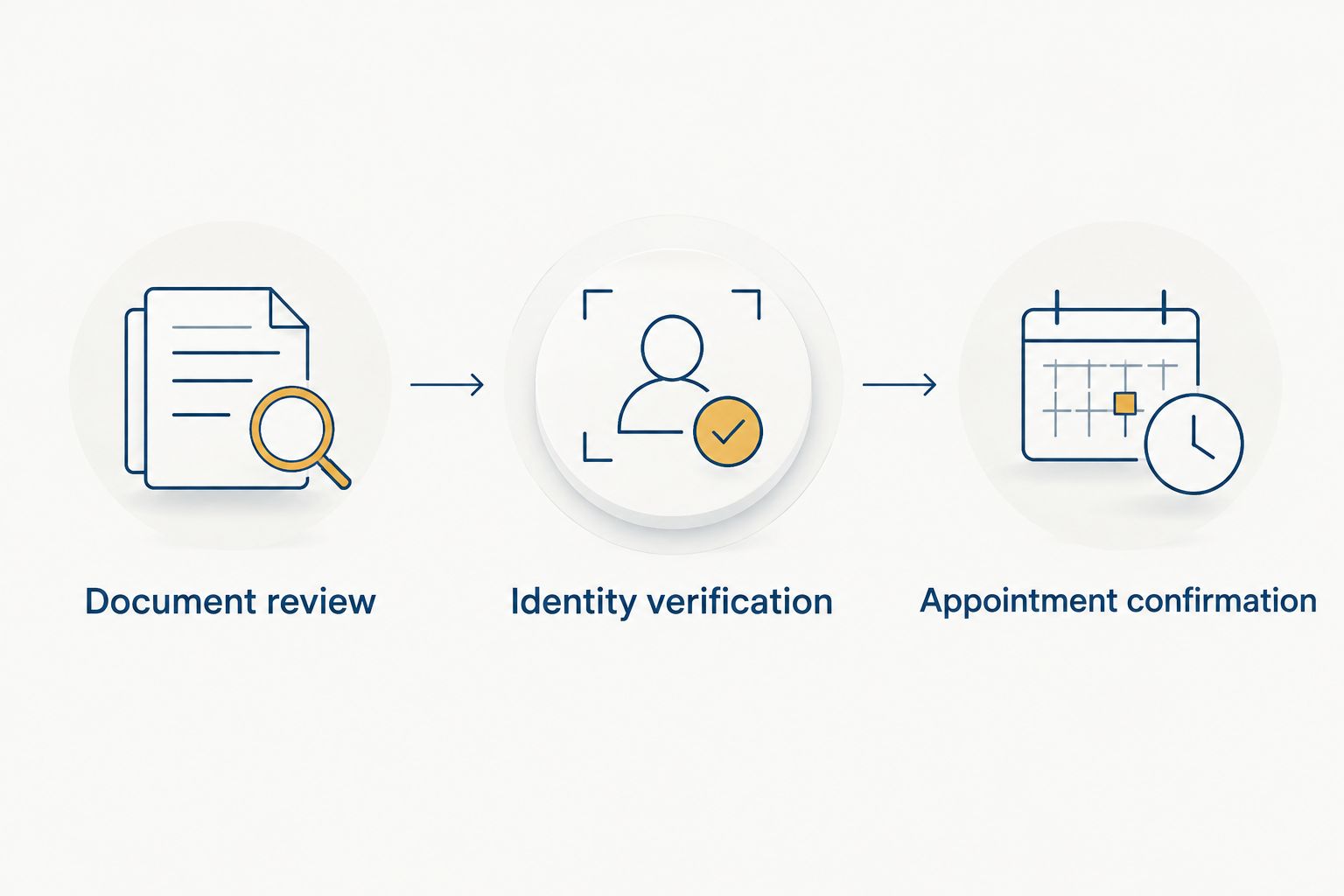
For repeat requests in 2026, organize your checklist around 3 checkpoints per request: document review, identity verification, and appointment confirmation. Track submission separately so a completed appointment does not get mistaken for an accepted mortgage file.
- Check the returned file for missing pages or incomplete execution.
- Compare the completed document with the recipient’s instructions.
- Preserve the returned document without unauthorized changes.
- Route corrections to the notary and responsible transaction contact.
- Record submission and acceptance as separate workflow events.
Compare appointment options for your mortgage workflow
Choose the format that fits the document and the assigned role, not simply the borrower’s preferred meeting method. The comparison below separates individual notarizations from broader closing coordination; those are different service requests.
| Option | Best for | Practical advantage | Key limitation |
|---|---|---|---|
| Maryland remote online notarization through Proof | Eligible individual documents accepted remotely by the receiving party | Lets the signer complete the notarial interaction remotely | Document eligibility, identity verification, and recipient acceptance still apply |
| In-person mobile notary appointment | Requests needing an in-person visit | Brings the notarial appointment to an agreed location | Baltimore County availability and appointment arrangements require confirmation |
| Lender- or title-coordinated closing appointment | Transactions requiring coordinated closing instructions and package handling | Keeps the closing assignment with the party managing its requirements | A general notary request does not establish acceptance of the full closing assignment |
For your 2026 workflow, treat remote notarization as a document-level decision, not a blanket approval for the transaction. Mobile service also requires document review; meeting in person does not remove the receiving party’s instructions or the notary’s limits.
If a borrower needs help understanding legal consequences, refer that question to an attorney. Craig is not an attorney and cannot provide legal advice.
Common mistakes mortgage loan officers make
Treating remote acceptance as automatic
A document’s availability as a PDF does not establish that the recipient accepts remote notarization. Obtain the relevant instructions before directing the borrower to a platform, and keep the approval attached to the request.
Requesting a notary when the assignment is a full closing
An individual notarization and an entire mortgage-closing assignment are not interchangeable descriptions. State exactly what is expected, including document handling and transaction coordination, and obtain explicit acceptance of that scope.
Sending borrowers to an unconfirmed appointment
A request, an introductory message, and a confirmed appointment represent different stages. Wait for CraigVet to contact you before describing the appointment as booked, and confirm Baltimore County availability for mobile requests.
Using the notary as a document adviser
Do not ask the notary which legal document the borrower should use, what loan language means, or whether signing serves the borrower’s interests. Send document-preparation questions to the issuer and legal questions to an attorney.
Copying sensitive information into every message
A repeat-business process should reduce unnecessary circulation of borrower information. Send only what the recipient needs through the agreed channel, and keep identification materials within the prescribed verification process rather than routine office correspondence.
FAQ
Can mortgage loan officers use remote online notarization in Maryland?
Mortgage loan officers can request Maryland remote online notarization for eligible documents. Confirm the receiving party’s acceptance and the notary’s review before arranging the borrower’s session.
Does a remote notary appointment cover an entire mortgage closing?
A remote notary appointment does not by itself establish acceptance of an entire mortgage-closing assignment. The lender or title company must define the scope, and the provider must confirm the assignment.
What should I send before requesting a borrower’s appointment?
Provide the document description, signer information, and receiving party’s relevant instructions through the agreed channel. Identify unresolved questions and the contact authorized to resolve them.
Does the borrower need identity verification through Proof?
The borrower must complete the identity-verification process required for the Proof appointment. Follow the specific appointment instructions rather than assuming a prior session’s requirements apply.
Can I book a mobile notary for a borrower in Baltimore County?
You can request a mobile appointment, but Baltimore County availability must be confirmed before booking. Do not tell the borrower the appointment is confirmed until CraigVet contacts you.
Can the notary explain mortgage terms to my borrower?
Craig is not an attorney and cannot provide legal advice. Direct mortgage-term questions to the lender or title company and legal questions to an attorney.
What should I do if the document changes after appointment preparation?
Tell the notary about the revised document before the session. Recheck the receiving party’s instructions and resolve any new questions before the borrower proceeds.
One last thing
Add a distinct acceptance field to your 2026 tracking sheet. A completed notarization records one event; the lender or title company’s acceptance records another. Keeping those statuses separate helps your team identify whether the next action belongs to the borrower, the notary, or the receiving party.


