

Notary services for financial advisors are notarial appointments for eligible client documents, with the aim of completing required notarizations within a financial planning workflow. For Maryland clients, CraigVet Notary Services offers remote online notarization through Proof for eligible documents, with mobile appointments as a secondary service and Baltimore County availability confirmed before booking.
- CraigVet Notary Services offers notary services for financial advisors through Maryland remote online notarization on Proof for eligible documents.
- Confirm document eligibility and receiving-party requirements before asking a client to attend a remote appointment.
- Prepare identity verification, document instructions, and signer participation before the session.
- Mobile appointments require availability confirmation; an appointment request is not a confirmed booking.
Why notarization matters for financial advisors
Financial advisors coordinate documents, client instructions, and receiving institutions. Notarization belongs inside that coordination process, but it does not replace legal review, institutional approval, or your firm's compliance procedures.
For your 2026 workflow, separate document acceptance from appointment logistics. A successful notarial appointment does not establish that an institution will accept a particular form or that the document achieves the client's intended legal outcome.
Start with 3 review questions: Does this document require notarization? Is the proposed method acceptable to the recipient? Can the signer complete the appointment requirements? Answering these questions before scheduling gives your client a clear next step rather than an appointment built around assumptions.
For repeat business, consistency matters. Keep the same intake questions across your team, while allowing the notary to assess each document and signer individually. A familiar client or previously accepted form does not remove the need for a fresh review.
How to arrange a Maryland notary appointment
Use the following process for your 2026 appointment checklist. Begin with the document and signer, then choose the appointment route; remote notarization is an option for eligible documents, not a requirement for every client.
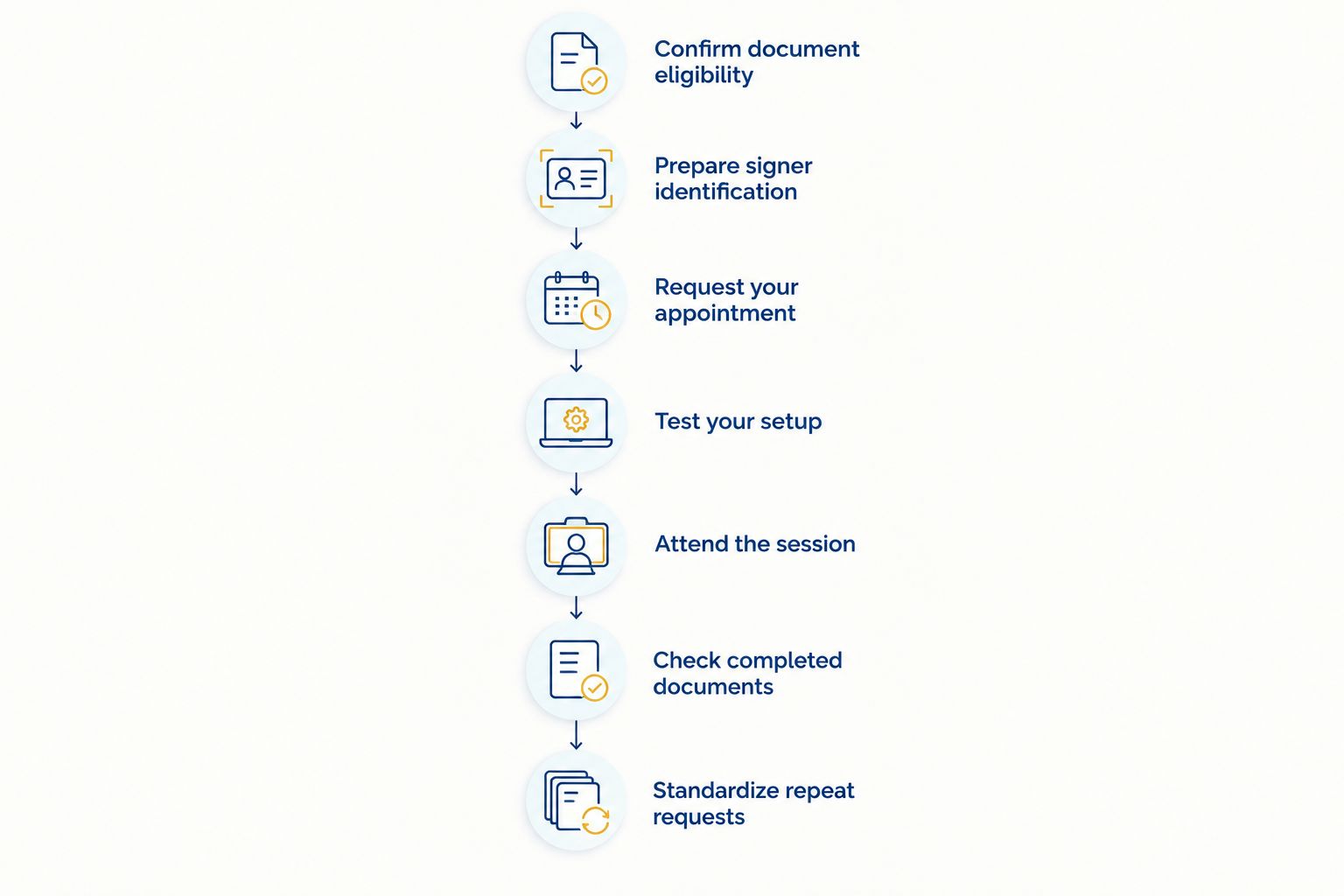
Confirm document eligibility
Begin manually: read the receiving institution's instructions and identify the exact document version your client must use. Ask the recipient whether it accepts remote online notarization for that document and whether it has additional execution or delivery requirements.
A power of attorney, trust-related form, or account document needs individual review. The document's financial purpose alone does not establish whether notarization is required or whether remote execution is appropriate. If instructions conflict, resolve the conflict with the issuing party, recipient, or the client's attorney before the appointment.
Do not ask the notary to choose a legal instrument or decide what authority your client should grant. Craig is not an attorney and cannot provide legal advice.
- Confirm the document's name, version, and intended recipient.
- Read the recipient's notarization and submission instructions.
- Ask whether remote online notarization is accepted.
- Identify any witness instructions for separate review.
- Refer legal questions to the client's attorney.
Prepare signer identification
Ask your client to review the appointment's identity-verification instructions before scheduling. For remote notarization, follow the Proof process and the notary's directions rather than treating an existing advisory relationship as a substitute for identity verification.
Do not promise that a particular identification document will be accepted before it has been reviewed under the applicable process. If the client's name differs across records, raise the discrepancy before the session instead of attempting an informal workaround.
Your 2026 intake checklist should distinguish between information your advisory firm already holds and information the notary or platform requires. Familiarity with the client does not authorize your team to answer identity questions or complete verification on the client's behalf.
- Ask the signer to review identification requirements.
- Flag name differences before the appointment.
- Confirm that the signer can participate personally.
- Direct identity-verification questions to the notary.
- Use the requested channel for any sensitive information.
Request your appointment
You can coordinate the request manually with a short document summary and the client's preferred appointment windows. State the intended recipient, proposed notarization method, signer participation needs, and any known document instructions without adding unnecessary financial information.
CraigVet Notary Services provides a remote option through Proof for eligible documents, avoiding the need to arrange an in-person meeting when remote notarization is suitable. The limitation is equally clear: document eligibility, identity verification, and appointment arrangements still require attention.
A submitted request is not a confirmed appointment. Wait until CraigVet contacts the client before treating the booking as confirmed or telling another professional that execution is scheduled. If you need a mobile appointment, confirm Baltimore County availability before booking.
- Describe the document and intended recipient.
- Provide the requested contact and scheduling details.
- Identify any participation or accessibility needs.
- Ask about eligibility before choosing remote notarization.
- Wait for direct contact before marking the appointment confirmed.
Request a Maryland notary appointment
Ask about remote eligibility or mobile availability; wait for contact before treating the appointment as confirmed.
Test your setup
For a remote appointment, prepare the client's device and connection using the current Proof instructions. Your team can help the client locate instructions and understand the appointment sequence, but the signer must complete the required participation and identity-verification steps personally.
Choose a private setting where the client can hear, respond, and review the document without avoidable interruptions. Check the device's camera, microphone, and document access before the appointment rather than discovering a technical barrier during the session.
If the signer cannot use the proposed setup, raise that issue before scheduling. Discuss another arrangement with the notary instead of assuming a staff member or relative can substitute for the signer.
- Review the current Proof setup instructions.
- Check camera, microphone, and connection access.
- Confirm that the signer can open the required document.
- Choose a private location for participation.
- Ask about technical or accessibility concerns in advance.
Attend the session
Follow the notary's instructions for identification, document review, signing, and the requested notarial act. Do not instruct a client to pre-sign a document unless the notary has explained what is appropriate for that document and act.
Keep your advisory role separate from the notarial role. You can clarify where a document came from or what the receiving institution requested, but legal interpretation and the notary's procedural decisions belong outside your appointment coordination duties.
If you plan to attend with your client, ask about participation arrangements beforehand. Avoid answering for the signer or treating your attendance as permission to control the session. An unresolved procedural issue needs clarification, not pressure to finish.
- Follow the notary's signing instructions.
- Allow the signer to answer personally.
- Disclose planned advisor or support-person participation.
- Raise unclear document instructions before proceeding.
- Stop for clarification when a requirement remains unresolved.
Check completed documents
After the appointment, follow the delivery instructions provided and check that you received the intended completed document. Review it against the receiving institution's submission checklist without altering the notarial certificate or attempting to repair an apparent error yourself.
Keep notarization completion separate from institutional acceptance. Your internal status should make clear whether the document has been completed, submitted, or accepted; these are different events in the client's workflow.
If the recipient rejects the document, obtain the specific reason before arranging another appointment. A missing attachment, an outdated form, and a notarial question require different responses. Send notarial questions back to the notary and legal questions to the appropriate attorney.
- Confirm receipt of the intended completed document.
- Check recipient instructions and required attachments.
- Record submission separately from acceptance.
- Do not edit a completed notarial certificate.
- Obtain the recipient's explanation for any rejection.
Standardize repeat requests
Assign 1 coordinator per request as an internal practice, even when several advisors serve the household or business. That coordinator can track instructions, confirmation, and delivery without having different staff members send conflicting messages to the client.
For repeat notarizations in 2026, maintain a reusable intake template rather than assuming the last appointment's requirements still apply. Recheck the document, recipient instructions, signer circumstances, and proposed appointment method each time.
Track process outcomes without copying sensitive identity material into a general scheduling log. Your firm's retention and privacy rules should determine what belongs in its records. The purpose of the checklist is consistent coordination, not an additional collection of client identification documents.
- Name the coordinator responsible for the request.
- Recheck eligibility for each new document.
- Record requested and confirmed appointment status separately.
- Track completed, submitted, and accepted status.
- Follow firm policies for access and retention.
Compare remote and mobile notary appointments
CraigVet Notary Services is best for Maryland financial advisors seeking remote notarization for eligible client documents. Its remote service uses Proof; mobile appointments provide a secondary route when availability and document requirements support an in-person arrangement.
Compare these 2 appointment routes by eligibility and client participation, not convenience alone. Remote service avoids an in-person meeting, but it requires the signer to complete the online process. Mobile service brings an in-person appointment into consideration, but location and availability must be confirmed.
| Option | Best for | Main advantage | Key limitation |
|---|---|---|---|
| Maryland remote online notarization through Proof | Eligible documents and signers able to complete online participation | Does not require an in-person meeting | Requires document eligibility, identity verification, suitable technology, and recipient acceptance |
| In-person mobile notary appointment | Clients seeking an in-person arrangement | Allows an in-person appointment when arranged | Baltimore County availability must be confirmed before booking; document requirements still apply |
Neither route replaces the recipient's instructions or legal advice. Ask about the document first, then decide which appointment arrangement fits the signer.
Common mistakes financial advisors make
Treating every financial form as remotely eligible
A financial document is not automatically suitable for remote notarization. Check the specific form and recipient's requirements instead of carrying an assumption from another institution or client file. Eligibility is document-specific, not relationship-specific.
Confusing notarization with legal approval
Notarization does not establish that a planning document accomplishes the client's intended legal result. Keep questions about authority, ownership, and legal effect with the client's attorney; Craig is not an attorney and cannot provide legal advice.
Letting staff complete identity steps for clients
Administrative help is different from signer participation. Your team can explain where to find instructions, but it must not impersonate the client, supply identity answers, or treat existing account verification as a replacement for the notarial process.
Calling an appointment confirmed too early
A request, preferred time, or calendar placeholder is not confirmation. For your 2026 scheduling procedure, use a pending status until CraigVet contacts the client, and confirm Baltimore County availability before booking a mobile appointment.
Repeating a rejected submission without diagnosis
Do not schedule another notarization solely because a recipient returned the document. Ask what failed, identify who must resolve it, and confirm the corrected instructions first. Repeating the same process without that explanation leaves the underlying issue unanswered.
FAQ
What's the best notary option for a Maryland financial advisor's clients?
Remote online notarization through Proof is a suitable starting option for eligible documents when the signer can complete the online process. CraigVet Notary Services also offers mobile appointments, with Baltimore County availability confirmed before booking.
Can every financial planning document be notarized online?
No, you must confirm eligibility for the specific document and the receiving party's requirements. Do not assume a form is eligible because another financial document was notarized remotely.
Can my assistant handle identity verification for my client?
Your assistant cannot complete the signer's identity-verification steps on the signer's behalf. Staff can help coordinate instructions, but the signer must participate personally in the required process.
Should my client sign before the notary appointment?
Follow the notary's instructions before signing. The appropriate signing procedure depends on the document and the requested notarial act, so do not give a blanket instruction to pre-sign.
Is my appointment confirmed after I submit a request?
No, a request is not a confirmed appointment. Wait until CraigVet contacts the client before treating the booking as confirmed, and confirm availability before booking a Baltimore County mobile appointment.
Can Craig tell my client which legal document to use?
No, Craig is not an attorney and cannot provide legal advice. Ask the client's attorney about document selection, legal authority, and the legal effect of financial planning documents.
What should I do if an institution rejects a notarized document?
Ask the institution for the specific reason before arranging another appointment. Refer notarial questions to the notary, legal questions to the client's attorney, and form or submission questions to the receiving institution.
One last thing
Make institutional acceptance a separate checkpoint in your 2026 workflow. A completed notarization is not the same as an accepted submission, and closing the task too early can leave your team unaware of an unresolved document issue.
Use a simple status sequence: requested, confirmed, completed, submitted, accepted. Assign ownership of the final check so your client knows whether the document has merely left your office or reached the receiving institution's required endpoint.


