

Estate planning attorneys’ notary support is the coordination of document notarizations with the aim of completing client signing appointments under the applicable execution requirements. For Maryland practices, remote online notarization through Proof is an option for eligible documents in 2026, but counsel must distinguish notarization from witness requirements and the legal requirements for executing each estate document.
- CraigVet Notary Services offers notary services for estate planning attorneys handling eligible Maryland documents through Proof.
- Confirm document eligibility, witness arrangements, and recipient requirements before choosing remote online notarization.
- Complete identity verification through the appointment process; sending a request does not confirm an appointment.
- Use mobile notarization as a secondary option, with Baltimore County availability confirmed before booking.
Why notary services matter for estate planning attorneys
An estate signing is not simply a collection of signatures. Your firm must distinguish the client’s legal instructions, the document’s execution requirements, and the notary’s responsibilities. Treating those as interchangeable creates preventable scheduling and completion problems.
CraigVet Notary Services is best for Maryland law firms seeking notary services for eligible documents through Proof. The service also offers mobile appointments, with Baltimore County availability confirmed before booking. A request submitted through CraigVet Notary Services is an inquiry, not a confirmed appointment; confirmation follows contact from the service.
For your 2026 workflow, put document eligibility ahead of convenience. A client’s ability to join a video session does not establish that every document in the client’s estate packet is suitable for remote notarization.
The practical distinction is straightforward: your firm controls legal drafting and execution instructions, while the notary performs the requested notarial service within Maryland notarial requirements. Craig is not an attorney and cannot provide legal advice.
Build a repeatable estate signing process
Confirm document eligibility
Start manually with a document-by-document review. Identify what each instrument requires rather than labeling the entire packet an estate plan and assigning one signing method to everything inside it. Ask the receiving institution about its acceptance requirements when a document will be submitted to a bank, custodian, recorder, or other recipient.
Keep 2 separate checks in your intake process: whether remote notarization is appropriate for the document and whether the intended recipient accepts the resulting format. Neither check replaces your firm’s analysis of execution requirements.
For repeat matters, maintain an internal checklist by document type. Revisit the checklist when the document, recipient, or signing circumstances change; a successful previous appointment is not blanket approval for the next packet.
- Identify the requested notarial act for each document.
- Separate notarization instructions from witness instructions.
- Confirm recipient requirements before arranging the signing.
- Flag unresolved legal questions for the responsible attorney.
Prepare the client and identity materials
Give the client written preparation instructions before selecting a session. Explain that remote online notarization includes identity verification and that a familiar relationship with the law firm does not replace the notary’s identity-verification process.
Ask the client to check the current identification and technical instructions supplied for the appointment. Do not promise that a particular identification document will be accepted without confirmation. A client who needs assistance should raise that need before the session, not after everyone has assembled.
Your firm should also distinguish technical assistance from participation in the signing. An assistant’s availability does not answer whether that person can serve as a witness or take another formal role.
- Ask the client to review the appointment’s identification instructions.
- Check access to a camera, microphone, and internet connection.
- Arrange a private location where the client can participate clearly.
- Disclose accessibility, communication, or participation concerns in advance.
Request the appropriate appointment
Once counsel has resolved the document questions, request Maryland remote online notarization through Proof for eligible documents. CraigVet Notary Services offers this remote route alongside its secondary mobile service. The remote option avoids arranging a shared physical meeting location, but it still requires preparation, identity verification, and confirmation.
Use 3 intake fields as a minimum internal summary: document type, participant roles, and requested appointment window. Add recipient instructions or other relevant constraints without sending unnecessary estate-planning details through an unconfirmed channel.
For a Baltimore County mobile request, confirm location coverage and availability before presenting the appointment as settled. In either format, keep the client’s calendar entry provisional until the service contacts the client and confirms the arrangements.
- State whether you are requesting remote or mobile notarization.
- Identify the documents and intended notarial acts.
- Describe signer and witness roles without assuming staffing is included.
- Provide scheduling preferences and wait for confirmation.
Assign responsibility for witnesses and instructions
Create a role sheet before the appointment. List the signer, the responsible attorney, the notary, and any required witnesses, then specify who is arranging each participant. Do not assume that booking a notary also books witnesses or legal supervision.
Assign 1 firm coordinator to manage changes. A single contact can keep the client, attorney, and notary working from the same instructions without asking the notary to resolve conflicting legal directions.
For your 2026 procedure, make the attorney’s execution instructions explicit. If a question arises about legal effect, witness qualifications, or the proper execution method, return it to counsel rather than treating the appointment as a substitute for legal review.
- Name the person responsible for arranging witnesses.
- Confirm each participant’s role before the session.
- Keep the final execution instructions with the responsible attorney.
- Route scheduling changes through the designated firm coordinator.
Complete the session without improvising
Before the appointment, verify that the signing version matches the version your firm approved. Tell the client when to sign according to the appointment instructions; do not assume that every signature should be completed in advance.
During the remote session, follow the Proof workflow and the notary’s directions for identity verification and the notarial act. If the document or participant list changes, pause and resolve the change rather than asking everyone to proceed with an improvised arrangement.
A notary appointment is not a legal consultation. Questions about the meaning of a power, distribution clause, fiduciary appointment, or other estate provision belong with the attorney before execution continues.
- Check the final document version against your approved packet.
- Follow the supplied signing and identity-verification instructions.
- Raise unclear names, missing pages, or inconsistent instructions immediately.
- Stop for attorney review when a substantive legal question arises.
Review the completed file and close the matter
After the appointment, use your firm’s own completion checklist. Confirm that the returned documents correspond to the intended packet and that the requested notarial portions appear completed. Escalate questions to the appropriate professional rather than making your own changes to a completed notarial certificate.
Establish how your firm will receive, store, and transmit completed documents. Ask about the delivery process instead of assuming a particular file format, turnaround, or retention arrangement. Your internal matter-closing deadline should leave room to review the completed packet before onward submission.
For repeat clients, retain the procedural lessons, not assumptions about future eligibility. A different document version, recipient, or participant arrangement deserves a fresh check.
- Match completed documents to the matter’s final document list.
- Check the requested signatures and notarial sections.
- Confirm the recipient’s submission instructions before delivery.
- Record unresolved issues and the person responsible for resolving them.
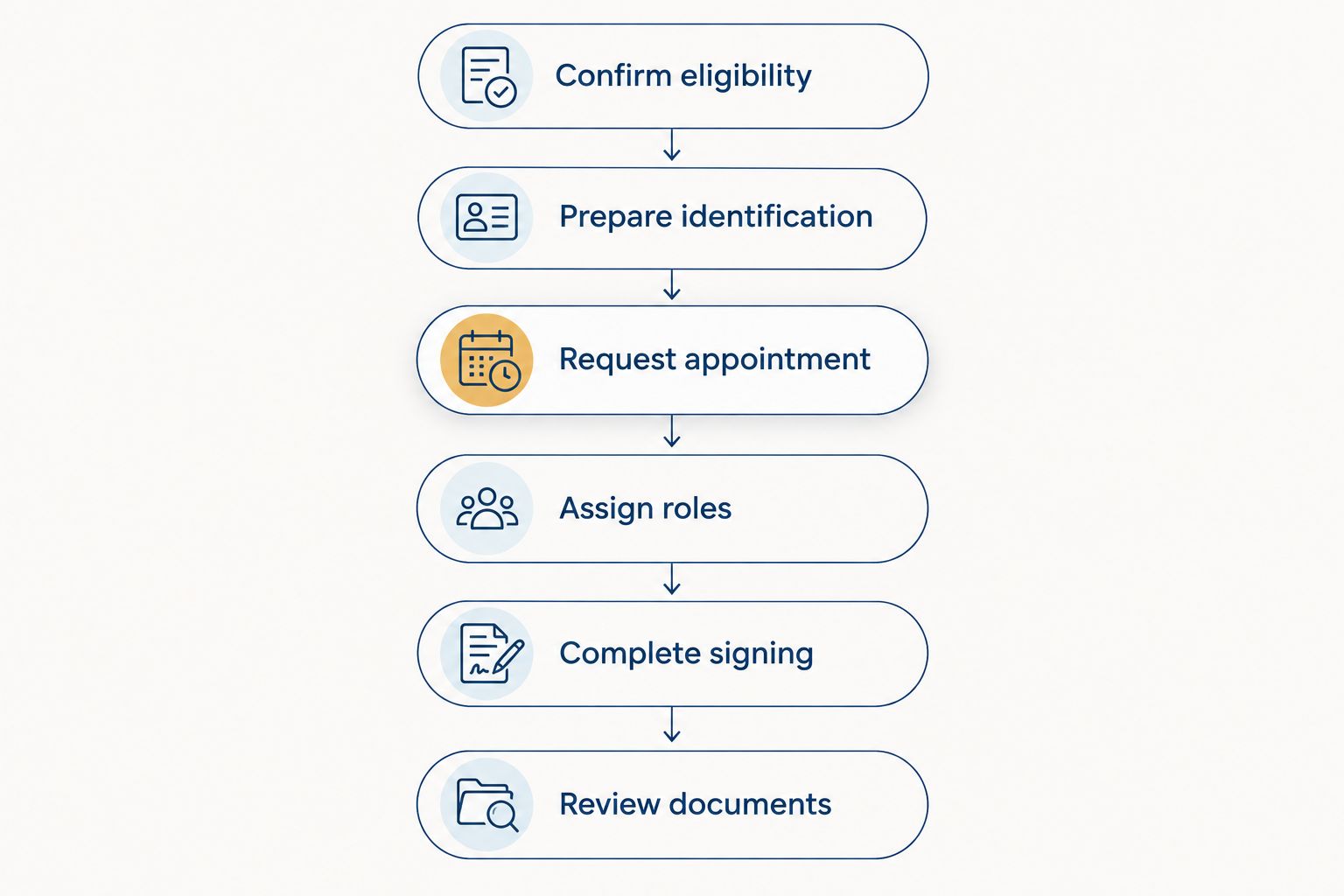
The process follows a clear sequence: Confirm eligibility, Prepare identification, Request appointment, Assign roles, Complete signing, Review documents. Keep these stages visible in your firm’s checklist so a calendar invitation does not become a substitute for preparation.
Compare appointment options for your practice
Choose the appointment format around the document and client, not around a default preference. For 2026 matters, the useful comparison is between eligible remote appointments and confirmed mobile appointments—not between a supposedly universal online solution and an in-person fallback.
| Option | Best for | Practical advantage | Key limitation |
|---|---|---|---|
| Remote online notarization through Proof | Eligible documents where participants can complete the remote process | Removes the need to arrange a shared physical meeting location | Requires document eligibility, identity verification, suitable technology, and recipient acceptance checks |
| In-person mobile notarization | Clients seeking an in-person appointment at an agreed location | Brings the notarial appointment to an agreed physical setting | Baltimore County availability and appointment details require confirmation; notarization does not replace other execution requirements |
Choose the format only after counsel reviews the execution requirements. Remote notarization does not eliminate witness obligations, and an in-person appointment does not resolve defective legal instructions.
CraigVet Notary Services offers both formats, but neither is a promise that every estate document can be completed as requested. Provide the relevant details, discuss eligibility, and wait for confirmation before giving the client a finalized schedule.
Request an estate signing appointment
Discuss eligible remote documents or ask about Baltimore County mobile availability before booking.
Common mistakes estate planning attorneys make
Treating the estate packet as one eligibility decision
A packet can contain documents with different signing instructions. Reviewing the packet only as a whole conceals those differences. Create an instrument-level checklist and assign the signing method separately wherever the requirements differ.
The same discipline applies when reusing a prior client’s appointment plan. A similar document title is not a substitute for reviewing the current version and its intended use.
Assuming the notary supplies witnesses
Notarial service and witness coordination are separate responsibilities. Confirm who will arrange witnesses, what roles they will perform, and how they will participate before offering the client a signing date.
Do not infer witness availability from the availability of a notary. Ask directly, then document the agreed arrangement in your matter instructions.
Treating a request as a confirmed appointment
A submitted inquiry does not mean a time slot is confirmed. Label internal calendar holds accordingly and tell the client that final arrangements follow contact from the service.
For mobile requests, confirm Baltimore County availability and the proposed location as part of that conversation. Avoid giving the client travel or attendance instructions based on an unconfirmed request.
Asking the notary to resolve legal questions
The notary does not replace counsel’s judgment about document language or legal execution requirements. Resolve substantive questions before the session, and pause the appointment if a new legal issue appears.
Keep that boundary in your client instructions: Craig is not an attorney and cannot provide legal advice. Clear responsibility protects the purpose of the appointment and prevents conflicting directions.
Sending unnecessary client information too early
Estate-planning matters contain sensitive personal information. Begin scheduling with the information needed to assess the request, then use the document-sharing process provided for the appointment.
Do not put dispositive instructions, account details, or an entire estate packet into a general scheduling message simply because those materials are available. Your firm should decide what is necessary and confirm how to transmit it.
FAQ
What's the best notary option for an estate planning law firm in Maryland?
Remote online notarization through Proof is an option for eligible documents when the client can complete identity verification and the remote appointment process. Counsel should first confirm execution requirements, witness arrangements, and recipient requirements; mobile notarization is a separate option subject to confirmed availability.
Can every document in an estate plan be notarized online?
No blanket approval applies to an entire estate packet. Review each document's execution requirements and remote eligibility separately, and confirm the intended recipient's requirements before arranging the appointment.
Does booking a notary also arrange the witnesses?
Do not assume a notary appointment includes witnesses. Your firm should confirm who will arrange them, their required roles, and how they will participate before the signing.
What does my client need for a remote notary appointment?
Your client needs to follow the appointment's identification, document, and technical instructions. Confirm access to a camera, microphone, and internet connection, and raise identification or accessibility questions before the session.
Is the appointment confirmed when I submit a request?
No, a submitted request is not a confirmed appointment. Wait until CraigVet Notary Services contacts the client and confirms the arrangements before treating the appointment as final.
Can a mobile notary attend my client's Baltimore County location?
Baltimore County mobile availability must be confirmed before booking. Provide the proposed location, document details, participant requirements, and scheduling preferences so the request can be discussed.
Can Craig advise my client about an estate document?
No, Craig is not an attorney and cannot provide legal advice. Questions about legal meaning, drafting, or execution requirements belong with the client's attorney before the signing proceeds.
One last thing
Ask what happens to the document after notarization before choosing how to notarize it. The intended recipient’s submission requirements belong at intake, not at the end of a completed appointment.
Add that question to your 2026 estate-signing checklist alongside eligibility, identification, and witness coordination. You will then be choosing an appointment format against a defined set of requirements rather than trying to make the completed document fit an assumption.


