

Accountant and CPA notary services provide document notarization for accounting firms and their clients, with the aim of completing required signing steps without confusing notarization with tax or legal advice. For Maryland firms, remote online notarization through Proof is a starting point for eligible documents; the process begins with document review, appointment coordination, and identity verification—not an assumption that every form needs notarization.
- Notary services for accountants and CPAs should start with document requirements, signer readiness, and recipient acceptance.
- CraigVet Notary Services fits Maryland accounting firms seeking remote online notarization through Proof for eligible documents.
- Confirm eligibility before scheduling; remote online notarization is not appropriate for every document.
- Treat mobile notarization as a secondary option, with Baltimore County availability confirmed before booking.
Why notarization matters for accountants and CPAs
Accounting firms coordinate documents for clients, business owners, authorized representatives, and other signers. The challenge is determining which signing requirements apply, then arranging the right appointment without taking responsibility for legal decisions outside the firm's role.
Notarization addresses the notarial act; it does not establish that the accounting, tax treatment, or document content is correct. Keep those responsibilities separate in your 2026 workflow.
CraigVet Notary Services offers Maryland remote online notarization through Proof, alongside in-person mobile appointments. For repeat requests, establish a consistent intake process rather than treating each document as an unrelated scheduling problem.
Your intake should answer three questions before anyone reserves time:
- Does the document actually require a notarial act?
- Is remote online notarization suitable for this document and recipient?
- Can the required signer complete the identity-verification and signing process?
A form's title alone does not answer these questions. Read its instructions, identify the receiving organization, and resolve unclear requirements before the appointment.
Build a repeatable notarization process
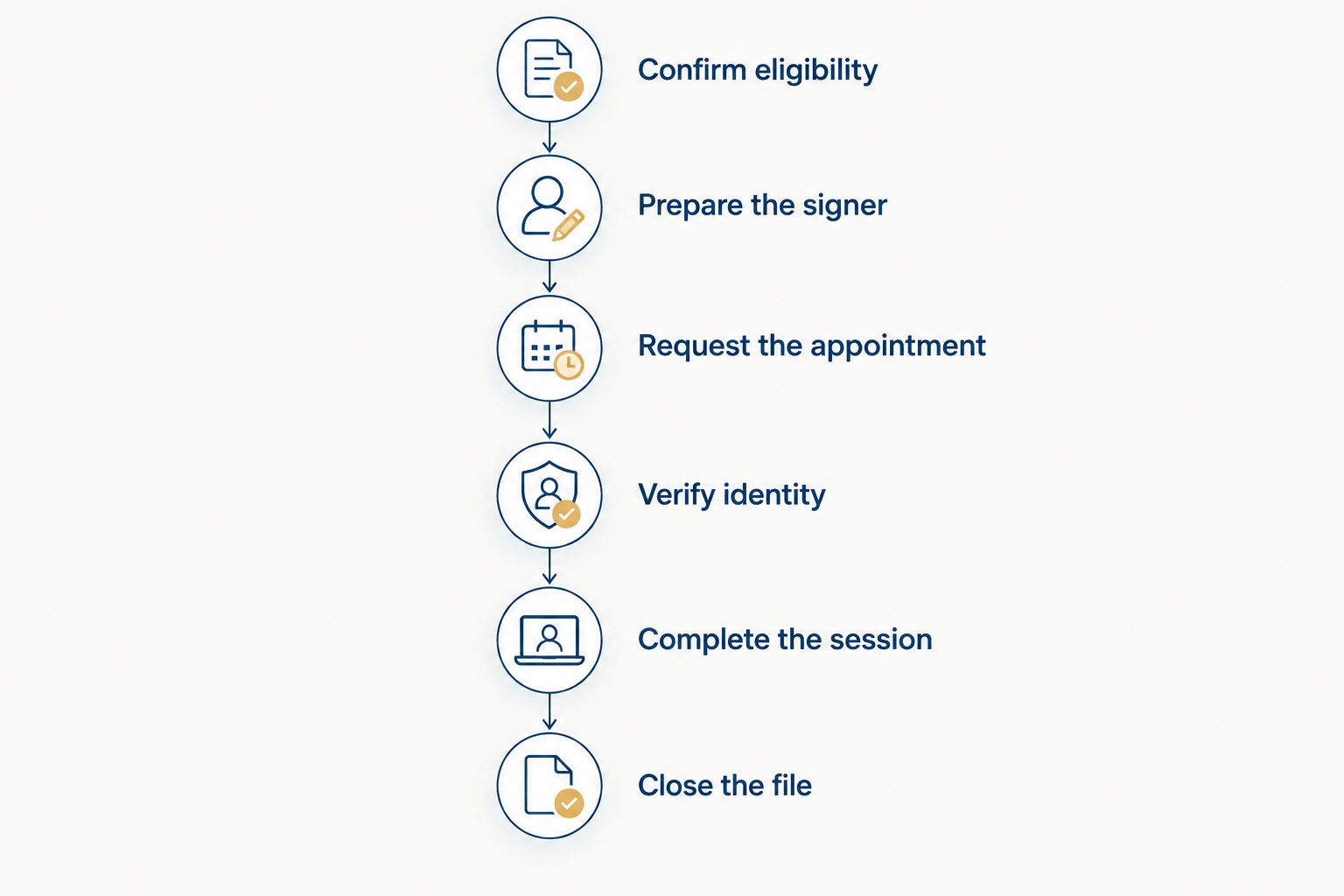
Confirm eligibility
Start manually: read the document instructions and ask the receiving organization what it requires. Do not assume that a business affidavit, authorization, or financial statement needs notarization simply because it concerns an important transaction.
Separate the requirement for notarization from the choice of appointment format. A recipient's acceptance of a document and a notary's ability to perform the requested act are different checks. Resolve both before directing a client into a remote session.
For your 2026 intake checklist, record who supplied the instructions and which document version they concern. A revised form deserves a fresh review rather than an automatic carryover of the previous instructions.
Stop scheduling when the required notarial act is unclear. Ask the document preparer or receiving organization for clarification; obtain legal advice when the question requires it.
- Read the complete document, including attachments and instructions.
- Identify the receiving organization and its stated requirements.
- Ask about acceptance of remote online notarization.
- Flag unclear notarial wording before the appointment.
- Keep substantive document decisions with the appropriate adviser.
Prepare the signer
Use a short email or telephone checklist before introducing any appointment system. Identify the actual signer, explain that identity verification is required, and ask whether the signer can participate directly in the proposed format.
The accounting firm's familiarity with a client is not a substitute for the notary's identity-verification process. Likewise, an employee coordinating the appointment does not automatically become the person authorized to sign.
For business documents, distinguish the person signing from the capacity in which that person intends to sign. Resolve questions about authority with the document preparer, recipient, or legal adviser—not by asking the notary to determine the firm's corporate arrangements.
Give the signer clear preparation instructions without promising a successful appointment. If identity verification or participation presents a difficulty, raise it before selecting the format.
- Confirm the signer's name and direct contact details.
- Identify any representative or business capacity involved.
- Ask about access to the equipment required for the remote session.
- Direct the signer to follow current identification instructions.
- Identify additional participants requested by the document instructions.
Request the appointment
A shared calendar and a standard request template are enough to organize your firm's side of the process. Assign one coordinator, gather the relevant instructions, and offer times that work for the signer rather than booking around an employee who will not sign.
For eligible documents, CraigVet Notary Services provides Maryland remote online notarization through Proof. This gives your firm a defined service route, but eligibility review and appointment confirmation remain necessary.
A submitted request is not a confirmed appointment. Wait until CraigVet contacts you before telling a client that the appointment is booked. Keep internal calendar entries marked as tentative until the details are confirmed.
If remote notarization is unsuitable, ask about an in-person mobile appointment. Baltimore County availability must be confirmed before booking; do not promise a visit on the provider's behalf.
- Name one firm contact for scheduling questions.
- Describe the document and intended recipient.
- Identify the signer and any coordination needs.
- Request the appropriate appointment format.
- Wait for provider contact and confirmation.
Verify identity
Before the session, ask the signer to review the current Proof and notary instructions. Do not build your firm's checklist around an assumed identification method or promise that a particular document will satisfy verification requirements.
Identity verification belongs to the notarization process. Your role is to help the signer arrive prepared, not to certify identity yourself or work around an unsuccessful check.
For your 2026 procedure, separate technical assistance from participation in verification. You can help a client locate instructions or check a connection without supplying answers, presenting yourself as the signer, or taking control of the client's identity checks.
If verification cannot be completed, pause and follow the notary's instructions. An alternative appointment format still requires its own eligibility and identity checks; it is not a way to bypass them.
- Review the current appointment instructions with the signer.
- Prepare the identification requested for that appointment.
- Check the camera, microphone, and connection beforehand.
- Let the signer complete verification personally.
- Raise verification difficulties directly with the notary.
Complete the session
Use a final readiness check before the appointment begins. Confirm that everyone is working from the intended document and that the signer understands which questions concern document content and which concern the notarial procedure.
Do not pre-complete signing steps based on assumptions. Follow the notary's instructions about signing and any required acknowledgment or oath. Questions about the legal effect of the document belong with an attorney, not with the appointment coordinator.
CraigVet Notary Services handles notarization, not legal advice. Craig is not an attorney and cannot provide legal advice, select a legal strategy, or resolve questions about the document's legal effect.
Keep client confidentiality in view when arranging the setting. Choose a space where the signer can participate clearly without exposing unrelated client files or allowing interruptions to direct the signing process.
- Confirm the correct document version.
- Keep unrelated client records out of view.
- Follow the notary's signing instructions.
- Direct content questions to the appropriate professional.
- Pause if the document changes or instructions conflict.
Close the file
After the appointment, check that your firm has the completed document it expected to receive. This is an administrative review, not a legal opinion about enforceability or an assurance that the recipient will accept the submission.
Follow the receiving organization's delivery instructions. Do not assume that the format used for the notarization determines the recipient's submission process, attachment requirements, or internal review.
For repeat business requests, retain a concise coordination record under your firm's approved policies. Record the document version, appointment status, delivery destination, and any unresolved follow-up. Avoid collecting extra identity materials merely because notarization occurred.
At your next 2026 workflow review, look for recurring coordination problems: unclear recipient instructions, missing participants, outdated forms, or appointments treated as confirmed too early. Fix the intake instruction responsible for the problem.
- Check receipt of the completed document.
- Confirm the intended recipient and submission method.
- Store files through your firm's approved process.
- Restrict access according to client confidentiality requirements.
- Assign responsibility for unresolved follow-up.
These six stages separate document decisions, signer preparation, and appointment execution. Use them as a handoff checklist so each person knows what must happen before the next stage begins.
Compare appointment options for accounting firms
Choose between two service routes based on document eligibility, recipient requirements, and signer readiness—not convenience alone. For a repeat-request workflow in 2026, remote online notarization is the first route to assess, while mobile service remains a secondary option requiring availability confirmation.
| Option | Best for | Practical advantage | Key limitation |
|---|---|---|---|
| Maryland remote online notarization through Proof | Accounting firms coordinating eligible documents with signers who can participate remotely | Removes the need for an in-person meeting for the notarial session | Requires eligibility review, identity verification, suitable technology, and confirmation of recipient requirements |
| In-person mobile notarization | Signers whose circumstances call for an in-person appointment | Allows the notarial meeting to take place in person | Baltimore County availability must be confirmed before booking; document and identity requirements still apply |
Neither format guarantees document acceptance. The receiving organization controls its own submission requirements, and the notary must determine whether the requested notarial act can proceed.
For CraigVet Notary Services, the useful distinction is clear: request Proof-based remote notarization for eligible documents first, then discuss mobile service when an in-person appointment is appropriate. Neither route replaces legal review or correct document preparation.
Request a notarization appointment
Ask about document eligibility and the appropriate format. Wait for contact before treating the appointment as confirmed.
Common mistakes accountants and CPAs make
Treating every financial document as a notary request
A document's financial importance does not establish a notarization requirement. Sending every authorization or statement for notarization creates an unnecessary handoff when the recipient has not requested it.
Check the instructions before requesting service. Ask the receiving organization to clarify unclear requirements instead of adding a notarial step as a precaution.
Substituting client familiarity for identity verification
Your firm might know the client well, but that relationship does not complete the notary's verification process. Preparing the client means explaining the requirement, not assuring the client that verification will be waived.
Keep the signer directly involved. Do not let an assistant or family member take over identity checks because they coordinate the client's other administrative tasks.
Reusing an old document packet without checking it
A previous appointment is a useful coordination reference, not blanket approval for the next document. Different versions, recipients, signers, and instructions need their own review.
For repeat notarizations in 2026, keep the workflow reusable but the eligibility decision document-specific. Confirm the current file before sending appointment instructions.
Asking the notary to resolve legal wording
Unclear wording is a reason to seek clarification, not an invitation for the notary to draft a solution. Craig is not an attorney and cannot provide legal advice.
Separate procedural questions from legal questions. Ask the notary how the appointment works; ask the appropriate legal adviser what the document should say or accomplish.
Promising a confirmed appointment too early
An internal calendar hold, client preference, or submitted request does not establish a confirmed appointment. This matters especially when coordinating several people's schedules or requesting a mobile visit.
Use explicit status labels: requested, awaiting contact, and confirmed. Tell the signer which status applies rather than allowing a tentative time to sound final.
FAQ
What's the best notarization option for a Maryland accounting firm?
Start by assessing Maryland remote online notarization through Proof for eligible documents. Confirm recipient requirements and signer readiness, then consider an in-person mobile appointment when appropriate.
Can all accounting and tax documents be notarized remotely?
No, remote online notarization is not appropriate for every document. Review the document instructions, confirm recipient requirements, and ask the notary about eligibility before scheduling.
Does notarization confirm that my client's tax information is correct?
No, notarization does not establish that tax information or accounting work is correct. Keep substantive review separate from the requested notarial act.
Can my staff complete identity verification for a client?
No, your staff should not complete the signer's identity verification on the signer's behalf. Staff can coordinate instructions and scheduling while the signer participates directly in verification.
Can an accountant coordinate repeat notarizations for business clients?
Yes, an accountant can coordinate appointment requests and document preparation steps for business clients. Each request still needs its own review of the document, signer, recipient requirements, and appointment details.
Is my appointment confirmed when I submit a request?
No, submitting a request does not confirm an appointment. Wait until CraigVet contacts you and confirms the arrangements before treating the appointment as booked.
Can I request a mobile notary appointment in Baltimore County?
You can ask about an in-person mobile appointment, but Baltimore County availability must be confirmed before booking. Document eligibility and identification requirements still need review.
Can Craig tell me which legal wording or notarial certificate to use?
Craig is not an attorney and cannot provide legal advice. Obtain clarification from the document preparer or receiving organization, and consult an attorney when the decision requires legal advice.
One last thing
The most useful repeat-client shortcut is a better intake checklist—not a skipped eligibility check. Save the questions, responsibilities, and confirmation process your firm uses, but review the actual document and recipient instructions every time.
Add one final checkpoint before releasing any appointment notice: has the provider confirmed it? That distinction keeps a routine coordination message from becoming a promise your firm cannot make.


