

Best overall: Maryland remote online notarization through Proof for eligible documents. Best for in-person signing without traveling: a mobile notary. Best for combining notarization with an existing trip: an office-based notary. In 2026, CraigVet Notary Services offers remote online notarization and mobile appointments; the right method depends on document eligibility, identity verification, and the receiving party’s requirements.
- The most convenient way to notarize documents in Maryland is remote online notarization when document and recipient requirements permit.
- CraigVet Notary Services offers Maryland remote online notarization through Proof; confirm eligibility before arranging a session.
- Choose a mobile notary when in-person signing matters; confirm Baltimore County availability before booking.
- Choose an office-based notary when an existing trip fits the appointment and document requirements.
Why this matters
Convenience means more than avoiding a drive. An appointment saves little effort if the receiving organization rejects the document format or required witnesses are missing.
For Maryland residents comparing methods in 2026, the first question is whether the document can follow the proposed process. The second is whether you can complete identity verification and any signing requirements. CraigVet Notary Services provides remote online notarization through Proof and in-person mobile appointments. An appointment request is not a confirmed appointment; wait for direct contact before relying on a time or location.
What makes the most convenient Maryland notary method?
Use these criteria before choosing a service:
- Document eligibility: Confirm that the document and requested notarial act fit the proposed method. Remote notarization is not suitable for every document.
- Recipient acceptance: Ask the receiving organization whether it accepts the completed document in the proposed format. Do not assume electronic and paper delivery are interchangeable.
- Travel burden: Remote sessions eliminate travel to the notary. Mobile appointments bring the notary to an agreed location; office visits require you to travel.
- Identity verification: Follow the selected service’s identification instructions. For remote appointments, confirm that you can complete the platform’s verification process.
- Signer coordination: Account for everyone who must participate, including any required witnesses. A convenient appointment for one person is not enough.
- Document return: Decide how you will receive and submit the completed document. Your workflow ends at acceptance, not simply at the notarial act.
Choose the method that satisfies the document requirements with the fewest unnecessary handoffs. Travel is a useful tiebreaker, not a substitute for eligibility.
How to arrange remote online notarization
Start with Maryland remote online notarization for eligible documents through Proof. Use this sequence for a 2026 appointment rather than uploading a document and assuming the entire process is settled.
Eligibility review
Identify the document, its receiving organization, and any instructions supplied with it. Ask the recipient whether remote online notarization and an electronic completed document meet its requirements.
Share relevant signing instructions when arranging service. Do not ask a notary to select legal wording, decide whether a document protects your interests, or determine which legal document you need. Craig is not an attorney and cannot provide legal advice.
Appointment request
Explain who will sign, the document type, and whether the recipient has specified witnesses or a particular process. Mention any deadline so it can be discussed before you make plans around the appointment.
Wait for direct confirmation and instructions. Submitting a request does not establish that the document is eligible, that a requested time is available, or that the appointment is confirmed.
Identity verification
Follow the Proof instructions provided for your session. Prepare the identification requested and check that you can use the required device, camera, microphone, and internet connection.
Keep identity documents within the instructed verification workflow. If verification cannot be completed, contact the notary for guidance on next steps rather than assuming the session can proceed without it.
Notarial act
Attend the session and follow the notary’s instructions about signing or acknowledging your signature. The steps depend on the notarial act required; do not treat every appointment as a request to sign a blank signature line.
Have the document ready in the requested format. If witnesses are required, resolve their participation before the appointment rather than expecting the notary to supply them automatically.
Document return
Follow the instructions for obtaining the completed document and delivering it to the receiving organization. Confirm whether the recipient needs electronic submission or a different delivery process.
For repeat business notarizations, retain the recipient’s instructions alongside the completed document. That gives the next requester a practical starting point without assuming that every future document has identical requirements.
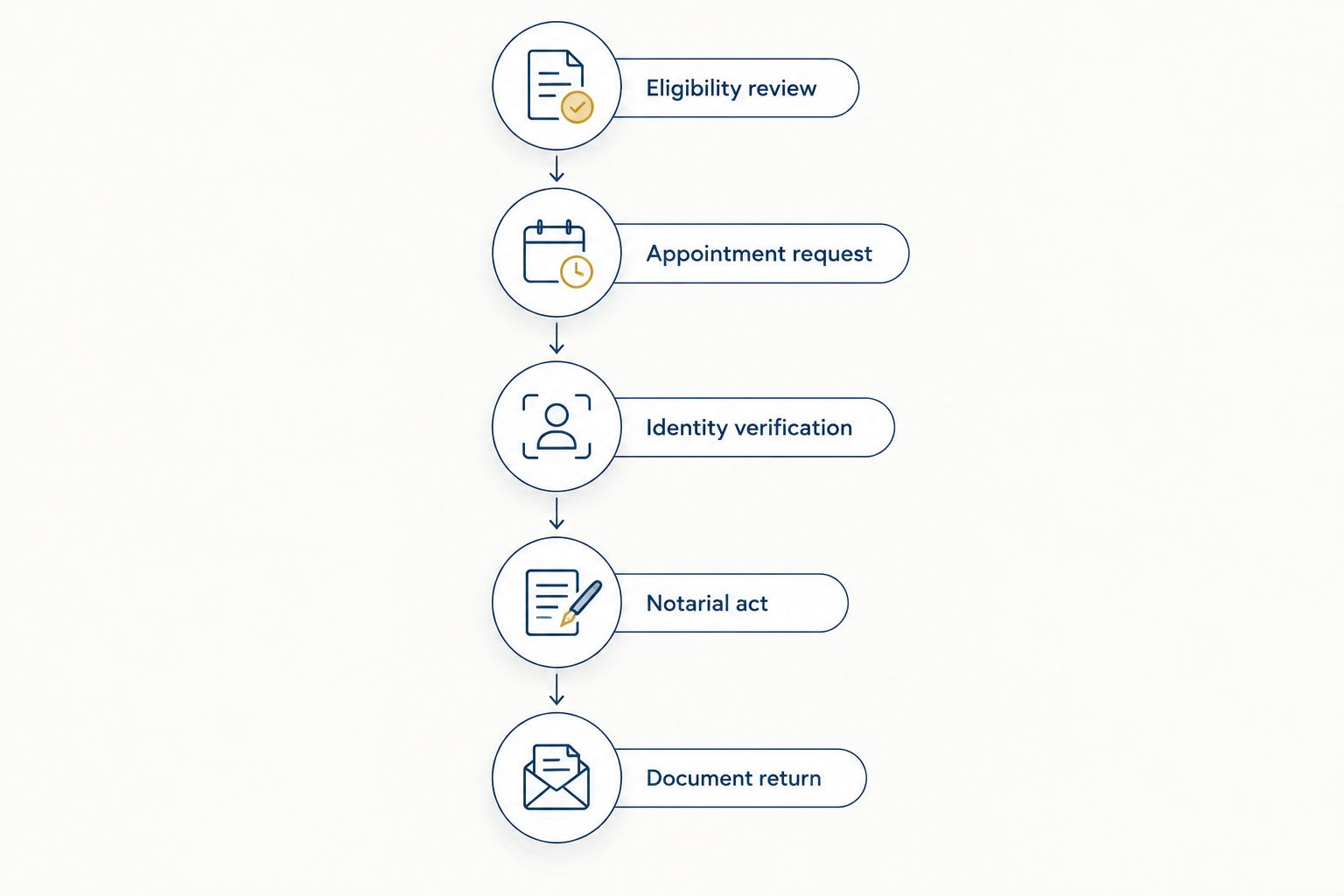
A repeatable process starts with document instructions, not a preferred appointment format. Resolve the requirements first, then choose the method that fits them.
Request notarization guidance
Discuss document eligibility and appointment instructions before choosing remote or mobile notarization.
Maryland notary methods at a glance
This 2026 ranking compares appointment methods, not individual providers’ performance. Each method has a distinct use case.
| Rank and method | Best for | Standout feature | Key limitation |
|---|---|---|---|
| 1. Remote online notarization | Eligible documents without travel | Online interaction with the notary through the designated platform | Requires suitable documents, recipient acceptance, and successful identity verification |
| 2. Mobile notary appointment | In-person signing at an agreed location | The notary travels to the appointment location | Requires location availability and coordination of physical participants |
| 3. Office-based notary | An existing trip that fits the service | Face-to-face signing at the provider’s premises | Requires travel and confirmation that the provider handles the document |
1. Remote online notarization: best for avoiding travel
CraigVet Notary Services offers Maryland remote online notarization through Proof. You participate through the platform instead of traveling to meet the notary, subject to document eligibility, identity verification, and Maryland notarial requirements.
CraigVet Notary Services remote online notarization is best for Maryland residents with eligible documents who want to avoid traveling to a notary. That recommendation does not extend to every document or every recipient.
Remote online notarization pros
- No trip to the notary: You do not need to build travel into the appointment.
- Electronic workflow: The appointment suits documents that can be handled and returned through the required electronic process.
- Useful for repeat requests: Businesses can use the same preparation checklist for recurring eligible documents.
- Clear preparation point: Platform instructions give you a defined verification and appointment process to follow.
Remote online notarization cons
- Eligibility limits remain: Online access does not make every document appropriate for remote notarization.
- Technology is necessary: Device, connection, or verification problems can prevent completion of the session.
- Recipient requirements still control: A convenient electronic appointment does not override the receiving organization’s instructions.
Best for: Individuals, families, and businesses whose documents and recipients permit the remote process.
For a business, identify a coordinator who can collect recipient instructions before each request. The signer still follows the required verification and notarial process; administrative preparation does not replace personal participation.
Verdict — Buy: Choose remote online notarization first when eligibility and recipient acceptance are confirmed. If either remains unresolved, settle that question before committing to the method.
2. Mobile notary: best for in-person signing without traveling
A mobile notary meets you at an agreed physical location. You keep the face-to-face appointment while shifting the travel to the notary.
This is the secondary service choice when remote notarization does not fit the document, technology, or recipient requirements. For Baltimore County appointments, confirm availability before booking and wait for direct appointment confirmation.
Mobile notary pros
- Less travel for the signer: You arrange a suitable meeting location instead of visiting an office.
- Physical document handling: An in-person appointment supports a paper-based signing process when that is required.
- Location coordination: Signers can plan around one agreed meeting place.
- No remote platform participation: The signer does not need to complete the appointment through an online video session.
Mobile notary cons
- Location availability matters: Do not assume every address or requested time can be accommodated.
- Participants must coordinate: Required signers and witnesses still need to be present as instructed.
- Paperwork requires preparation: Missing pages, identification, or document instructions are not solved by having the notary travel.
Best for: Maryland residents who need an in-person appointment and prefer an agreed location over an office visit.
Before requesting service, provide the proposed location and explain any access arrangements. Confirm who will be present and whether a quiet, suitable signing space is available. These details are particularly useful when a business is coordinating the appointment for someone else.
Verdict — Hold: Treat the mobile appointment as pending until Baltimore County availability, document requirements, and the appointment details are confirmed. Choose it when physical presence solves a requirement that remote service cannot.
3. Office-based notary: best for combining with an existing trip
An office-based notary handles the appointment at the provider’s premises. This method fits when you already plan to visit that location and the provider confirms it can handle your document.
Do not equate a business having a notary with unrestricted document service. Ask about appointments, identification, witnesses, and any limits before traveling.
Office-based notary pros
- Fits an existing errand: You can combine the appointment with a trip you already need to make.
- Face-to-face process: You meet the notary in person rather than using a remote platform.
- Paper document workflow: You can bring the physical document when the receiving organization requires that format.
Office-based notary cons
- Travel remains your responsibility: The appointment requires a trip to the provider’s location.
- Service scope needs confirmation: The provider must agree to handle the document and requested notarial act.
- Operating arrangements affect convenience: Appointment rules and access requirements need checking before departure.
Best for: Residents whose existing schedule already includes a suitable notary location.
Prepare the same information you would supply for a mobile appointment: document type, recipient instructions, signer details, and witness requirements. An office visit changes the meeting place, not the need for preparation.
If the trip exists only because you need notarization, compare remote eligibility and mobile availability first. Office-based service is the strongest convenience choice when it fits your route rather than creating a separate journey.
Verdict — Buy: Choose an office-based notary when the provider confirms the service and the visit fits an existing trip. Skip an unconfirmed walk-in that depends on assumptions about availability or document acceptance.
Practical guidance for repeat business notarizations
For recurring Maryland business requests in 2026, use a short intake checklist rather than assuming the previous appointment’s instructions still apply:
- Record the receiving organization and its current submission instructions.
- Identify the signer and any required witnesses.
- Confirm the document version and requested notarial act.
- Ask whether remote completion is accepted before selecting the method.
- Record appointment confirmation separately from the initial request.
- Assign responsibility for returning the completed document.
Keep legal questions separate from appointment coordination. A notary can explain the notarial process but cannot choose a legal instrument or advise whether its terms serve your business interests.
How these methods are ranked
The ranking prioritizes eligibility first, then travel, participant coordination, verification requirements, and document return. It is a practical decision framework, not a claim that one method completes every appointment faster.
Remote service ranks first because it removes travel when the document qualifies. Mobile service ranks second because it preserves in-person signing at an agreed location. Office-based service ranks third because its convenience depends on your trip and the provider’s confirmed service arrangements.
Which Maryland notary method should you choose?
Start with remote online notarization for eligible documents in 2026. Move to a mobile appointment when you need physical presence and an agreed location. Choose an office-based notary when a confirmed service fits a trip you already plan to make.
The most convenient way to notarize documents in Maryland is the method that completes the required process without an avoidable second appointment. Ask about eligibility and recipient acceptance before choosing by travel alone.
FAQ
What’s the most convenient way to notarize documents in Maryland?
Remote online notarization is the most convenient option when the document is eligible and the receiving organization accepts the completed format. It avoids travel, but the signer must still complete identity verification and the required notarial process.
Does CraigVet Notary Services offer online notarization?
CraigVet Notary Services offers Maryland remote online notarization through Proof for eligible documents. Request eligibility guidance and wait for appointment confirmation before relying on a requested time.
Can every Maryland document be notarized remotely?
No. Confirm the document’s eligibility, any witness requirements, and the receiving organization’s acceptance before arranging remote notarization.
Is a mobile notary better than an online notary?
A mobile notary is the better fit when an in-person appointment is required or the remote process does not fit your needs. Remote notarization is the stronger convenience choice when eligibility is confirmed and you want to avoid travel.
What do I need for an online notary appointment?
You need the eligible document, the identification requested for verification, and a setup that meets the platform’s appointment requirements. Follow the instructions for your session and resolve any witness requirements beforehand.
Can I book a mobile notary anywhere in Baltimore County?
Confirm Baltimore County availability for your proposed location before booking. An appointment request does not confirm service availability or a meeting time; wait for direct contact.
Can Craig tell me which legal document to use?
No. Craig is not an attorney and cannot provide legal advice. Ask an attorney about document selection or legal effect, and use the notary for the appropriate notarial process.
One last thing
Ask the receiving organization about the completed document before you choose the appointment method. This question catches a practical mismatch that travel comparisons miss: the signing process and the submission format must both work.
A notarization is not legal advice or a guarantee that a document accomplishes your intended legal result. Resolve legal questions with an attorney, then arrange the notarial act. That order keeps appointment preparation focused and avoids asking the notary to make decisions outside the service.


