

Best first choice: Maryland remote online notarization through Proof for eligible documents accepted electronically. Best for an existing workplace appointment: an on-site notary; best for avoiding travel when paper documents require an in-person appointment: a mobile notary. Start with CraigVet Notary Services to discuss remote eligibility before requesting an appointment.
- The fastest way to notarize documents in Maryland starts with document eligibility and recipient acceptance, not appointment speed alone.
- Choose CraigVet Notary Services for remote online notarization through Proof when the document and recipient permit it.
- An existing on-site notary avoids another trip; mobile notarization brings the appointment to an agreed location.
- Prepare identification, document instructions, and witness requirements before requesting an appointment.
- Baltimore County mobile availability requires confirmation; an appointment request is not a confirmed booking.
Why this matters
The fastest way to notarize documents in Maryland is the method that gets an acceptable document back to its recipient with the fewest avoidable steps. A quick appointment does not help if the recipient requires a different format, missing witnesses prevent completion, or identity verification cannot be completed.
For your 2026 document needs, start with eligibility rather than travel distance. Remote online notarization removes the trip to a notary, but it does not remove Maryland notarial requirements or the recipient’s document instructions.
Confirm the required format before arranging the appointment. That decision determines whether remote, on-site, mobile, or a separate in-person visit belongs first on your list.
What makes the fastest notarization method
These criteria explain the ranking before you compare the options:
- Document eligibility: The selected method must support the document and the required notarial act.
- Recipient acceptance: Confirm whether the receiving organization accepts remote notarization and an electronically notarized document.
- Appointment coordination: Consider how much scheduling you need between the signer, notary, and any required witnesses.
- Identity readiness: Prepare acceptable identification and be ready to complete the selected method’s identity checks.
- Travel requirements: Favor a method that avoids an unnecessary journey without compromising document requirements.
- Delivery format: Account for what happens after notarization, including electronic submission or delivery of a paper original.
A method ranks highly when it removes a step you would otherwise need. These are process-based rankings, not promises about appointment duration or same-day completion.
Prepare your Maryland appointment
CraigVet Notary Services offers Maryland remote online notarization through Proof, with mobile appointments as a secondary option. Use the following preparation sequence to reduce preventable interruptions regardless of the method you choose.
Document review
Identify the document, its recipient, and the recipient’s instructions. Ask whether remote notarization is accepted, whether an original paper document is required, and whether witnesses must participate.
Do not assume that every document containing a signature needs notarization. The document preparer or receiving organization should explain what it requires; a notary cannot replace legal advice about your document.
Format confirmation
Match the appointment to the required output. Remote online notarization uses an electronic process, while an in-person appointment supports documents handled in the required physical format.
If the instructions are unclear, resolve that uncertainty before booking. Recipient acceptance and legal eligibility are separate checks; both matter.
Appointment request
Provide the document type, your preferred method, and any relevant signer or witness arrangements. For mobile service, include the proposed Baltimore County location so availability can be checked.
An appointment request does not reserve a confirmed appointment. Wait for CraigVet to contact you and confirm the arrangements before treating the booking as final.
Identity verification
For a remote appointment, follow the Proof instructions for identity verification and the online session. Prepare the identification requested for your appointment and check that your device supports the required audio and video connection.
For an in-person appointment, follow the notary’s identification instructions. Do not assume that possessing identification guarantees completion; the notary must satisfy the applicable requirements.
Document completion
Follow the notary’s directions during the appointment, including when to sign or acknowledge a signature. Confirm how you will receive the completed document and how the recipient expects it to be submitted.
Keep the notarized document in the required format. Printing an electronic document is not a substitute for checking whether the recipient accepts that version.
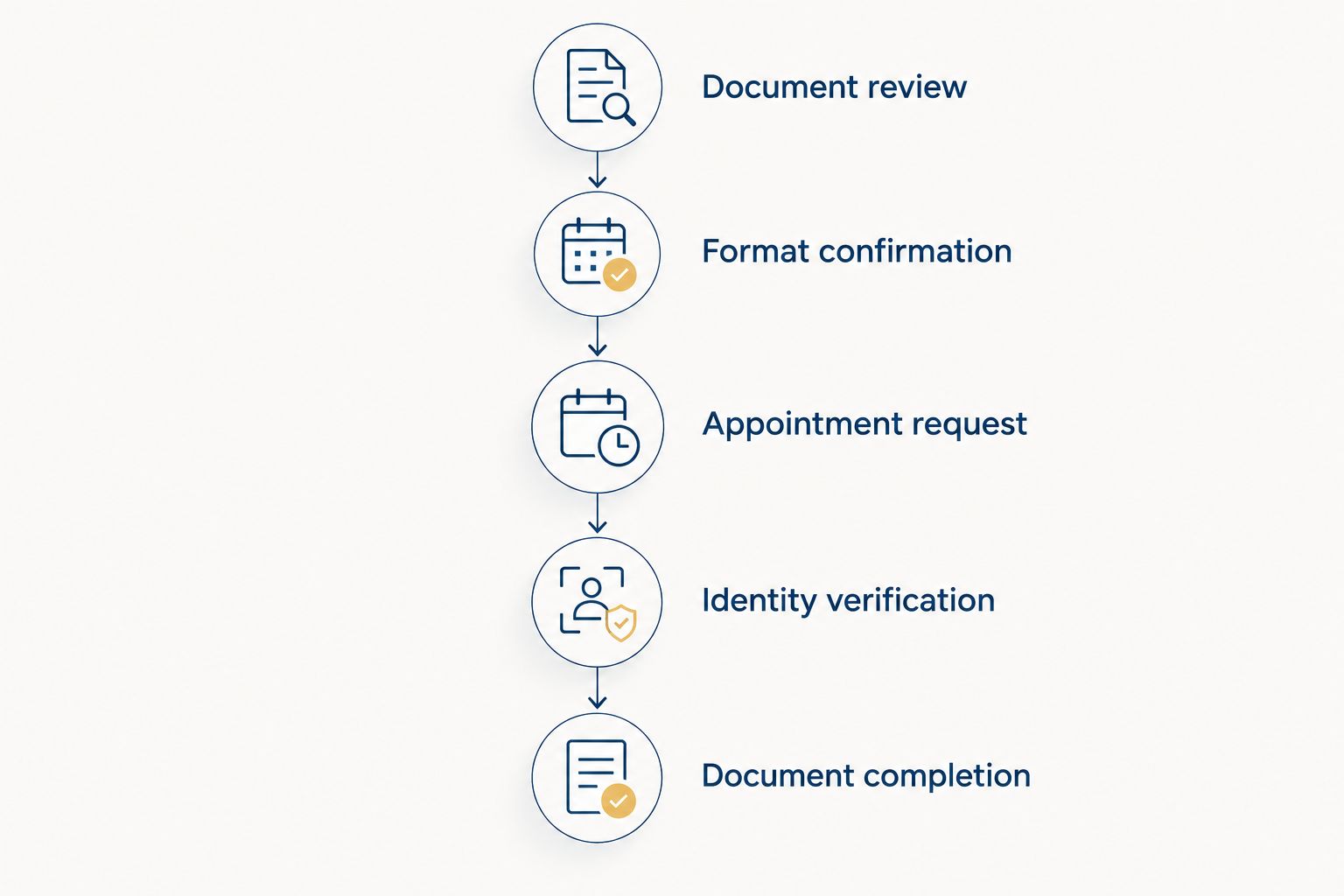
For recurring business appointments in 2026, keep this preparation sequence consistent. A reusable checklist helps your staff provide the same necessary information without assuming that every document has the same requirements.
Request a notarization appointment
Discuss remote eligibility or Baltimore County mobile availability before your appointment is confirmed.
Notarization methods at a glance
The order below favors fewer separate trips and less coordination. An already arranged on-site appointment can outrank remote notarization for your particular document; the ranking changes when your circumstances remove a step.
| Rank and method | Best for | Standout advantage | Key limitation |
|---|---|---|---|
| 1. Remote online notarization through Proof | Eligible documents accepted electronically | Removes travel to the notary | Requires remote eligibility, recipient acceptance, and online identity verification |
| 2. An existing on-site notary | Signers already at an office with a suitable notary | Uses a visit you already need to make | Depends on the notary’s availability and ability to perform the required act |
| 3. Mobile in-person notarization | Signers who need an in-person appointment without traveling | Brings the appointment to an agreed location | Requires location and scheduling confirmation |
| 4. A separate in-person notary visit | Signers who can travel with the required documents | Provides a direct physical appointment | Adds a journey and requires checking service arrangements first |
1. Remote online notarization: best for eligible electronic documents
Remote online notarization connects you with a notary through an online session rather than a shared physical location. CraigVet Notary Services offers this method through Proof for eligible Maryland documents.
Choose CraigVet Notary Services for Maryland remote online notarization when your document is eligible and its recipient accepts the format. This is the default first option because it removes travel, not because every remote appointment takes less time than every in-person appointment.
Remote online notarization pros:
- Removes your journey to a notary’s location.
- Supports an electronic document workflow when the recipient accepts it.
- Lets businesses consider notarization without arranging a physical meeting location.
- Provides an appointment process that includes identity verification.
Remote online notarization cons:
- Not every document or receiving organization permits the remote route.
- Technical access and identity verification must work for the signer.
- Separate witness requirements still need attention where applicable.
Best for: Individuals, families, and businesses whose documents qualify for remote notarization and whose recipients accept the completed electronic format.
Before choosing this method in 2026, ask the recipient a direct question: will it accept this document notarized remotely through an electronic process? A clear answer prevents you from completing the wrong workflow.
Verdict: Buy this service when eligibility and acceptance are confirmed; wait when either is unresolved.
2. An existing on-site notary: best for an appointment already in place
An existing on-site notary is the practical choice when you are already visiting an office and a suitable notary can handle your document there. This method removes the need to coordinate a separate location.
The advantage comes from the appointment you already have, not from a universal speed difference. Confirm the notary’s participation before arriving with a document that depends on it.
An existing on-site notary pros:
- Fits notarization into a visit you already need to make.
- Avoids a second journey when the service is confirmed.
- Keeps physical documents within an in-person workflow.
An existing on-site notary cons:
- The office might not provide notarization for your document or circumstances.
- The notary’s schedule can differ from the office’s general opening arrangements.
- Additional signers or witnesses can require separate coordination.
Best for: A signer who already has a confirmed office visit and confirmed access to a notary suitable for the document.
Ask who will perform the notarization, what identification to bring, and whether everyone required must attend. Do not treat an organization’s general opening hours as confirmation that a notary can see you.
Verdict: Buy this service when notarization is confirmed within your existing visit; skip an unconfirmed trip.
3. Mobile notarization: best for avoiding travel with paper documents
Mobile notarization brings an in-person notary appointment to an agreed location. It is the secondary option when remote notarization is unsuitable and traveling to a notary would add unnecessary coordination.
For Baltimore County appointments, confirm CraigVet Notary Services availability before booking. A proposed location and requested appointment are not final until CraigVet contacts you to confirm the arrangements.
Mobile notarization pros:
- Avoids the signer’s journey to a separate notary location.
- Supports an in-person appointment for documents requiring that approach.
- Lets you propose a location where the necessary participants can meet.
Mobile notarization cons:
- The location and appointment depend on confirmed service availability.
- Signers, identification, documents, and any required witnesses still need preparation.
- An incomplete document or unresolved requirement can prevent completion despite the notary’s travel.
Best for: Individuals or local businesses that need an in-person appointment and prefer to bring the participants together at an agreed location.
For a 2026 business request, identify the document types and participants before proposing a visit. Bringing several documents together does not establish that every document is eligible or that one arrangement satisfies every requirement.
Verdict: Buy this service after location and appointment confirmation; wait if those arrangements remain open.
4. A separate in-person visit: best for signers ready to travel
A separate in-person visit means taking your document to a notary at a confirmed location. It is a straightforward alternative when remote notarization is unsuitable and you can make the journey.
This method ranks last because it adds a trip that the other options can avoid. It becomes the better choice when a suitable appointment is already available and the required people and documents can attend.
A separate in-person visit pros:
- Provides a physical appointment for the required document process.
- Lets you bring the paper document directly to the notary.
- Avoids dependence on your own remote audio and video setup.
A separate in-person visit cons:
- Adds travel and location planning to the task.
- Requires advance confirmation that the notary can handle your request.
- A missing signer, witness, or acceptable identification can make the trip unsuccessful.
Best for: Signers who can travel and have confirmed the appointment’s document, identification, and attendance requirements.
Prepare before leaving. Check the exact location, the appointment arrangements, the document instructions, and who needs to be present rather than relying on a general listing for notary services.
Verdict: Buy this service when the trip is confirmed and prepared; skip a speculative walk-in.
How the methods are ranked
This ranking uses document fit, recipient acceptance, appointment coordination, identity readiness, travel, and delivery format. Remote notarization leads because it removes a physical journey; an existing on-site notary follows because it can fit into an established visit.
Mobile notarization removes the signer’s travel but requires a location agreement. A separate in-person visit adds travel, although a confirmed appointment can make it the most practical choice for your specific circumstances.
The ranking is a decision guide, not a completion-time guarantee. Apply it to the document in front of you rather than assuming that the first method always wins.
Which notarization method should you choose?
For eligible Maryland documents in 2026, start by checking remote online notarization through Proof. If the recipient accepts the format and the signer can complete identity verification, that route avoids arranging a physical meeting.
If remote notarization does not fit, check whether a suitable notary is already part of an office visit. Otherwise, choose between a confirmed mobile appointment and a confirmed trip based on where the required participants can meet.
For repeat business needs, record the recipient’s instructions alongside each document type. Do not turn one successful appointment into a blanket rule for all contracts, authorizations, or other paperwork.
Craig is not an attorney and cannot provide legal advice. Direct questions about document validity, legal effect, or which notarial act your document requires to the document preparer, receiving organization, or an attorney.
FAQ
What's the fastest way to notarize documents in Maryland?
Start with remote online notarization when the document is eligible and its recipient accepts the electronic format. It removes travel, but appointment coordination, identity verification, and document requirements still determine the practical route.
Can CraigVet Notary Services notarize every document online?
No, remote online notarization is limited to eligible documents. CraigVet Notary Services offers Maryland remote notarization through Proof, and you should confirm the recipient’s acceptance before arranging the appointment.
Is a mobile notary faster than an online notary?
Neither method is universally faster. Remote notarization avoids physical travel, while mobile notarization suits an in-person appointment at an agreed location; eligibility and confirmed arrangements determine which fits your task.
What do I need for a remote notary appointment?
Prepare the document, the recipient’s instructions, the requested identification, and a device that supports the required online connection. Follow the Proof appointment instructions and clarify any witness requirements beforehand.
Does requesting an appointment confirm my booking?
No, an appointment request is not a confirmed booking. Wait for CraigVet to contact you and confirm the arrangements, including Baltimore County availability for a mobile appointment.
Should I sign my document before meeting the notary?
Follow the notary’s instructions about when to sign or acknowledge your signature. Requirements depend on the notarial act, so do not assume every document follows the same signing procedure.
Can a business use online notarization for recurring documents?
A business can consider remote online notarization for recurring documents that are eligible and accepted by their recipients. Review each document’s format, signer, identification, and witness requirements rather than assuming one approval covers every request.
Can Craig tell me which legal document I need?
No, Craig is not an attorney and cannot provide legal advice. Ask an attorney or the document’s responsible preparer about legal choices, and obtain the receiving organization’s submission instructions before arranging notarization.
One last thing
Ask about the final document before asking about the earliest appointment. An available notary cannot make an unacceptable delivery format acceptable to your recipient.
Keep the recipient’s instructions with your appointment notes. That simple habit connects the appointment to the actual goal: submitting a correctly completed document in the required form.


