
Best overall for eligible remote appointments: Maryland remote online notarization through Proof. Best for a controlled meeting location: an office-based notary appointment. Best when travel is the obstacle: a mobile notary appointment. For secure notarization Maryland residents can request in 2026, CraigVet Notary Services offers remote appointments through Proof and in-person mobile service, with document eligibility and appointment details confirmed first.
- For secure notarization Maryland clients can arrange remotely, choose CraigVet Notary Services through Proof for eligible documents.
- Office-based appointments suit signers who want an established meeting location and an in-person identity check.
- Mobile appointments address travel barriers; confirm Baltimore County availability before booking.
- Document eligibility, identity verification, and recipient acceptance matter more than convenience alone.
Why this matters
A notarization method is not secure simply because it happens online or across a desk. Security depends on identifying the signer, completing the required notarial procedure, and using a method appropriate for the document.
For your 2026 appointment, start with the document and its receiving organization—not the nearest available appointment. A properly completed notarization does not guarantee that a recipient accepts the document's format or that its contents accomplish your legal purpose.
You can review CraigVet Notary Services before requesting an appointment. Submitting a request does not confirm an appointment; wait for direct contact before making arrangements around it.
What makes the best secure notarization method?
Use these criteria to assess the options before choosing a meeting format:
- Document eligibility: Confirm that the document and requested notarial act can use the proposed method.
- Identity verification: Understand what identification and verification steps the appointment requires.
- Controlled participation: Give the notary a clear opportunity to communicate with the signer without interference.
- Document handling: Keep the correct version ready and follow instructions for signing and returning it.
- Recipient requirements: Ask whether the receiving organization accepts remote notarization, electronic documents, or paper originals.
- Practical access: Choose a setting where the signer can participate, communicate, and complete the required steps.
This ranking prioritizes different appointment needs. It does not claim that remote, office-based, or mobile notarization has a measured lower fraud rate than the others.
Notarization methods at a glance
These 3 methods serve different needs. Remote online notarization leads for eligible documents when you want to avoid travel; the in-person alternatives address location and participation requirements.
| Rank and method | Best for | Standout security feature | Key limitation |
|---|---|---|---|
| 1. Remote online notarization through Proof | Eligible documents with remote participation | Identity verification and live audiovisual interaction within the remote process | Requires document eligibility and successful completion of the remote process |
| 2. Office-based in-person notarization | Signers who want an established meeting location | Face-to-face interaction at a designated appointment site | Requires travel and confirmation that the provider handles the requested act |
| 3. Mobile in-person notarization | Signers who need the notary to travel | Face-to-face interaction at an agreed location | Location, privacy, and service availability need advance coordination |
1. Remote online notarization: best for eligible remote documents
Remote online notarization lets you appear before a notary through live audiovisual communication rather than traveling to the same room. CraigVet Notary Services provides Maryland remote online notarization through Proof for eligible documents.
Best for: Individuals, families, and businesses that need remote participation and can complete the required identity and document checks.
For a business arranging repeat notarizations in 2026, the main advantage is procedural consistency: staff can prepare the document, identify the signer, and confirm recipient instructions before requesting each appointment. Repeat use does not remove verification requirements or make every document eligible.
Remote online notarization pros:
- Removes travel from an eligible appointment.
- Supports live communication between the signer and notary.
- Uses a defined remote identity-verification process.
- Allows businesses to organize preparation around electronic documents.
Remote online notarization cons:
- Depends on suitable technology and the signer's ability to complete verification.
- Does not fit every document or recipient requirement.
- Requires a private setting despite taking place remotely.
Do not treat an uploaded document as an approved document. Ask about eligibility, witnesses, and signing instructions before the session, and keep sensitive files out of unrelated email threads.
Verdict: Choose remote online notarization first for eligible documents when remote participation fits both the signer and the recipient.
2. Office-based notarization: best for a designated meeting site
An office-based appointment brings the signer and notary together at an established location. This is a general alternative to remote or mobile service, not a statement that CraigVet offers office appointments.
Best for: Signers who want face-to-face communication at a designated meeting site and can travel there.
The security benefit is the opportunity for direct interaction in a planned setting. The location alone does not establish the quality of the notarization: the notary must still identify the signer and complete the appropriate procedure.
Office-based notarization pros:
- Provides face-to-face communication without a video connection.
- Gives the signer a designated destination for the appointment.
- Supports physical document handling when paper is required.
Office-based notarization cons:
- Requires the signer to travel.
- Does not guarantee privacy unless suitable space is arranged.
- Requires advance confirmation of document handling and witness arrangements.
Before traveling, confirm that the provider handles your requested notarial act. Ask what to bring and whether the signer should leave signatures incomplete until instructed; an acknowledgment and an oath-based act do not necessarily follow identical signing procedures.
Verdict: Choose an office-based appointment when a designated meeting location and direct communication fit your needs better than remote participation.
3. Mobile notarization: best when the signer cannot travel
A mobile notary travels to an agreed location for an in-person appointment. The change is where the meeting happens—not a waiver of identity verification or Maryland notarial requirements.
Best for: Individuals, families, and businesses that need an in-person meeting without requiring the signer to travel to a provider's location.
CraigVet Notary Services offers mobile appointments as a secondary service. Confirm Baltimore County availability before booking, and wait for direct contact to confirm the appointment.
Mobile notarization pros:
- Brings face-to-face service to an agreed location.
- Addresses travel and accessibility obstacles.
- Allows document preparation at the planned meeting site.
Mobile notarization cons:
- Requires coordination of location and access details.
- Needs a suitable space without unnecessary interruptions.
- Depends on confirmed service availability.
For a workplace visit, select a quiet meeting area rather than a busy reception desk. For a family appointment, let the signer communicate directly with the notary; another person's convenience should not control the signer's participation.
A mobile appointment in 2026 still requires advance document preparation. Travel arrangements cannot solve an incomplete document, an unresolved identification issue, or an unavailable required witness.
Verdict: Choose mobile notarization when travel is the barrier and an appropriate in-person meeting can be arranged.
How to prepare for a remote appointment
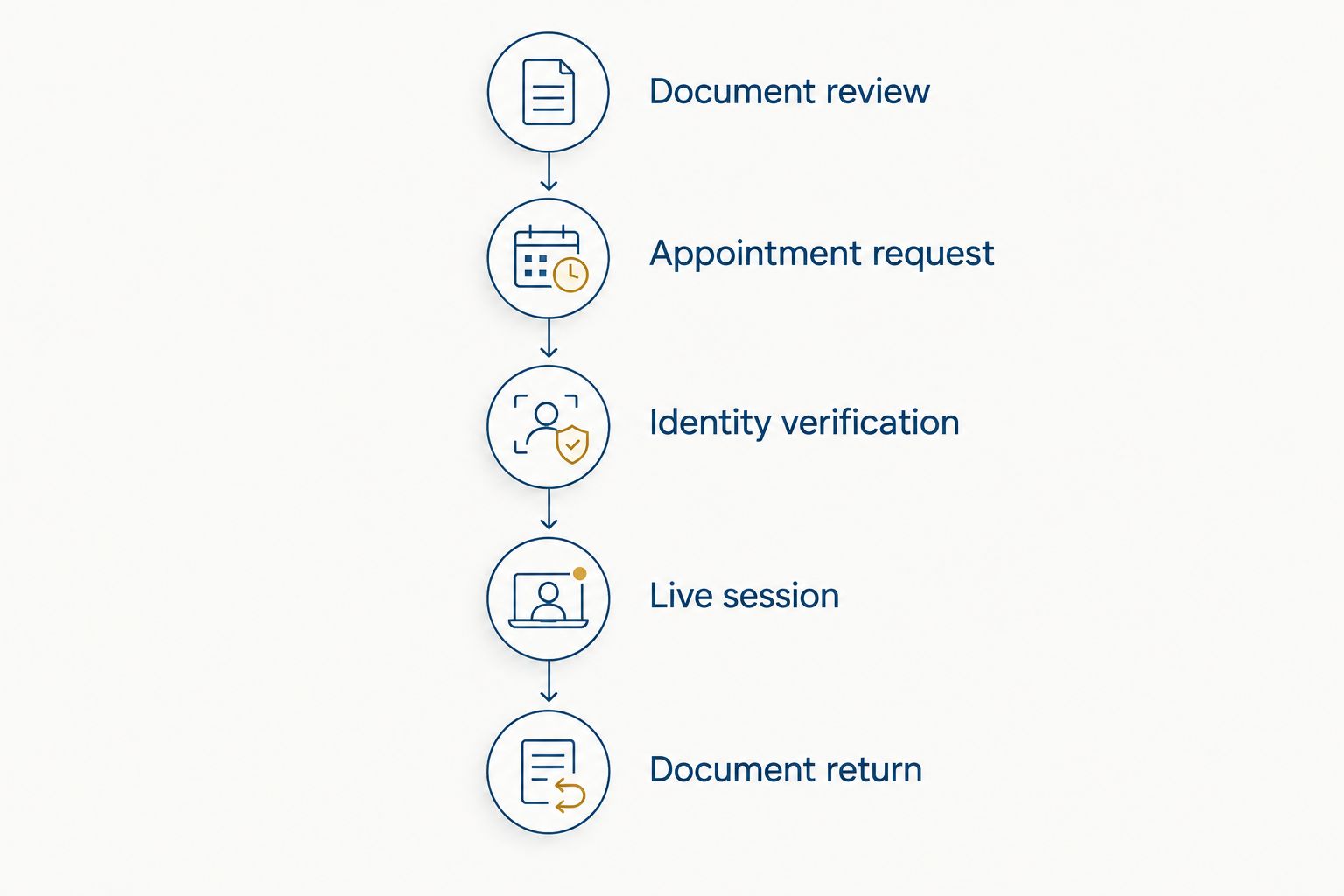
Use this 5-step sequence to organize an eligible remote notarization. It is a preparation checklist, not a guarantee that a document qualifies or an appointment will proceed.
Document review
Identify the document, the receiving organization, and the requested notarial act. Ask the recipient about electronic acceptance, paper-original requirements, and witnesses before requesting the appointment.
Do not ask the notary to select legal language or determine which document protects your interests. Those questions belong with the document issuer or an attorney.
Appointment request
Provide the information requested for eligibility and scheduling. Tell the provider about multiple signers, witness instructions, or participation needs rather than introducing them during the session.
For a 2026 business workflow, assign a staff contact to coordinate these details. That person organizes the appointment but does not replace the signer's participation.
Identity verification
Have your identification ready and follow the instructions provided for Proof. Do not assume that sending a photograph of identification by email completes the verification process.
Use the instructed process for sensitive information. If verification cannot be completed, the appointment cannot simply bypass it.
Live session
Join from a quiet, private location with working audiovisual equipment and the correct document ready. Follow the notary's instructions about signing, acknowledgments, or oaths as applicable.
Pause if the file is wrong or the document needs substantive changes. Completing the wrong version creates a separate problem that notarization does not resolve.
Document return
Follow the delivery instructions supplied for the completed document. Check that you have the intended file before sending it to the recipient.
Store the completed document according to your personal or business requirements. Keep access limited to people who need it.
Practical security checks before you commit
Separate document acceptance from signer readiness. These 2 checks answer different questions, and completing one does not settle the other.
Document acceptance: Ask the receiving organization which format it accepts and what instructions apply. If it supplies a notarial certificate or witness instructions, share those details before the appointment rather than interpreting them yourself.
Signer readiness: Confirm that the signer can participate directly, complete identity verification, and communicate with the notary. For remote appointments, check the connection and audiovisual equipment; for in-person appointments, arrange an appropriate meeting space.
For any method, avoid sending unnecessary personal information during scheduling. Ask which materials are needed and how to provide them through the instructed process.
Request a Maryland notary appointment
Ask about remote document eligibility or confirm Baltimore County mobile availability before making plans.
What businesses should standardize for repeat notarizations
Repeat notarizations need a repeatable preparation process—not an assumption that the last appointment settles the next one. Build a short internal checklist around document ownership, signer coordination, and recipient instructions.
- Name the coordinator: Give the notary a clear scheduling contact.
- Identify the document owner: Direct substantive document questions to the issuer or appropriate adviser.
- Confirm participants: Establish which signers and witnesses need to attend.
- Control versions: Separate drafts from the document intended for execution.
- Plan delivery: Decide who sends the completed document to its recipient.
Keep the notary's role separate from business approval. A notarization does not establish that a transaction is commercially sound, that a contract is enforceable, or that someone has received legal advice.
For repeat appointments in 2026, reuse the preparation checklist—not assumptions about eligibility. A different document, recipient, or signer can change what the next appointment requires.
How these methods were ranked
Remote online notarization ranks first for eligible remote participation, office-based notarization for a designated meeting site, and mobile notarization for overcoming travel barriers. The order reflects those use cases, not comparative fraud statistics or a product test.
The deciding criteria are document eligibility, identity verification, controlled participation, document handling, recipient requirements, and access. A method that fails your document or participation requirements is not the right choice, regardless of its rank.
Which notarization method should you choose?
CraigVet Notary Services is best for Maryland individuals and businesses seeking remote online notarization through Proof for eligible documents. Start there when the signer can complete the remote process and the receiving organization accepts the resulting format.
Choose an in-person alternative when the document, recipient, or participation requirements call for it. Use an office-based appointment for a designated meeting site, or request mobile service when travel is the obstacle.
Craig is not an attorney and cannot provide legal advice. Questions about a document's legal effect, the correct legal form, or the appropriate notarial act should be resolved with the document issuer or an attorney before the appointment.
FAQ
What's the most secure notarization method in Maryland?
The right method is one that meets Maryland notarial requirements and fits the document, signer, and recipient. Remote online notarization suits eligible remote appointments; in-person service addresses needs that require physical attendance.
Can every Maryland document be notarized online?
No, not every document is suitable for remote online notarization. Confirm document eligibility, the requested act, and recipient requirements before arranging a session.
Is remote online notarization just a video call?
No, remote online notarization requires more than an ordinary video call. The process includes identity verification, live audiovisual participation, and the applicable notarial procedures.
What should I prepare for a Proof appointment?
Prepare the intended document, identification, recipient instructions, and suitable audiovisual equipment. Follow the appointment instructions for verification and signing rather than assuming that emailing identification is sufficient.
Does submitting a request confirm my appointment?
No, submitting a request does not confirm an appointment. Wait for direct contact to establish eligibility, scheduling, and any preparation requirements.
Can I request a mobile notary in Baltimore County?
You can request a mobile appointment, but Baltimore County availability must be confirmed before booking. Provide the meeting location and document details so the arrangements can be discussed.
Can Craig tell me which legal document I need?
No, Craig is not an attorney and cannot provide legal advice. Ask the document issuer or an attorney to resolve questions about legal forms, legal consequences, or the appropriate notarial act.
One last thing
The most useful preparation step happens before identity verification: confirm what the receiving organization will accept. An appointment cannot resolve an unanswered requirement for a paper original, a witness, or a different document format.
For your 2026 appointment, write those instructions down and share them during scheduling. Clear preparation gives the notary and signer a defined task without asking either to guess about the recipient's requirements.


