

Yes—remote online notarization is a safe option for eligible legal documents when identity verification, a properly authorized notary, and the required electronic process are in place. Security does not establish that your document qualifies for remote execution or that its recipient will accept it; confirm both before your 2026 appointment.
- Is it safe to use remote online notarization for legal documents? Yes, with identity verification, document eligibility, and recipient acceptance.
- CraigVet Notary Services offers Maryland remote online notarization through Proof for eligible documents.
- Notarization does not confirm that a document is legally sufficient or that its terms protect you.
- A submitted appointment request is not confirmed until CraigVet contacts you.
Why this matters
A notarized signature and a legally effective document are different things. You need the right notarial procedure, but you also need any separate signing, witnessing, filing, and acceptance requirements satisfied.
CraigVet Notary Services is a fit for Maryland individuals and businesses seeking remote online notarization for eligible documents through Proof. Mobile appointments are a secondary option, with Baltimore County availability confirmed before booking.
For your 2026 paperwork, start with eligibility rather than convenience. A secure online session cannot correct an unsuitable document or replace advice about its legal consequences.
Is it safe to use remote online notarization for legal documents?
Yes, provided the document and appointment satisfy the applicable requirements. Remote online notarization uses an electronic document and live audiovisual communication rather than placing the signer and notary in the same room. Identity verification remains central to the process.
Safety has separate parts: confirming who is signing, protecting access to the transaction, completing the required notarial act, and delivering a document the recipient accepts. Do not treat success at one part as proof of the others.
| Appointment option | Best for | What supports a sound appointment | Limitation to resolve |
|---|---|---|---|
| Maryland remote online notarization through Proof | Eligible documents and signers prepared for an online session | Identity verification, live communication, and the applicable electronic notarial process | Document eligibility, recipient acceptance, and technology access must be checked |
| In-person mobile notarization | Documents or circumstances requiring an in-person appointment | Direct interaction with the notary and an agreed appointment location | Baltimore County availability must be confirmed before booking; other execution requirements still apply |
Neither format makes the underlying agreement fair, accurate, or enforceable. The notary performs the requested notarial act; an attorney addresses legal meaning and sufficiency.
How do you prepare for a Maryland remote appointment?
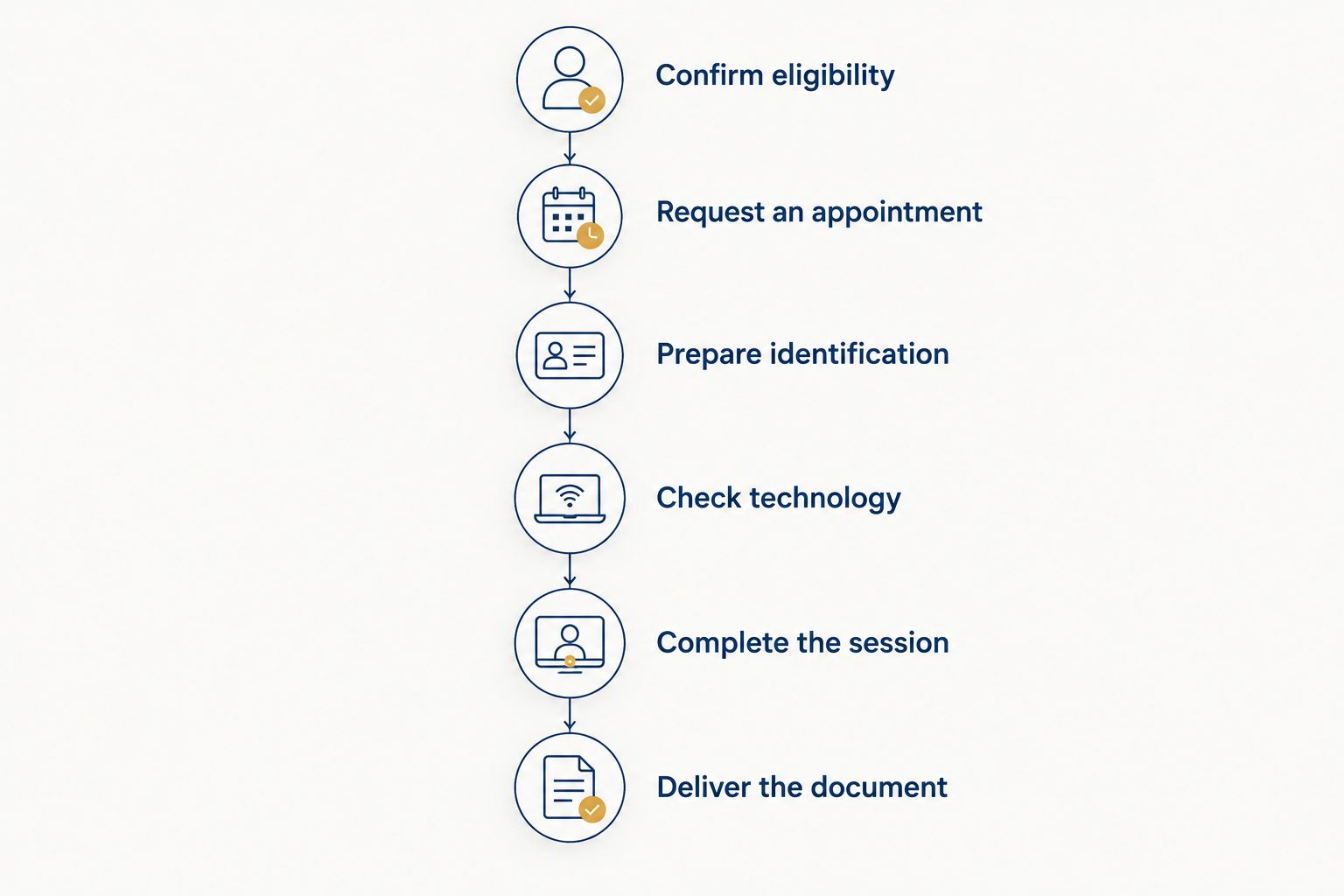
Use this sequence before signing. It separates document questions from identity checks and keeps an appointment request from being mistaken for a confirmed booking.
- Confirm eligibility. Identify the document, the requested notarial act, and the organization receiving it. Ask whether remote online notarization is acceptable and whether separate witnesses or original documents are required.
- Request an appointment. Explain what needs notarizing and who must participate. Wait for CraigVet to contact you; submitting a request does not confirm an appointment.
- Prepare identification. Follow the identity-verification instructions provided for your Proof session. Do not assume that possessing identification automatically means you will complete every verification step.
- Check technology. Prepare a device that supports the required live session, with a working camera, microphone, and connection. Choose a private setting where you can hear instructions and review the document.
- Complete the session. Follow the notary's directions about signing and any required acknowledgment or oath. Do not sign in advance unless instructed to do so for your document and notarial act.
- Deliver the document. Follow the recipient's submission instructions. Keep the completed electronic file intact rather than assuming a printed or altered copy serves the same purpose.
The order matters. Finding out about a recipient's paper-original requirement after the online session creates a problem that identity verification cannot solve.
For a 2026 appointment involving several participants, establish who signs which document before requesting a session. Ask about witnesses separately; a witness and a notary do not perform interchangeable roles.
What makes a remote notarization secure?
Remote notarization depends on controls working together, not on a single security label. Evaluate the process you are actually being asked to complete.
Identity verification
Follow the session's identity-verification instructions through the designated process. The notary must establish the signer's identity under the applicable Maryland requirements; a familiar name in an email is not a substitute.
If verification cannot be completed, ask what happens next. Do not ask another person to complete identity checks for you or use someone else's account to bypass a difficulty.
Live participation
A remote online notarization is not simply emailing a signed file to someone who adds a seal. The live session allows the notary to interact with the signer and carry out the applicable notarial procedure.
Make sure you can communicate clearly and review what you are signing. Stop if a page is unfamiliar, the instructions are unclear, or someone is pressuring you to proceed.
Controlled document handling
Use the transaction instructions provided for your appointment. Avoid circulating identification or sensitive documents through unrelated message threads when the designated process provides a submission method.
After completion, retain the electronic document as delivered. Editing the completed file can affect electronic signatures and the recipient's ability to verify it.
Clear limits
A notarial certificate records a notarial act; it is not an attorney's opinion about your document. It does not establish that every statement in the document is true.
Craig is not an attorney and cannot provide legal advice. Questions about legal rights, document drafting, or whether a particular form accomplishes your objective belong with an attorney.
Why does remote notarization suitability vary?
The useful question is not whether online notarization is always safe. It is whether this document, this signer, and this recipient fit the permitted process.
- Document requirements: Particular documents can carry execution rules beyond notarization. Identify those requirements before choosing an appointment format.
- Requested notarial act: An acknowledgment and an oath involve different procedures. Obtain instructions from the document's issuer or appropriate legal adviser if the required act is unclear.
- Recipient acceptance: A receiving business, agency, court, or recording office can have submission requirements. Confirm the permitted format directly with that recipient.
- Signer circumstances: Identification, ability to participate, and the signer's location can affect whether the appointment can proceed under the applicable rules.
- Witness requirements: Determine whether witnesses are necessary and how they must participate. Do not assume the notary supplies witnesses or replaces them.
- Technical readiness: Camera, microphone, connectivity, and access to the electronic document affect your ability to complete the session properly.
For 2026 requests, verify current instructions rather than relying on a previous transaction. A document accepted by one recipient does not establish acceptance by another.
How should businesses handle repeat notarizations?
Standardize preparation, not assumptions about eligibility. Businesses needing repeat notarizations benefit from a consistent intake process, but each document and signer still needs appropriate review.
Create a short internal checklist covering the document's recipient, requested notarial act, signers, witnesses, and delivery format. Assign responsibility for obtaining recipient instructions before staff request an appointment.
Keep these 3 checks separate:
- Acceptance check: Does the receiving organization accept this document through remote online notarization?
- Participation check: Can every required participant complete the instructed process?
- Completion check: Has the finished document been delivered in the required format?
A previous successful appointment does not settle those questions for a new employee, transaction, or recipient. Avoid copying old signing instructions into a new matter without checking them.
CraigVet Notary Services offers Maryland remote online notarization through Proof for eligible business documents. For repeat requests, describe the recurring need, but wait for contact before treating any requested appointment as confirmed.
Limit internal access to identification and completed paperwork according to your organization's document-handling procedures. Convenience is not a reason to distribute sensitive files to employees who do not need them.
Does another state's document change the answer?
A Maryland notarial appointment and a document governed by another state's law raise different questions. The notary's authority, the document's execution requirements, and the receiving organization's acceptance instructions must each be addressed.
For example, Nevada living trust notarization requirements concern a particular document type and jurisdiction; they do not establish that the same execution process applies to a Maryland document or that remote notarization is appropriate for your trust.
If your paperwork involves a trust, estate plan, property transaction, or another jurisdiction, obtain document-specific instructions from the appropriate attorney or recipient. Do not infer remote eligibility from the document's title alone.
Ask 2 questions before choosing the appointment format: What execution requirements apply to this document, and what completed format will the recipient accept? The answers establish what must be checked next; they do not replace legal advice.
When is an in-person mobile appointment the better choice?
An in-person appointment is the better fit when the document requires physical execution or the signer cannot complete the remote process. It also removes the need for the signer to participate through an online audiovisual session.
The trade-off is coordination of a physical location and appointment time. An in-person visit does not remove identification requirements, witness requirements, or restrictions on legal advice.
For Baltimore County mobile requests, confirm availability before booking. Describe the document and any access or participant needs when making the request, and do not treat the appointment as confirmed before CraigVet contacts you.
Keep remote online notarization as the first consideration for eligible documents, not as a promise that every request belongs online. The appropriate format follows the document's requirements and the signer's ability to participate.
What should you check before sharing identification?
Confirm that the appointment communication relates to your actual request before following instructions or sending sensitive information. If a message is unexpected or conflicts with earlier directions, pause and verify it through your established contact with the service.
Watch for requests that move identity checks to an unrelated account or ask another person to impersonate the signer. Those requests conflict with the purpose of identity verification.
During your 2026 appointment preparation, keep your document, identification, and recipient instructions organized but separate from unrelated paperwork. Review the file you are about to sign, not just its filename.
If the document shown in the session is not the document you intended to sign, stop. Resolving a mismatch before signing is more useful than trying to explain it after delivery.
FAQ
Is remote online notarization legally valid in Maryland?
Maryland permits remote online notarization when the applicable legal requirements are satisfied. A particular document can still have separate execution and acceptance requirements, so confirm its eligibility before the appointment.
Can every legal document be notarized online?
No, you should not assume every legal document qualifies for remote online notarization. Confirm the document's requirements, any necessary witnesses, and the recipient's acceptance instructions before choosing the format.
Is using Proof enough to guarantee my document will be accepted?
No, using Proof does not guarantee recipient acceptance or establish that your document is legally sufficient. Confirm the receiving organization's instructions before completing the notarization.
Do I need identification for an online notary appointment?
Yes, identity verification is part of the remote online notarization process. Follow the instructions provided for your session and ask about any identification difficulty before the appointment.
Can I sign the document before the video appointment?
Follow the notary's instructions about when to sign. The appropriate procedure depends on the document and notarial act, so do not assume signing beforehand is acceptable.
Can Craig tell me whether my legal document protects me?
No, Craig is not an attorney and cannot provide legal advice. Ask an attorney about legal protections, document drafting, and whether the document accomplishes your intended purpose.
Is my appointment confirmed when I submit a request?
No, submitting a request does not confirm an appointment. Wait for CraigVet to contact you, and confirm Baltimore County availability before booking a mobile appointment.
One last thing
The most useful preparation happens before identity verification: ask the recipient how it wants the completed document delivered. An otherwise properly completed session can leave you with the wrong submission format if you skip that question.
For your 2026 request, bring the document's instructions as well as the document itself. Choose the appointment format only after you know what the recipient requires.


