

A mobile notary is worth the extra cost in 2026 when having the notary come to you solves a real barrier, such as difficulty traveling or gathering signers at another location. For eligible documents, Maryland remote online notarization through Proof deserves consideration first because it removes the need for an in-person visit. Before choosing either method, confirm document eligibility, the recipient’s requirements, and what the appointment includes.
- Is a mobile notary worth the extra cost in 2026? Yes, when an in-person visit solves a practical barrier.
- Proof supports Maryland remote online notarization for eligible documents; confirm suitability before arranging an appointment.
- Craigvetnotary offers remote online and mobile notary services; Baltimore County mobile availability requires confirmation.
- An appointment request is not a confirmed booking. Wait for CraigVet to contact you.
Why this matters
Your decision is not simply whether convenience deserves an additional expense. It is whether you need an in-person appointment at all, and whether your chosen method meets the document recipient’s requirements.
Craigvetnotary is best for Maryland clients seeking eligible remote online notarization through Proof or an individually confirmed mobile appointment. Start with the document and its intended recipient, then choose the appointment format. That order keeps convenience from taking priority over suitability.
The right appointment is the one that fits both your document and your ability to complete the required process. A visit to your location is useful only if it resolves a problem that a suitable remote appointment does not.
Is a mobile notary worth the extra cost in 2026?
Yes, when you need an in-person notarization and traveling creates a meaningful obstacle. If your document is eligible for Maryland remote online notarization and the recipient accepts that format, an online appointment through Proof is another way to avoid travel.
Compare the practical differences before requesting an appointment:
| Appointment method | Best for | Main advantage | Main limitation | Confirm before proceeding |
|---|---|---|---|---|
| Maryland remote online notarization through Proof | Clients with eligible documents who can complete the online process | No in-person meeting with the notary | Document eligibility, recipient requirements, and identity verification still apply | Whether the document and signer can use the remote process |
| Mobile notary appointment | Clients who need an in-person meeting at an agreed location | The notary travels to the appointment location | Travel and location coordination are necessary | Baltimore County availability, location, appointment details, and the full charge |
Neither method is automatically better. Remote notarization removes the physical meeting, but it does not remove eligibility or identity requirements. Mobile service changes where you meet the notary, but it does not change what the notary is authorized to do.
For your 2026 decision, compare the complete arrangements rather than the service names. Ask whether the quoted total covers the requested appointment and whether anything about your document, location, or participants needs clarification.
Start with Maryland remote online notarization
For eligible documents, Maryland remote online notarization through Proof gives you a way to complete the notarial appointment without meeting the notary in person. It is the first option to discuss when avoiding travel is your main goal.
Best for: individuals, families, and businesses whose documents and circumstances fit the remote process. The advantage is straightforward: you do not need to coordinate a physical meeting location. The limitation is equally important: not every document or signing situation belongs in a remote appointment.
Do not assume that a document is eligible just because it can be scanned or uploaded. Tell the notary what the document is, who will sign it, and where it will be submitted. Ask the recipient whether it has instructions about remote notarization or document delivery.
You should also be ready to discuss identity verification. An online appointment still requires the signer to complete the applicable verification process; access to a video connection alone does not establish identity.
For a business arranging repeat notarizations in 2026, make remote eligibility part of the initial intake conversation. That gives staff a consistent starting point without treating every document as interchangeable.
When a mobile notary is the better fit
A mobile appointment deserves consideration when you need an in-person meeting and bringing everyone to another location is impractical. The service addresses a location problem: the notary comes to an agreed place rather than requiring you to travel to the notary.
Best for: clients who need in-person service at a location confirmed in advance. Examples include someone who has difficulty leaving home or a business arranging for signers to meet at its premises. These are reasons to ask about mobile service, not promises that every requested location or situation can be accommodated.
The main benefit is reduced travel for the signer. The trade-off is that the appointment needs location-specific coordination, including access instructions and a suitable place to complete the document.
For Baltimore County mobile appointments, confirm availability before booking. Do not treat a submitted request, preferred time, or proposed address as an accepted appointment; wait for CraigVet to contact you.
Mobile service is not a substitute for legal guidance. Craig is not an attorney and cannot provide legal advice, including advice about which document you need or whether its terms protect your interests.
How to prepare for either appointment
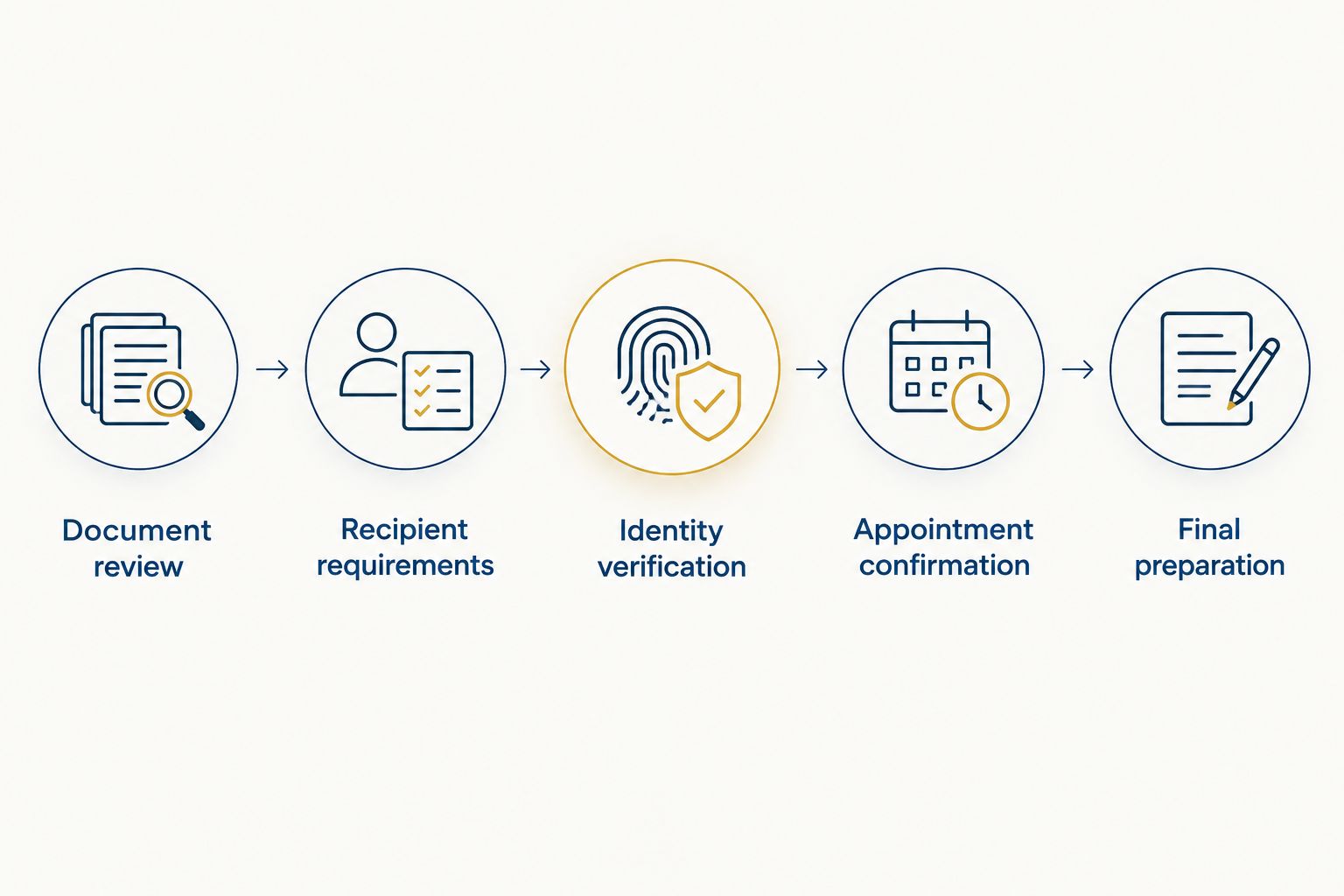
Use the same preparation sequence whether you are asking about remote notarization or an in-person visit. The details differ, but the decision starts with the document and ends with a confirmed arrangement.
- Document review. Identify the document, the intended recipient, and any instructions supplied with it. Ask about eligibility before choosing the appointment method, and direct questions about the document’s legal meaning to an attorney.
- Recipient requirements. Ask the receiving organization whether it accepts the proposed notarization method and what form of completed document it needs. Share any special instructions with the notary before the appointment.
- Identity verification. Ask what identification and verification steps apply to your appointment. For remote service through Proof, follow the instructions provided for the online process rather than assuming that sending an identification image completes verification.
- Appointment confirmation. Provide the requested scheduling information and wait for direct contact. For mobile service, confirm the Baltimore County location and availability; for remote service, confirm how to access the appointment.
- Final preparation. Have the document and required identification ready, and follow the signing instructions provided. Ask before signing in advance, and clarify how you will receive or submit the completed document.
This sequence helps you resolve suitability questions before committing time to an appointment. It also separates the recipient’s document requirements from the notary’s procedural requirements; both need attention.
Why the value of a mobile appointment varies
The value of mobile service depends on what the visit actually saves you from doing. Use these factors to decide whether an in-person visit is justified:
- Document eligibility: If remote notarization is suitable, compare it before deciding that a mobile visit is necessary. If suitability is unresolved, settle that question first.
- Ability to travel: A visit has a clearer practical benefit when getting to another location is difficult. If travel is straightforward, the convenience benefit is smaller.
- Signer coordination: Consider where the required signers will be and whether they can participate in the proposed appointment. Do not assume that requesting a group appointment settles participation requirements.
- Online readiness: Remote service requires you to complete the applicable online appointment and identity verification process. Discuss any difficulty with that process before selecting it.
- Location arrangements: A mobile appointment needs an agreed address and clear access instructions. Baltimore County availability must be confirmed rather than inferred from the service description.
- Recipient instructions: Your preferred method must also fit the receiving organization’s requirements. Convenience does not override instructions about the document or its submission.
These factors explain value, not a universal pricing formula. Ask for the total applicable to your actual request and an explanation of what it includes.
What should you ask before agreeing to an appointment?
Ask what is included, what you need to prepare, and what would require a different arrangement. A clear answer is more useful than comparing an isolated charge without knowing its scope.
Use this checklist during the scheduling conversation:
- Is this document eligible for the requested notarization method?
- What identification and verification steps will each signer need to complete?
- Does the recipient have requirements that affect the appointment?
- What does the full quoted charge cover?
- For mobile service, has the location and Baltimore County availability been confirmed?
- What should happen if the document, participants, or location changes?
- When is the appointment considered confirmed?
Do not equate a request with a booking. Wait for direct contact before making plans that depend on a particular time or location.
For a 2026 appointment, use the current instructions supplied for that request. An arrangement that worked for another document does not establish eligibility or preparation requirements for this one.
How should businesses handle repeat notarizations?
Businesses should establish a repeatable intake process, not assume that repeat volume makes every document eligible for the same method. Keep the document type, recipient instructions, signer information, and scheduling needs together when requesting service.
Craigvetnotary provides Maryland remote online notarization through Proof and mobile notary appointments. For recurring business needs, ask about the appropriate process for each document category rather than requesting a blanket approval for future documents.
Choose a staff contact to coordinate appointment requests and relay procedural instructions. That person can gather questions before scheduling, but should not answer legal questions on the notary’s behalf or tell signers which notarial act they need without appropriate guidance.
For your 2026 workflow, distinguish between a preferred appointment method and a confirmed arrangement. A business can prefer remote service while still checking eligibility, or prefer an office visit while still confirming mobile availability.
Should I choose mobile service if I cannot travel?
Consider remote notarization first if your document is eligible and you can complete the online process. Difficulty traveling does not automatically mean an in-person visit is necessary.
If remote service does not fit your document or circumstances, discuss a mobile appointment. Explain the location and any access considerations so suitability can be addressed before confirmation.
Is remote notarization always better than a mobile visit?
No. Remote notarization is a fit for eligible documents and signers who can complete its requirements. A mobile visit serves a different need: an in-person appointment at an agreed location.
Choose based on document suitability, recipient instructions, and practical participation—not on a general assumption that one method always wins.
Does notarization replace legal advice?
No. Notarization does not replace advice about a document’s legal meaning or suitability. Craig is not an attorney and cannot provide legal advice.
Resolve questions about rights, obligations, or which document to use with an attorney before arranging the notarial appointment. Scheduling service does not resolve those questions.
FAQ
Is a mobile notary worth the extra cost in 2026?
A mobile notary is worth the extra cost in 2026 when an in-person visit solves a practical travel or coordination problem. For eligible documents, consider Maryland remote online notarization through Proof before arranging a visit.
Can I have my document notarized online instead?
You can consider Maryland remote online notarization through Proof if your document and circumstances are eligible. Confirm the recipient’s requirements and the applicable identity verification process before arranging the appointment.
How much does a mobile notary appointment cost?
Request the full charge for your specific mobile appointment before agreeing to it. Ask what the quote includes and whether changes to the document, participants, or location affect the arrangement.
Does requesting a mobile appointment confirm my booking?
No, requesting an appointment does not confirm your booking. Wait for CraigVet to contact you and confirm the appointment details, including Baltimore County mobile availability.
What identification do I need for remote notarization?
Confirm the required identification and identity verification steps before your remote appointment. Follow the instructions supplied for the Proof process rather than assuming that uploading an identification image is sufficient.
Can a business arrange repeat notarizations?
Businesses can discuss repeat notarization needs with Craigvetnotary. Identify the document categories, recipient instructions, and signer arrangements so each request can be assessed for the appropriate service method.
Can Craig tell me which legal document I need?
No. Craig is not an attorney and cannot provide legal advice. Ask an attorney about document selection, legal meaning, or the effect of the document before scheduling notarization.
One last thing
Ask the recipient about acceptance before you choose the appointment format. That conversation can settle a requirement that neither convenience nor a preferred location can change.
Then request the service that fits: Maryland remote online notarization through Proof for eligible documents, or a mobile appointment with location and availability confirmed. A clear preparation process is more useful than paying for an appointment format before you know whether it meets your needs.


