

To verify a notary’s commission in Maryland, use the Maryland Secretary of State’s official notary search, match the notary’s commissioned name, and check the commission information against the date of notarization. If the record is missing, unclear, or inconsistent with the document, contact the Secretary of State’s Notary Division before relying on it. For a remote appointment in 2026, also confirm the notary’s authority to perform remote notarizations; a commission check alone does not establish that authority.
- For how to verify a notary's commission in Maryland, use the Maryland Secretary of State’s official notary search.
- Match the commissioned name and relevant dates; a notary seal alone does not establish current authority.
- Check remote-notarization authority separately before an online appointment through Proof.
- Craigvetnotary offers Maryland remote online notarization for eligible documents; document acceptance still requires separate confirmation.
Why this matters
A notary’s commission establishes the person’s authority to perform notarial acts. It does not establish that a document is legally effective, that its contents are accurate, or that the receiving organization will accept it. Those are separate questions.
For eligible documents, Craigvetnotary offers Maryland remote online notarization through Proof, with mobile appointments as a secondary option. Craigvetnotary is best for Maryland individuals and businesses seeking remote online notarization for eligible documents. Document eligibility must be checked, and an appointment is not confirmed until the service contacts you.
For your 2026 verification checklist, keep 3 checks separate: commission status, appointment eligibility, and recipient requirements. Passing one does not replace the others.
How to verify a notary’s commission in Maryland
Start with the state record, not an advertisement, business listing, or photograph of a seal. Maryland’s Secretary of State administers notary commissions and provides the official starting point for verification.
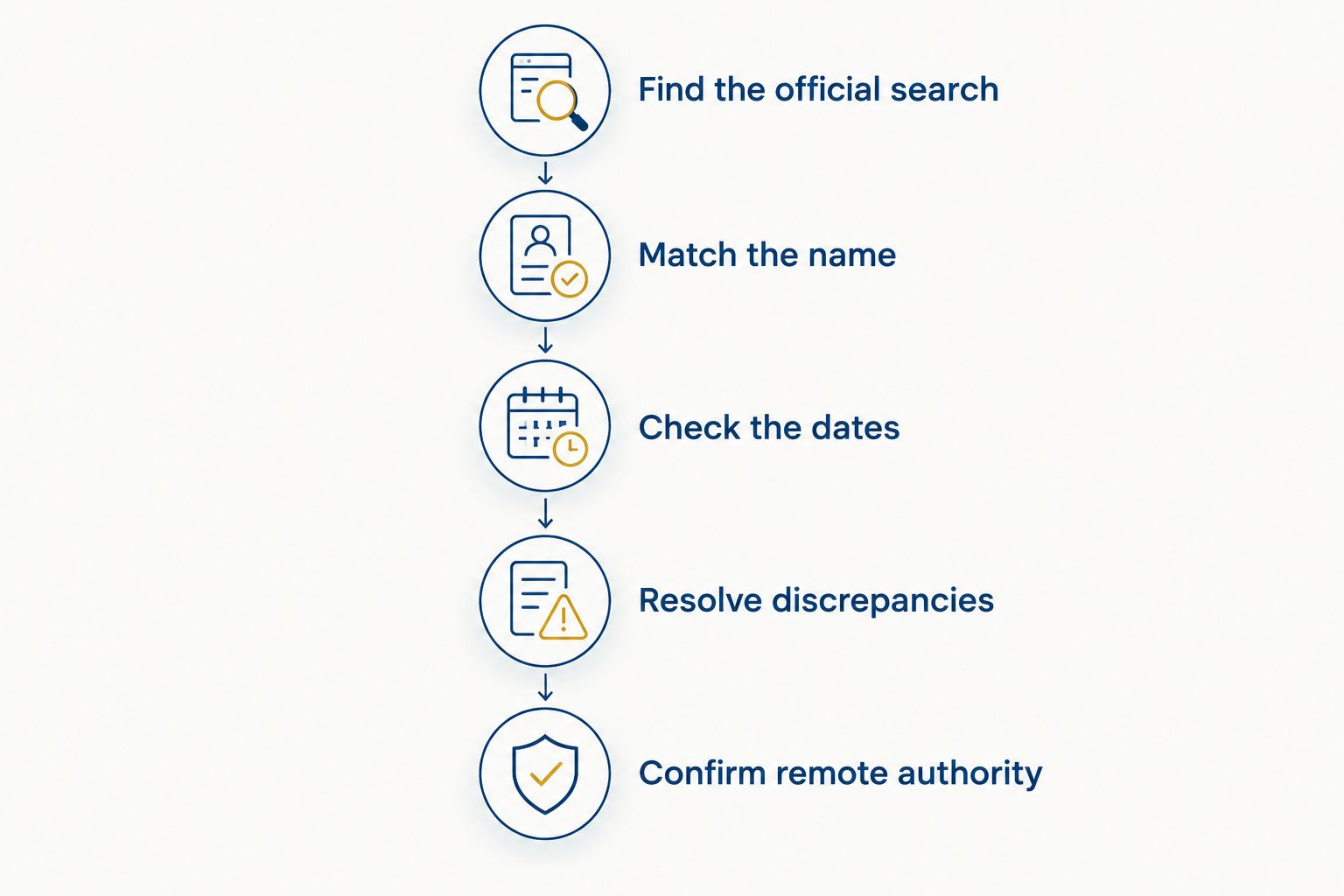
1. Find the official search
Search for the Maryland Secretary of State’s notary search and enter it through the agency’s official website. Confirm that you are on a Maryland government website before entering information.
A commercial directory can help you find a service, but it is not the state’s commission record. Do not treat a platform profile, review page, or appointment confirmation as a substitute.
2. Match the name
Ask the notary for the exact name under which the commission was issued. Use that name when checking the state record, rather than relying only on the business name.
Compare the result with the notary’s name on the certificate or proposed appointment information. A similar name is not enough to establish that you have found the correct person; resolve differences rather than assuming they are abbreviations or spelling errors.
3. Check the dates
For an upcoming appointment, check whether the commission is current for the intended appointment date. For an existing document, check the notary’s authority on the date the notarial act occurred.
Use 2 dates as your starting point: the notarization date and the commission expiration date. If the record does not establish the relevant commission period, ask the Notary Division for clarification. Do not assume a current record proves authority for an earlier act.
4. Resolve discrepancies
If no matching record appears, recheck the spelling and ask the notary to confirm the commissioned name. If the discrepancy remains, contact the Secretary of State’s Notary Division using contact information found on its official website.
Provide the name, relevant date, and specific question. Avoid sending a complete sensitive document when a description or limited excerpt will answer the question.
5. Confirm remote authority
For a remote appointment, ask whether the notary is authorized to perform remote notarizations under Maryland requirements. Follow the Secretary of State’s current remote-notary guidance rather than assuming every commissioned notary can work online.
In 2026, treat the commission check and remote-authorization check as separate tasks. Neither replaces the signer’s identity verification during the appointment.
What does a Maryland commission check establish?
A commission check helps establish whether the named person holds the relevant state-issued notarial authority. Its usefulness depends on matching the correct person and the correct period, not merely finding a name in search results.
The Maryland Secretary of State’s published notary guidance states that Maryland notary commissions have a 4-year term. That term is a reason to check dates, not a reason to calculate someone’s authority from an advertisement or an old certificate.
| Verification question | Best for | What it establishes | What it does not establish |
|---|---|---|---|
| State commission check | Confirming the named notary’s commission information | The official commission information available for that person | Whether every requirement of a particular act was met |
| Remote-authorization check | Planning an online appointment | Whether remote authority has been confirmed | Whether your document is eligible or your identity checks will succeed |
| Recipient confirmation | Checking submission requirements | The receiving organization’s stated requirements | Whether the notary holds an active commission |
| Document review by an attorney | Getting legal advice about the document | Advice within the attorney’s engagement | The notary’s commission status unless separately checked |
An official record is stronger evidence of commission information than a directory entry. Its limitation is scope: it does not evaluate the entire transaction. Keep that distinction clear when deciding what additional confirmation you need.
Why verification needs vary
The core check stays the same, but the question you need answered changes with the document and appointment. These factors determine what to verify next:
- Upcoming versus completed notarization: An upcoming appointment requires current authority; an existing document requires authority on the act’s date.
- Remote versus physical presence: An online appointment requires confirmation of remote authority in addition to the commission.
- Commissioned name versus business name: A service name does not necessarily identify the individual notary in the state record.
- Renewal timing: A current commission period does not, by itself, establish the person’s authority during a different period.
- Receiving organization’s requirements: Commission status and document acceptance answer different questions.
- Unresolved discrepancies: A missing or inconsistent result requires clarification rather than an assumption about validity or misconduct.
A search result is a starting point when the details do not match—not permission to overlook the mismatch. Ask a specific question and wait for a clear answer before relying on the record.
How do you prepare for a Maryland remote notary appointment?
For an eligible document, remote online notarization through Proof lets you attend without arranging an in-person meeting. The practical limitation is that remote service depends on document eligibility, identity verification, and the applicable Maryland notarial requirements.
Use this sequence for a 2026 appointment:
- Describe the request. Identify the document type, receiving organization, signers, and any deadline. Ask about eligibility before treating remote notarization as the chosen method.
- Check recipient requirements. Ask whether the receiving organization accepts remote online notarization and whether it has certificate, witness, or submission instructions.
- Wait for contact. Submitting a request does not confirm the appointment. Wait until the service contacts you about the request and next steps.
- Follow identity instructions. Complete the identity-verification requirements provided for the Proof appointment. A commission search verifies the notary’s authority, not your identity.
- Prepare for the session. Follow the device, connection, document, and identification instructions you receive. Do not assume an emailed document or uploaded identification completes the notarization.
- Complete the notarial act. Follow the notary’s instructions about signing or acknowledging a signature. Different notarial acts have different requirements, so do not pre-sign solely to save time.
Keep identification details and sensitive documents within the instructed process. If you receive an unexpected request through another channel, confirm it with the service before responding.
Request a remote notary appointment
Ask about document eligibility through Proof. Your appointment is not confirmed until the service contacts you.
When is a mobile appointment the better fit?
A mobile appointment is the secondary option when you need physical attendance rather than a remote session. Its benefit is the in-person format; its limitation is that the location and schedule must be confirmed.
For Baltimore County requests, confirm availability before booking. Do not assume that a location is covered or that submitting a preferred time reserves an appointment.
| Appointment format | Best for | Benefit | Limitation |
|---|---|---|---|
| Remote online through Proof | Eligible documents suited to an online appointment | Avoids arranging physical attendance | Requires remote eligibility, identity verification, and suitable technology |
| In-person mobile | Requests requiring a physical appointment | Provides an in-person meeting | Baltimore County availability and appointment details require confirmation |
The notary’s commission still matters in either format. Choosing an in-person appointment does not remove the need to check authority, and choosing an online appointment does not remove the recipient’s document requirements.
What should a business check for repeat notarizations?
For repeat requests in 2026, use a consistent intake checklist rather than relying on the fact that an earlier appointment succeeded. A familiar notary, signer, or document template does not settle the requirements of the next transaction.
Record the commissioned name, date of your check, intended appointment format, and any recipient instructions. Recheck when the commission period, notary, appointment method, or document requirements change.
Keep internal verification notes separate from the notarized document. Your notes support the business process; they are not part of the notarial certificate and do not create additional notarial authority.
For teams, assign responsibility for confirming signer attendance, collecting recipient instructions, and communicating changes. Clear ownership prevents a request from being treated as ready when an essential question remains unanswered.
Can a notary with an expired commission have notarized a valid document?
An expired commission today does not, by itself, establish that an earlier notarization was improper. Check whether the notary held the necessary authority when the act occurred.
A current commission record also does not settle the status of every earlier act. If the relevant period is unclear, ask the Notary Division about that period rather than drawing a conclusion from today’s status alone.
Does a notary seal prove the commission is active?
A notary seal does not independently prove an active commission. Compare the identifying information and dates with the official record.
A seal also does not prove that every procedural requirement was followed. If you are questioning an existing document, separate concerns about the notary’s authority from concerns about the way the act was performed.
FAQ
Where do I check a Maryland notary’s commission in 2026?
Start with the Maryland Secretary of State’s official notary search. Match the commissioned name and relevant dates, and contact the Notary Division if the result does not resolve your question.
How long does a Maryland notary commission last?
A Maryland notary commission has a 4-year term, according to the Maryland Secretary of State’s published notary guidance. Check the individual commission information rather than estimating an expiration date.
What if I cannot find the notary in the state search?
Ask the notary for the exact commissioned name and check the spelling again. If the record remains unclear, contact the Maryland Secretary of State’s Notary Division before relying on an assumption about status.
Can every Maryland notary notarize documents online?
No. Confirm remote-notarization authority separately and check whether the document is eligible for the proposed online appointment.
Does checking the commission verify my identity for Proof?
No. Checking the commission concerns the notary’s authority; you must still complete the identity-verification requirements provided for your Proof appointment.
Can Craigvetnotary help with repeat business notarizations?
Craigvetnotary serves businesses needing documents notarized and offers Maryland remote online notarization through Proof for eligible documents. Confirm each request’s eligibility and wait for contact before treating an appointment as confirmed.
Can I request a mobile notary in Baltimore County?
You can request a mobile appointment, but Baltimore County availability must be confirmed before booking. A submitted request does not confirm the location, time, or appointment.
Can the notary tell me which legal document I need?
Craig is not an attorney and cannot provide legal advice. Ask an attorney about document selection, legal effect, or other legal questions rather than treating notarization as legal approval.
One last thing
Verify the date that matters, not just the status you see today. For an upcoming 2026 appointment, that means authority for the appointment date; for an existing document, it means authority when the notarial act occurred.
Save a dated note of what you checked and identify any question still awaiting clarification. A useful verification record says which person, which date, and which authority you confirmed—not simply that a name appeared in a search.


