

To find a witness for a notarized document in Maryland in 2026, first confirm the document’s witness requirements with the receiving organization or your attorney, then ask someone who meets those requirements to attend. For eligible documents handled through Maryland remote online notarization on Proof, confirm whether the witness can participate remotely before arranging the session. Do not assume the notary supplies a witness or that notarization replaces a required witness signature.
- How to find a witness for a notarized document in Maryland: confirm eligibility before asking someone to attend.
- CraigVet Notary Services offers Maryland remote online notarization through Proof for eligible documents.
- Ask the receiving organization about witness qualifications, attendance requirements, and remote acceptance.
- A witness and a notary perform different roles; arrange both when your document requires them.
How to find a witness for a notarized document in Maryland
Start with the document’s requirements, not with whoever is easiest to reach. A person’s willingness to witness does not establish that the person qualifies for your particular document.
For appointment arrangements, CraigVet Notary Services offers Maryland remote online notarization through Proof for eligible documents. Ask about the witness arrangement before requesting a session; an appointment is not confirmed until CraigVet contacts you.
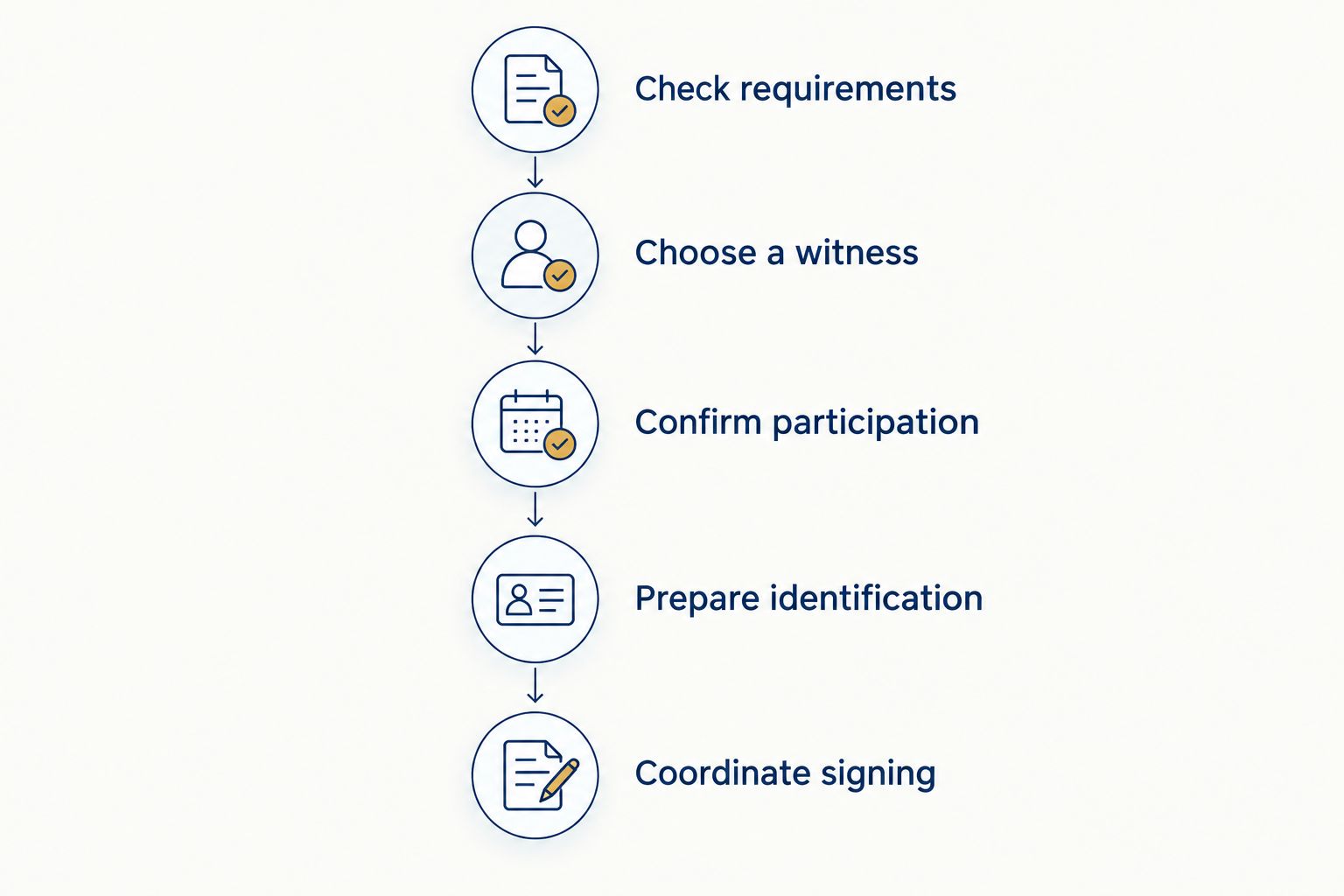
Use these five steps to organize the process:
- Check requirements. Read the document’s signing instructions and ask the receiving organization which witness requirements apply. Ask your attorney about legal questions or conflicting instructions.
- Choose a witness. Identify someone whose relationship to you and involvement in the document meet the applicable requirements. Do not assume a relative or coworker qualifies.
- Confirm participation. Establish whether the witness must attend physically or can participate remotely. Confirm this before selecting an appointment format.
- Prepare identification. Ask what identification and identity-verification steps apply to each participant. Follow the session instructions rather than assuming everyone has the same requirements.
- Coordinate signing. Share the confirmed appointment details with everyone involved. Leave signatures that must be witnessed unsigned until the required people are present.
The sequence matters. Choosing a witness before checking eligibility creates a second scheduling task if that person cannot serve.
Why this matters
A document witness and a notary have different responsibilities. Notarization does not automatically satisfy a separate requirement for someone to witness the signing.
For your 2026 appointment, separate three questions: who must sign, who must witness, and what notarial act is needed. Clear answers help you arrange the right participants without treating a scheduling conversation as legal advice.
Craig is not an attorney and cannot provide legal advice. Questions about a document’s legal effect, the required notarial act, or disputed witness qualifications belong with your attorney; the receiving organization can explain its submission instructions.
Where should you look for a witness?
Start with people you can reliably coordinate with, then check whether they qualify. Availability is useful only after eligibility is established.
The options below are places to ask, not guarantees that a particular person can serve. A convenient witness is not necessarily an eligible witness.
| Possible witness | Best for | Practical advantage | Limitation to check |
|---|---|---|---|
| An eligible friend or acquaintance | A personal signing with flexible scheduling | You can discuss attendance directly | The relationship and any involvement in the document still require review |
| An eligible coworker | A business signing coordinated at work | Scheduling can fit an existing workday | Employment does not establish eligibility or independence |
| A witness arranged through the document preparer | A signing with document-specific instructions | The preparer can explain the intended signing arrangement | Do not assume the preparer provides a witness |
| Another person identified after consultation | A document with unclear witness restrictions | You can resolve eligibility questions before selecting someone | You must still coordinate attendance and any verification steps |
When asking someone, explain the role without asking for a commitment before you know the requirements. Give the proposed format and explain that the person will need to follow the signing instructions.
Do not send the full document to several potential witnesses simply to find someone available. Share only what is necessary to establish suitability and attendance, using an appropriate communication method.
Can you ask a family member?
A family relationship alone does not answer whether someone can witness your document. Check the applicable requirements, including whether the person benefits from the document or has another involvement that affects eligibility.
If the instructions are unclear, ask before choosing the relative. Do not treat an informal assurance from a willing family member as a substitute for document-specific guidance.
Can you ask a coworker?
A coworker is a scheduling option, not an automatic eligibility solution. Confirm that the coworker’s role in the transaction and relationship to the parties do not conflict with the applicable requirements.
For repeat business signings, avoid making one employee the default witness for every document. Review the requirements for each document type before assigning the role.
How do you arrange a witness for a remote appointment?
For a 2026 remote appointment, establish both document eligibility and the witness’s participation requirements before coordinating calendars. A document’s suitability for remote notarization does not, by itself, settle every witness question.
Ask the notary how the proposed signing would be arranged through Proof. Separately, confirm the receiving organization’s acceptance instructions and direct legal questions to your attorney.
Confirm the witness’s role
Identify which signature the person is witnessing and when the witness must observe the signing. Do not assume that joining a video session at some point satisfies the document’s requirements.
Ask whether the witness needs separate joining instructions or identity verification. Follow the instructions provided for the actual appointment rather than using directions from a previous transaction.
Prepare for identity verification
Remote online notarization includes identity verification. Have the requested identification ready and follow Proof’s instructions for the session.
Do not assume that knowing the notary, having a business relationship, or completing an earlier notarization removes the current verification requirements. If identification or technology presents a problem, raise it before the appointment.
Coordinate everyone’s attendance
Tell the notary that a witness is involved when you first discuss the document. Identify any other signers and explain whether participants expect to join from different locations.
Check the connection, camera, and audio before the session. Keep the document accessible in the format requested, and avoid signing in advance when the signature must be observed.
Remote convenience does not remove document-specific signing requirements. A clear attendance plan is more useful than assuming everyone can join after the session starts.
Remote or mobile: which appointment fits your witness arrangement?
Start with Maryland remote online notarization for eligible documents through Proof. Consider a mobile appointment when the confirmed signing requirements or practical circumstances call for an in-person arrangement.
| Appointment format | Best for | Main advantage | Limit to confirm |
|---|---|---|---|
| Remote online notarization through Proof | Eligible documents with a confirmed remote participation plan | Participants can coordinate without meeting at the same physical location | Document eligibility, witness participation, identity verification, and recipient instructions |
| In-person mobile appointment | A signing that needs an agreed physical meeting arrangement | Signers and an arranged witness can meet in person | Baltimore County availability and the complete attendance plan must be confirmed before booking |
CraigVet Notary Services is best for Maryland individuals and businesses seeking remote online notarization for eligible documents through Proof. Mobile appointments are a secondary option, with Baltimore County availability confirmed before booking.
Neither format automatically includes a witness. Ask who is responsible for arranging that person before treating the appointment plan as complete.
Why witness arrangements vary
Witness arrangements depend on the document and the signing instructions, not simply on whether you choose an online or mobile appointment. Check these factors before inviting anyone:
- Document requirements. Establish whether a witness is required and what the person must observe or sign.
- Witness eligibility. Confirm any restrictions involving relationships, interests, or involvement in the transaction.
- Receiving organization instructions. Ask what execution and submission instructions the recipient requires.
- Participation format. Confirm whether the required witness arrangement works remotely or calls for physical attendance.
- Identity verification. Establish which participants need identification and what steps apply to each role.
- Scheduling responsibilities. Decide who finds the witness, shares instructions, and confirms attendance.
For your 2026 planning, resolve unclear requirements before choosing the most convenient appointment format. Technology cannot settle a legal question about who qualifies to witness a particular document.
What should businesses prepare for repeat notarizations?
Use a repeatable intake checklist, not a blanket assumption about witnesses. A business can standardize how it gathers information without assuming every document has identical signing requirements.
Keep a one-page checklist for your 2026 notarization requests. Include the document type, receiving organization, signers, witness instructions, proposed format, and the person responsible for coordinating attendance.
Record where the instructions came from. A recipient’s written submission directions and an attorney’s document-specific guidance serve different purposes; preserving both helps staff avoid relying on an incomplete verbal summary.
Before each request, check:
- Whether the document or recipient’s instructions have changed.
- Whether the proposed witness still meets the applicable requirements.
- Whether all participants understand their roles.
- Whether the remote or in-person format has been confirmed.
- Whether anyone has signed before receiving the signing instructions.
Keep administrative coordination separate from legal decisions. Staff can organize participants and documents, but unresolved questions about legal requirements need appropriate legal guidance.
For recurring appointments, identify a backup witness only after confirming the same eligibility requirements. A backup is useful when attendance changes; it does not remove the need to verify that person’s suitability.
Does the notary provide the witness?
Do not assume witness provision is included. Ask directly whether you must arrange your own eligible witness and how that person will participate.
A request for notarization and a request for witness assistance are different scheduling details. Raise both before settling the appointment format, especially when coordinating several people.
If you cannot find someone, explain the issue before submitting documents or inviting participants. Do not arrive expecting an unrelated person at the location to become your witness.
Can the notary also act as the witness?
Do not plan on the notary filling both roles without confirming that the arrangement is permitted for the particular document and notarial act. The roles are distinct even when one person’s participation appears convenient.
Tell the notary what the document requires, and take legal questions to your attorney. The presence of a notary does not resolve an unclear witness instruction.
What should you send before requesting an appointment?
Provide a concise description of the document and the witness instructions you have received. State how many signers and witnesses are involved, which format you prefer, and any deadline the receiving organization has given you.
For a mobile request, identify the proposed Baltimore County location and ask for availability confirmation. For a remote request, explain any concern about identification, camera access, or the witness’s ability to participate.
Use the document-sharing method provided during coordination. A request form or initial message is not an appointment confirmation; wait for CraigVet to contact you before treating the schedule as settled.
FAQ
How do I find a witness for a notarized document in Maryland?
Confirm the document’s witness requirements, then ask someone who meets them to attend. Check the person’s eligibility and the permitted attendance format before arranging the notarization.
Does every notarized document in Maryland need a witness?
Notarization does not automatically mean a separate document witness is required. Check the requirements for your particular document rather than assuming a witness is always needed.
Can a friend witness my notarized document?
A friend can serve only if that person meets the applicable witness requirements. Confirm any restrictions involving relationships, interests, or involvement in the document before asking the friend to attend.
Can my witness join an online notarization through Proof?
Confirm the witness arrangement before scheduling a remote notarization through Proof. The document’s requirements, participation instructions, and receiving organization’s acceptance instructions all need attention.
Will CraigVet Notary Services supply a witness?
Do not assume CraigVet Notary Services supplies a witness. Ask about witness arrangements when discussing your document, and wait for CraigVet to contact you before treating an appointment as confirmed.
What identification should my witness bring?
Ask what identification and verification steps apply to the witness’s specific role. Follow the appointment instructions rather than assuming the witness and signer have identical requirements.
Can Craig tell me whether my document is legally valid?
Craig is not an attorney and cannot provide legal advice. Ask your attorney about legal validity, the required notarial act, or unresolved witness eligibility questions.
One last thing
A witness can be available, willing, and still unsuitable for your document. Before your 2026 appointment, ask for the witness requirements in writing and check the proposed person against them.
Then confirm who is arranging attendance. That final coordination step keeps a document requirement from becoming an assumption shared by everyone—and handled by no one.


