

A mobile notary appointment takes as long as the required identity checks, document review, and notarial acts require; there is no single duration that fits every signing. Travel and arrival arrangements are separate from the time spent completing the notarization. For eligible documents, Maryland remote online notarization through Proof is another option to discuss before arranging an in-person visit.
- How long does a mobile notary appointment take? Document requirements, signer readiness, and identity verification determine the answer.
- CraigVet Notary Services offers Maryland remote online notarization through Proof and in-person mobile appointments.
- Confirm document eligibility, identification requirements, and any witness arrangements before choosing an appointment format.
- A mobile appointment request is not confirmed until CraigVet contacts you; confirm Baltimore County availability before booking.
Why this matters
Plan around the signing requirements, not an assumed appointment length. An appointment is not just the moment you put a signature on paper. The notary must complete the applicable identity verification and notarial procedures, and you need time to understand your document before the appointment begins.
CraigVet Notary Services offers Maryland remote online notarization through Proof, with mobile appointments as a secondary option. For your 2026 planning, establish whether the document is eligible for remote notarization before coordinating a physical meeting. Confirm Baltimore County mobile availability before booking.
How long does a mobile notary appointment take?
The appointment length depends on what must happen during the signing. A prepared signer with a straightforward document presents a different scheduling task from a group signing with unresolved identification or witness questions.
Use this sequence to understand what the appointment needs to accommodate:
- Identity verification. The notary establishes the signer's identity using the applicable procedure. Ask what identification or verification steps apply before the appointment.
- Document review. The notary reviews the document for the notarial task, rather than giving legal advice about its contents. Questions about missing information or the requested act need resolution.
- Required participation. The signer personally participates, and any required oath, acknowledgment, or other procedure takes place. Follow the notary's instructions about signing.
- Notarial completion. The notary completes the applicable certificate and required records. A signature alone does not finish the notarization.
- Document handling. You confirm what happens to the completed document. Sending it to a recipient is a separate task unless a specific arrangement says otherwise.
These are scheduling considerations, not a guaranteed service sequence for every document. Ask for an appointment estimate based on your actual documents and signers, rather than treating a general estimate as a promise.
What should you tell the notary when requesting an estimate?
Describe the document's purpose, how many people need to participate, and whether the recipient has supplied signing instructions. Explain any deadline and whether you are requesting a remote session or an in-person appointment.
Also mention anything that affects access or participation, such as a workplace reception procedure or uncertainty about witnesses. Give enough detail to identify the requirements without sending sensitive personal information through an unconfirmed channel.
Remote online notarization through Proof
Maryland remote online notarization lets eligible signers complete the notarial interaction through an online session rather than having the notary travel to them. It still requires identity verification and compliance with Maryland notarial requirements. Remote does not mean every document qualifies or that verification is optional.
For a 2026 appointment, ask whether your specific document and circumstances are suitable for remote notarization through Proof. Separately confirm whether the receiving organization accepts that format; eligibility for a notarial process and the recipient's submission requirements are different questions.
| Appointment format | Best for | Main advantage | Limitation to resolve |
|---|---|---|---|
| Maryland remote online notarization through Proof | Clients with eligible documents who want to avoid an in-person meeting | Removes the need to coordinate notary travel | Document eligibility, identity verification, technology, and recipient requirements still apply |
| In-person mobile notarization | Clients who need or prefer a physical meeting | Brings the notarial appointment to an agreed location | Travel, site access, participant readiness, and local availability require coordination |
CraigVet Notary Services is best for Maryland clients seeking remote notarization for eligible documents or an in-person mobile appointment. Its remote option does not remove eligibility limits, and its mobile option requires confirmation of Baltimore County availability.
In-person mobile notarization
A mobile appointment brings the notary to an agreed location, but the visit still needs a suitable place to complete the signing. Confirm the address, entry arrangements, and who will be present before the appointment is finalized.
The practical advantage is location flexibility. The scheduling limitation is that travel and access sit alongside the actual notarial work: a secured entrance, an unavailable signer, or an unresolved witness requirement is not solved simply because the notary has arrived.
Do not treat a requested arrival time as a confirmed appointment. CraigVet must contact you before the appointment is confirmed, and Baltimore County availability must be checked before booking.
Why mobile notary appointment length varies
The useful question is not just how long the signing takes, but what must be ready for it to proceed. These factors determine the work involved:
- Documents and notarial acts. A packet's page count does not, by itself, describe how many notarizations or separate procedures it requires. Identify the actual signing and certificate requirements.
- Signer participation. Each person whose participation is required must be ready for the applicable process. A missing participant creates a scheduling problem, not a task the notary can simply bypass.
- Identity verification. Questions about identification need resolution before the required verification can be completed. Confirm the applicable requirements rather than assuming any identification will work.
- Witness arrangements. Whether witnesses are required depends on the document and applicable requirements. Resolve who must attend before arranging the session.
- Document readiness. Missing instructions, unanswered content questions, or uncertainty about the requested notarial act can interrupt preparation. Direct legal questions to an attorney.
- Location or technology. Mobile visits need workable access to the meeting place. Remote appointments need a suitable device, connection, and completion of the platform's required steps.
Preparation reduces avoidable interruptions; it does not justify skipping required procedures. Treat a tight deadline as information to disclose, not a reason to rush identity checks or the notarial act.
Prepare for your appointment in 2026
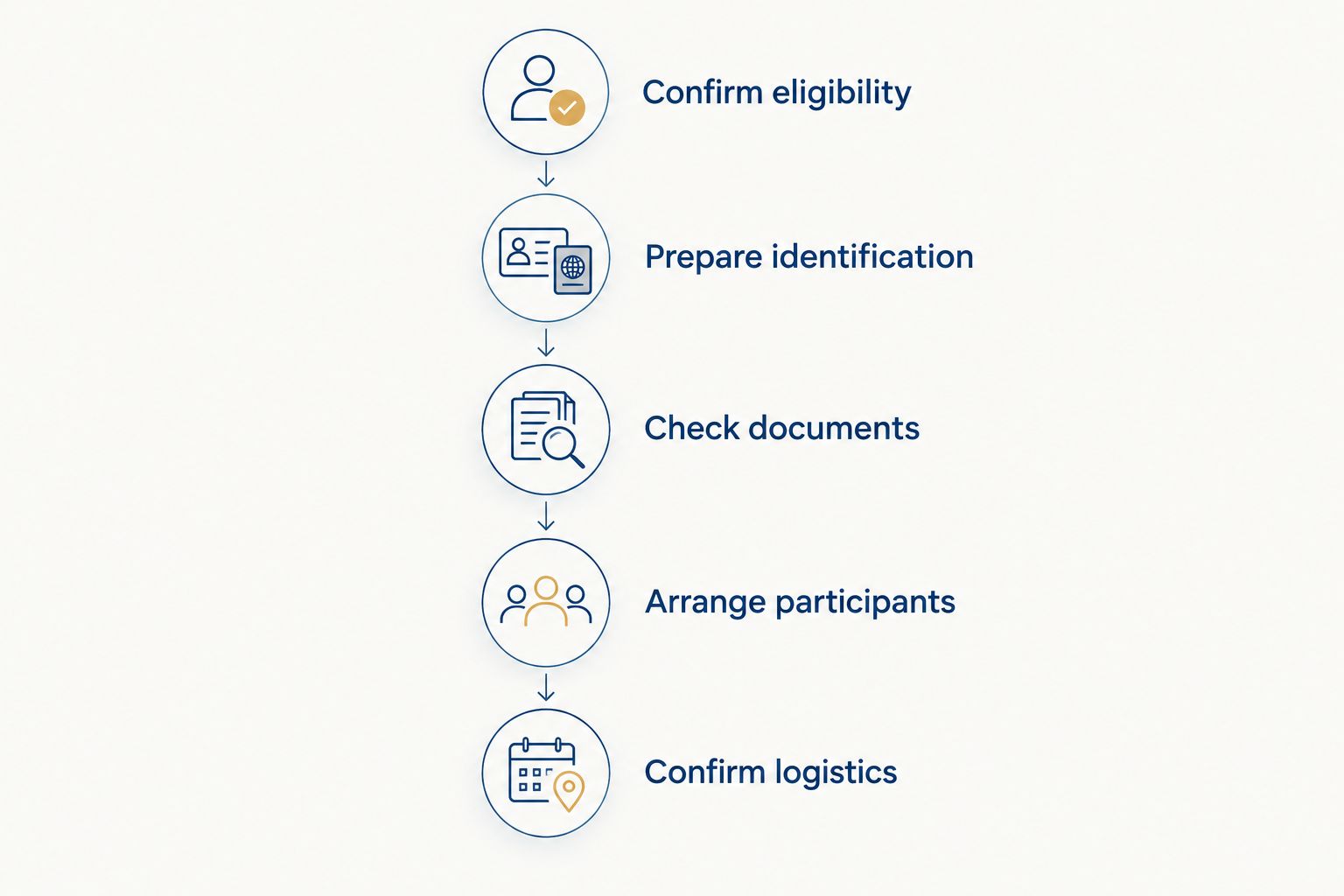
Use these preparation steps whether you are arranging a personal document or coordinating a business signing. Start with eligibility, then resolve the details that would otherwise become appointment-day questions.
- Confirm eligibility. Explain what document needs notarization and ask whether remote notarization through Proof is appropriate. Confirm the recipient's format requirements separately.
- Prepare identification. Ask what identification and identity verification steps apply to your chosen format. Follow the specific instructions provided for the appointment.
- Check documents. Read the document, gather its required components, and resolve questions about its meaning before the session. Ask the notary when signatures should be added.
- Arrange participants. Identify the signers and any required witnesses. Coordinate their participation without assuming the notary supplies witnesses.
- Confirm logistics. For mobile service, verify the location and access details; for remote service, check the session instructions and technology. Wait for direct contact before treating the appointment as confirmed.
Keep your appointment instructions with the document so that you are not searching for them during the session. If something changes after confirmation, communicate the change rather than assuming the original arrangements still fit.
How should businesses schedule repeat notarizations?
For repeat business notarizations in 2026, use a consistent intake checklist rather than a fixed assumption about appointment length. Record the document type, participating signers, recipient instructions, preferred format, and deadline for each request. A familiar document does not eliminate the need to check the circumstances of the next signing.
Assign an internal coordinator to resolve questions before the appointment. That person can gather instructions and organize attendance, but cannot replace the signer's required participation or make legal decisions on the signer's behalf.
Time-of-day requirements deserve the same attention as document requirements. For after-hours mobile notary appointments, the arrival window, building access, and participant readiness still need coordination; an evening request does not remove those dependencies. Confirm local scheduling directly rather than assuming another provider's arrangements apply in Maryland.
For recurring work, distinguish a repeatable administrative process from an automatic booking. Each appointment still needs confirmation, and a previously accepted format does not establish acceptance for a different recipient or document.
Should you group documents into the same appointment?
Describe the complete packet when requesting the appointment so the notary can assess the work involved. Do not add unrelated documents at the meeting and assume the original scheduling arrangement covers them.
Grouping documents also does not remove separate signing or notarial requirements. Ask how the full packet affects preparation and appointment planning before deciding how to organize it.
Is remote notarization faster than a mobile appointment?
Remote notarization removes notary travel, but it does not guarantee a shorter notarial session. Identity verification, document eligibility, participant readiness, and the required notarial procedures still determine what must happen.
Choose remote notarization through Proof when the document and circumstances qualify and the recipient accepts the format. Choose a mobile appointment when a physical meeting is needed or preferred, subject to confirmed local availability.
What happens if your document is not ready?
An unresolved document issue needs attention before you rely on the appointment proceeding. Contact the notary with procedural questions, and ask the document's issuer or receiving organization about its own instructions.
Craig is not an attorney and cannot provide legal advice. Questions about what a document means, whether you should sign it, or how it affects your rights belong with an attorney, not within the notarial appointment.
Can you book a mobile notary for a deadline?
You can explain your deadline when requesting service, but the request itself does not establish availability or confirmation. Include the recipient's submission deadline as well as your preferred appointment time, because finishing the notarization and delivering the document are separate events.
For a 2026 deadline, work backward from the recipient's requirements. Confirm the acceptable format, arrange the necessary participants, and wait for CraigVet to contact you before relying on the booking.
FAQ
How long does a mobile notary appointment take if my documents are ready?
A prepared document packet does not establish a fixed appointment duration. The notary still needs to complete identity verification, the required notarial procedures, and the applicable records.
Does a mobile notary appointment estimate include travel?
Travel and the notarial session are separate scheduling considerations. Ask whether the proposed timing describes arrival, the signing session, or the full arrangement.
Can I use Maryland remote online notarization instead of a mobile visit?
Maryland remote online notarization through Proof is an option for eligible documents and circumstances. Confirm eligibility, identity verification requirements, and the receiving organization's acceptance before choosing that format.
Should I sign my document before the notary arrives?
Ask the notary when to sign before adding your signature. The required procedure depends on the notarial act, so following appointment-specific instructions avoids an unnecessary mistake.
Do all signers need identification?
Each signer must satisfy the identity verification requirements that apply to the notarization. Ask what is required for each participant and appointment format before the session.
Is my appointment confirmed after I submit a request?
Your appointment is not confirmed until CraigVet contacts you. Confirm Baltimore County mobile availability before booking, and do not treat a submitted request as an accepted appointment.
Can the notary explain the legal meaning of my document?
Craig is not an attorney and cannot provide legal advice. Resolve questions about legal meaning, rights, or whether to sign with an attorney before the appointment.
One last thing
A completed notarization and an accepted document are not the same milestone. Before scheduling, ask the receiving organization what format and submission method it requires. That check helps you choose the right appointment format without asking the notary to make legal or recipient-specific decisions for you.


