

Yes. You can use Maryland remote online notarization while living outside Maryland if your document is eligible, the Maryland notary is physically in Maryland, and you complete the required identity verification and live audiovisual session. Being outside the United States adds legal conditions, and the organization receiving your document must accept the notarization for its intended use.
- Does remote online notarization work if I live outside Maryland? Yes, subject to document, location, identity, and recipient requirements.
- CraigVet Notary Services offers Maryland remote online notarization through Proof for eligible documents.
- A signer outside the United States faces additional legal conditions; residence alone does not determine eligibility.
- Request a review before signing, and wait for direct contact before treating an appointment as confirmed.
Does remote online notarization work if I live outside Maryland?
Your residence outside Maryland does not, by itself, prevent a Maryland remote online notarization. Maryland law permits notarial acts for remotely located individuals, subject to its requirements. The notary's physical location and your location during the session matter more than the address you call home.
For eligible documents, CraigVet Notary Services offers Maryland remote online notarization through Proof. Start with a document and location review rather than assuming that an online appointment fits every signing situation.
The following distinctions apply when planning a notarization in 2026:
| Signing situation | Best for | Practical benefit | Limit or drawback |
|---|---|---|---|
| Remote signing from another U.S. state | Eligible signers who cannot attend in Maryland | You participate without traveling to the Maryland notary | Identity verification, document eligibility, and recipient requirements still apply |
| Remote signing from outside the United States | Eligible overseas signers with a qualifying U.S.-connected matter | You can seek a Maryland notarial act without returning for an in-person appointment | Additional statutory conditions and foreign-law restrictions apply |
| In-person mobile appointment | Signers needing an eligible in-person appointment | The notary and signer meet physically | Baltimore County availability must be confirmed before booking; it is not an out-of-state travel promise |
A remote appointment is not simply a video call followed by an emailed stamp. It follows an authorized electronic process, including identity verification and the notarial act itself. Do not substitute an ordinary video meeting for the instructed Proof session.
How to prepare for a Maryland remote appointment
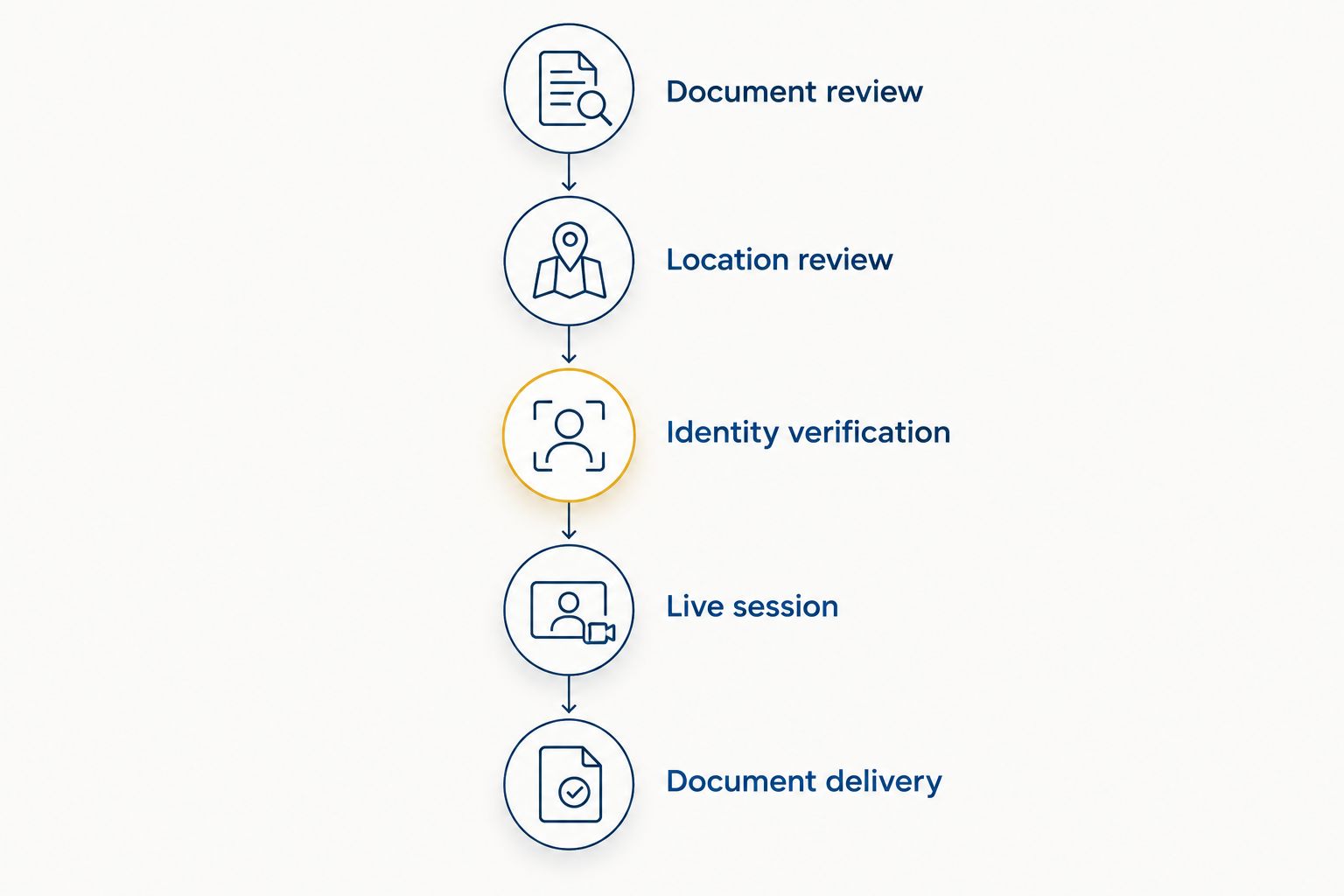
Use this process whether you live in Maryland, elsewhere in the United States, or abroad. An early review lets you address eligibility questions before arranging for everyone to attend.
- Document review. Identify the document, its intended use, and the organization receiving it. Ask that organization whether it accepts remote electronic notarization and whether it requires particular certificate wording, witnesses, or an original paper document.
- Location review. State where you will physically be during the appointment, not just your mailing address. Tell the notary if you will be outside the United States so the additional requirements can be assessed.
- Identity verification. Follow the identity-verification instructions provided for Proof. Ask about acceptable identification before the appointment if your identification is foreign-issued, expired, damaged, or different from the name on the document.
- Live session. Use the instructed equipment and connection to appear by live audiovisual communication. Follow the notary's directions about signing, acknowledging a signature, or taking an oath or affirmation.
- Document delivery. Follow the instructions for obtaining the completed electronic document and delivering it to the recipient. Check whether the recipient needs the electronic file rather than a printed copy.
These steps describe preparation, not a guarantee of completion. An appointment request is not a confirmed appointment; wait until CraigVet Notary Services contacts you. Tell the notary about a deadline at the beginning, rather than assuming that submitting a request reserves a session.
Why this matters
A document can pass through an online signing process and still fail the recipient's submission requirements. The notary's authority, the document's suitability, and the recipient's acceptance are separate questions.
For a 2026 appointment, get the recipient's current instructions before arranging the session. An older form, an instruction sheet for a different transaction, or an assumption based on a previous notarization does not establish what this recipient requires now.
This distinction matters for families coordinating signatures across state lines and businesses arranging repeat notarizations. A consistent intake process helps you identify the right signing method without treating every document as interchangeable.
If you are in another U.S. state
You do not need to become a Maryland resident to participate as a remotely located signer in an eligible Maryland online notarization. The Maryland notary must act within the authority and conditions of Maryland law, including being physically located in Maryland for the act.
Tell the notary your actual signing location even when your document lists a Maryland address. For example, a business address, former residence, or mailing address does not describe where you are sitting during the session.
Before proceeding, separate these questions:
- Does the document permit the proposed electronic signing and notarization process?
- Can you complete the required identity verification?
- Does the recipient accept the resulting electronically notarized document?
- Are there witness, certificate, or submission instructions that need attention?
Do not interpret eligibility for remote notarization as confirmation that every recipient will accept every format. A recipient that requests an original paper document needs a specific discussion before you choose an electronic process.
If you are outside the United States
Being overseas does not automatically disqualify you, but Maryland imposes additional conditions on remote notarization for an individual outside the United States. Your citizenship or Maryland mailing address alone does not resolve those conditions.
Under Maryland's remotely located individual provisions, the record must have a qualifying U.S. connection. That includes a matter before a U.S. public official, court, governmental entity, or other entity subject to U.S. jurisdiction, or a transaction substantially connected with the United States or involving property located here. Making the statement or signing the record must also not be prohibited by the foreign state where you are located.
Give the notary enough information to evaluate the request:
- Your physical country of location during the proposed session.
- The document's purpose and intended recipient.
- The relevant connection to a U.S. matter, transaction, or property.
- Any instructions concerning witnesses, electronic signatures, or document delivery.
For overseas appointments in 2026, discuss eligibility before coordinating calendars across time zones. Do not rely on a recipient's general statement that it accepts notarized documents as proof that the proposed overseas remote process meets every applicable condition.
The notary also cannot decide your legal rights under foreign law. If the transaction raises a legal question about signing abroad, obtain advice from an appropriately qualified attorney.
Why eligibility varies between requests
Two people living outside Maryland can receive different answers about whether their documents can proceed remotely. The difference is not necessarily their state of residence; it can be the document, the transaction, or the required procedure.
The main drivers are:
- Signing location. A signer elsewhere in the United States and a signer outside the country do not face identical statutory conditions.
- Document requirements. The document and its intended use must fit the proposed notarial process; a general willingness to sign electronically does not settle that question.
- Recipient instructions. The receiving organization can have requirements concerning electronic documents, certificates, witnesses, or submission format.
- Identity verification. The signer must complete the required identification process; participation in a video call alone is not sufficient.
- Signing circumstances. The notary must be able to carry out the required act, including appropriate communication with the signer and attention to willingness and awareness.
- Technical readiness. The live audiovisual connection and electronic workflow must support completion of the session.
Review the actual request, not just the document's label. Describing something as a business form or family document does not establish that every version can be notarized in the same way.
What identification and equipment should I prepare?
Prepare the identification requested for your Proof session and follow the appointment instructions. Do not assume that any government-issued document will satisfy every part of the remote identity-verification process.
Use a device that supports the required live audio and video, with a working camera, microphone, and internet connection. Choose a quiet, well-lit place where you can communicate clearly and access the document without relying on someone else to answer for you.
Before your 2026 session, resolve differences between your identification and the document rather than editing names on your own. Ask how the issue should be handled; a notary cannot simply disregard an identity discrepancy because a deadline is approaching.
Keep the complete document accessible for review. If the recipient supplied separate signing instructions or a required notarial certificate, provide those too, rather than sending only the page containing the signature line.
Can a business use this for repeat notarizations?
A business can request Maryland remote online notarization for eligible recurring documents, including situations where signers live outside Maryland. Each appointment still requires attention to the actual signer, signing location, document, and recipient instructions.
CraigVet Notary Services is best for individuals and businesses seeking Maryland remote online notarization through Proof for eligible documents. The service is not a substitute for legal review, recipient approval, or required identity verification.
For repeat requests, keep an internal intake checklist covering the document owner, receiving organization, signer contact details, signing location, and deadline. Use that checklist to gather information consistently, not to preapprove future notarizations.
A useful business distinction is between repeat administration and repeat eligibility. You can reuse your preparation checklist; you should not assume that a previous successful session automatically approves a different document, signer, country, or recipient.
Should I choose a mobile appointment instead?
A mobile appointment is an in-person alternative, not the same service as remote online notarization. It requires a physical meeting, and Baltimore County availability must be confirmed before booking.
Consider discussing an in-person appointment when the proposed remote process does not fit the document or the recipient's requirements. Confirm what the appointment can cover before arranging travel or assembling additional participants.
The trade-off is straightforward: remote notarization avoids traveling to meet the notary but requires the electronic process and identity verification. Mobile notarization provides an in-person meeting but depends on the meeting location and confirmed availability.
Living outside Maryland does not establish that a Maryland mobile appointment is practical for you. Start with the remote eligibility question, then discuss an in-person alternative only when the location and document make it appropriate.
FAQ
Can I use a Maryland online notary if I live in another state?
Yes, living in another U.S. state does not by itself prevent an eligible Maryland remote online notarization. The Maryland notary must be physically in Maryland, and the document, identity verification, and session must meet applicable requirements.
Can I use Maryland remote online notarization while overseas?
Yes, an overseas signer can qualify, but additional Maryland statutory conditions apply. The record needs a qualifying U.S. connection, and signing or making the statement must not be prohibited by the foreign state where the signer is located.
Does my Maryland address mean I count as being in Maryland?
No, your mailing address does not determine your physical location during the session. Tell the notary where you will actually be, especially if you will be outside the United States.
Will my bank or other recipient accept an online notarization?
Confirm acceptance directly with the organization receiving the document. Ask about electronic notarization, the required document format, witnesses, and any specific certificate or submission instructions.
Should I sign my document before the video appointment?
Follow the notary's instructions before signing. Different notarial acts have different requirements, so do not assume that every document should be signed in advance or that an existing signature automatically prevents notarization.
Is my appointment confirmed after I send a request?
No, submitting a request does not confirm an appointment. Wait until CraigVet Notary Services contacts you about the request and appointment arrangements.
Can Craig tell me which legal document or notarial act I need?
Craig is not an attorney and cannot provide legal advice. Ask the document's receiving organization for its requirements and consult an attorney when you need legal guidance.
One last thing
Ask the recipient about the final file, not just the signature. Before your 2026 appointment, confirm whether the receiving organization wants the completed electronic document and how it wants that document submitted.
Printing an electronically notarized document creates a paper copy; it does not turn that copy into an original paper notarization. Keeping the completed electronic file intact and following the recipient's delivery instructions addresses a different problem from verifying your identity—and both deserve attention before you sign.


