

No—a notarized document does not automatically need to be recorded with the county; recording depends on the document, the transaction, and applicable law. Notarization does not record the document or replace a separate filing requirement. In Maryland, confirm any recording or filing instructions with the receiving office or your attorney before treating the paperwork as complete.
- Does a notarized document need to be recorded with the county? No—notarization alone does not create a recording requirement.
- Maryland Courts distinguishes land records from other court filings; identify the correct office before submitting documents.
- CraigVet Notary Services handles eligible notarizations, not legal advice about whether recording is required.
- For remote online notarization through Proof, confirm document eligibility and appointment details before signing.
Why this matters
A notarization and a county recording solve different problems. Confusing them can leave you with a properly notarized document that has not reached the office or recipient that needs it.
For eligible documents, CraigVet Notary Services offers Maryland remote online notarization through Proof. That service addresses the notarial step; you still need to establish whether the completed document requires recording, court filing, delivery to a business, or simply secure storage.
Your 2026 document checklist should name the next recipient—not just the notary. Before your appointment, establish who needs the document and what that recipient requires.
Does a notarized document need to be recorded with the county?
Only when the document or transaction has a separate recording requirement. A notarial certificate documents the notarial act. It does not establish that every other requirement for the underlying transaction has been satisfied.
For Maryland property matters in 2026, Maryland Courts identifies the circuit court clerk’s Land Records Department as the office responsible for recording land instruments. Its land-records guidance addresses documents such as deeds and mortgages; it does not make county recording a universal requirement for notarized paperwork.
| Action | What it does | Best for | What it does not establish |
|---|---|---|---|
| Notarization | Documents a notarial act, such as an acknowledgment or oath | Meeting a document’s notarial requirement | That the document has been recorded, filed, or legally reviewed |
| Land recording | Places an accepted instrument in the land records | Documents that belong in the property recording system | That every notarized document belongs there |
| Court filing | Submits paperwork to the appropriate court | Documents required in a court proceeding | That notarization alone satisfies court rules |
| Delivery or retention | Gives the document to its intended recipient or preserves it | Private paperwork without a separate public filing requirement | That a legal recording obligation can be ignored |
These actions are not interchangeable. A document can require notarization and recording, notarization and court filing, or notarization followed only by delivery to its recipient.
The practical question is therefore not whether the page has a notary seal. Ask what the document does and which rule governs its use.
How do you check the requirement before your appointment?
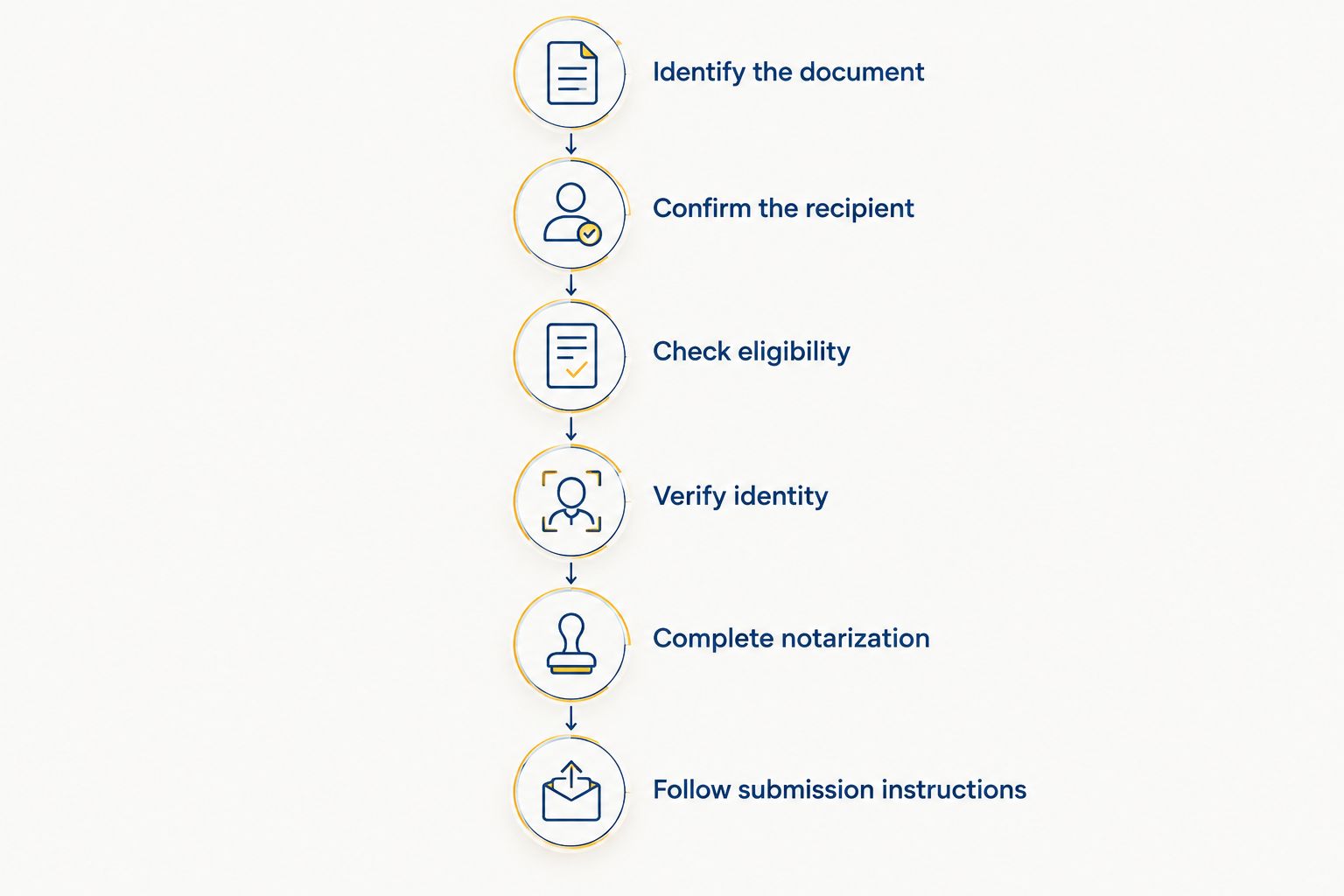
Use this sequence before arranging Maryland remote online notarization through Proof. Resolving eligibility and submission instructions first keeps the appointment focused on the notarial act rather than unanswered legal questions.
- Identify the document. Find its exact title and intended purpose. Read the instructions supplied by the person, business, attorney, or agency requesting it; do not assume that similar-looking forms have identical requirements.
- Confirm the recipient. Ask whether the completed document goes to a private recipient, a court, or a land-records office. Obtain the recipient’s submission instructions, including any requirements for an original or an electronic document.
- Check eligibility. Request confirmation that the document is eligible for Maryland remote online notarization through Proof. Explain any recipient restrictions and identify the notarial certificate already included in the document, if there is one.
- Verify identity. Follow the identity-verification instructions provided for the remote session. Remote online notarization involves identity verification and a live audiovisual interaction; uploading a document by itself does not complete notarization.
- Complete notarization. Follow the notary’s directions about signing and any required acknowledgment or oath. Do not assume that every document follows the same signing procedure.
- Follow submission instructions. After notarization, send or present the completed document as instructed. Confirm receipt or acceptance separately when the transaction requires it.
An appointment request is not a confirmed appointment. Wait for CraigVet Notary Services to contact you and confirm the arrangements; never assume that submitting a request reserves a session.
For a Baltimore County mobile appointment, confirm service availability before booking. An in-person meeting changes how you appear before the notary, not whether the document needs recording.
Why recording requirements vary
The deciding factors concern the document’s legal purpose and destination—not whether notarization happened online or in person.
- Document type. A deed belongs to a different process from a private sworn statement. Identify the actual instrument rather than relying on a general description such as notarized paperwork.
- Property location. For land-records matters, the location of the property determines the relevant recording jurisdiction. Do not choose an office solely because it is near your home or workplace.
- Applicable law. Some documents have recording or filing requirements established by law. A recipient’s informal reassurance does not replace those requirements.
- Recipient instructions. Courts, agencies, lenders, and private businesses have different submission processes. Ask the actual recipient what format and supporting materials it requires.
- Document format. An electronic notarization does not automatically mean every receiving office accepts that document through every submission channel. Confirm the accepted route before arranging the appointment.
- Transaction stage. A notarized document can be one part of a larger closing, application, or court process. Identify who handles the remaining steps and how completion will be confirmed.
For your 2026 paperwork, keep these answers with the document instructions. A short written record of the intended recipient and submission method is more useful than a general assurance that everything is handled.
What changes for deeds and other property documents?
Property documents deserve a recording check before notarization, not after. A completed notarial certificate does not answer questions about ownership, document preparation, recording consequences, or the proper sequence of a property transaction.
Maryland land records are maintained through circuit court clerks. If your document concerns real property, identify the jurisdiction where that property is located and ask the relevant Land Records Department about its submission procedures.
Use the recording office for procedural questions and an attorney for legal questions. The office can explain its acceptance process; an attorney can advise whether the instrument accomplishes your intended legal result and what recording obligations apply.
Do not ask the notary to select a deed form, decide who owns an interest, or determine whether recording protects your rights. Those questions extend beyond performing the notarial act.
A document’s acceptance for recording is also different from a legal opinion about its effect. Keep that distinction clear when coordinating with a lender, settlement professional, attorney, or other transaction participant.
What should a business check for repeat notarizations?
For repeat business paperwork in 2026, create instructions for each document type rather than a single rule for every notarized form. Similar appearance does not establish identical filing requirements.
CraigVet Notary Services is best for Maryland individuals and businesses seeking notarization of eligible documents through Proof, not legal advice about recording. Businesses should assign responsibility for document preparation, the notarization appointment, and any later submission instead of treating them as one task.
A useful internal handoff records:
- The document’s exact title and the party requesting it.
- The signer and any participation requirements supplied by the recipient.
- Whether remote online notarization is acceptable for that specific use.
- The person responsible for recording, filing, or delivery.
- The evidence your business needs to confirm completion.
Remote online notarization offers an online appointment route for eligible documents. Its limit is equally important: it does not remove identity-verification requirements or settle a recipient’s recording rules.
Mobile notarization provides an in-person alternative when appropriate, subject to confirmed availability in Baltimore County. Neither appointment format replaces legal advice or guarantees acceptance by a receiving office.
Does online notarization change whether I need county recording?
Online notarization does not, by itself, change the recording requirement. The document’s purpose and applicable law remain the starting point, whether the notarization occurs through Proof or during an in-person appointment.
For a 2026 remote appointment, confirm both document eligibility and the recipient’s accepted submission format. A valid remote notarial process and an acceptable recording submission are separate checks.
Is a notarized document automatically filed with the court?
A notarized document is not automatically filed with the court. Court filing requires submission through the process applicable to the case and receiving court.
If the document belongs to an existing case, use that court’s instructions and any directions from your attorney. Do not substitute land-records submission for a court filing merely because both involve a clerk’s office.
Who should tell me whether my document needs recording?
An attorney should advise you when the answer requires interpreting your legal obligations. The receiving office can explain its procedures, and the requesting party can identify its own submission requirements.
Craig is not an attorney and cannot provide legal advice. Ask legal questions before the appointment so the notarial session does not become the point where you discover an unresolved recording issue.
FAQ
Does every notarized document have to go to the county clerk?
No, every notarized document does not have to go to the county clerk. The document’s purpose, applicable law, and submission requirements determine whether recording or filing is necessary.
Where do I record a notarized property document in Maryland?
Maryland land instruments are recorded through the circuit court clerk’s Land Records Department for the relevant property jurisdiction. Confirm the document’s submission requirements with that office and ask an attorney about legal recording obligations.
Will the notary record my document after the appointment?
Do not assume that the notary will record your document after the appointment. Identify who is responsible for recording or filing and confirm that responsibility separately from the notarization arrangements.
Can I use Maryland remote online notarization through Proof?
Maryland remote online notarization through Proof is available for eligible documents through CraigVet Notary Services. Confirm eligibility, follow identity-verification instructions, and wait for appointment confirmation before treating the session as booked.
Should I sign my document before the online appointment?
Follow the notary’s instructions before signing because the required procedure depends on the notarial act. Some acts require signing in the notary’s presence; ask about your document before the session.
Does recording prove that my document is legally correct?
Recording does not replace legal review of your document. Ask an attorney whether the document achieves your intended result and whether additional legal steps apply.
Can I book a mobile notary instead of an online appointment?
Mobile notary appointments are a secondary service, with Baltimore County availability confirmed before booking. Changing to an in-person appointment does not remove a separate recording or filing requirement.
One last thing
The most useful question after notarization is: Who needs this document next, and how will I know they accepted it? A completed seal is evidence of a notarial act, not a receipt from the destination office.
Before your 2026 appointment, write the next step on your document checklist. If recording is required, name the responsible person and receiving office; if it is not, identify the intended recipient or storage location. Keep that handoff separate from appointment confirmation and the notarization itself.


