

Yes, you can use remote online notarization for eligible real estate closing documents in Maryland, but Maryland’s authorization does not mean every closing can happen remotely. Your lender and title or settlement company must approve the signing method, and documents submitted for recording must meet the receiving office’s requirements. For a closing in 2026, confirm those conditions before arranging a remote notary appointment through Proof.
- Can I use remote online notarization for a real estate closing in Maryland? Yes, when documents and transaction requirements permit.
- Maryland authorization does not replace lender approval, title company instructions, or recording requirements.
- Craigvetnotary offers Maryland remote online notarization through Proof for eligible documents; confirm closing acceptance before requesting an appointment.
- A remote notary appointment does not, by itself, coordinate or complete your real estate settlement.
Can I use remote online notarization for a real estate closing in Maryland?
Yes, but approval must cover your actual closing documents—not just remote notarization in general. Maryland permits remote notarial acts subject to its legal requirements. Whether that method fits your transaction also depends on the instructions governing your closing.
Craigvetnotary provides Maryland remote online notarization through Proof for eligible documents. Ask your settlement contact whether an independently arranged remote notarization is acceptable before requesting that service.
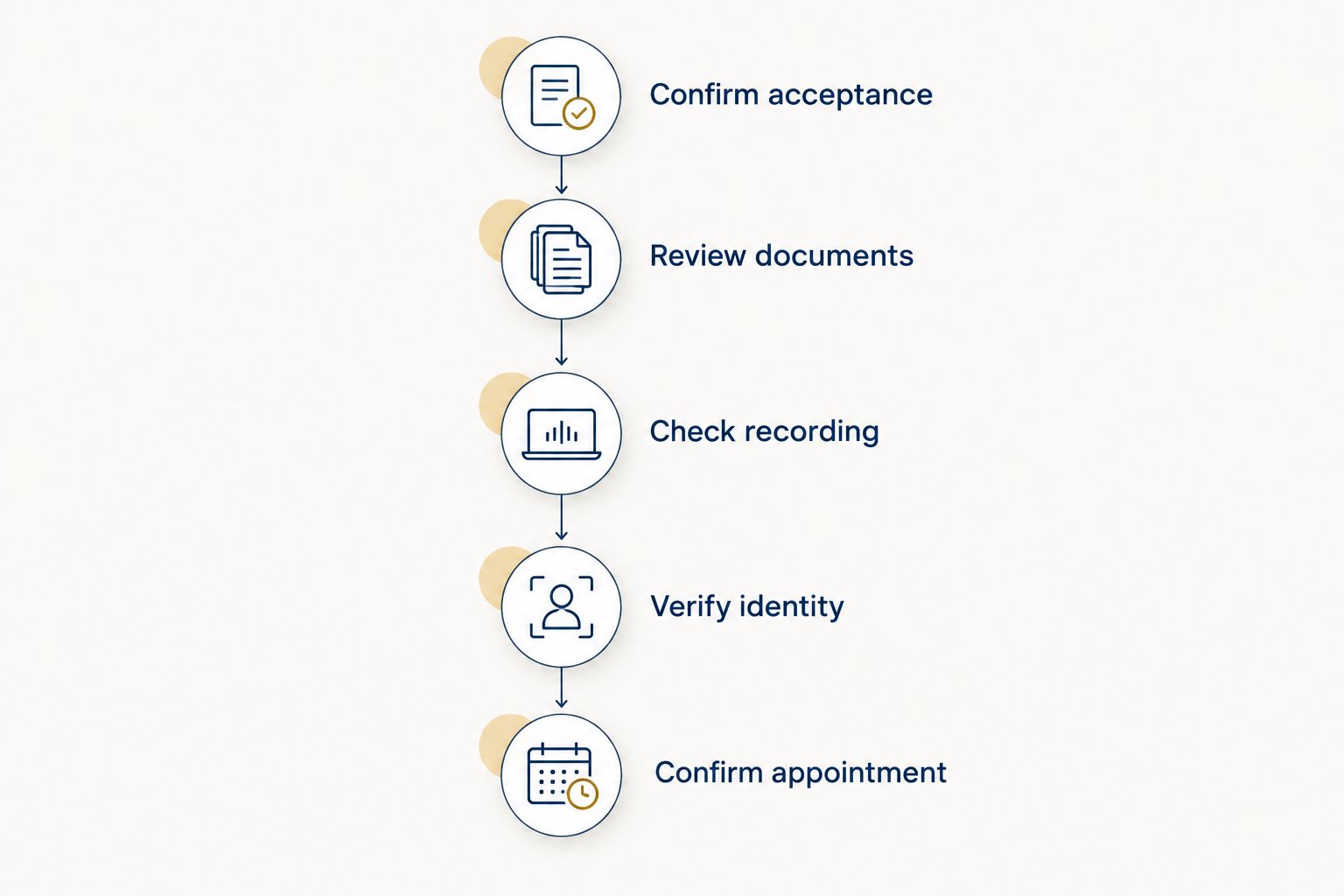
Use this sequence to establish whether remote signing fits your 2026 closing:
- Confirm acceptance. Ask the title or settlement company whether your transaction permits remote online notarization and whether the lender has approved it.
- Review documents. Identify which documents need notarization, which signing method each requires, and who provides the final versions.
- Check recording. Ask the settlement company to confirm that documents requiring recording can be submitted in the proposed format.
- Verify identity. Follow the identity verification instructions for the approved remote session rather than assuming an emailed identification image is sufficient.
- Confirm appointment. Wait for the notary’s direct confirmation and preparation instructions before treating a requested time as booked.
Why this matters
A notarization and a real estate closing are not the same service. A notary performs the required notarial act; your settlement professionals coordinate the transaction’s broader requirements, including document instructions, funding, and recording.
That distinction matters when you receive a closing package electronically. Receiving a PDF does not establish permission to sign electronically, use a remote notary, or return an electronic original. Get explicit instructions before changing the signing method.
Remote online notarization: best for approved electronic documents
Remote online notarization connects the signer and notary through an authorized audiovisual process rather than requiring physical presence in the same room. For eligible documents, Craigvetnotary offers Maryland remote online notarization through Proof.
The practical benefit is avoiding an in-person notary meeting for the approved documents. The limitation is that a remote session still depends on document eligibility, identity verification, technical readiness, and the closing parties’ acceptance.
Do not treat a general approval for electronic signatures as approval for remote notarization. Ask whether the settlement company accepts the proposed notarization process for each document that requires it and whether its instructions specify the platform or notary arrangement.
Best for: Signers whose settlement team has approved remote notarization for the relevant documents. Choose this route only after that approval is clear.
Mobile notarization: best for documents requiring physical attendance
A mobile appointment brings the notary to an agreed location for an in-person notarial act. It is a separate signing route, not an automatic substitute when a remote session does not work.
The benefit is physical attendance where the document instructions require it. The limitation is the need to coordinate location, timing, document preparation, and service availability. Craigvetnotary offers mobile appointments, with Baltimore County availability confirmed before booking.
Best for: Signers whose instructions require an in-person notarization and whose appointment location has been accepted. Confirm the arrangement before printing or signing the package.
| Signing route | Best for | Main benefit | Main limitation |
|---|---|---|---|
| Remote online notarization | Eligible documents approved for remote execution | No physical meeting with the notary for those documents | Requires accepted procedures, identity verification, and suitable technology |
| Mobile in-person notarization | Documents requiring physical attendance | Signer and notary meet at an agreed location | Requires confirmed location and appointment availability |
Neither route, by itself, means the notary is acting as your settlement agent. Ask your closing contact who is responsible for supervising the package, receiving completed documents, and resolving signing questions.
Why remote closing eligibility varies
For a Maryland real estate closing in 2026, evaluate the actual transaction rather than relying on a general statement that remote notarization is legal. These requirements determine the appropriate next step:
- Lender instructions. If financing is involved, ask whether the lender permits remote notarization for the specific loan package.
- Title and settlement procedures. Confirm who arranges the signing and whether a separately requested notary appointment is permitted.
- Document requirements. Different documents can have different execution instructions, even within the same package.
- Recording requirements. Documents destined for land records must meet the applicable receiving office’s requirements.
- Signer verification. The signer must complete the required identification process and participate in the notarial act.
- Technical readiness. A remote session requires working audiovisual communication and the ability to use the approved electronic process.
An approval at one stage does not answer every other question. For example, a lender’s acceptance does not eliminate the need to confirm how a recordable document will be delivered and submitted.
What should I ask my title company before booking?
Ask your title company to approve the proposed remote notarization arrangement before you schedule it. Give the company the document names and explain whether you are requesting notarization for a limited set of documents or the entire signing package.
Use these questions for a closing planned in 2026:
- Does this transaction permit remote online notarization?
- Has the lender approved that method for the applicable documents?
- Must the settlement company arrange the notary or platform?
- Can the approved documents be notarized through Proof?
- Which documents require a different signing method or witnesses?
- Who supplies the final documents and confirms the return instructions?
- Who verifies that recordable documents meet submission requirements?
Keep the written instructions with your closing materials. If the package changes, ask whether the approval still applies. A revised document can require another review of the signing instructions.
How do I prepare for a Maryland remote notary appointment?
Prepare only after the closing team has accepted the proposed process. For a remote appointment in 2026, follow the notary’s current instructions and the platform’s prompts rather than a checklist copied from another transaction.
Before the appointment
Have the final documents available in the format requested. Review them for completeness, but do not fill in unfamiliar legal provisions or choose a notarial certificate without appropriate direction from the document provider or a qualified attorney.
Have your identification ready and follow the stated identity verification process. Use a device with a working camera, microphone, and internet connection, and choose a private place where you can hear and respond clearly.
Do not sign in advance unless the instructions specifically permit it. The required timing depends on the notarial act, so ask the notary rather than assuming every document follows the same procedure.
During the appointment
Follow the identity verification and document-signing instructions. The notary must be able to communicate with you and complete the required notarial procedures; a failed connection or incomplete verification can prevent completion.
If the document differs from the version you expected, stop and contact your settlement professional. The notary cannot resolve a dispute over loan terms, ownership interests, or the legal effect of a document.
After the appointment
Follow the approved return instructions and confirm receipt with the settlement contact. Do not assume that completing the notarial session means the closing has funded or that the deed has been recorded.
Keep the completed documents and transaction communications according to your needs and your settlement professional’s guidance. Ask the closing team—not just the notary—what remains outstanding.
Request an eligibility review
Ask about eligible documents through Proof. Your appointment is not confirmed until CraigVet contacts you.
Can a business use the same process for repeat notarizations?
Businesses can use a repeatable intake process, but each document and transaction still needs an eligibility check. A previous successful remote notarization does not establish approval for a different lender, document package, or recording destination.
For repeat requests, identify a business contact who can obtain final documents and resolve questions with the document recipient. Gather the signer’s name, document purpose, intended recipient, deadline, and any signing instructions before requesting an appointment.
For business-owned property, ask the settlement professional what documentation establishes the signer’s authority. Identity verification establishes who is participating; it does not replace the transaction’s separate authority requirements. Do not rely on a job title alone to settle that question.
What happens if remote notarization is not accepted?
If remote notarization is not accepted, ask the settlement company to identify an approved alternative before booking another service. That alternative might involve an in-person signing or different arrangements coordinated by the closing team.
Do not print an electronic package, sign it, and scan it back without permission. Changing the document format or execution method can conflict with the recipient’s instructions.
For an in-person mobile appointment, confirm the location and service availability first. A request is not a confirmed appointment, and Baltimore County availability must be checked before booking.
FAQ
Is remote online notarization legal for Maryland real estate documents?
Maryland permits remote notarial acts, but eligibility for a real estate transaction depends on the documents and applicable closing requirements. Confirm lender, settlement, and recording acceptance before arranging the session.
Can I use any online notary for my Maryland closing?
Do not choose a remote notary independently without checking your settlement company’s instructions. The closing team can require a particular arrangement, approved process, or document return method.
Does a Proof appointment complete my real estate closing?
A Proof notarization appointment does not, by itself, complete your real estate closing. Your settlement team must confirm that all signing, funding, delivery, and recording requirements have been satisfied.
Do I need identification for a remote notary appointment?
You must complete the required identity verification for a remote notary appointment. Follow the notary’s preparation instructions and the platform’s verification prompts; do not assume that sending an identification image alone completes the process.
Can I sign my closing documents before the video appointment?
Do not sign before the appointment unless your instructions specifically permit it. Ask the notary about the required timing for the applicable notarial act, and follow the settlement company’s document instructions.
What if my closing documents need witnesses?
Confirm witness requirements and participation arrangements with your settlement professional before booking. Do not assume the notary supplies witnesses or that every witness arrangement works in a remote session.
Can the notary explain whether I should sign my closing documents?
The notary cannot advise you whether signing is legally in your interests. Craig is not an attorney and cannot provide legal advice; direct questions about rights, obligations, or document changes to a qualified attorney.
Is my appointment confirmed when I submit a request?
Your appointment is not confirmed until CraigVet contacts you. Remote eligibility and any mobile appointment availability must be established before you rely on a requested time.
One last thing
For your 2026 closing, ask one final question: Who confirms that the completed document will be accepted? That person or organization should approve the signing route before you commit to it.
A notarization can satisfy its procedural requirements without resolving every condition of the underlying transaction. Keep document acceptance, notarization, and closing completion as separate checkpoints, and ask your settlement contact to confirm each one.


