

A Maryland will does not become valid through remote notarization alone. In 2026, a will signed with remotely participating witnesses must follow Maryland’s will-execution requirements, including the attorney-supervised process for electronic presence; an ordinary online notary appointment does not replace that process.
- Can a will be notarized remotely in Maryland? Notarization alone does not satisfy Maryland’s will-execution requirements.
- Maryland’s remote will-execution process requires attorney involvement; a Proof appointment does not replace that process.
- A Maryland will generally requires the testator’s signature and at least two credible witnesses.
- CraigVet Notary Services handles eligible notary appointments, not legal advice about creating or executing wills.
Why this matters
Notarizing a signature and legally executing a will are different acts. A notary verifies identity and performs the appropriate notarial act. A will must separately meet the rules governing the person making it, the signature, and the witnesses.
That distinction matters before you upload an estate document or arrange a video call. Booking Maryland remote online notarization does not establish that a will is eligible for that appointment or that its signing arrangements meet Maryland law.
For this 2026 guide, the relevant legal framework includes Maryland Code, Estates and Trusts §§ 4-101 and 4-102, covering testamentary capacity and will execution, and State Government § 18-214, addressing notarial acts using communication technology. These are separate requirements, not interchangeable routes to a valid will.
Can a will be notarized remotely in Maryland?
Do not use a routine remote notary appointment as your will-signing plan. Maryland recognizes a process for executing a will with witnesses participating through electronic presence, but that process carries requirements beyond connecting with a notary by video.
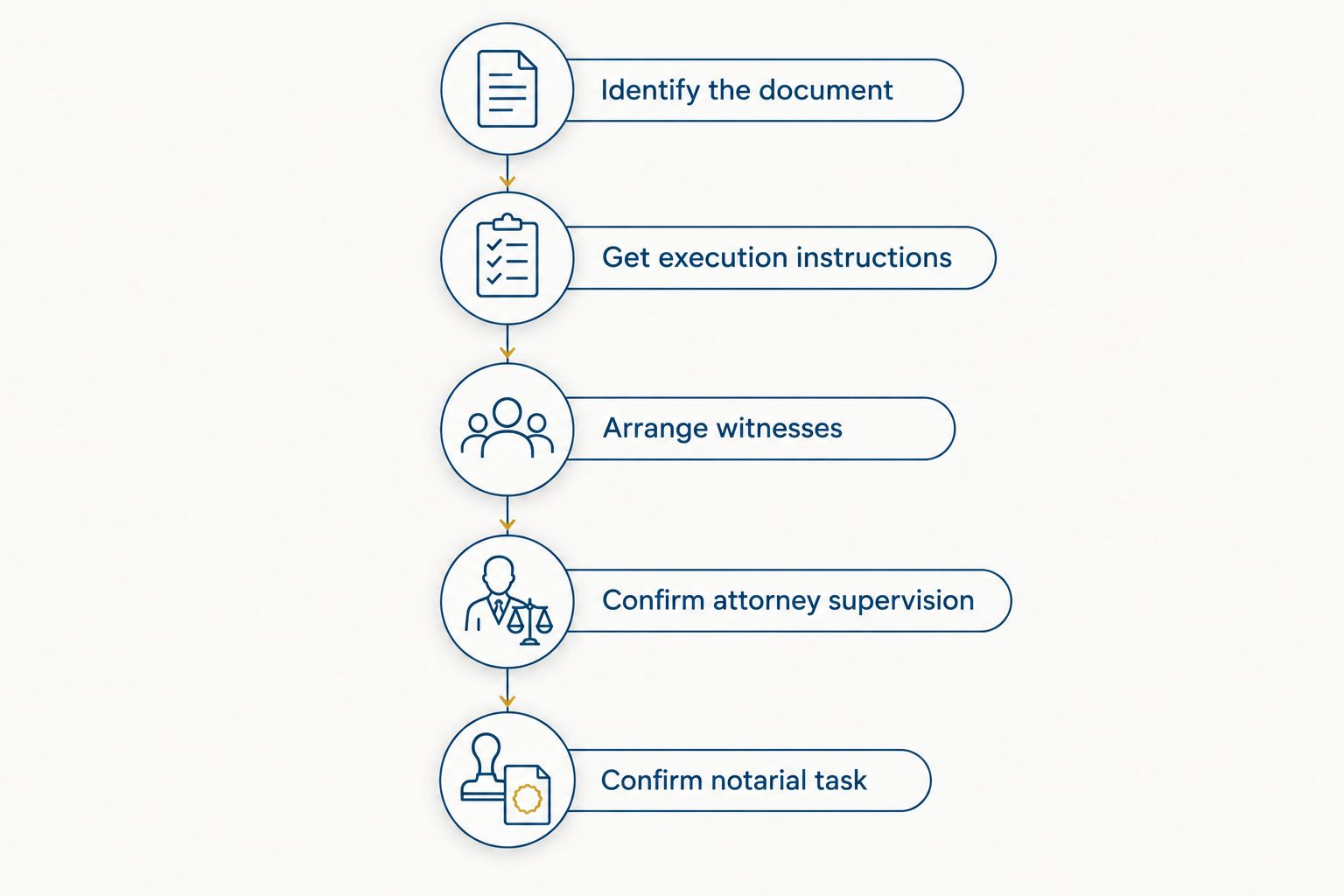
Use this sequence before arranging a signing:
- Identify the document. Establish whether you have a will, an amendment to a will, or a separate estate-planning document. Similar-looking signature pages do not establish identical legal requirements.
- Get execution instructions. Ask a Maryland estate-planning attorney which requirements apply to the exact document and proposed signing method.
- Arrange witnesses. A Maryland will generally requires at least 2 credible witnesses. A notary’s signature does not replace those witnesses.
- Confirm attorney supervision. When using electronic presence, follow the applicable attorney-supervision and certification requirements rather than assembling an informal video call.
- Confirm any notarial task. If the attorney’s instructions call for a separate notarial act, establish its eligibility and arrangements before requesting an appointment.
The practical answer is not simply whether a camera and electronic seal are available. It is whether the entire execution procedure meets Maryland’s requirements.
Notarization, witnessing, and remote execution are different
A notary appointment, a witness arrangement, and an attorney-supervised will execution serve different purposes. None should be selected solely because it is easier to schedule.
| Process | Best for | What it addresses | What it does not replace |
|---|---|---|---|
| Remote online notarization | Eligible documents requiring a notarial act | Identity verification and the applicable notarial procedure through communication technology | Will-execution requirements or legal advice |
| In-person witnessing | A will-signing plan using physical presence | Witness participation under the applicable execution rules | Document preparation or legal review |
| Attorney-supervised remote will execution | A will-signing plan using electronic presence | The specific requirements for remote participation in executing a will | Compliance with the remaining requirements for a valid will |
Remote participation removes the need for everyone to share the same room, but it introduces a specific legal procedure. In-person signing avoids that particular remote-presence issue, but it still requires proper execution.
For your 2026 appointment planning, keep the roles separate: the attorney determines the legal signing plan, witnesses perform their required role, and the notary performs only an authorized notarial act.
What Maryland requires beyond a notary stamp
Maryland’s general will requirements include capacity and execution formalities. Under Estates and Trusts § 4-101, a person making a will must be at least 18 years old and legally competent to make one.
Under § 4-102, the general execution framework requires a written will, the required signature, and attestation and signatures by at least 2 credible witnesses. The statute also addresses electronic presence and its additional requirements.
Think of the person making the will as 1 testator, with witnesses serving a separate legal function. Neither an identity check nor a notary stamp determines whether the testator has testamentary capacity or whether the document expresses legally effective instructions.
A notarized signature is not a legal opinion about the will. It does not confirm that a beneficiary designation works, that a clause is enforceable, or that the document coordinates with the rest of your estate plan.
If your instructions, document, or proposed signing arrangement conflict, stop before signing. Ask the attorney responsible for the document to resolve the conflict rather than asking the notary to choose a legal approach.
How to prepare for an eligible remote notary appointment
CraigVet Notary Services offers Maryland remote online notarization through Proof for eligible documents. That service is distinct from arranging attorney-supervised remote execution of a will.
Once the document’s legal signing requirements are settled, prepare for any eligible notarial appointment in this order:
- Describe the exact document. Explain what needs notarization and identify any written signing instructions from the document’s preparer or receiving organization.
- Request eligibility review. Do not assume an estate-planning document qualifies merely because it contains a notary certificate or signature line.
- Wait for contact. An inquiry or appointment request is not a confirmed appointment. CraigVet must contact you before you treat the arrangement as confirmed.
- Follow identity-verification instructions. Prepare the identification and information requested for the Proof process. Identity verification is part of the appointment, not a substitute for document eligibility.
- Prepare your connection. Use a device that supports the required audio and video interaction, and choose a private setting where you can communicate clearly.
- Follow signing instructions. Do not guess whether to sign beforehand, upload a previously signed copy, or change the certificate. Follow the instructions for the particular notarial act.
CraigVet Notary Services is best for Maryland clients seeking notary appointments for eligible documents, not legal advice about wills. Its role is to provide the notarial service within its limits, not to select an estate-planning strategy.
Request an eligibility review
Describe your document and signing instructions. An appointment is confirmed only after CraigVet contacts you.
Why the right signing process varies
The right process depends on the document and the signing arrangement, not simply your preference for an online appointment. Before choosing a method in 2026, resolve these factors:
- Document type: A will and a separate document accompanying it can have different execution requirements.
- Physical or electronic presence: Remote witness participation triggers requirements that do not disappear because everyone can see the video call.
- Attorney involvement: The remote will-execution process requires the appropriate attorney supervision and certification.
- Witness arrangements: Confirm who will witness, how they will participate, and how their signatures will be completed.
- Identity verification: An eligible remote notarial act requires its own identity-verification procedure.
- Receiving-party instructions: Identify any instructions from the attorney or organization handling the document without treating those instructions as a replacement for Maryland law.
These factors explain why a generic online-notary booking is not enough to settle a will-signing question.
Does a Maryland will need to be notarized to be valid?
A Maryland will generally needs at least 2 credible witnesses, not a notary stamp, to satisfy its witnessing requirement. Notarization is not the general requirement that makes a Maryland will valid; the applicable capacity and execution rules control.
Do not add a notarial certificate simply to make the document appear more official. If a prepared estate packet includes a certificate, ask the attorney what act it relates to and how it fits the signing instructions.
Can two witnesses join my will signing by video?
Having 2 witnesses on a video call is not, by itself, a compliant remote will execution. Maryland’s electronic-presence process includes attorney-related requirements, so arrange it through a Maryland estate-planning attorney rather than treating a general video meeting as sufficient.
Also distinguish remote presence from electronic signatures. Permission to participate remotely does not mean you can select any electronic-signature tool or signing method.
Is a mobile notary the alternative for a will?
A mobile appointment changes where the notary meets you; it does not change the legal requirements for the will. If your signing plan requires witnesses or attorney direction, an in-person notary visit does not supply those arrangements automatically.
CraigVet Notary Services also offers in-person mobile appointments, with Baltimore County availability confirmed before booking. Treat mobile service as a secondary option for an eligible notarial task, not as a substitute for determining how the will must be executed.
Before requesting a visit, explain the document, the proposed location, and the attorney’s signing instructions. Do not assume a notary will provide witnesses, coordinate the estate-signing process, or approve the document’s legal content.
Practical guidance for families and repeat business requests
For a family arranging estate documents, designate someone to gather the attorney’s instructions and communicate appointment details. Each signer must still participate as required; a family coordinator cannot complete another person’s identity verification or signing obligations.
For a local business coordinating repeat notarizations, separate routine eligible documents from estate-planning requests. A successful earlier appointment does not establish that a different document qualifies for the same process.
Use a short intake checklist:
- What is the exact document, rather than its general category?
- Who prepared it and supplied the signing instructions?
- Does it require witnesses, a notarial act, or both?
- Who is responsible for arranging each participant?
- Has eligibility been reviewed for the requested appointment method?
- Has the appointment actually been confirmed?
For repeat requests in 2026, consistent intake prevents staff from promising the wrong service before anyone has reviewed the document. Keep appointment coordination separate from legal questions about validity, beneficiaries, or estate-planning choices.
FAQ
Can a will be notarized remotely in Maryland and become valid that way?
Remote notarization alone does not make a Maryland will valid. The will must meet Maryland’s capacity and execution requirements, and remote witness participation requires the applicable attorney-supervised process.
Do I need two witnesses for a Maryland will?
A Maryland will generally requires at least 2 credible witnesses under Estates and Trusts § 4-102. Ask a Maryland estate-planning attorney to confirm the execution requirements for your document and signing arrangement.
Can I use Proof instead of an attorney for a remote will signing?
A Proof notary appointment does not replace the attorney involvement required for Maryland’s remote will-execution process. Confirm the will-signing plan with a Maryland estate-planning attorney before requesting any separate notarial service.
Can I sign my will before the online appointment?
Do not sign based on assumptions about the appointment. Follow the attorney’s will-execution instructions and the separate instructions for any eligible notarial act.
Can a mobile notary bring witnesses for my will?
Do not assume a mobile notary appointment includes witnesses. Confirm witness arrangements with the attorney directing the will signing and separately confirm any eligible mobile notarial service.
Is my appointment confirmed after I send a request?
An appointment request is not a confirmed appointment. CraigVet Notary Services must contact you before you treat the arrangement as confirmed; Baltimore County mobile availability also requires confirmation before booking.
Can Craig tell me whether my will is legally valid?
Craig is not an attorney and cannot provide legal advice. Questions about a will’s validity, wording, beneficiaries, or execution method belong with a Maryland estate-planning attorney.
One last thing
Check the signing instructions before checking the notary’s calendar. A document with a notary block can still require witnesses, attorney supervision, or a different execution arrangement; the printed block does not establish that remote notarization is appropriate.
Before you request an appointment, ask the preparing attorney to identify exactly what must happen, who must participate, and which document needs any notarial act. That clarification gives you a usable appointment plan without asking a notary to make a legal decision.


