

A notary generally cannot recall a completed notarization or cancel the underlying document simply because someone changes their mind after signing. In Maryland, a suspected mistake calls for review of the notarial certificate, the circumstances, and the receiving organization’s requirements—not an assumption that the notary can erase the transaction. For eligible documents, a new remote online notarization through Proof can address a replacement signing, but it does not automatically cancel the earlier document.
- Can a notary void or cancel a notarization after signing? Generally, no unilateral recall exists for a completed notarial act.
- CraigVet Notary Services offers Maryland remote online notarization through Proof for eligible documents, not cancellation of legal obligations.
- Separate a certificate error from a dispute about the document; each requires a different response.
- Contact the receiving organization before arranging a correction, replacement document, or new notarization.
Why this matters
Canceling an appointment, correcting a certificate, and canceling a contract are different actions. Confusing them can leave you with a replacement document that does not resolve the original problem.
For a Maryland appointment in 2026, CraigVet Notary Services offers remote online notarization through Proof for eligible documents, with mobile appointments as a secondary option. The first task after a disputed signing is to identify what needs attention: the notarial act, the document, or the legal arrangement behind it.
Craig is not an attorney and cannot provide legal advice. Questions about whether an agreement remains enforceable belong with a qualified attorney, not with the notary who witnessed or acknowledged the signature.
Can a notary void or cancel a notarization after signing?
Generally, a notary cannot unilaterally undo a completed notarization. A notarial act records a particular event, such as an acknowledgment or an oath associated with a signature. It does not give the notary continuing authority to withdraw your consent to the document.
The correct response depends on what happened. Use this distinction before asking anyone to stamp a replacement or mark an original as void.
| Situation | Appropriate next step | What it does not establish |
|---|---|---|
| You changed your mind about the document | Ask the recipient about withdrawal procedures; obtain legal advice where rights are involved | That the notarization or agreement is canceled |
| You found an error in the notarial certificate | Contact the original notary and receiving organization about the permitted correction process | That you should edit the certificate yourself |
| The document contains incorrect terms | Ask the document preparer or an attorney how to replace or amend it | That a notary can rewrite the agreement |
| You suspect impersonation or coercion | Preserve evidence and seek appropriate legal or law-enforcement assistance | That a replacement notarization resolves the misconduct |
| An online session was interrupted | Confirm whether a notarial act was actually completed | That closing the browser canceled a completed act |
A defect does not automatically answer whether a document has legal effect. That determination can depend on the document, the defect, and applicable law.
What should you do after finding a problem?
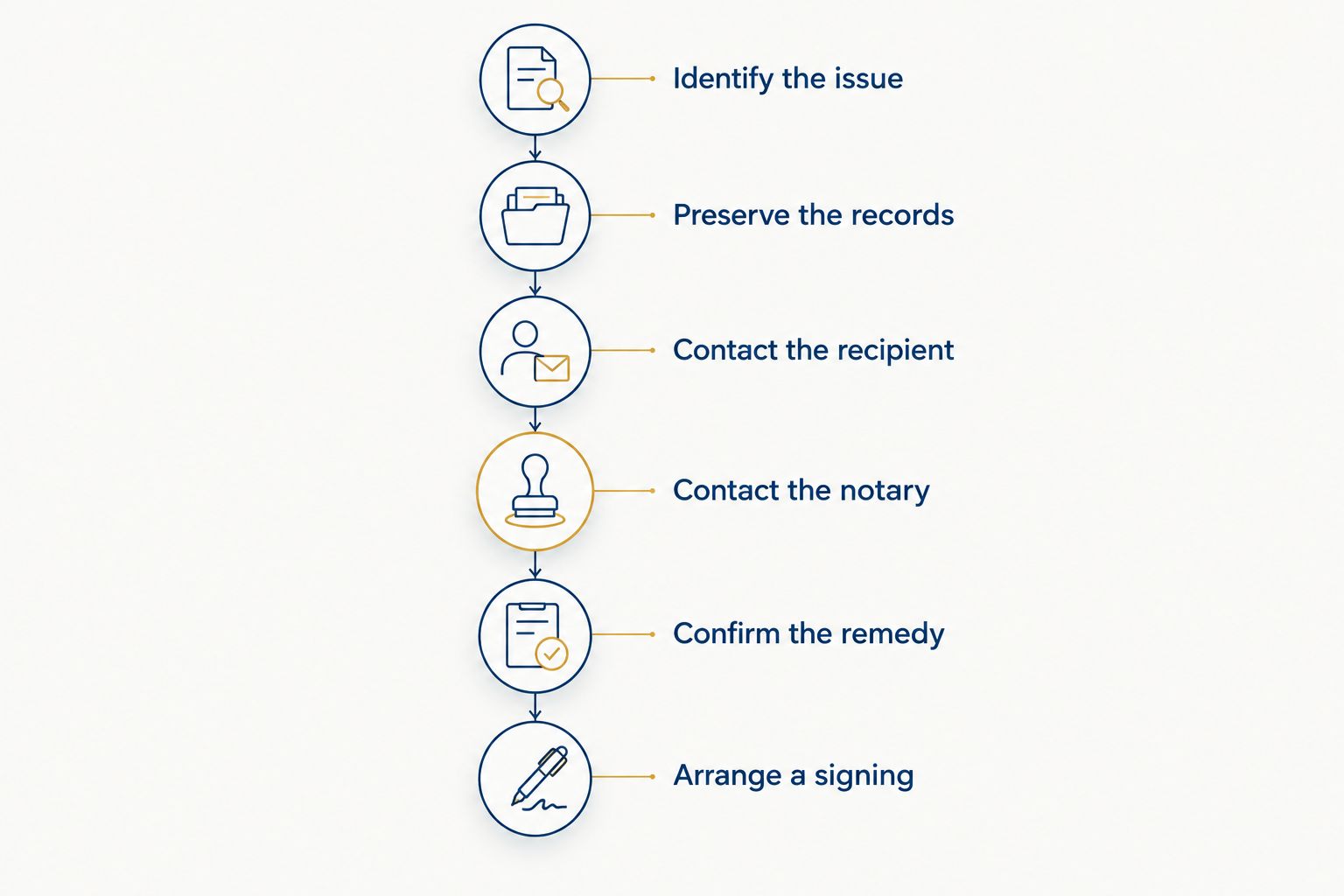
For a 2026 Maryland signing, start with a clear account of the problem rather than a request to erase the notarization. These steps help the notary and receiving organization distinguish a procedural issue from a legal dispute.
- Identify the issue. State whether the problem concerns your signature, identity verification, certificate wording, document contents, or a change of mind. Describe what happened without altering the document.
- Preserve the records. Keep the document as received, any completed electronic file, and relevant correspondence. Retain the original version separately from any proposed replacement.
- Contact the recipient. Ask whether the document has been accepted, recorded, or acted upon. Request its requirements for submitting a correction, withdrawal request, or replacement.
- Contact the notary. Explain the specific concern and ask what corrective action Maryland notarial requirements permit. The notary should not be asked to backdate a new act or certify an appearance that did not happen.
- Confirm the remedy. Determine whether the next action requires a corrected certificate, a new signing, a replacement document, or legal advice. Do not assume these are interchangeable.
- Arrange a signing. If another notarization is required, confirm document eligibility, identity-verification requirements, and appointment details before proceeding.
Keep your explanation factual. A statement such as an incorrect certificate date identifies a concrete issue; a general demand to cancel everything does not tell the recipient which action you need.
Certificate errors: correction is not cancellation
A notarial certificate records the notarial act. An incorrect entry in that certificate raises a different question from an incorrect clause in the document itself.
Contact the original notary before making any change to the certificate. The permitted response depends on the error and applicable requirements; a new notarization can require another appearance and a new certificate reflecting the actual act.
Do not change a notary’s signature, seal, or certificate yourself. Do not ask the notary to use the original signing date for a new act performed later.
A receiving organization can explain what it requires for acceptance, but its instructions do not authorize a notary to disregard Maryland notarial requirements. If those instructions conflict with what the notary can lawfully do, resolve the conflict before another appointment.
Document disputes: the notary cannot cancel your obligations
If the problem is an unwanted agreement, inaccurate terms, or a dispute between signers, focus on the document’s legal effect. Notarization and enforceability are separate questions.
A notary does not become the document’s author or legal adviser by performing the notarial act. The notary cannot decide that a signed agreement is rescinded, release a party from an obligation, or determine ownership rights.
Ask the document preparer or recipient what administrative process applies. Obtain legal advice when the issue involves rights, deadlines, property, disputed authority, or potential financial loss.
A second notarization is not a substitute for a valid cancellation or amendment process. Even when a replacement document is accepted, clarify how the recipient will treat the earlier version.
Remote online notarization: confirm whether the act was completed
An interrupted Proof session and a completed remote notarization are not the same situation. Before requesting another appointment, establish whether the notarial act was completed and which document version resulted.
For a 2026 remote appointment, ask about document eligibility and identity verification before entering a replacement signing. Do not assume that a previous identity check removes the requirements for a new notarial act.
Closing a browser, removing your own downloaded copy, or deciding not to use a completed document does not itself establish legal cancellation. Ask the recipient how to handle a document already submitted.
If the concern involves a technical problem, describe it precisely: whether the session disconnected, whether signing was completed, and whether you received a completed file. Keep technical support questions separate from questions about the document’s legal effect.
Why the corrective process varies
There is no single correction procedure for every post-signing problem. These factors determine which questions you need answered:
- The location of the error. A certificate entry and a contract term involve different responsibilities.
- Whether the act was completed. A stopped appointment is different from a completed notarization.
- The recipient’s requirements. A replacement must address what the receiving organization needs without bypassing notarial requirements.
- The document’s purpose. An administrative correction does not necessarily resolve a dispute about legal rights.
- The suspected misconduct. Impersonation, coercion, or unauthorized changes call for evidence preservation and appropriate advice, not merely another stamp.
- The next signing method. Remote eligibility and mobile arrangements must be checked for the new appointment.
Explain these facts when making contact. A precise description gives the recipient and notary a usable starting point without asking either to make assumptions.
How should you prepare for another Maryland appointment?
CraigVet Notary Services is best for Maryland individuals and businesses seeking remote online notarization for eligible documents through Proof. That service addresses a new notarial act; it does not decide whether an earlier document has been canceled.
Before requesting an appointment, have the proposed document ready for eligibility review and ask about the identity-verification process. Confirm whether the recipient needs a replacement document, a particular certificate, or another procedural step before you sign.
| Appointment option | Best for | Practical benefit | Limit to confirm |
|---|---|---|---|
| Remote online notarization through Proof | Eligible documents handled remotely | Avoids an in-person meeting | Document eligibility and identity-verification requirements |
| In-person mobile appointment | Signers seeking an in-person visit | Brings the appointment to an agreed location | Baltimore County availability and appointment arrangements |
For remote notarization, prepare to complete identity verification and participate in the live session as directed. Ask in advance what identification and technical setup your appointment requires; do not assume that every document can be notarized remotely.
For a mobile appointment, confirm Baltimore County availability before booking. A request is not a confirmed appointment until CraigVet contacts you and confirms the arrangements.
Request a Maryland notary appointment
Ask about eligible documents, Proof identity verification, or Baltimore County mobile availability.
What should a business do with a replacement document?
For repeat notarizations in 2026, separate document approval from appointment scheduling. The employee coordinating a signing should know who approves the document, who receives it, and who can authorize a replacement.
Keep the earlier and replacement versions distinguishable. Record which version was submitted and the recipient’s response, rather than assuming that the newest file automatically supersedes everything previously sent.
A useful internal handoff includes:
- The specific error or reason for replacement.
- The recipient’s written requirements, when provided.
- The approved document version for the next signing.
- The signer and any additional participants the document requires.
- The person responsible for confirming acceptance afterward.
This is document-control guidance, not a determination of legal validity. Refer disputed authority, cancellation rights, or conflicting instructions to the business’s attorney before arranging another notarization.
Can a notary refuse before the notarization is finished?
Yes. A notary can decline to complete an act when applicable requirements are not satisfied, including identity or personal-appearance requirements. Refusing an incomplete act is different from recalling a completed notarization.
Tell the notary immediately if you do not understand the document or do not want to proceed. The notary cannot provide the legal advice needed to resolve uncertainty about its terms.
Does notarizing a replacement cancel the original?
No. Notarizing a replacement does not, by itself, cancel the original document. The recipient’s procedures and applicable law determine what additional action is needed.
Before signing again, ask what happens to the earlier version. If the answer affects your rights or obligations, obtain legal advice rather than relying on the replacement stamp.
FAQ
Can a notary void or cancel a notarization after signing?
Generally, a notary cannot unilaterally recall a completed notarization or cancel the underlying document. Identify whether the concern involves a certificate error, the document’s contents, or a legal dispute before choosing the next step.
Can I cross out the notary stamp if I no longer want to use the document?
Do not cross out or alter the notary’s seal or certificate as a cancellation method. Preserve the document and ask the recipient or an attorney what withdrawal or cancellation process applies.
What if my name or the date is wrong on the notarial certificate?
Contact the original notary and receiving organization about the specific error. Do not edit the certificate yourself or assume that a correction can be made without another appearance.
Does a replacement notarization make the earlier document invalid?
No, a replacement notarization does not automatically invalidate the earlier document. Confirm how the recipient will handle both versions and obtain legal advice if their legal effect is disputed.
Can an online notarization through Proof be canceled by closing the session?
Closing a session does not itself cancel a notarial act that has already been completed. Confirm whether the act was finished and whether a completed document was issued before arranging another signing.
Can CraigVet Notary Services help with a new Maryland signing in 2026?
CraigVet Notary Services offers Maryland remote online notarization through Proof for eligible documents and in-person mobile appointments. Confirm eligibility, identity-verification requirements, and Baltimore County mobile availability; an appointment is not confirmed before client contact and confirmation.
Can Craig tell me whether my signed agreement is still enforceable?
No. Craig is not an attorney and cannot provide legal advice, including advice about enforceability, rescission, or whether a replacement document ends an earlier obligation.
One last thing
Ask what must happen to the earlier document before you sign the replacement. That question separates a completed appointment from a resolved problem.
For your 2026 records, keep the recipient’s instructions alongside the relevant document versions. A new notarial act documents a new event; it is not an eraser for the earlier one.


