

Yes, a notary can refuse to notarize a document in Maryland when identity, willingness, capacity, or another requirement for the notarial act is not satisfied. Maryland law also permits refusal for other reasons unless another law prohibits it. For a Maryland remote online notarization in 2026, eligible documents can be handled through Proof, but choosing a remote appointment does not remove these safeguards or guarantee completion.
- Can a notary refuse to notarize a document in Maryland? Yes; identity, willingness, and legal requirements matter.
- Maryland remote online notarization through Proof remains subject to document eligibility and identity verification.
- CraigVet Notary Services serves Maryland individuals and businesses seeking remote notarization of eligible documents.
- A correctable appointment problem is different from a legal question about what a document should say.
Why this matters
A refusal can interrupt a family transaction, delay a business filing, or require another appointment. The useful question is not simply whether the notary said no. It is which requirement prevented completion and whether you can address it.
For Maryland remote online notarization, CraigVet Notary Services offers appointments through Proof for eligible documents. Mobile appointments are a secondary option; Baltimore County availability must be confirmed before booking. Neither format guarantees that a particular document or signing situation qualifies.
Can a notary refuse to notarize a document in Maryland?
Yes. Maryland's notarial law allows a notary to refuse when the notary is not satisfied that the signer has the capacity to execute the record or is signing knowingly and voluntarily. It also permits refusal for other reasons unless refusal is prohibited by another law.
That discretion does not let a notary ignore legal restrictions. A refusal must still comply with applicable law, including applicable nondiscrimination requirements. Conversely, your deadline, your relationship with the notary, or your previous successful appointment does not require a notary to complete an improper act.
Maryland's Revised Uniform Law on Notarial Acts and the Maryland Secretary of State's notary guidance provide the governing framework. The practical distinctions below concern the notarial act—not whether your underlying transaction is legally advisable.
| Reason for stopping | What it means | Your next step |
|---|---|---|
| Identity cannot be established | The notary cannot satisfactorily identify the signer | Ask which identification requirements remain unmet |
| Willingness is uncertain | The signer appears pressured or does not freely agree | Allow the signer to speak independently |
| Capacity is uncertain | The notary is not satisfied that the signer can execute the record | Ask what concern prevented completion; seek legal advice when needed |
| Required appearance is missing | The required personal appearance has not occurred | Arrange the appropriate in-person or authorized remote appearance |
| A conflict prevents the act | The notary has a disqualifying interest or role | Arrange an independent notary |
| The requested act is unclear | The notary cannot determine what authorized act is requested | Obtain instructions from the recipient or an attorney |
A refusal is not a ruling that your document is invalid. It means that this notarial act was not completed under the circumstances presented.
Identity verification can prevent completion
A notary must establish the signer's identity using a method permitted by Maryland law. Having a name printed on a document does not establish identity, and familiarity with a business does not automatically establish the identity of its employees.
For remote online notarization through Proof, follow the identity-verification instructions provided for your appointment. Do not assume that displaying identification to a webcam satisfies every remote verification requirement. Resolve questions before the signing session rather than relying on the notary to overlook a failed step.
Name differences also deserve advance attention. If the document and identification use different versions of your name, explain the difference before the appointment. Do not change a legal document merely to make the names match without appropriate instructions.
Ask a procedural question: what identification or verification requirement remains unresolved? That produces a more useful answer than asking whether the notary can make an exception.
Doubts about willingness or capacity can justify refusal
A signature must reflect the signer's own decision. If someone answers every question for the signer, pressures the signer, or prevents a private response, the notary has reason to examine whether the signature is voluntary.
Capacity concerns are different from disagreement with a transaction. The notary is assessing the requirements for the notarial act, not deciding whether the document represents a wise financial or family choice.
Age, disability, or a medical diagnosis alone should not be treated as a substitute for assessing the actual signing situation. If communication or accessibility arrangements are needed, discuss them beforehand without assuming that another person can answer or sign for the individual.
For family appointments, explain the process without coaching answers. Give the signer room to respond directly. A relative's urgency does not resolve a notary's concern about willingness or capacity.
Why a Maryland notary's decision varies
The same notary can complete one appointment and stop another because the circumstances differ. For a 2026 appointment, focus on these factors rather than whether a similar document was notarized previously:
- Identity evidence: The notary needs a legally acceptable basis for identifying the person appearing.
- Requested notarial act: An acknowledgment and an oath-based act involve different requirements.
- Signer's participation: The signer must satisfy the appearance, willingness, and capacity requirements applicable to the act.
- Document readiness: Unresolved blanks, missing instructions, or uncertainty about the certificate can prevent completion.
- Notary independence: A disqualifying interest cannot be cured by the signer's permission.
- Appointment format: Remote eligibility, identity verification, and technical participation affect whether an online session can proceed.
These are checkpoints, not a promise that satisfying a checklist guarantees notarization. A notary must assess the actual circumstances when performing the act.
How do you prepare for a remote appointment after a refusal?
Identify the unresolved requirement before arranging another session. Repeating the same appointment without addressing the cause of refusal leaves the same obstacle in place.
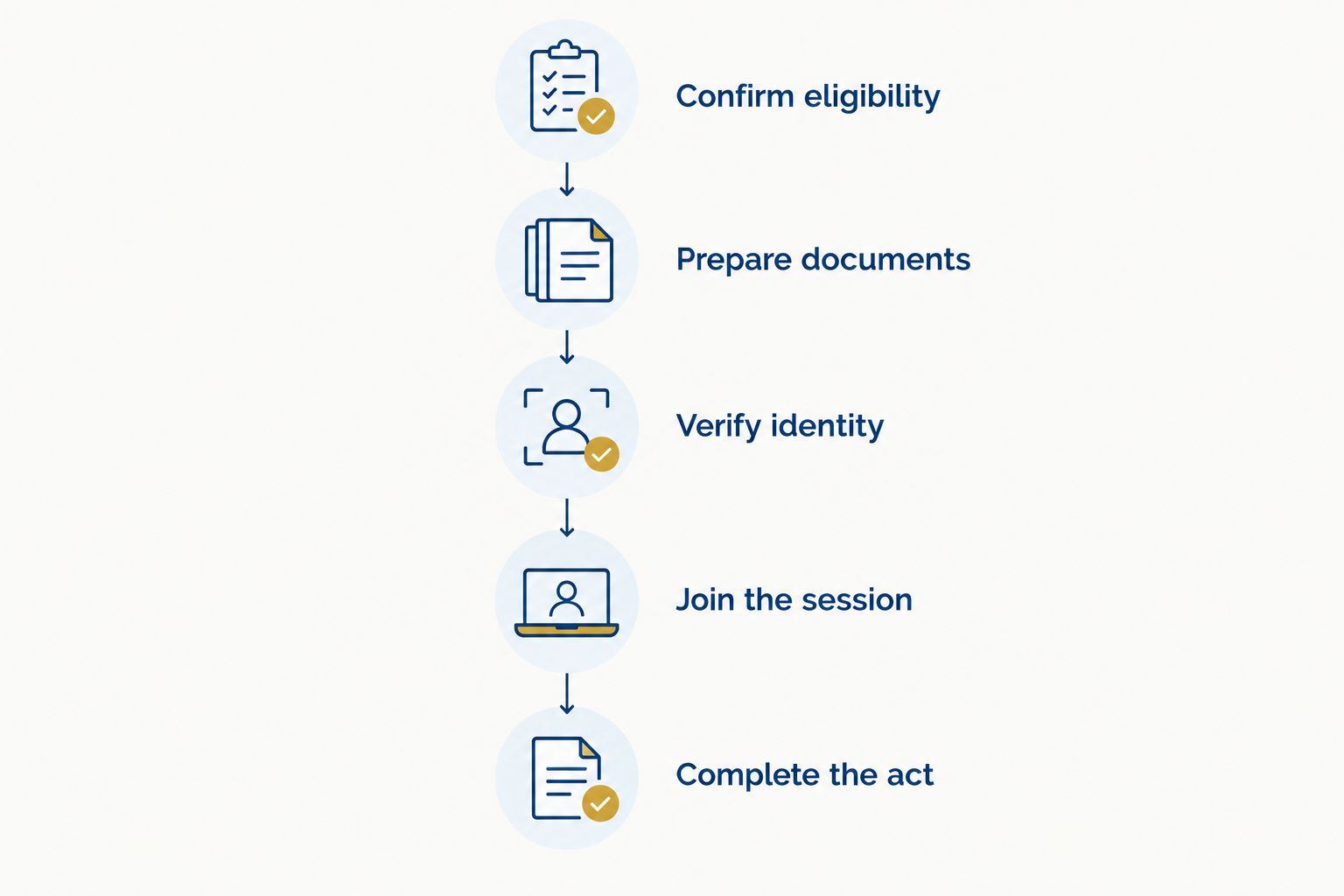
For a Maryland remote online notarization through Proof in 2026, use this sequence:
- Confirm eligibility. Explain the document type, the intended recipient, and the requested notarial act. Ask whether remote notarization is appropriate for the appointment; separately confirm the recipient's requirements.
- Prepare documents. Follow the recipient's instructions for completing the document. Identify any required witnesses or certificates before the session, and ask when signatures must be made.
- Verify identity. Follow Proof's appointment instructions and complete the required verification steps. Raise identification questions before the scheduled signing.
- Join the session. Use the instructed setup and a connection that allows you to communicate with the notary. Keep the signer available to answer directly.
- Complete the act. Follow the notary's directions for the requested act. If an unresolved requirement stops the session, ask what must happen before another attempt.
CraigVet Notary Services is best for Maryland individuals and businesses seeking remote notarization of eligible documents through Proof. An appointment request is not a confirmed appointment; wait for contact confirming the arrangements.
Request a Maryland notary appointment
Discuss remote document eligibility or confirm Baltimore County mobile availability before booking.
Is mobile notarization a solution if remote notarization stops?
Mobile notarization changes the appointment format, not the notary's legal duties. An in-person meeting can address a remote participation problem, but it does not resolve coercion, a disqualifying conflict, or uncertainty about the requested act.
Choose the format around the actual obstacle. If the problem concerns document instructions, resolve those instructions first rather than arranging travel for an appointment that still cannot proceed.
| Appointment format | Best for | Practical advantage | Limitation |
|---|---|---|---|
| Remote online through Proof | Eligible documents and signers able to complete remote requirements | The signer and notary meet remotely | Eligibility, identity verification, and technical requirements still apply |
| In-person mobile | Signers seeking an in-person appointment | The notary meets the signer in person | Baltimore County availability must be confirmed before booking; all notarial requirements still apply |
Use mobile service to address a format problem, not to bypass a safeguard. Tell the next notary why the earlier appointment stopped so the underlying issue can be assessed before arrangements are made.
What should you ask after a refusal?
Ask whether the issue concerns identity, document preparation, appearance, willingness, capacity, or a conflict. Then ask whether it is something you can correct before requesting another appointment.
Keep the conversation procedural. A notary can explain what prevented completion without advising you how to rewrite a contract, transfer property, or select a legal strategy.
Useful questions include:
- What requirement prevented this notarial act?
- Which appointment instructions should I review before trying again?
- Does the document recipient need to clarify the requested certificate or act?
- Is an in-person appointment relevant to this particular problem?
- Does this question require an attorney rather than a notary?
Do not ask the notary to backdate a certificate, ignore verification, or certify an appearance that did not occur. A deadline does not authorize those shortcuts.
How can a business reduce repeat appointment problems?
For repeat notarizations in 2026, standardize preparation without assuming automatic approval. Each signer and each notarial act still requires its own assessment, even when your business uses the same document repeatedly.
Use 1 checklist per document so requirements do not get lost across a batch. Record the recipient's instructions, the requested act, the signer's name, any witness instructions, and whether remote acceptance has been confirmed. Keep legal questions separate from appointment logistics.
Assign 1 appointment coordinator to gather instructions and communicate scheduling details. That coordinator organizes the process; the coordinator does not replace the signer's participation or answer questions about the signer's willingness.
Review 1 document at a time before submitting a batch. A recurring template can still contain a missing field, an unexpected certificate, or instructions that differ from the previous transaction.
After a refusal, update the checklist with the procedural correction rather than unnecessary sensitive information. Better preparation reduces avoidable obstacles, but it never removes the notary's duty to assess the appointment.
FAQ
Can a Maryland notary refuse even if I have identification?
Yes. Identification is only part of the requirements for notarization. The notary must also address the requested act, required appearance, willingness, capacity, and any disqualifying conflict.
Can a notary refuse because I already signed the document?
An existing signature does not automatically prevent every notarial act. An acknowledgment and a verification on oath or affirmation have different signing requirements, so ask the notary for instructions before signing again.
Can every Maryland document be notarized online in 2026?
No. Maryland remote online notarization is for eligible documents and appointments that satisfy applicable requirements. Confirm document eligibility and the recipient's requirements before arranging a session.
Will a mobile notary complete a document that an online notary refused?
Not necessarily. An in-person appointment does not remove identity, willingness, capacity, or conflict requirements. It is relevant when the unresolved issue concerns the remote appointment format.
Can a family member answer questions for the signer?
A family member should not replace the signer's own responses about willingness or the signing decision. Discuss communication or accessibility needs before the appointment so appropriate arrangements can be considered.
Can I ask another notary after a refusal?
Yes, but another notary must independently satisfy the requirements for the act. Explain why the earlier appointment stopped instead of concealing the issue or seeking someone to disregard it.
Is my appointment confirmed when I submit a request?
No. A CraigVet Notary Services appointment is not confirmed until the client is contacted and the arrangements are confirmed. Baltimore County mobile availability must be confirmed before booking.
Can Craig tell me which legal document or certificate to choose?
Craig is not an attorney and cannot provide legal advice. Ask the document recipient for its requirements and consult an attorney when selecting a document or notarial act requires legal judgment.
One last thing
Ask what act the recipient requires—not simply where the stamp belongs. A notarial certificate records a particular act, and a stamp cannot substitute for the required appearance, identification, acknowledgment, oath, or affirmation.
Before your next appointment, obtain clear recipient instructions and share the reason for any previous refusal. That gives you a practical path to resolving the issue without asking a notary to step outside Maryland notarial requirements.


