

No. Form I-9 employment eligibility verification does not require notarization, and a notary seal does not replace the employer’s verification responsibilities. An employer can designate a notary as its authorized representative to complete the employer’s portion, but the person acts as a representative—not as a notary—and must follow the applicable document-examination procedure.
- Can a notary notarize I-9 employment verification forms? No; Form I-9 requires employer verification, not notarization.
- USCIS permits employers to designate authorized representatives, including notaries, to complete the employer’s portion.
- An ordinary video call does not satisfy physical document examination requirements.
- Maryland remote online notarization through Proof is separate from Form I-9 employment eligibility verification.
Can a notary notarize I-9 employment verification forms?
Form I-9 is not a notarial certificate. A notary who helps complete it needs authorization from the employer, not a request to stamp the form. The employer remains responsible for errors made by its authorized representative.
For Maryland clients, Craigvetnotary provides remote online notarization through Proof for eligible documents. That service must not be confused with completing an employer’s I-9 process.
| Process | Best for | What it accomplishes | Important limitation |
|---|---|---|---|
| Form I-9 verification | Employers documenting a new hire’s identity and employment authorization | Records the required examination and employer certification | A notary seal does not satisfy the process |
| Maryland remote online notarization | Clients with eligible documents requiring a notarial act | Allows an eligible notarization through an online appointment | It does not automatically qualify as remote I-9 examination |
| Mobile notarization | Clients needing an eligible in-person notarial act | Brings the notarial appointment to an agreed location | Physical attendance alone does not authorize someone to complete an I-9 |
For 2026 hiring workflows, use the current U.S. Citizenship and Immigration Services (USCIS) Form I-9 instructions and its Handbook for Employers, also called M-274, as the federal references. Separate employer instructions from any instructions for an unrelated notarization.
Why this matters
Calling the appointment an “I-9 notarization” creates the wrong expectation. The employer needs someone to examine acceptable documents and complete the relevant certification, not someone to acknowledge a signature under a notarial seal.
The distinction also protects the employee. A worker should not arrive expecting an online notarial appointment when the employer requires physical examination of original documents.
Decide which service you need before scheduling. If a separate employment document requires notarization, handle that document as a separate request rather than adding a seal to Form I-9.
How does a notary act as an I-9 authorized representative?
An employer can designate an authorized representative to act on its behalf. USCIS does not require that representative to hold a notary commission, and having a commission does not by itself create employer authorization.
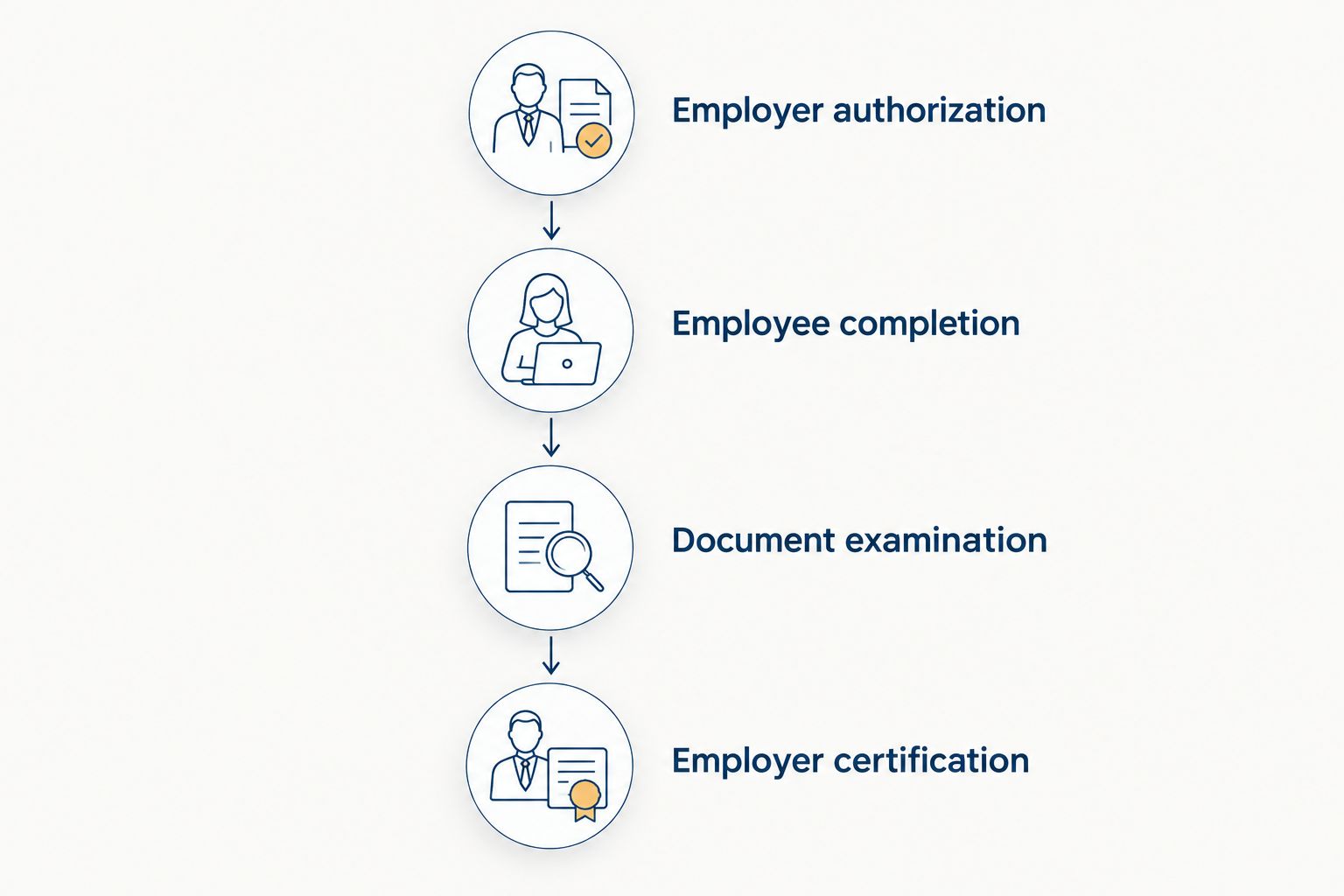
Use this sequence before the employee attends an appointment:
- Employer authorization. Ask the employer to identify who can complete the verification and provide its instructions. Confirm the employer accepts the proposed representative before arranging the meeting.
- Employee completion. The employee completes and signs Section 1 no later than the first day of employment for pay. The employer’s representative must not substitute their own answers for the employee’s attestations.
- Document examination. Follow the applicable examination procedure. Under the standard physical-examination process, examine original acceptable documents in the employee’s presence, subject to USCIS exceptions such as an acceptable certified birth certificate or qualifying receipt.
- Employer certification. Complete the appropriate employer fields accurately, using the employer’s information and the representative’s own signature where required. Return the completed form through the employer’s approved process.
The representative must determine whether the documents reasonably appear genuine and relate to the person presenting them. This is not a guarantee of document authenticity, and it is not a notarial acknowledgment.
For a 2026 appointment, obtain the employer’s current instructions before the meeting rather than relying on an old onboarding email. A representative needs to know which process the employer requires and where the completed record belongs.
What documents should an employee bring?
Employees choose which acceptable documents to present. The employer or representative must not demand a particular document, such as a passport or green card, when the employee presents another acceptable combination.
There are 2 document routes for establishing identity and employment authorization:
| Document route | Best for | What the employee presents | Limitation |
|---|---|---|---|
| List A | Employees choosing a document or document combination that establishes both requirements | An acceptable List A document or listed combination | Follow the current list and any document-specific conditions |
| List B plus List C | Employees choosing to establish the requirements separately | 1 acceptable List B document and 1 acceptable List C document | Both parts are required; a List B document alone is insufficient |
List B establishes identity. List C establishes employment authorization. Do not treat a document as acceptable merely because it includes a photograph, a signature, or a government agency’s name.
Use the official Lists of Acceptable Documents, not an appointment provider’s improvised checklist. USCIS rules address receipts, extensions, and other special circumstances that require more care than a general instruction to bring photo identification.
For repeat business appointments, tell employees where to find the acceptable-document lists without choosing documents for them. Keep that message consistent across new hires so individual employees are not given different documentary demands.
When must the employer complete the verification?
The employer generally must complete Section 2 within 3 business days after the employee’s first day of employment for pay. Section 1 is due no later than that first day.
A shorter employment period has a different rule: if employment will last fewer than 3 business days, the employer must complete Section 2 no later than the first day of employment. Scheduling a representative does not extend either deadline.
For 2026 onboarding, build the appointment into the hiring process before the employee starts. Waiting until the deadline to discover that a provider only performs notarizations creates an avoidable scheduling problem.
If a deadline has already been missed, the employer should follow USCIS guidance for completing and correcting the record. Never backdate a signature or ask a representative to certify an examination that did not occur.
Why the right appointment process varies
The correct arrangement depends on the employer’s verification process, not on whether the appointment provider advertises notary services. Confirm these factors before booking:
- Employer designation: The employer must authorize the person acting on its behalf; the employee’s request alone is not enough.
- Examination method: Standard physical examination and the authorized alternative procedure have different requirements.
- Document choice: The employee decides which acceptable documents to present, including an acceptable List A route or List B and List C combination.
- Hiring deadline: The employee’s start date determines when the employer’s portion must be completed.
- Provider acceptance: Do not assume a notary accepts I-9 representative work merely because the person offers notarization.
- Separate notarial needs: An additional affidavit or other employment document needs its own eligibility review if notarization is requested.
A clear request identifies the employer, the required task, the examination method, and the deadline. It does not simply ask for an “employment verification stamp.”
Can a remote notary verify I-9 documents over video?
A remote online notarization appointment is not a substitute for the standard I-9 physical-examination process. Proof identity verification and an online notarial session do not, by themselves, satisfy the employer’s I-9 obligations.
USCIS permits an alternative remote document-examination procedure for qualifying employers enrolled in E-Verify and in good standing. That procedure includes reviewing document copies, conducting a live video interaction, retaining required copies, and making the required indication on Form I-9.
The employer must establish eligibility for that procedure and follow all of its requirements. An employee cannot turn a standard physical-examination appointment into a compliant remote process by choosing a video call.
For 2026 remote hires, ask the employer a specific question: “Are you using physical document examination through an authorized representative, or the DHS-authorized alternative procedure?” Get that answer before sending identity documents or booking a session.
How should staffing agencies handle I-9 appointments?
Staffing businesses need a repeatable handoff between the hiring team, employee, and authorized representative. The organization responsible for completing Form I-9 must be clear; responsibility should not be inferred from the worksite address or the person arranging the appointment.
Understanding how staffing agencies verify work eligibility starts with separating the employer’s I-9 certification from placement logistics, background screening, and any separate notarization. Those tasks serve different purposes, even when they occur during the same onboarding period.
Give the representative the employer’s instructions before the meeting. Include the employer’s contact for procedural questions, the examination method, the submission process, and the employee’s start date.
For repeat appointments, check completed records for missing fields and unresolved questions promptly. A recurring arrangement does not transfer the employer’s responsibility to the representative or make earlier instructions permanently current.
Standardize the handoff, not the employee’s document choice. A consistent process should preserve the employee’s right to choose acceptable documentation.
How should Maryland clients request the right service?
Craigvetnotary’s notary services fit Maryland clients who need eligible documents notarized; employer-directed I-9 verification is a separate task. The business offers remote online notarization through Proof and in-person mobile notary appointments.
For an eligible remote notarization, describe the document and requested notarial act when submitting the appointment request. Follow the appointment instructions for identity verification and the live online session, and do not assume every document qualifies for remote completion.
If your employer asks you to find a notary for Form I-9, clarify that the request concerns authorized-representative work. Ask whether Craigvetnotary accepts that assignment before treating it as a service booking.
Mobile appointments are secondary to the remote service. Baltimore County availability must be confirmed before booking, and an appointment is not confirmed until Craigvetnotary contacts you.
Craig is not an attorney and cannot provide legal advice. Direct questions about immigration status, employment eligibility, disputed document requirements, or legal consequences to the employer’s qualified adviser rather than asking a notary to make those decisions.
Does Form I-9 need a notary stamp?
Form I-9 does not need a notary stamp. The authorized representative signs the employer certification in that capacity; the representative does not add a notarial certificate to turn the verification into a notarization.
If the employer separately requests a notarized statement, identify that document and its requirements independently. Do not assume the separate statement replaces Form I-9.
Can an employee choose any notary for the appointment?
The employer must approve or designate the authorized representative. An employee can suggest a person, but a notary appointment alone does not establish that the employer accepts the representative or the proposed process.
Confirm acceptance before sharing documents or traveling. Also confirm that the person agrees to perform representative work rather than only notarial acts.
FAQ
Can a notary notarize I-9 employment verification forms in Maryland?
Form I-9 does not require notarization in Maryland. An employer can designate a notary as an authorized representative, but that person completes the employer’s verification task rather than performing a notarial act.
Do I need a notary if my employer tells me to get my I-9 notarized?
Ask the employer whether it means an authorized representative must examine your documents and complete its portion of Form I-9. The form itself does not require a notary seal, and the employer must approve the representative.
Can I complete my I-9 through an ordinary video call?
An ordinary video call does not satisfy the standard physical document-examination requirement. A qualifying employer using the DHS-authorized alternative procedure must follow that procedure’s separate requirements.
What is the employer’s I-9 completion deadline?
The employer generally must complete Section 2 within 3 business days after employment for pay begins. If the job will last fewer than 3 business days, Section 2 must be completed no later than the first day.
Can my employer insist that I bring a passport?
Your employer cannot demand a passport when you present another acceptable document or combination. Employees choose from the applicable USCIS Lists of Acceptable Documents.
Is Proof identity verification the same as I-9 verification?
Proof identity verification for a remote notarial appointment is not the same as the employer’s Form I-9 verification. Completing one process does not automatically satisfy the other.
Which I-9 instructions should an employer use in 2026?
Use the current USCIS Form I-9 instructions, Lists of Acceptable Documents, and Handbook for Employers for your 2026 hiring process. Confirm that any employer-specific instructions follow the applicable federal procedure.
One last thing
The most useful appointment question is not “Do you have a notary stamp?” It is “Has my employer authorized you to complete its I-9 verification, and which examination procedure will you follow?”
That question separates the task from the professional title. Get the employer’s answer and the provider’s acceptance before the appointment, then bring the acceptable documents you choose under the applicable USCIS rules.


