

Yes, a notary can notarize documents for multiple signers during the same appointment, provided each signer meets the requirements for the notarial act. For Maryland remote online notarization through Proof, the document, identity-verification requirements, and proposed signer arrangement need review before the session is confirmed. Sharing an appointment does not replace each signer’s required appearance, identification, acknowledgment, or oath.
- Can a notary notarize documents for multiple signers at once? Yes, when each signer meets the applicable requirements.
- Maryland remote online notarization through Proof requires eligibility review and individual identity verification.
- CraigVet Notary Services suits Maryland clients seeking remote notarization for eligible documents.
- A shared appointment does not guarantee that every signature belongs in one notarial certificate.
Why this matters
Coordinating several signers is a scheduling task and a notarial task. Getting everyone onto a call does not establish that the document is eligible, the required people have appeared, or the notarial certificate fits the transaction.
For your 2026 appointment, send the document and signer details before arranging everyone’s attendance. CraigVet Notary Services offers Maryland remote online notarization through Proof, with mobile appointments as a secondary option. A request is not a confirmed appointment; wait until the business contacts you.
Can a notary notarize documents for multiple signers at once?
Yes. Multiple signers can share a notary appointment, but the notary must address each person’s participation separately. A person’s presence does not establish another person’s identity or authorize someone else’s signature.
The relevant question is not simply how many names appear on the document. It is what each person must do, what notarial act is requested, and whether the appointment format supports those requirements.
| Appointment format | Best for | Practical advantage | Limitation to resolve before booking |
|---|---|---|---|
| Maryland remote online notarization through Proof | Eligible documents and signers seeking an online appointment | Participants use an online notarization process rather than meeting the notary physically | Confirm document eligibility, identity verification, and the proposed signer arrangement |
| In-person mobile notarization | Signers seeking an in-person appointment at an agreed location | The notary and signers meet physically | Confirm Baltimore County availability, the location, and everyone’s attendance before booking |
Neither format removes the need to identify each signer and perform the required notarial act. Choose the format after confirming the document’s requirements, not merely because everyone prefers the same meeting time.
What does “at once” actually mean?
A shared appointment means the notary handles the participating signers within an arranged session. It does not mean the notary verifies everyone collectively or treats all signatures as interchangeable.
For example, a document with 2 signers still requires the notary to address each signer’s identity and required participation. One person cannot simply confirm the other person’s identity on the assumption that being spouses, relatives, or business partners is enough.
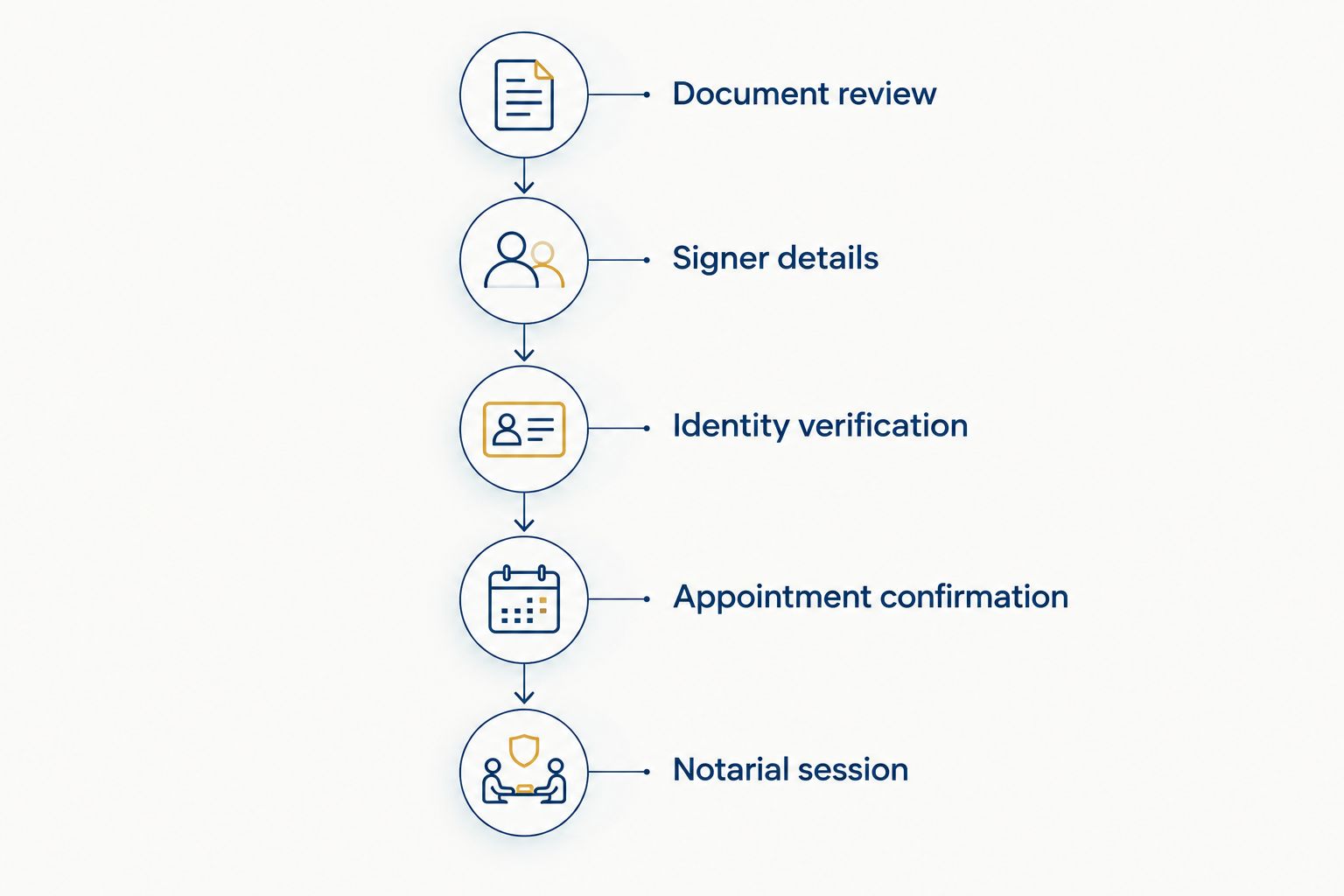
Arrange a Maryland remote online appointment in clear steps
Use this sequence when requesting a multi-signer appointment in 2026. Complete the document and participation review before asking everyone to reserve the same time.
- Document review. Explain what document needs notarization, who will receive it, and how many people must sign. Follow the instructions for submitting documents securely; do not send identity documents through an unrequested channel.
- Signer details. Identify everyone whose signature requires notarization. Explain whether the participants expect to join from the same place or different locations, and identify any separate witness requirements.
- Identity verification. Ask what each signer needs for the Proof identity-verification process. Each person should follow the appointment instructions rather than assuming another participant’s verification covers the group.
- Appointment confirmation. Wait for contact confirming the proposed arrangement and next steps. Do not treat a submitted request or a suggested time as a confirmed session.
- Notarial session. Follow the notary’s directions for appearing, acknowledging or signing as required, and completing any oath or affirmation. Do not sign early unless the instructions for the particular notarial act permit it.
This sequence separates preparation from the notarial act itself. Clearing the scheduling details does not remove the notary’s responsibility to assess the participants and document during the session.
What should each signer prepare?
Each signer should read the appointment instructions personally. Forwarding an invitation without the preparation instructions leaves important details unresolved.
Have the document ready in the requested format, review the identity-verification instructions, and confirm the equipment needed for an online appearance. If a name on the document differs from the identification a signer intends to present, raise that issue before the appointment rather than assuming the difference is acceptable.
Also flag any difficulty communicating with the notary or participating independently. The organizer should not answer substantive questions on another signer’s behalf or pressure someone to continue.
Multiple signers on the same document
When several people sign one document, identify which signatures actually require notarization. A document can contain names, witness lines, organizational titles, and signature spaces serving different purposes.
Do not assume that every name needs the same notarial act. The certificate wording and transaction requirements matter, and the notary cannot choose legal requirements for you.
For a business agreement with 3 signers, prepare a simple roster showing each person’s name and role. Treat that as an organizational aid, not a substitute for the document’s instructions or the notary’s individual checks.
A shared document also does not automatically mean a shared certificate. Ask whether the existing certificate can properly record the requested acts; obtain legal or recipient guidance when the document leaves the required act unclear.
Multiple signers with separate documents
A shared appointment can involve separate documents, but each document still needs review. Similar-looking forms do not necessarily request the same acknowledgment, oath, or other notarial act.
If your group brings 2 documents, identify the signers and receiving organization for each document. This prevents the organizer from treating the entire packet as a single undifferentiated request.
For repeat business appointments, keep a document inventory alongside the signer roster. List the document title, intended signer, recipient, and any instructions supplied by the recipient. Avoid entering unnecessary sensitive information into a scheduling spreadsheet.
Organize by document and signer, not just by meeting time. A calendar invitation shows who was invited; it does not show whose signature needs notarization on which page.
Why multi-signer appointment requirements vary
The number of people matters, but it is not the only planning factor. Review these details before requesting a shared appointment:
- Document eligibility. Confirm whether the particular document is suitable for Maryland remote online notarization and whether the intended recipient accepts that format.
- Required notarial act. An acknowledgment and a verification on oath or affirmation involve different signer actions. Obtain direction when the required act is unclear.
- Individual identification. Every signer must satisfy the identification requirements applicable to the session; another participant’s successful verification does not cover the group.
- Signer locations. Tell the notary where each participant expects to be. Do not assume that an online connection alone establishes eligibility for every location arrangement.
- Witness requirements. Identify any required witnesses separately from the people whose signatures need notarization. A notary appointment does not automatically supply witnesses.
- Recipient instructions. A properly performed notarial act and a recipient’s document-acceptance requirements are separate issues. Resolve format questions with the receiving organization before the session.
These factors explain why a group appointment needs review rather than an automatic confirmation. They also give your business a repeatable intake checklist without assuming that every future document will qualify.
Practical guidance for repeat business appointments
CraigVet Notary Services is best for Maryland clients seeking remote online notarization for eligible documents. For a business organizing repeat notarizations, the useful starting point is a consistent intake process—not a promise that every packet can use the same arrangement.
Assign an organizer to gather document and scheduling information. Each signer should still receive the instructions directly and remain responsible for their own participation.
Keep a reusable 2026 intake checklist
Record the document title, intended recipient, signer names, signer locations, requested appointment format, and any witness instructions. Distinguish information supplied by the recipient from assumptions made internally.
Before reusing an earlier arrangement, check whether the document or participants have changed. A previous successful appointment does not establish eligibility for a different document, a different signer, or a different location.
Separate administrative help from legal decisions
An office manager can coordinate attendance and distribute instructions. That role does not authorize the office manager to select a notarial act, change legal wording, or decide whether someone has authority to bind a business.
Craig is not an attorney and cannot provide legal advice. Direct questions about legal effect, representative authority, or which notarial act a document requires to the document’s issuer or a qualified attorney, as appropriate.
Treat mobile appointments as a separate arrangement
If the online format does not fit the request, ask about an in-person mobile appointment. Confirm Baltimore County availability before booking and identify the proposed location and participants.
Mobile service is not an automatic fallback with a reserved time. The business must contact you before the appointment is confirmed, and an in-person meeting does not remove document or identification requirements.
Can everyone join from different locations?
Different locations need review before a Maryland remote online appointment is confirmed. Explain where each signer will be and ask whether the proposed arrangement is eligible and supported through Proof.
Do not send a shared meeting invitation as proof that the arrangement has been accepted. The appointment instructions—not the organizer’s assumptions—should control how each signer joins.
Do all signers have to sign in front of the notary?
The required notarial act determines what each signer must do in the notary’s presence. An acknowledgment generally involves acknowledging an existing signature, while a verification on oath or affirmation requires the applicable oath or affirmation and signing procedure.
Do not instruct everyone to sign in advance. Follow the notary’s directions for the particular document and act.
Can one signer finish if another signer is absent?
An absent signer’s required appearance cannot be replaced by another participant. Whether the available signer’s portion can proceed separately depends on the document, certificate, and requested act.
Tell the notary about the absence before the session. Do not assume the entire document will be completed or accepted with a required signer missing.
FAQ
Can a notary notarize documents for multiple signers at once?
Yes, multiple signers can share an appointment when each person meets the requirements for the requested notarial act. Each signer’s identity and required participation must be addressed individually.
Can my business request a group online notarization in Maryland in 2026?
Yes, your business can request a group appointment, subject to document eligibility and review of the signer arrangement. CraigVet Notary Services offers Maryland remote online notarization through Proof; wait for contact before treating the appointment as confirmed.
Does every signer need to complete identity verification?
Yes, each signer must satisfy the identification requirements applicable to the appointment. One participant’s verification does not establish another participant’s identity.
Can a spouse or business partner appear for an absent signer?
A spouse or business partner cannot replace another signer’s required personal appearance merely because of that relationship. Questions about signing under legal authority require separate review, and Craig cannot provide legal advice.
Does one document with several signatures need only one notarial certificate?
Several signatures do not automatically mean one certificate is appropriate. The required acts, certificate wording, and participants’ appearances determine what the notary can properly complete.
Will an online notary appointment include any witnesses we need?
Do not assume an online appointment includes witnesses. Identify any witness requirements before booking and confirm how those requirements will be addressed.
Can we request a mobile appointment instead of using Proof?
Yes, you can request an in-person mobile appointment. Baltimore County availability and the proposed arrangement must be confirmed before booking.
One last thing
Ask the receiving organization about remote electronic notarization before coordinating everyone’s calendars. Document acceptance and the notary’s ability to perform an act are different questions.
For a multi-signer appointment, that early check is especially useful: it lets you resolve the format before asking the entire group to prepare. Confirm the document first, then coordinate the people.


