

Yes, a notary can notarize eligible documents for someone in a Maryland hospital or nursing home, either through a permitted remote online session or an in-person visit. The signer must participate personally, satisfy identity-verification requirements, and sign willingly; a relative cannot simply sign in the patient’s place without appropriate legal authority. Facility access, document requirements, and the signer’s condition must be checked before an appointment proceeds.
- Can a notary notarize documents at a hospital or nursing home? Yes, when identity, willingness, and document requirements are satisfied.
- CraigVet Notary Services offers Maryland remote online notarization through Proof for eligible documents; mobile availability requires confirmation.
- A hospital visit does not remove identity-verification, witness, or personal-participation requirements.
- Confirm document acceptance, facility access, and the signer’s ability to participate before requesting an appointment.
Can a notary notarize documents at a hospital or nursing home?
The location does not replace the requirements for a valid notarial act. A hospital room or nursing-home setting can accommodate notarization, but the notary still needs to determine whether the requested act can proceed.
For Maryland appointments in 2026, CraigVet Notary Services offers remote online notarization through Proof for eligible documents, with mobile appointments as a secondary option. Baltimore County mobile availability must be confirmed before booking. Submitting a request does not confirm an appointment; wait for the business to contact you.
| Appointment format | Best for | Main advantage | Main limitation |
|---|---|---|---|
| Maryland remote online notarization through Proof | Eligible signers who can participate in the online process | Does not require a notary to enter the facility | Requires suitable technology, successful identity verification, and an eligible document |
| In-person mobile notarization | Signers whose circumstances call for a physical visit | Allows the notary and signer to meet in person | Depends on confirmed availability, facility access, and document requirements |
These 2 appointment formats address different practical needs. Neither guarantees that a document can be notarized, and neither allows the notary to overlook concerns about identity or willingness.
Prepare for Maryland remote online notarization
Start with remote online notarization when the document and signer are eligible. For a hospital patient or nursing-home resident, the practical question is whether the person can participate directly in the session—not whether a family member can operate the device alone.
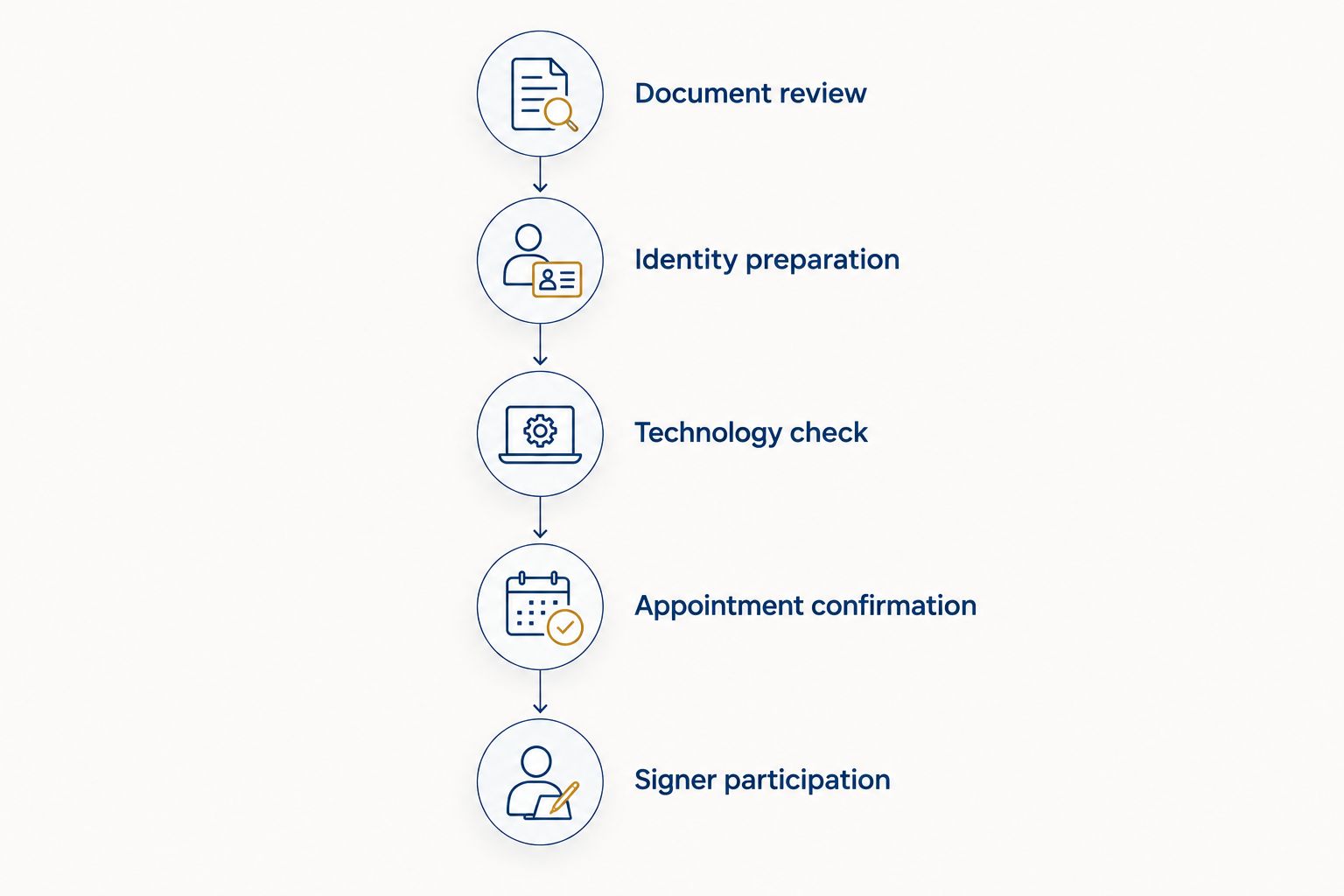
Use these 5 preparation steps for a 2026 appointment request:
- Document review. Identify the document, the receiving organization, and any instructions supplied with it. Ask the recipient whether it accepts remote online notarization and whether witnesses or a particular form are required.
- Identity preparation. Have the signer’s identification information ready and ask what the Proof identity-verification process requires. Do not assume a facility wristband or a relative’s confirmation replaces that process.
- Technology check. Confirm access to a suitable device, camera, microphone, and internet connection. Arrange a setting where the signer can hear, respond, and communicate without someone answering for them.
- Appointment confirmation. Explain that the signer is in a hospital or nursing home and describe practical barriers, such as restricted device use or scheduled care. Wait for direct confirmation before treating the requested session as scheduled.
- Signer participation. Follow the notary’s instructions during the session. The signer must personally complete the required participation; assistance with a device does not authorize another person to answer identity or willingness questions.
Ask before signing anything in advance. The correct procedure depends on the notarial act, and an earlier signature does not remove the signer’s obligation to appear and participate as required.
Why this matters
A care setting adds coordination problems to an already important document task. Medical care, visitor restrictions, and the signer’s ability to communicate all affect whether the appointment can proceed without interruption.
Arrange the appointment around the signer, not just the paperwork. A family’s urgency does not establish the signer’s willingness, and a completed notarial certificate does not establish that the document achieves the family’s legal goal.
For your 2026 preparation checklist, separate document questions from appointment questions. Ask the receiving organization or an attorney about legal requirements; ask the notary about the notarial process and appointment arrangements.
Remote online notarization at a care facility
Remote online notarization connects the signer and notary through an authorized online process rather than putting them in the same room. At a care facility, that approach still requires the signer to complete the applicable identity checks and participate in the live session.
CraigVet Notary Services is best for Maryland individuals and businesses seeking remote online notarization through Proof for eligible documents. That service fits a care-setting request only when the document, signer, and appointment circumstances meet the applicable requirements.
The practical benefit is avoiding the need to coordinate a notary’s physical entry. The limitation is that a video connection alone is not enough: eligibility, identity verification, and personal participation still control whether the act proceeds.
Before choosing remote notarization, ask these questions:
- Can the signer see, hear, and communicate through the device?
- Does the facility permit the equipment and internet access needed for the session?
- Can the signer complete the required identity-verification process?
- Has the document recipient confirmed any acceptance or witness requirements?
A caregiver can help position equipment or arrange a quiet space. The caregiver should not supply the signer’s answers, direct the signer’s choices, or treat the session as something that can be completed on the patient’s behalf.
Mobile notarization at a hospital or nursing home
An in-person mobile appointment brings the notary to the signer’s location. It is an option to discuss when remote participation is unsuitable, but a physical visit does not resolve every obstacle.
For Baltimore County requests in 2026, confirm mobile availability before making arrangements with the facility. Provide the facility name, location, access instructions, and the signer’s preferred contact person when requesting the appointment. Do not describe a visit as booked until you receive confirmation.
The advantage is direct, in-person interaction without requiring the signer to use the remote platform. The limitation is the need to coordinate travel, building access, visitor procedures, and the signer’s availability.
Ask facility staff about:
- Visitor authorization and any restrictions on outside service providers.
- Where the appointment can take place without disrupting care.
- Whether the signer’s identification and documents will be accessible.
- How staff will communicate a room change or interruption.
- Whether any proposed staff witnesses are permitted and willing to serve.
Do not assume a nurse, administrator, or receptionist can act as a witness. Witness eligibility and facility policy are separate questions, and staff participation must be arranged rather than presumed.
Why a hospital or nursing-home appointment varies
The same document title does not mean every bedside appointment follows the same process. These factors determine what needs to be settled before the notary proceeds:
- Document purpose: A healthcare directive, financial authorization, and other signed statement can involve different instructions and formalities.
- Recipient requirements: The organization receiving the document can have requirements that need clarification before signing.
- Signer participation: The notary needs direct interaction with the signer, not answers supplied entirely by a family member.
- Identification: Remote verification and in-person identification follow their applicable procedures; care-facility admission does not replace them.
- Witness arrangements: Some documents require witnesses in addition to a notarial act. A notary appointment does not automatically supply them.
- Facility access: Visiting rules, care schedules, privacy, and equipment restrictions affect practical arrangements.
Resolve these questions before gathering everyone for the signature. Discovering a missing witness or an unaccepted signing method at the bedside creates an avoidable interruption.
Does a medical power of attorney always need notarization?
No. Execution requirements depend on the applicable law and the particular document; a healthcare-related title does not establish that notarization is required or sufficient. Ask an attorney or the receiving organization to clarify the requirements rather than adding a notarial act by assumption.
A notarized medical power of attorney and hospital admission paperwork address different tasks: documenting decision-making authority is not the same as completing a facility’s intake process. A workflow used in another state does not establish Maryland signing requirements.
Before requesting notarization, identify what the document authorizes, who will receive it, and which execution instructions apply. If witnesses are required, confirm their qualifications and participation separately from the notary appointment.
Craig is not an attorney and cannot provide legal advice. CraigVet Notary Services cannot choose a legal document for you, decide who should receive decision-making authority, or determine whether a document accomplishes your legal objective.
Can a patient’s relative sign instead?
A relative cannot sign for a patient merely because of the family relationship. Any authority to act for someone else must be established through the applicable legal arrangement and reflected in the document’s signing requirements.
If someone proposes signing under an existing power of attorney or another representative role, disclose that before the appointment. Ask an attorney or the receiving organization to confirm the authority and required signing format; the notary does not create authority through notarization.
Do not substitute a relative’s signature because the patient is tired, unavailable, or unable to participate. Those circumstances require clarification of the legal and procedural options, not an improvised signature.
What if the signer is confused, sedated, or unable to communicate?
Tell the notary about participation concerns before arranging the session. A diagnosis or medication name alone does not answer whether a particular notarial act can proceed, and the notary does not perform a medical capacity assessment.
The notary must still address the applicable requirements for the act, including the signer’s identity and willingness. If the signer cannot communicate sufficiently for those requirements to be satisfied, the appointment cannot proceed simply because relatives agree that signing would be helpful.
Coordinate timing with facility staff without asking anyone to change medical care for the appointment. If legal deadlines or decision-making authority are involved, seek legal guidance rather than assuming a later notary visit will solve the issue.
Practical guidance for families and repeat business requests
Families should designate a contact person to coordinate access and paperwork, while keeping the signer’s decisions separate from that coordination. Have the complete document and recipient instructions available rather than bringing only the signature page.
For businesses handling repeat requests in 2026, use the same intake checklist each time. Record the document type, intended recipient, proposed signing method, witness instructions, facility contact, and appointment-confirmation status. Keep sensitive identity information out of unnecessary group messages.
A repeat relationship does not waive identity verification or make every future document eligible for remote notarization. Review each request on its own facts, especially when the signer, facility, or receiving organization changes.
FAQ
Can a notary come to a hospital room in Maryland?
Yes, an in-person notarization can take place in a Maryland hospital room when facility access and the applicable notarial requirements are satisfied. Confirm mobile availability and access arrangements before treating a visit as booked.
Can someone in a nursing home use an online notary?
Yes, a nursing-home resident can use remote online notarization when the document and signer are eligible. The resident must complete the required identity verification and personally participate in the online session.
Does a hospital wristband count as identification for notarization?
Do not rely on a hospital wristband as a substitute for the required identification process. Ask the notary what identification is acceptable for the proposed in-person or remote appointment.
Can I arrange notarization for my parent without attending?
You can help coordinate an appointment, but your parent must satisfy the signer requirements personally. Ask whether any document-specific witnesses or other participants need to attend.
Will the notary bring witnesses to the nursing home?
Do not assume witnesses are included in the appointment. Confirm whether the document requires witnesses and arrange eligible participants before the session.
Can a notary notarize a document if the patient cannot answer questions?
A notary cannot proceed when the applicable participation requirements cannot be satisfied. A family member answering in the patient’s place does not resolve that problem.
Is my appointment confirmed after I send a request?
No, sending a request does not confirm an appointment. Wait for CraigVet Notary Services to contact you and confirm the arrangements, including any Baltimore County mobile availability.
One last thing
Ask what the receiving organization needs before asking when the notary can arrive. Confirm the exact document, signing method, and witness instructions first. That sequence prevents an appointment from producing a notarized document that still fails the recipient’s requirements.


