

Yes—a notary can notarize an eligible loan signing document remotely when the notary is authorized to perform remote online notarization and the lender and other receiving parties accept that method. For a Maryland appointment in 2026, confirm document eligibility, identity verification requirements, and delivery instructions before scheduling; a remote notarial act does not automatically make an entire loan package acceptable for remote closing.
- Can a notary notarize a loan signing document remotely? Yes, when eligibility and recipient acceptance are confirmed.
- Maryland remote online notarization requires identity verification and a live audiovisual appointment, not just an electronic signature.
- CraigVet Notary Services is best for Maryland clients seeking eligibility review before an online notary appointment.
- Confirm lender instructions before signing; requesting an appointment does not confirm a booking.
Can a notary notarize a loan signing document remotely?
Yes, but approval must cover the document, the notarization method, and the receiving party's requirements. A lender's willingness to accept electronic signatures is not, by itself, approval for remote online notarization.
For Maryland remote online notarization through Proof, CraigVet Notary Services offers a starting point for reviewing eligible documents and appointment requirements. Craig must contact you before an appointment is confirmed.
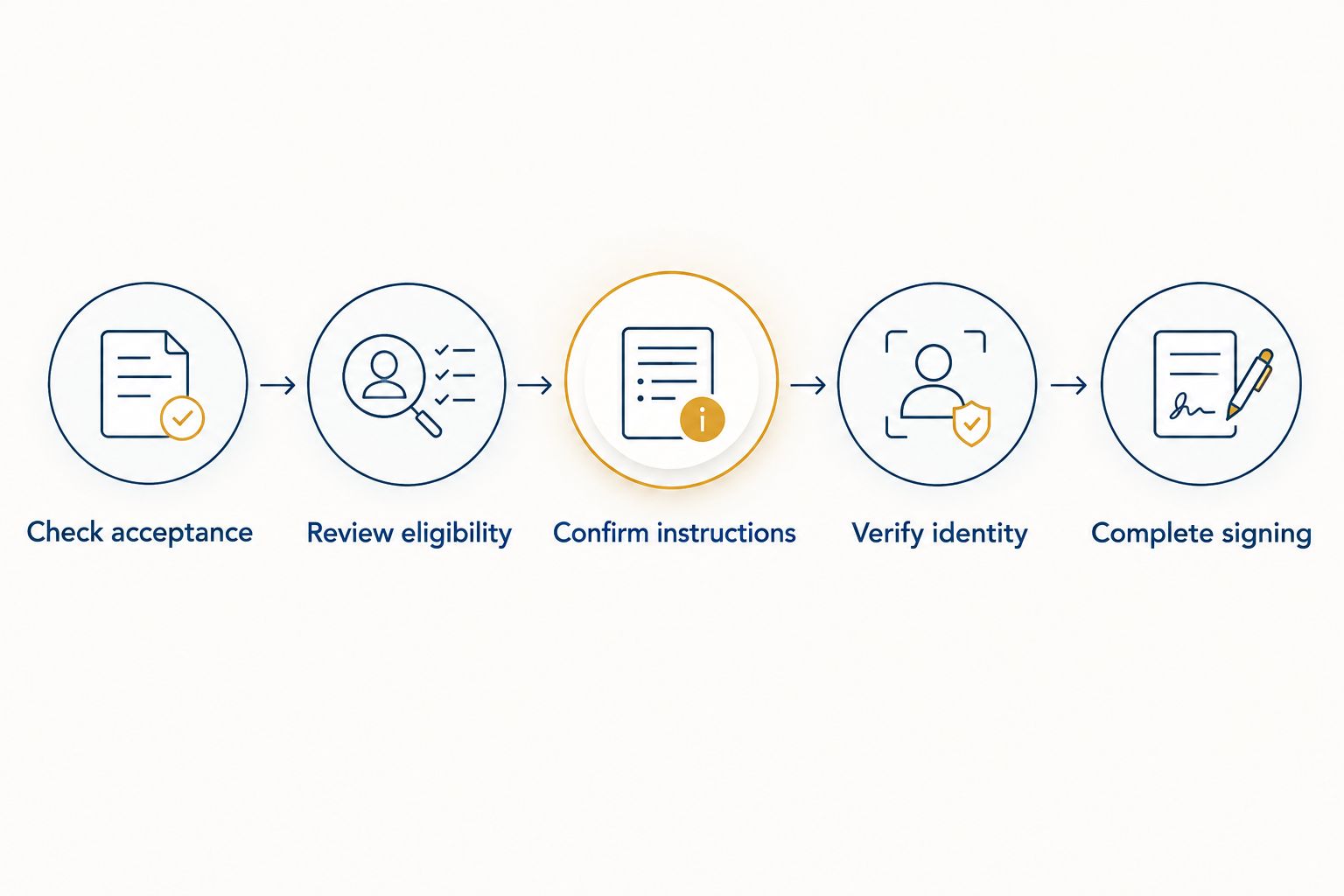
Use these 5 preparation steps before arranging a remote loan-document notarization:
- Check acceptance. Ask your lender and, when involved, your title or settlement company whether they accept remote online notarization for the specific document. Identify the office or person responsible for approving the signing method.
- Review eligibility. Provide the document type and relevant signing instructions for review. Do not assume that eligibility for one document extends to every document in the package.
- Confirm instructions. Ask who must sign, whether witnesses are required, and how the completed document must be returned. Resolve conflicting directions before the appointment.
- Verify identity. Follow the Proof appointment instructions for identity verification. Prepare the identification and device access specified for your appointment rather than relying on an identification list from another service.
- Complete signing. Attend the live remote session and follow the notary's directions. Return the completed document using the receiving party's approved delivery method.
These steps separate appointment preparation from loan approval. The notary performs the authorized notarial act; the lender and other receiving parties determine whether the resulting document satisfies their transaction requirements.
Why this matters for a loan signing
A loan package can contain documents with different signing requirements. Some require a notarial act, while others require signatures without notarization. Treating the package as a single undifferentiated task makes it harder to identify which instructions apply to which document.
The practical distinction is between completing a notarization and completing a closing. A properly performed notarial act does not replace lender review, settlement instructions, or any applicable recording requirements.
For a 2026 transaction, get current instructions from the party receiving the document. A process accepted for an earlier transaction is not approval for a new one, even when the borrower, property, or lender is familiar.
Remote online notarization or a mobile appointment?
There are 2 appointment routes to consider: remote online notarization and an in-person mobile appointment. Start with remote eligibility; consider mobile service when the transaction requires physical presence or paper handling.
| Appointment route | Best for | Main benefit | Main limitation |
|---|---|---|---|
| Remote online notarization through Proof | Eligible documents whose receiving parties accept remote notarization | You meet the notary through a live audiovisual session without an in-person visit | Document eligibility, identity verification, technology, and recipient acceptance must all be satisfied |
| In-person mobile notarization | Documents requiring an in-person appointment or an approved paper-signing process | You meet the notary in person at an agreed location | Travel arrangements and Baltimore County availability require confirmation before booking |
Remote notarization is the first route to review, not a promise that every loan document qualifies. An in-person appointment also needs advance review; choosing paper does not remove questions about witnesses, document instructions, or the required notarial act.
CraigVet Notary Services provides Maryland remote online notarization through Proof, with mobile appointments as a secondary service. For a mobile request, confirm Baltimore County availability before making plans around a proposed location or time.
Why remote loan-document eligibility varies
Remote eligibility depends on the transaction rather than the convenience of the appointment. These factors determine what you need to confirm:
- Document requirements: Identify the document and the notarial act requested. A general request to notarize a loan package leaves important instructions unresolved.
- Recipient acceptance: Confirm that the lender and other relevant receiving parties accept remote online notarization, not merely electronic signatures.
- Identity verification: The signer must complete the verification required for the remote appointment. Having identification nearby is preparation, not a guarantee of successful verification.
- Signer and witness arrangements: Determine who must participate and whether the document requires witnesses beyond the notary. Obtain instructions for arranging their participation.
- Technology access: The remote session requires working audiovisual access and the ability to follow the platform's signing process. Resolve connection or device problems before starting.
- Document delivery: Confirm whether the receiving party expects an electronically completed document, paper originals, or another approved return method.
These factors are review questions, not reasons to assume rejection. Asking them early gives the notary and transaction parties a clear basis for deciding how to proceed.
What should you ask your lender before booking?
Use 3 acceptance checks: approval of remote notarization, approval of the specific document, and approval of the return method. Ask for instructions tied to your transaction rather than a general statement that the lender accepts digital documents.
A useful request identifies the document by its actual name and asks whether Maryland remote online notarization is acceptable. If a title or settlement company is coordinating the signing, include that company in the confirmation process.
Your preparation list should answer these questions:
- Which documents require notarization?
- Is remote online notarization accepted for each of those documents?
- Who must sign, and are witnesses required?
- Are there instructions for the notarial certificate?
- Who receives the completed document, and in what form?
- Who can resolve a conflicting instruction during preparation?
Do not ask the notary to choose between conflicting lender and settlement instructions. Send the conflict back to the responsible transaction contact. Clear directions protect you from completing a session that does not satisfy the intended recipient.
How does identity verification work for a remote appointment?
Identity verification is part of remote online notarization, not an optional preliminary step. For a Maryland appointment through Proof, follow the verification directions supplied for that appointment and be prepared to participate in the live audiovisual session.
Do not assume that displaying an identification document over a routine video call completes the process. Remote notarization uses an authorized workflow; an ordinary video meeting and a scanned signature are not substitutes.
Before your appointment, check that you can access the required device, camera, microphone, and connection. Use a setting where you can hear instructions, respond clearly, and review the document without unnecessary interruptions.
For your 2026 appointment, rely on current appointment instructions rather than a saved checklist from another platform. If verification cannot be completed, contact the notary for the next procedural step instead of attempting to bypass it.
Can you sign the loan document before the remote appointment?
Ask before signing. Whether a document can already bear your signature depends on the required notarial act and the receiving party's instructions. Do not assume every loan document follows the same signing procedure.
For example, an acknowledgment and a signature witnessed as part of a notarial act do not necessarily have identical signing requirements. Tell the notary if a document is already signed so the situation can be reviewed before the session.
If you are unsure which notarial act is required, ask the document's issuer or a qualified attorney. The notary cannot provide legal advice or select a legal course of action for you.
Does remote notarization complete the entire loan closing?
No—remote notarization completes the applicable notarial act, not every obligation in a loan closing. The transaction can still require additional signatures, lender review, document delivery, or recording steps.
Ask your lender or settlement contact who is responsible for each remaining task. A completed notarial certificate does not show that every closing condition has been satisfied.
Keep the final document and the return instructions together. Before treating the task as finished, confirm that you have delivered the document to the correct recipient in the required form.
Practical guidance for businesses with repeat notarizations
A business arranging recurring notarizations should separate reusable preparation from transaction-specific approval. A standard internal checklist helps employees gather the right information, but each document still needs its own eligibility and acceptance review.
Assign a business contact to coordinate document instructions, signer participation, and return requirements. That person should know which questions belong with the notary and which require the lender, settlement company, or legal adviser.
For repeat appointments, keep these responsibilities clear:
- The business supplies accurate document and signer information.
- The receiving party confirms its acceptance and delivery requirements.
- The notary reviews the requested notarial service and appointment procedure.
- Each signer completes the required identity verification and participates as instructed.
For a 2026 workflow, build in a confirmation stage before notifying employees that an appointment is booked. An inquiry, submitted request, or proposed time does not become a confirmed appointment until CraigVet contacts the client.
This approach supports repeat work without assuming that prior approval carries over. Changes in the document, signer, or recipient can change the preparation required.
What can the notary explain, and what requires legal advice?
The notary can explain the appointment process, identity verification steps, and requirements for performing the requested notarial act. Questions about loan terms, legal consequences, document selection, or whether you should sign belong with the appropriate lender contact or a qualified attorney.
Craig is not an attorney and cannot provide legal advice. Notarization does not establish that a loan is suitable for you or that its terms protect your interests.
If you do not understand a clause, pause before signing and obtain an explanation from the responsible professional. Appointment convenience should not replace understanding the document you are being asked to execute.
FAQ
Can a Maryland notary notarize my loan document online?
Yes, a Maryland notary authorized for remote online notarization can notarize an eligible loan document when the applicable requirements are met. Confirm that your lender and other relevant receiving parties accept remote notarization before scheduling.
Is an electronic signature the same as remote online notarization?
No, an electronic signature is not the same as remote online notarization. Remote notarization includes identity verification, a live audiovisual appearance, and the required notarial act; signing electronically alone does not provide those elements.
Can every document in my mortgage package be notarized remotely?
No, you should not assume that every document in a mortgage package qualifies for remote notarization. Ask the lender or settlement company to identify which documents require notarization and which methods it accepts for each document.
What identification should I prepare for a Proof appointment?
Prepare the identification specified in the instructions for your Proof appointment. Follow the current verification directions and ask about unclear requirements before the session; possessing identification does not guarantee successful verification.
Can I request a mobile appointment instead of remote notarization?
Yes, you can request an in-person mobile appointment for review. Baltimore County availability and the appointment details must be confirmed before booking, and the document still needs to meet the applicable notarial requirements.
Does submitting an appointment request confirm my booking?
No, submitting an appointment request does not confirm your booking. Wait until CraigVet contacts you and confirms the arrangements before treating a proposed time or location as scheduled.
Can Craig explain whether I should sign my loan agreement?
No, Craig is not an attorney and cannot provide legal advice about whether you should sign a loan agreement. Direct questions about legal consequences to a qualified attorney and questions about lender instructions to the responsible lender contact.
One last thing
Before requesting your 2026 appointment, identify the person who will accept the completed document. Ask that person to confirm the notarization method and return instructions together, not as separate assumptions.
A convenient signing method is useful only when it produces a document the intended recipient accepts. Keep that acceptance check ahead of scheduling, identity verification, and signing.


