

Yes—a notary can notarize a document written in a foreign language when the document, signer, communication, and notarial certificate meet the applicable requirements. For Maryland remote online notarization through Proof, a foreign-language document still requires an eligibility review; notarization does not certify its translation or guarantee that the receiving organization will accept it.
- Can a notary notarize a document written in a foreign language? Yes, subject to applicable notarial requirements.
- Maryland remote online notarization requires more than a readable signature: communication, identity verification, and certificate requirements matter.
- Notarization does not establish that a foreign-language document or its translation is accurate.
- Ask the receiving organization about translation and authentication requirements before requesting an appointment.
Why this matters
A document's language is only part of the decision. You also need to know what notarial act the recipient requires, whether you can communicate with the notary, and whether the completed document will meet the recipient's submission rules.
For a 2026 appointment, start with an eligibility inquiry through CraigVet Notary Services. Maryland remote online notarization through Proof is the primary option for eligible documents; submitting an inquiry does not confirm an appointment.
A notarized signature and an accepted document are different outcomes. Establish the recipient's requirements before arranging the signing, especially when a document will cross a national border.
Can a notary notarize a document written in a foreign language?
Yes, provided the notary can lawfully complete the requested notarial act. The document's foreign language does not, by itself, answer whether a particular notarization can proceed.
For Maryland appointments, distinguish the document's contents from the notarial certificate. The document contains the transaction or statement. The certificate records the act the notary performs, such as taking an acknowledgment or administering an oath for a sworn statement.
The notary must understand the certificate being completed and communicate sufficiently with the signer to perform the act. Do not assume that an accompanying friend, translated summary, or interpreter resolves those requirements.
| Situation | What supports proceeding | What still needs review |
|---|---|---|
| Foreign-language document with an understandable notarial certificate | The certificate makes the requested act identifiable | Signer communication, identity, document eligibility, and recipient instructions |
| Foreign-language document and foreign-language certificate | A notary who understands the certificate can assess its wording | Whether the certificate satisfies Maryland notarial requirements |
| Signer and notary cannot communicate directly | A notary who shares the signer's language addresses the communication issue | Do not assume an interpreter is an acceptable substitute |
| Recipient requests a certified translation | Translation and notarization can be addressed as separate requirements | Who must certify the translation and what statement, if any, requires notarization |
This distinction matters because the notary does not approve the underlying agreement. A properly performed notarization does not establish that the document is legally effective, correctly translated, or suitable for its intended purpose.
How do you request a Maryland remote appointment?
For a foreign-language document in 2026, request review before selecting a signing arrangement. Explain both the document's language and the language you use comfortably in conversation.
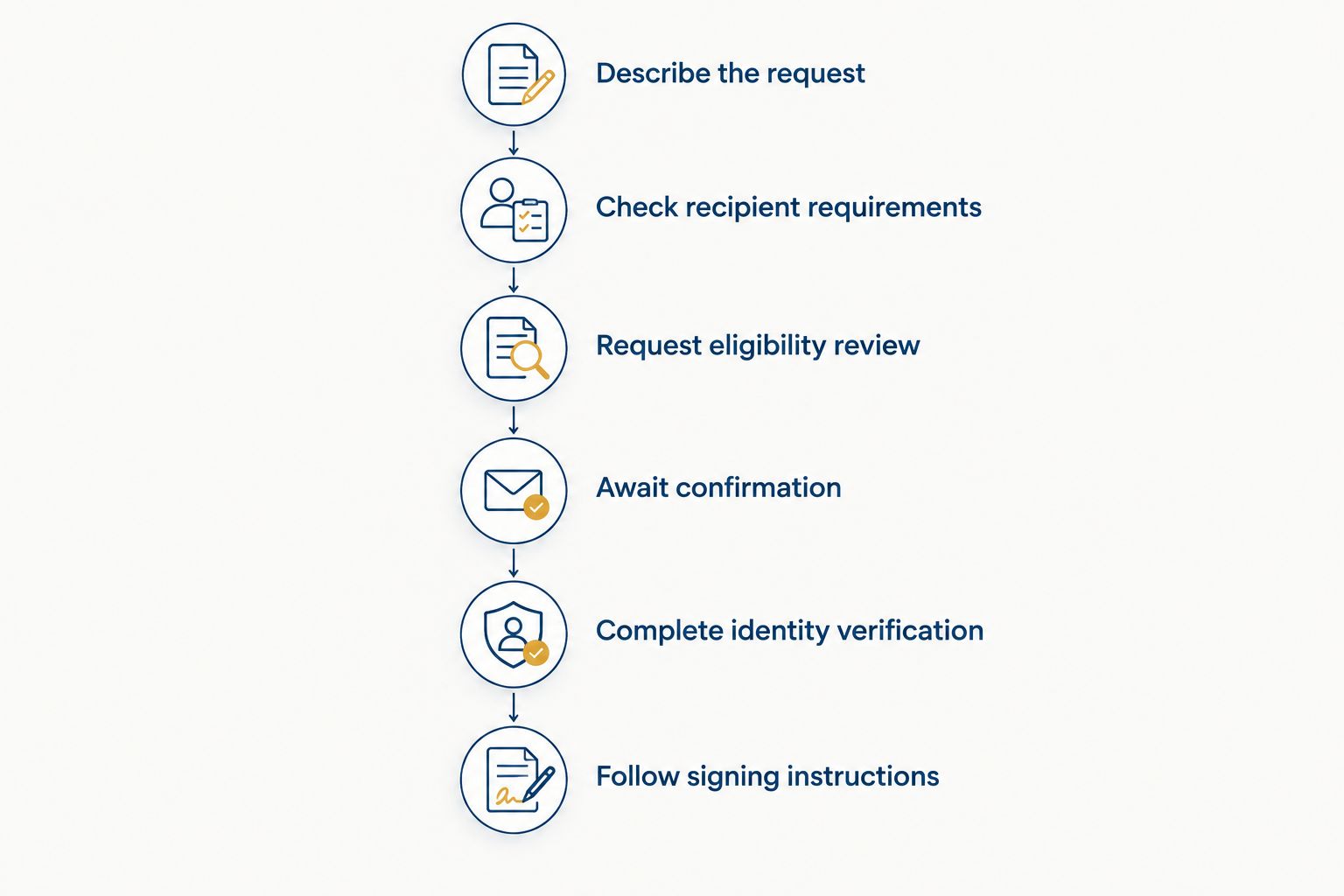
- Describe the request. Identify the document type, its language, the intended recipient, and where it will be used. Explain whether you are signing for yourself or on behalf of a business.
- Check recipient requirements. Ask whether the recipient accepts electronic signatures and remote online notarization. Request its certificate wording, translation instructions, and any authentication requirements.
- Request eligibility review. Explain what notarial act is requested, if the recipient has specified one. Follow the instructions provided for sharing documents rather than sending identity documents through an unrequested channel.
- Await confirmation. CraigVet Notary Services must contact you before the appointment is confirmed. A submitted request is not a confirmed appointment or a determination that the document is eligible.
- Complete identity verification. Follow the Proof instructions for identity verification and the online session. Be prepared to participate personally and respond to the notary's questions.
- Follow signing instructions. Do not assume you should sign beforehand. The required timing depends on the notarial act; for a sworn signature, signing in the notary's presence matters.
Identity verification and language communication serve different purposes. Establishing who you are does not establish that the notary can communicate with you or complete an unfamiliar certificate.
Keep the recipient's written instructions available during the review. A clear request helps distinguish a signature notarization from a translation certification, authentication request, or legal question.
Does the notary need to understand the document's language?
The notary needs enough understanding to perform the requested act lawfully, including understanding the notarial certificate and communicating with you. That is different from translating or providing legal advice about every provision in the document.
Do not treat a foreign-language certificate as routine paperwork. If the notary cannot understand what the certificate says, the notary cannot simply sign and stamp it based on your summary.
A separate certificate is not an automatic solution either. The appropriate notarial act and acceptable certificate wording must be established without asking the notary to make legal decisions for you.
If you do not understand the document you are signing, obtain an explanation from an appropriate translator or legal adviser before the appointment. The notarization appointment is not a substitute for understanding your obligations.
Why foreign-language notarization eligibility varies
Eligibility depends on the complete request, not merely the language printed on the page. These factors determine what needs to be resolved before a Maryland appointment:
- Signer communication. The notary must be able to communicate with you sufficiently to perform the act. Identify a language you both understand rather than assuming another person can answer for you.
- Certificate wording. The notary needs to understand the certificate and determine whether the requested act can be completed under Maryland notarial requirements.
- Recipient instructions. A receiving organization can require a particular format, translation, original document, or authentication process. Confirm those requirements directly.
- Requested signing method. A document suitable for an in-person appointment is not automatically suitable for remote online notarization. Recipient acceptance of the remote format also matters.
- Identity verification. You must complete the identity-verification requirements applicable to the appointment. A translated document does not replace identification.
- Purpose and destination. A document intended for use abroad can raise separate translation or authentication questions. Notarization alone does not resolve them.
For your 2026 request, provide these details together. Reviewing only a signature page can leave the certificate, destination, or recipient's instructions unresolved.
Is remote online notarization better than a mobile appointment?
Remote online notarization is the first option to review for eligible documents, not a promise that every foreign-language document qualifies. A mobile appointment changes how you meet the notary; it does not remove communication or certificate requirements.
| Appointment option | Best for | Practical advantage | Limitation |
|---|---|---|---|
| Maryland remote online notarization through Proof | Eligible signers whose recipients accept the electronic format | You participate remotely rather than arranging an in-person meeting | Document eligibility, identity verification, communication, and recipient acceptance still require review |
| In-person mobile notarization | Signers whose circumstances call for an in-person appointment | You meet the notary in person | Baltimore County availability must be confirmed before booking; language requirements still apply |
CraigVet Notary Services is a fit for Maryland signers seeking remote notarization of eligible documents. Its mobile service is secondary, with Baltimore County availability confirmed before booking.
Choose the appointment format after checking the document requirements. An in-person meeting does not solve an unreadable certificate, and an online platform does not replace direct communication with the notary.
Request an eligibility review
Explain the document language, recipient requirements, and preferred appointment format.
Can a notary certify a translation?
Notarizing a translator's signature is different from certifying that the translation is accurate. If a recipient requests a certified translation, ask what certification it requires and who must provide it.
A translator's signed statement can itself require notarization. In that situation, the notary performs the requested act for the translator's signature or sworn statement; the notarization does not independently verify the translated text.
Ask the recipient to distinguish these requests:
- A translation accompanied by the translator's certification.
- A notarized signature on the translator's statement.
- A notarized signature on the underlying document.
- Authentication of a notarized document for use abroad.
These are separate tasks. Completing one does not establish that the others are unnecessary or that the recipient's full requirements have been met.
Will a foreign organization accept a Maryland notarization?
A Maryland notarization does not guarantee acceptance by an overseas recipient. The receiving organization determines its submission requirements, including whether it accepts remote online notarization and electronic documents.
Ask about an apostille or other authentication before your 2026 appointment, not after completing the signing. An apostille authenticates the origin of a public document; it does not certify that the underlying statements are true or that a translation is accurate.
Give the recipient a precise description of the intended process. Asking whether it accepts a Maryland remote online notarization is more useful than asking whether it accepts a document that is merely described as notarized.
Keep the response with your document instructions. If the recipient requires an original paper document or a different execution process, resolve that issue before proceeding remotely.
What should a business prepare for repeat notarizations?
For repeat business appointments in 2026, standardize the information submitted for review rather than assuming each document qualifies because an earlier one did. Different signers, certificates, languages, and recipients can change the requirements.
Create an internal intake checklist covering:
- Document type and document language.
- Signer's name and preferred communication language.
- Individual or business signing capacity.
- Recipient and destination country.
- Requested notarial act and certificate wording.
- Acceptance of electronic signatures and remote notarization.
- Translation and authentication instructions.
Have an authorized person resolve legal questions about signing capacity or document wording before the appointment. The notary cannot choose a legal strategy for your business or decide whether an employee has authority under your governing documents.
Repeat use is a reason to improve preparation, not to skip review. Retain the recipient's current instructions and check them when the document, signer, destination, or signing method changes.
FAQ
Can a notary notarize a document written in Spanish?
Yes, a Spanish-language document can be notarized when the applicable requirements are met. For a Maryland appointment, review signer communication, the notarial certificate, identity verification, and document eligibility before scheduling.
Can my friend translate for me during the notarization?
Do not assume a friend can substitute for direct communication with the notary. Explain the language issue before booking and ask whether a notary who shares your language is needed.
Does notarization prove my translation is correct?
No, notarization does not prove that a translation is correct. Notarizing a translator's signature or sworn statement is separate from independently verifying the translated text.
Can I use Proof for a foreign-language document in Maryland?
An eligible foreign-language document can be considered for Maryland remote online notarization through Proof. Document review, signer communication, identity verification, and recipient acceptance still need to be addressed.
Should I sign my foreign-language document before the appointment?
Follow the notary's signing instructions rather than signing in advance by default. The timing depends on the requested notarial act, and a sworn signature requires signing in the notary's presence.
Do I need an apostille after notarization?
An apostille is not required for every notarized document. Ask the receiving organization what authentication it requires for the destination and document before arranging the notarization.
Is my appointment confirmed when I submit a request?
No, submitting a request does not confirm an appointment. CraigVet Notary Services must contact you to confirm arrangements; Baltimore County mobile availability also requires confirmation before booking.
Can Craig tell me which legal document or notarial act I need?
Craig is not an attorney and cannot provide legal advice. Ask the receiving organization to identify its requirements, and consult an attorney when choosing the document or notarial act requires legal judgment.
One last thing
Before your 2026 appointment, send the receiving organization this question: Do you accept this document electronically signed and remotely notarized by a Maryland notary, and do you require a translation or authentication?
That question addresses the format and acceptance issues a stamp cannot fix. Keep the answer, share the relevant instructions during eligibility review, and wait for appointment confirmation before making signing arrangements.


