

Yes—in Maryland, a notary can accept certain government-issued identification that expired no more than 3 years before the notarial act, provided it meets Maryland’s identification requirements. That does not mean an expired ID will work for remote online notarization through Proof: document eligibility and the platform’s identity-verification requirements must also be satisfied.
- Can a notary notarize a document with an expired ID? Maryland permits qualifying identification expired within 3 years.
- Maryland Code § 18-206 sets identification rules; Proof’s remote identity verification requires a separate eligibility check.
- CraigVet Notary Services offers Maryland remote online notarization through Proof for eligible documents.
- Check identification before requesting an appointment; a request is not confirmation.
Why this matters
An expired ID is not automatically unusable for a Maryland notarization. But the expiration date alone does not settle whether your appointment can proceed. The identification must establish your identity under the applicable rules, and the chosen appointment method must support that verification.
For Maryland clients considering CraigVet Notary Services, start with remote online notarization through Proof for eligible documents. Disclose an expired ID before the appointment process advances rather than waiting until the video session. That gives Craig the information needed to explain the next step without treating your appointment request as confirmed.
Can a notary notarize a document with an expired ID?
Maryland permits certain qualifying identification that expired no more than 3 years before the notarization. Maryland Code, State Government § 18-206 establishes the identification standard. It includes passports, driver’s licenses, and government-issued nondriver identification cards that are current or fall within that expiration window.
The statute also addresses other government-issued identification containing a photograph or signature, subject to its requirements and the notarial officer’s satisfaction. Do not assume that every card issued by a government agency is sufficient. The notary must assess the actual identification presented.
For a notarization taking place in 2026, measure the expiration window against the date of the notarial act—not the date you first requested an appointment.
| Identification situation | Maryland identification position | What you should do |
|---|---|---|
| Current qualifying government-issued ID | Falls within the statute’s identification framework | Confirm that it is suitable for the appointment method |
| Qualifying ID expired within 3 years | Can fall within Maryland’s permitted expiration window | Disclose the expiration date before proceeding |
| ID expired more than 3 years ago | Falls outside that statutory expiration window | Ask about another lawful identification method |
| Expired ID proposed for Proof | The statutory window alone does not establish platform acceptance | Confirm remote identity-verification requirements first |
| Another person’s ID | Does not establish your identity as the signer | Present identification belonging to you |
The table separates legal eligibility from appointment readiness. A card can fall within Maryland’s expiration window without resolving every other concern, such as an unclear photograph, conflicting identifying information, or remote verification that cannot be completed.
What does the 3-year window mean in practice?
An otherwise qualifying ID that expired 2 years before the appointment is within the statutory expiration window. An ID that expired 4 years before the appointment is outside it. Neither example establishes whether the particular document or remote session is eligible.
Check the exact expiration date rather than estimating from memory. If your ID is near the boundary, provide that date when discussing the appointment. A rescheduled appointment must still meet the identification requirements on the day the notarial act occurs.
How to prepare for Maryland remote online notarization
For remote online notarization in 2026, confirm both document eligibility and identity verification before treating the session as ready. Proof is the platform used for the remote service, but Maryland’s expired-ID allowance is not a promise that Proof will accept a particular credential.
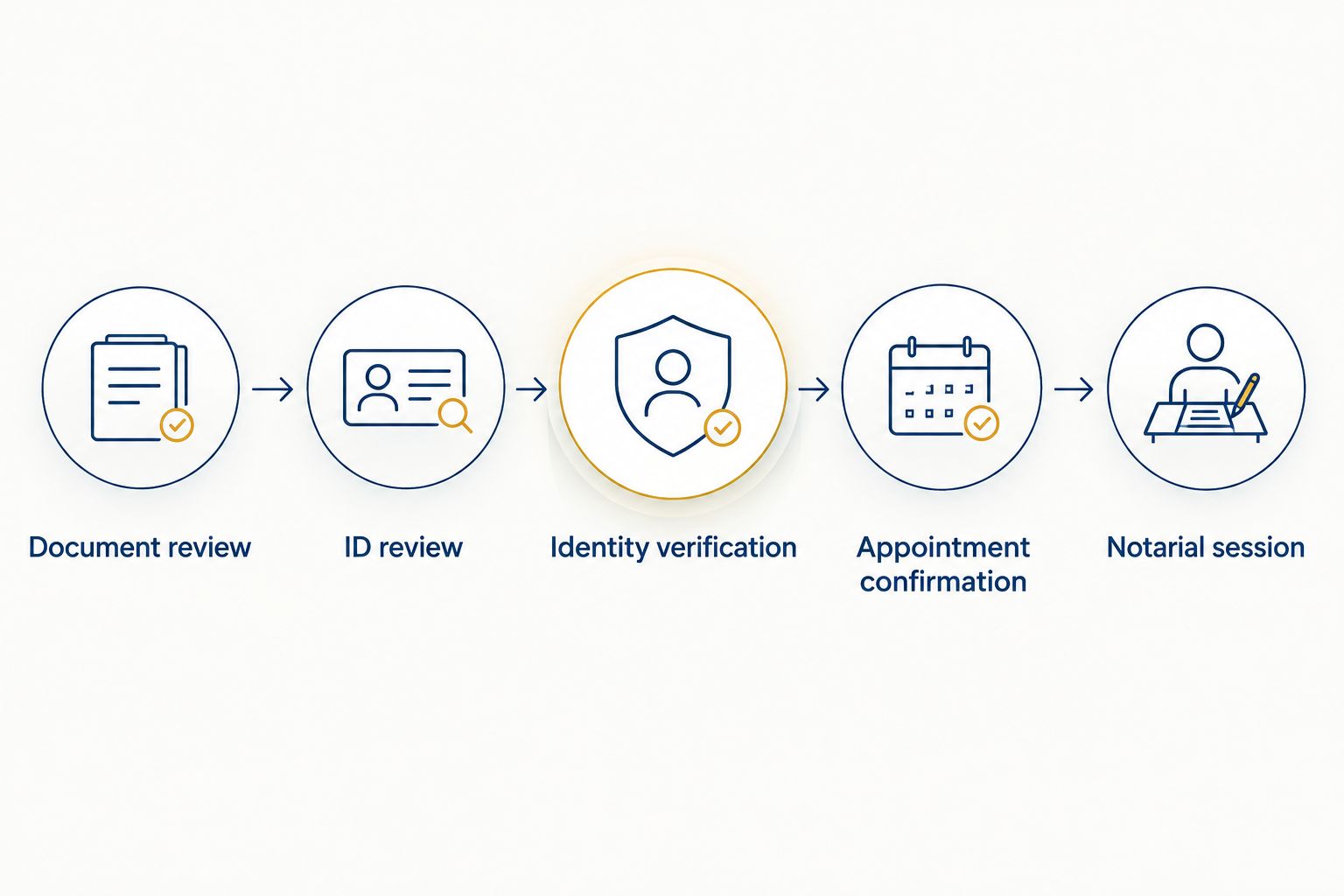
Use this sequence when an expired ID is your available identification:
- Document review. Explain what kind of document you need notarized and whether its recipient has specified a notarization method. Ask about eligibility before assuming the document can be completed remotely.
- ID review. Identify the issuing authority, identification type, and expiration date. Mention damaged, unreadable, or inconsistent information rather than leaving those issues for the session.
- Identity verification. Follow the identity-verification instructions provided for the Proof process. An ordinary video conversation does not replace the required verification.
- Appointment confirmation. Wait for CraigVet to contact you about the request and next steps. Submitting a request does not confirm an appointment.
- Notarial session. Follow the notary’s instructions for appearing, signing when required, and completing the appropriate notarial procedure. Keep the identification discussed during preparation accessible.
Each step resolves a different question. Document review concerns the requested transaction; ID review concerns the credential; identity verification concerns establishing who is appearing. Completing one does not automatically satisfy the others.
Ask how to provide any requested information securely. Do not send an unsolicited image of your identification merely because you are asking whether its expiration date is acceptable. Start with the identification type and expiration date, then follow the instructions you receive.
CraigVet Notary Services is best for Maryland clients seeking remote online notarization of eligible documents through Proof. The service fits that specific need; it does not remove document restrictions or guarantee that an expired credential will pass remote identity verification.
Remote online or mobile: which appointment fits your situation?
An expired ID does not make an in-person mobile appointment an automatic solution. A mobile notary still must establish your identity under Maryland’s requirements. The difference is how you appear before the notary, not whether identification matters.
| Appointment method | Best for | Practical advantage | Limitation |
|---|---|---|---|
| Remote online through Proof | Maryland clients with eligible documents who can complete remote verification | You appear through an online session rather than arranging an in-person meeting | Document eligibility and remote identity verification must both be satisfied |
| In-person mobile | Clients needing an in-person appointment where service is confirmed | The notary meets you in person | Identification requirements still apply; Baltimore County availability must be confirmed before booking |
For 2026 appointments, choose the method after checking the document and identification—not simply because one method appears more convenient. If the document recipient requires a particular form of execution, raise that requirement before arranging either service.
Mobile appointments are a secondary option, with Baltimore County availability confirmed before booking. Do not interpret an inquiry, proposed location, or preferred time as confirmation that a mobile appointment has been accepted.
Why acceptance of an expired ID varies
The same expiration date does not produce the same answer in every situation. These factors determine what needs to be checked:
- State law. Maryland’s identification statute governs the Maryland rule discussed here. Do not apply its expiration window to a notarial act governed by another state’s law.
- Identification type. A qualifying passport or driver’s license is not interchangeable with an employee badge or an unidentified membership card.
- Time since expiration. Maryland’s permitted window is measured against the notarial act, not the date printed on the document being notarized.
- Ability to identify you. The notary must assess the credential and the person appearing. An expiration date within the window does not resolve conflicting identity information.
- Appointment method. Remote online notarization has identity-verification requirements beyond simply showing a card during a video call.
- Document requirements. A document’s eligibility for the intended notarization is separate from whether your identification is acceptable.
Ask two separate questions: “Can this identification establish my identity?” and “Can this document be notarized using this method?” Combining them into a single question creates avoidable confusion. An acceptable credential does not make every document eligible for remote notarization.
What should I do if my ID expired more than 3 years ago?
More than 3 years after expiration, the credential falls outside Maryland’s statutory expiration window. Present another qualifying identification document if you have one, or ask the notary whether another lawful identification method applies. Do not assume an expired credential becomes acceptable because the transaction is urgent.
Maryland law recognizes identification methods beyond presenting a qualifying credential, including personal knowledge and qualifying credible-witness procedures. Their requirements must actually be met. Bringing a friend, relative, or coworker does not automatically establish an acceptable identification method, especially for a remote appointment.
Renewing identification addresses the expired credential itself. If you need a notarization before renewal is complete, discuss the actual documents you possess; do not describe an application receipt as equivalent to the credential it is intended to replace.
Can I use an expired ID on Proof in 2026?
The 3-year Maryland allowance does not establish that Proof will accept your expired ID. Remote identity verification is a separate requirement, so confirm the process for your specific credential before relying on an online appointment.
A state-law answer and a platform answer serve different purposes. Maryland law defines permissible identification methods; the remote process must also establish identity in the manner required for that session. Do not treat an online statement about Maryland’s expiration window as platform approval.
If remote verification cannot be completed, ask about the next appropriate step. Switching devices or scheduling another session is not a substitute for resolving an identification problem. An in-person appointment also requires its own eligibility and availability confirmation.
Does notarizing a document make its contents legally valid?
The 3-year identification allowance addresses identity, not the legal effect of your document. A notarial act does not replace advice about whether a document achieves your intended purpose, contains the right terms, or will be accepted by its recipient.
Ask the receiving organization about its submission requirements before the appointment. If you need advice about the document’s legal meaning or the appropriate notarial act, consult an attorney or obtain proper instructions from the relevant recipient. Craig is not an attorney and cannot provide legal advice.
Guidance for businesses with repeat notarizations
For a business coordinating notarizations in 2026, make identification review part of appointment preparation rather than an informal check immediately before signing. Ask each signer to verify their identification type and expiration date. Do not assume an employee’s previous successful appointment establishes eligibility for the next one.
Use a consistent preparation checklist:
- Identify the signer and the document requiring notarization.
- Confirm the recipient’s stated execution requirements.
- Ask whether the signer’s available identification is current or expired.
- Flag an expired credential before requesting the session.
- Confirm whether remote notarization is appropriate for the document.
- Wait for appointment confirmation before coordinating everyone’s attendance.
Keep the process narrow. A business administrator can organize the appointment, but the notary determines whether identification and notarial requirements are satisfied. Internal familiarity with an employee is not a substitute for the notary’s required identification process.
CraigVet Notary Services provides Maryland remote online notarization through Proof and in-person mobile appointments. For repeat business needs, identify the intended method and any expired-ID issues when making the request. This keeps the discussion focused on the actual transaction without assuming continuing approval for future documents or signers.
FAQ
Can a Maryland notary accept a driver’s license that expired last year?
A qualifying driver’s license that expired within 3 years falls within Maryland’s statutory expiration window. The notary must still establish identity, and remote platform requirements must also be satisfied.
Can I get a document notarized online with an expired passport?
An expired passport does not automatically qualify for online notarization. Maryland permits qualifying credentials expired within 3 years, but the remote identity-verification process must also accept and verify your identification.
Is an ID that expired 4 years ago acceptable in Maryland?
An ID that expired 4 years ago is outside Maryland’s 3-year statutory expiration window. Ask about another qualifying credential or another lawful identification method.
Will a mobile notary accept an expired ID that an online platform rejects?
A mobile appointment requires its own identification assessment under Maryland law. A platform rejection does not determine the outcome of an in-person assessment or guarantee mobile appointment eligibility.
Can my spouse identify me instead of showing an ID?
Your spouse’s presence alone does not satisfy identification requirements. Any credible-witness procedure must meet the applicable legal requirements and be appropriate for the appointment method.
Is my appointment confirmed after I submit a request?
Submitting a request does not confirm your appointment. Wait for CraigVet to contact you about eligibility, availability, and next steps.
Can Craig tell me whether my document protects my legal interests?
Craig is not an attorney and cannot provide legal advice. Ask an attorney about the document’s legal effect or whether its terms meet your needs.
One last thing
Check the expiration date against the actual appointment date, not today’s date. An identification document near the end of Maryland’s permitted expiration window needs another check if the appointment moves. That small preparation step keeps a scheduling change from becoming an identification problem.
Before requesting your 2026 notarization, have the document type, identification type, and exact expiration date ready. Ask about remote eligibility first, disclose the expired ID, and wait for confirmation before making arrangements around the appointment.


