

Yes—a Maryland notary can notarize an eligible document signed outside the United States, including through remote online notarization when the signer remains abroad and Maryland’s requirements are met. The correct procedure depends on whether you are acknowledging an existing signature or taking an oath, and notarization does not guarantee that the receiving organization will accept the document.
- Can a notary notarize a document signed outside the United States? Yes, subject to identity, appearance, and document requirements.
- Maryland remote online notarization can serve eligible signers abroad; the notary must be physically in Maryland.
- An acknowledgment can cover an earlier signature; an oath-based certificate requires the appropriate oath and signing procedure.
- CraigVet Notary Services offers Maryland remote online notarization through Proof; eligibility and appointment confirmation come first.
Why this matters
Where you signed and where you appear before the notary are different questions. A signature made abroad is not automatically disqualified, but an overseas signature alone does not establish that the requested notarial act is permitted.
For Maryland remote online notarization in 2026, start with the document’s requirements, your location, and the recipient’s instructions. CraigVet Notary Services offers remote online notarization through Proof for eligible documents, with identity verification and appointment details addressed before the session.
A document can pass through a valid notarial process and still fail the recipient’s separate submission rules. Confirm both before you arrange an appointment, particularly when a court, government office, lender, or foreign authority will receive the completed document.
Can a notary notarize a document signed outside the United States?
Yes, provided the notary can perform the requested act under the law governing that notary. For Maryland, distinguish an earlier overseas signature from a signer who is still overseas during the appointment.
Maryland’s remote-notarization provisions allow qualifying acts for people outside the United States, subject to additional conditions. The Maryland Secretary of State’s notary guidance and the Maryland State Government Article, Title 18, are the relevant official references for Maryland notarial requirements; foreign-law questions require separate guidance.
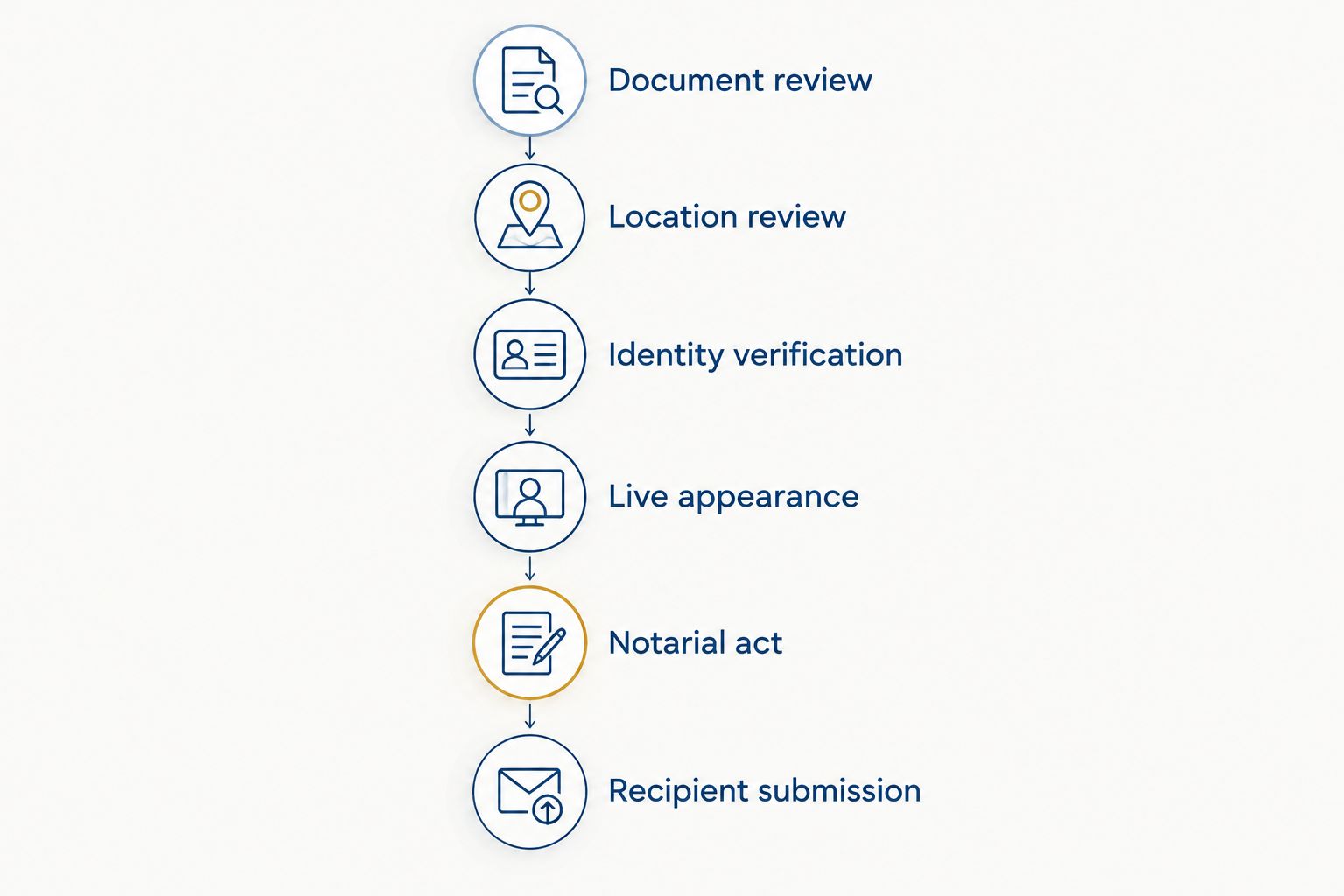
Use this sequence for a 2026 appointment:
- Document review. Identify the complete document, its intended use, and the requested notarial certificate. Ask the recipient to clarify unclear instructions.
- Location review. Tell the notary where you will physically be during the appointment, not just where you live or where you signed.
- Identity verification. Complete the applicable identification process. Having previously signed the document does not replace identity verification.
- Live appearance. Appear through the permitted live audiovisual process for remote notarization, or attend an in-person appointment.
- Notarial act. Acknowledge the signature or complete the required oath and signing procedure, as applicable.
- Recipient submission. Deliver the completed document in the format the receiving organization requires.
Do not select a certificate simply because its wording looks familiar. If you do not know which notarial act is required, obtain instructions from the recipient or an attorney. A notary cannot make that legal decision for you.
Maryland remote online notarization while you are abroad
Remote online notarization is the relevant option when you remain outside the United States and need an eligible Maryland notarial act. The Maryland notary must be physically located in Maryland during the act; the signer’s permitted location is a separate issue.
For a signer outside the United States, Maryland law imposes conditions beyond an ordinary domestic remote appointment. The record must have a qualifying United States connection, such as a matter involving a United States governmental entity, property within United States jurisdiction, or a transaction substantially connected with the United States. The notarial act must also not be prohibited by the foreign country where the signer is located.
Do not treat a United States connection as automatic permission. Tell the notary the country where you will attend and explain the document’s purpose so the location and transaction requirements can be assessed.
An online meeting by itself is not remote online notarization. You must use the required notarial process, including identity verification, live appearance, and the applicable electronic document and recording procedures.
In-person notarization after you return to Maryland
An earlier signature made abroad does not, by itself, prevent a later acknowledgment in Maryland. You must still appear before the notary, establish your identity, and acknowledge the signature as required.
An oath-based act needs different handling. If the document requires you to swear or affirm its contents and sign as part of that procedure, follow the notary’s instructions rather than assuming the earlier signature is sufficient.
Mobile appointments are a secondary option for eligible in-person work. Baltimore County availability must be confirmed before booking, and an inquiry is not a confirmed appointment.
| Option | Best for | Main benefit | Main limitation |
|---|---|---|---|
| Maryland remote online notarization | Eligible signers who remain abroad | Allows the required appearance through an authorized online process | Foreign-location conditions, identity verification, technology, and recipient requirements still apply |
| In-person notarization in Maryland | Signers who can attend locally | Provides physical appearance before the notary | Requires attendance; an earlier signature does not satisfy every type of notarial act |
CraigVet Notary Services is best for individuals and businesses seeking Maryland remote online notarization for eligible documents through Proof. Eligibility review remains necessary, and remote notarization is not suitable for every document or destination.
Does an existing signature need an acknowledgment or an oath?
An acknowledgment confirms that the signer acknowledges the signature; an oath or affirmation addresses the truthfulness of a statement. These are not interchangeable procedures.
For an acknowledgment, a signature can generally predate the notarial appointment. The signer must still personally appear through a legally permitted method and acknowledge signing the record. Sending a signed attachment without appearing does not complete the act.
For a jurat or verification on oath or affirmation, the signer must take the required oath or affirmation and follow the applicable signing procedure. Do not assume that a previously signed page removes those obligations.
Check the certificate attached to the document before the session. If the certificate is absent or the instructions conflict, ask the recipient or an attorney which act is needed; the notary cannot choose based on the legal outcome you want.
Why eligibility varies
The answer changes with the requested act and the circumstances, not simply with the country where ink first touched the page. For a 2026 request, address these factors before scheduling:
- Notarial act. An acknowledgment and a verification on oath or affirmation require different actions from the signer.
- Signer location. A signer attending from another country triggers additional remote-notarization conditions, including the foreign-law restriction.
- United States connection. An overseas remote notarization must meet Maryland’s applicable connection requirements for the record.
- Identity verification. The signer must complete an acceptable identification process; an existing signature is not proof of identity.
- Recipient requirements. The recipient determines its submission requirements, including whether an electronic notarized record meets its needs.
- Document and technology requirements. The document must be eligible for the proposed process, and the signer must be able to complete the required online session.
An employer’s deadline does not remove any of these conditions. Resolve uncertainty before the appointment rather than asking the notary to work around it during the session.
What should you prepare before the appointment?
Provide a clear description of the document and its destination. Include the country where you will be during the session, whether you already signed, and any instructions supplied by the receiving organization.
Have the complete document available for review, not only the signature page. Do not remove a certificate, change its wording, or add a different certificate without appropriate direction.
Before a remote appointment, ask which identification and technical requirements apply to your circumstances. Plan for a private setting where you can hear, respond, and participate without someone answering on your behalf.
For repeat business notarizations, use a consistent intake checklist in 2026:
- Identify the signer and any stated signing capacity.
- Record the signer’s physical location for the proposed session.
- Obtain the recipient’s certificate and submission instructions.
- Flag existing signatures and any witness requirements.
- Confirm how the completed document must be returned.
- Wait for direct appointment confirmation before notifying other participants.
CraigVet Notary Services offers Maryland remote online notarization through Proof, but a submitted request does not confirm an appointment. The appointment is confirmed only after CraigVet contacts you. Craig is not an attorney and cannot provide legal advice.
Will the receiving organization accept a remotely notarized document?
A completed notarization does not guarantee acceptance. Ask the receiving organization whether it accepts a Maryland remotely notarized electronic document for your specific purpose and whether it requires an additional authentication step.
Keep the question precise: identify the document, the intended transaction, and the destination. A general statement that an organization accepts notarized documents does not necessarily answer whether its workflow accepts your electronic record.
Do not assume printing an electronically notarized record produces the format the recipient requires. Obtain delivery instructions before choosing the appointment method, especially when an original paper record is requested.
Do I need an apostille for a document signed abroad?
An apostille is not required merely because you signed outside the United States. Authentication requirements depend on where the notarized document will be used and what the receiving authority requires.
An apostille authenticates the origin of an eligible public document; it does not establish that the document’s contents are true. Ask the receiving authority about its requirements before arranging notarization or authentication.
For cross-border use in 2026, keep notarization and authentication as separate checks. Completing the first does not automatically complete the second.
Can someone else bring my signed document to the notary?
Someone else’s delivery of your signed document does not replace your required appearance for an acknowledgment or oath-based act. If you are the person whose signature or statement is being notarized, arrange a permitted appearance yourself.
A business administrator can coordinate documents and communicate scheduling details. That coordination does not allow the administrator to acknowledge another person’s signature or take an oath on that person’s behalf.
FAQ
Can a Maryland notary notarize my document if I signed it overseas?
Yes, an overseas signature does not automatically prevent Maryland notarization. The notary must determine whether the requested act can be completed, including the applicable appearance, identification, and certificate requirements.
Can I stay outside the United States during online notarization?
Yes, Maryland permits qualifying remote notarizations for signers outside the United States, subject to additional conditions. These include a qualifying United States connection for the record and no prohibition on the notarial act in the foreign country where you are located.
Does the Maryland notary have to be in Maryland?
Yes, the Maryland notary must be physically in Maryland when performing the remote notarial act. A signer's permitted overseas location does not change the notary's location requirement.
Do I have to sign again if I already signed abroad?
Not necessarily for an acknowledgment, because an acknowledgment can address an existing signature. An oath-based act requires the appropriate oath and signing procedure, so obtain instructions before changing or signing the document again.
Can my coworker attend the notary appointment for me?
No, a coworker cannot replace your required appearance to acknowledge your signature or take your oath. A coworker can help coordinate the appointment without acting as the signer.
Will online notarization guarantee that my document is accepted overseas?
No, remote notarization does not guarantee acceptance by a foreign authority or other recipient. Confirm the recipient's format and authentication requirements before the appointment.
Is my appointment confirmed after I submit a request?
No, a request does not confirm an appointment. Wait until CraigVet contacts you; Baltimore County mobile availability must also be confirmed before booking.
Can Craig tell me which legal certificate my document needs?
Craig is not an attorney and cannot provide legal advice. Ask the receiving organization or an attorney which notarial act and certificate your document requires.
One last thing
The most useful question is not just where you signed—it is what the recipient needs you to do now. Before your 2026 appointment, obtain the recipient’s written instructions, identify your physical location during the session, and disclose the existing signature.
That information separates a straightforward acknowledgment from a request requiring a different signing procedure, additional authentication, or another appointment method. For a business managing repeat requests, collect it at intake rather than after the signer has joined the session.


