
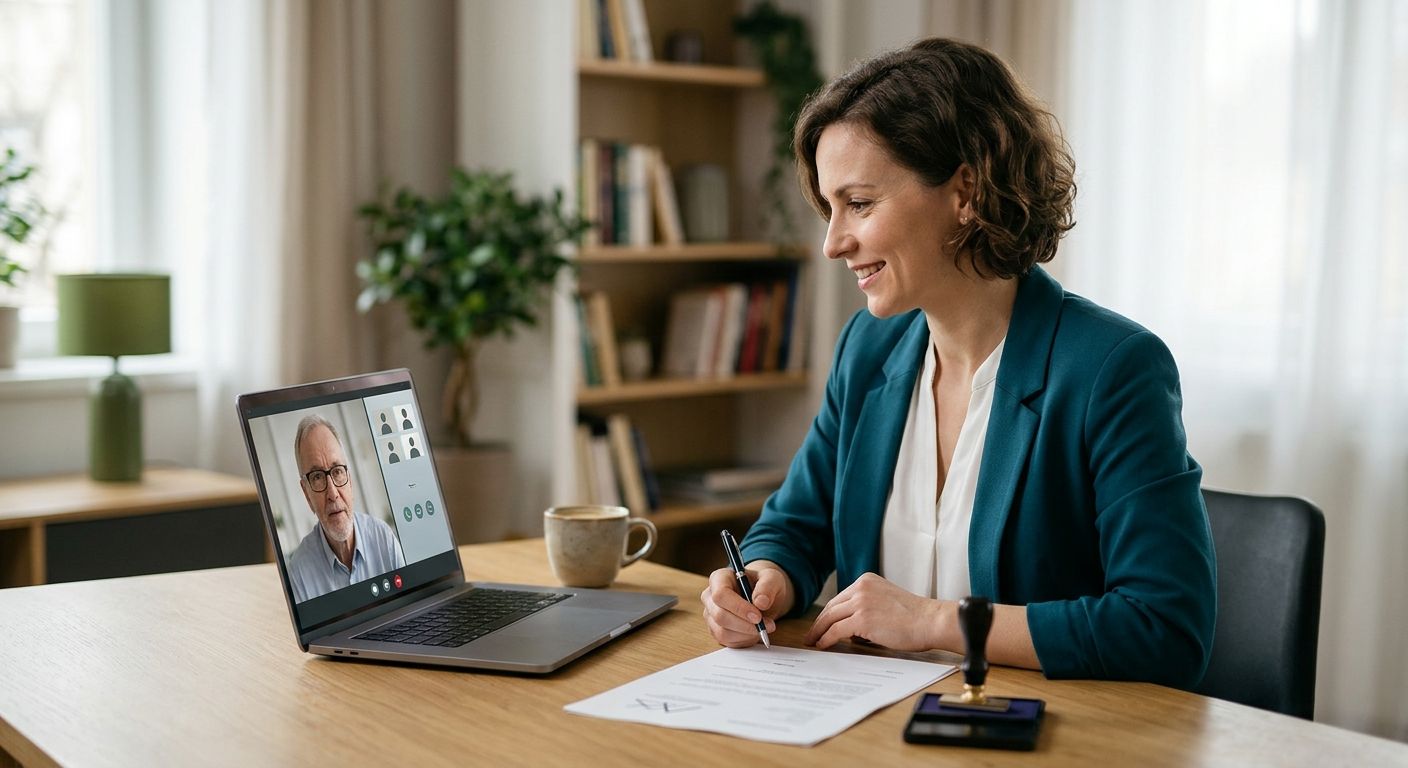
Yes, a notary can notarize an eligible document over a video call when the appointment follows the applicable remote online notarization requirements, including identity verification and compliant audio-video communication. In Maryland, an ordinary video chat alone does not complete those requirements, and you must also check whether the document and its receiving organization accept electronic notarization.
- Can a notary notarize a document over video call? Yes, through compliant remote online notarization—not an ordinary video chat.
- Maryland remote online notarization requires identity verification, an eligible document, and a compliant appointment.
- CraigVet Notary Services offers remote online notarization through Proof; appointment confirmation follows direct contact.
- Confirm the recipient accepts an electronically notarized document before arranging the appointment.
Can a notary notarize a document over video call?
Yes—but the video connection is only part of the notarization. Maryland permits remote notarial acts subject to its notarial requirements. The Maryland Secretary of State’s notary guidance and Maryland’s State Government Article, Title 18, provide the governing framework; a video-chat invitation does not replace that framework.
For a 2026 appointment, start with document eligibility and recipient acceptance, then complete the identity-verification and signing process. CraigVet Notary Services provides Maryland remote online notarization through Proof for eligible documents.
Request the appointment
Explain what document needs notarization, who will receive it, and whether the recipient supplied signing instructions. Identify everyone expected to sign and mention any separate witness instructions before scheduling.
A request is not a confirmed appointment. Wait until the service contacts you to confirm the arrangement, document suitability, and next steps; do not assume that submitting your preferred time reserves it.
Check eligibility
Have the complete document and the recipient’s instructions ready for review. Ask the receiving organization whether it accepts an electronically signed, remotely notarized version, rather than asking only whether it accepts a notarized document.
These are different questions. A document can require notarization while the recipient still requires a particular signing method, original paper format, or additional execution formalities.
Verify identity
Follow the identity-verification instructions supplied for the Proof appointment. Have the requested identification ready, and check that its information is consistent with the signer information provided for the appointment.
Identity verification is more than briefly holding an identification card up to a webcam. Remote notarization uses the verification process required for the transaction; an unclear image, incomplete information, or an unsuccessful verification requires resolution before the notarization proceeds.
Join the session
Use a device that supports the appointment’s camera, microphone, and connection requirements. Choose a quiet, well-lit setting where you can hear the notary, respond directly, and show what the process requires.
The notary must communicate with the actual signer. An assistant or family member can help organize an appointment, but cannot appear as a substitute for the person whose signature is being notarized.
Complete signing
Follow the notary’s instructions about when and how to sign or acknowledge a signature. Do not assume that every notarial act requires exactly the same signing sequence.
For example, an acknowledgment and a verification on oath or affirmation involve different notarial procedures. If you do not know which act your document requires, ask its preparer, recipient, or an attorney rather than asking the notary to choose a legal course for you.
Retain the document
Follow the completion instructions for obtaining and keeping the electronically notarized document. Before sending it onward, check that you have the completed version rather than the unsigned file you originally prepared.
Use the recipient’s requested delivery method. Printing an electronic document does not necessarily satisfy a requirement for an original paper document, so settle that question before the appointment—not after signing.
Why this matters
A completed video call is not proof that a document has been validly notarized. The appointment must include the required notarial act, identity checks, and completion procedures—not just a conversation with someone who is a notary.
For Maryland individuals and businesses arranging appointments in 2026, the practical issue is acceptance. Confirm both the notarization method and the recipient’s document requirements before anyone signs. That separates a useful completed document from a file the recipient cannot use.
Notarization also has limits. It does not establish that every statement in a document is true, approve the transaction, or replace legal advice about what you are signing.
Remote online notarization versus a mobile appointment
Remote online notarization and mobile notarization are different appointment formats. Remote service uses an online session; a mobile appointment brings an in-person notary to an agreed location.
| Appointment format | Best for | Practical advantage | Limitation |
|---|---|---|---|
| Remote online notarization through Proof | Eligible documents whose recipients accept electronic notarization | You meet the notary through an online session rather than arranging an in-person meeting | Document eligibility, identity verification, technology, and recipient acceptance must all be addressed |
| In-person mobile notarization | Documents or circumstances requiring an in-person appointment | The signer and notary meet physically at an agreed location | Travel arrangements and appointment availability require confirmation; Baltimore County service must be confirmed before booking |
CraigVet Notary Services is best suited to Maryland individuals and businesses seeking remote online notarization for eligible documents through Proof. Mobile appointments are a secondary option, with Baltimore County availability confirmed before booking.
Neither format removes the need for proper identification or appropriate document preparation. Choose the format around the document’s requirements, not around an assumption that an online appointment works for every transaction.
Why video-call notarization eligibility varies
There is no universal answer for every document. For a Maryland remote appointment in 2026, these factors determine what needs checking:
- Document requirements. Some transactions involve execution rules beyond notarization. Ask the preparer or an attorney about requirements you do not understand.
- Recipient acceptance. A receiving organization’s instructions determine whether the completed electronic format serves your intended purpose.
- Identity verification. The signer must complete the identity checks required for the remote appointment. A working camera alone is not enough.
- Signer participation. The signer must communicate directly with the notary and participate in the required act. Someone else cannot take the signer’s place.
- Witness instructions. A separate witness requirement is not automatically fulfilled by the notary’s presence. Identify it before arranging the session.
- Technical suitability. The appointment needs usable audio-video communication and access to the relevant document workflow. Resolve access problems before proceeding.
These checks are separate. Recipient acceptance does not guarantee successful identity verification, and successful identity verification does not establish that the document satisfies every legal requirement.
How should a business prepare for repeat notarizations?
Standardize preparation, not eligibility assumptions. A business that regularly requests notarizations still needs to check each document, signer, and recipient instruction.
Create a short intake record containing the document name, receiving organization, signer names, signing instructions, and any witness requirements. Keep the record focused on appointment coordination; do not circulate identification documents more widely than necessary.
Separate coordination from signing
An office manager can organize documents and communicate scheduling needs. The actual signer still has to complete identity verification and participate in the notarial appointment.
Tell signers what they need to prepare without answering legal questions on the notary’s behalf. If an employee asks whether they should sign a document or which notarial act to select, direct that question to the document’s preparer or an attorney.
Check each recipient’s instructions
A process accepted by one recipient does not establish acceptance by another. Even documents with similar names can arrive with different execution or submission instructions.
For repeat requests in 2026, retain the current instructions with the transaction record. Reusing an old checklist is useful only when you also check that it fits the document now being signed.
Arrange scheduling before the deadline
Tell the service about the actual submission deadline and everyone who must participate. Do not treat a requested appointment time as confirmed or promise a completed notarization before the service contacts you.
CraigVet Notary Services offers both remote online and mobile notary services, but each request still needs the appropriate format and confirmation. For businesses, that distinction belongs in the scheduling process—not in a last-minute message to the signer.
What should you have ready before the appointment?
Prepare the complete document, the receiving organization’s instructions, and the identification requested for your appointment. Read the document before the session so you can identify questions that require legal advice rather than notarial assistance.
For a remote appointment, check your camera, microphone, connection, and access to the appointment instructions. Use a private location where you can participate without someone else answering for you or viewing information unnecessarily.
Do not share account passwords or identity-verification answers with an appointment coordinator. Follow the platform’s instructions directly, and ask for clarification if a request appears unrelated to the appointment.
For a mobile request, provide the proposed location and explain any access arrangements. Baltimore County availability must be confirmed before booking; a proposed address does not establish that an appointment has been accepted.
Craig is not an attorney and cannot provide legal advice. Questions about a document’s legal effect, the correct form, required witnesses, or whether you should sign belong with the document preparer, recipient, or an attorney.
Request a notary appointment
Ask about document eligibility and the next steps. Your appointment requires confirmation after contact.
Can I use an ordinary video-chat app instead?
An ordinary video-chat app alone does not complete Maryland remote notarization requirements. The session must be part of a compliant notarial process, including identity verification and the required records and document procedures.
For CraigVet Notary Services remote online notarization, the appointment uses Proof. Follow the supplied instructions rather than replacing that process with a separate video call.
Can I sign the document before the video call?
Ask for instructions before signing because the required sequence depends on the notarial act. An acknowledgment can involve acknowledging an existing signature, while other acts require signing and an oath or affirmation as part of the procedure.
Do not add a signature simply to make the document look ready. Tell the notary if you have already signed, and obtain legal guidance if the document’s execution requirements are unclear.
Does the notary have to be in Maryland?
A notary performing a Maryland remote notarial act must be physically located in Maryland. The signer’s location is a separate eligibility question and should be disclosed when requesting the appointment.
Do not assume that joining an online session makes location irrelevant. If the signer is outside Maryland or outside the United States, provide that information before scheduling so the applicable requirements can be checked.
FAQ
Can a notary notarize a document over video call in Maryland in 2026?
Yes, an eligible document can be notarized through a compliant Maryland remote online notarization appointment in 2026. An ordinary video call alone does not satisfy the requirements; identity verification and the required notarial procedures still apply.
Do I need identification for an online notary appointment?
Yes, you must complete the identity-verification process required for the remote appointment. Follow the supplied instructions and have the requested identification ready.
Can someone else attend the video call and sign for me?
Someone else cannot simply replace you for notarization of your signature. If the document involves an authorized representative or another signing capacity, explain that arrangement before the appointment and obtain legal guidance when needed.
Will every organization accept a remotely notarized document?
Do not assume every organization accepts the same electronic document format. Ask the recipient specifically whether it accepts remote online notarization and follow its submission instructions.
Does the notary provide any witnesses my document needs?
Do not assume that witnesses are included or that the notary fulfills a separate witness requirement. Identify witness instructions before scheduling and confirm the arrangements.
Is my appointment confirmed when I submit a request?
No, submitting a request does not confirm an appointment. Wait for direct contact confirming the arrangements and next steps.
Can I book a mobile notary appointment in Baltimore County?
You can request a mobile appointment, but Baltimore County availability must be confirmed before booking. Provide the proposed location and document requirements when you ask.
Can Craig tell me which legal document I need?
No, Craig is not an attorney and cannot provide legal advice. Ask an attorney or the appropriate document preparer about document selection, legal effect, and execution requirements.
One last thing
Before booking a 2026 appointment, ask the receiving organization this specific question: Does it accept an electronically signed document notarized through Maryland remote online notarization?
That question is more useful than asking whether it accepts notarized documents. Resolve the format first, then arrange the notarization. Keep the recipient’s instructions with your document so the signer, coordinator, and notary are working from the same requirements.


