

Yes, a Maryland notary can notarize a document for a family member when neither the notary nor the notary’s spouse is a party to the document or has a direct beneficial interest in it. Family ties alone do not disqualify the notary, but a conflict of interest does; remote online notarization through Proof is an option only for eligible documents and signers who complete the required identity verification.
- Can a notary notarize a document for a family member in Maryland? Yes, when statutory conflict-of-interest restrictions do not apply.
- Maryland State Government Article §18-203 bars notarization when the notary or spouse is a party or has a direct beneficial interest.
- Craigvetnotary offers Maryland remote online notarization through Proof for eligible documents; identity verification remains required.
- Use an independent notary when the family transaction creates a conflict. Requesting an appointment does not confirm it.
Can a notary notarize a document for a family member in Maryland?
The deciding issue is the notary’s involvement in the document, not simply the family relationship. Maryland State Government Article §18-203 prohibits a notarial act involving a record to which the notary or the notary’s spouse is a party, or in which either has a direct beneficial interest.
For your 2026 appointment, separate the relationship question from the transaction question. A parent, adult child, or sibling relationship does not automatically answer whether the notary can act.
| Situation | Maryland conflict rule | Practical next step |
|---|---|---|
| A relative signs a document unrelated to the notary’s interests | The relationship alone does not prohibit notarization | Check the document, identity requirements, and requested notarial act |
| The notary is a party to the document | The notary cannot perform the notarial act | Use an independent notary |
| The notary’s spouse is a party to the document | The notary cannot perform the notarial act | Use an independent notary |
| The notary or spouse has a direct beneficial interest | The notary cannot perform the notarial act | Use an independent notary |
| The document’s effect on the notary or spouse is unclear | The relationship alone does not resolve the conflict question | Resolve the legal question before proceeding |
An independent appointment removes the family member from the notarial role; it does not resolve defects in the document itself. You can request Maryland notary services and explain the document’s purpose before arranging the appointment.
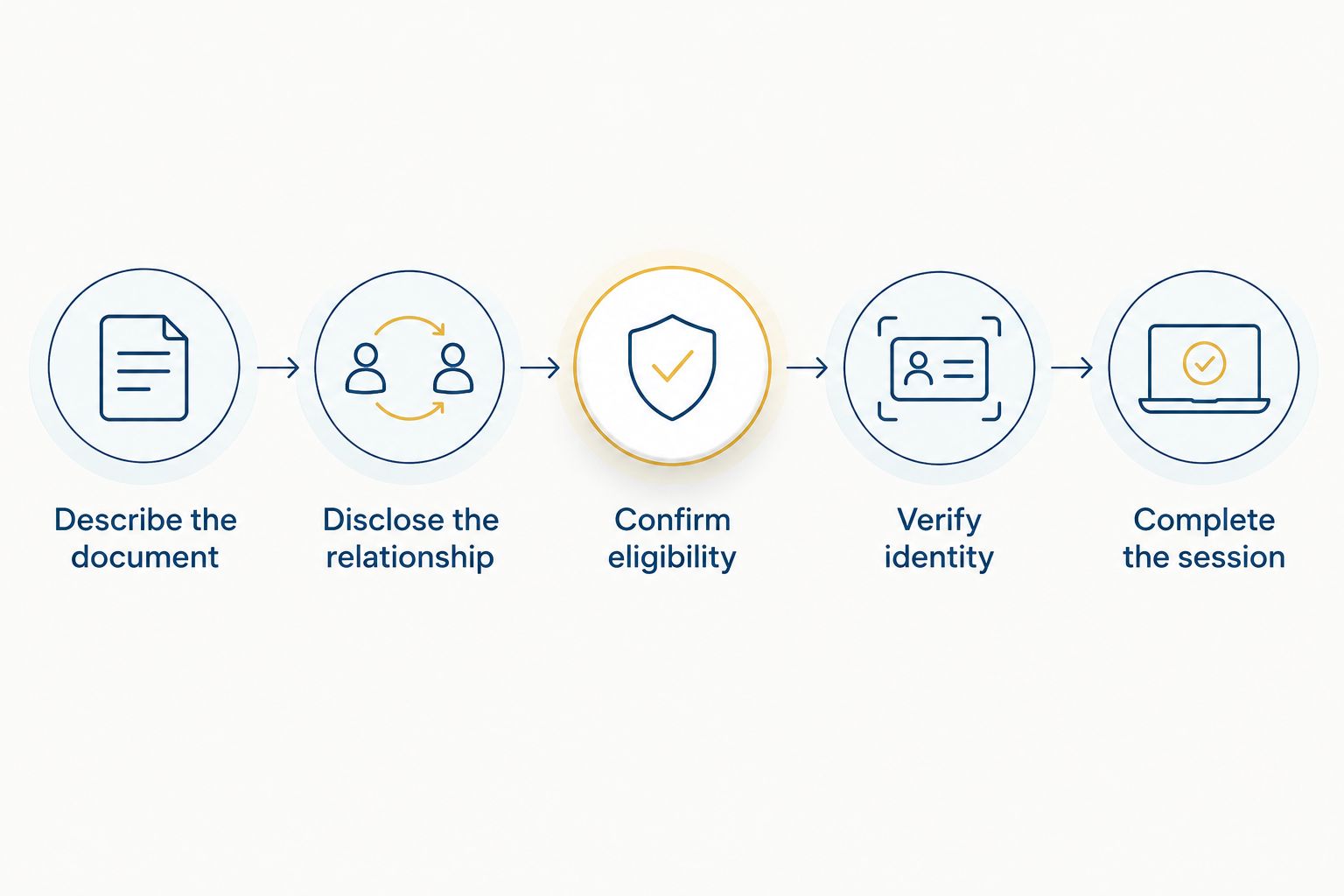
How to arrange an eligible remote online notarization
Maryland remote online notarization through Proof is a practical starting point for eligible documents. It does not remove conflict-of-interest restrictions or replace the signer’s required participation.
1. Describe the document
Tell the notary what kind of document needs notarization and who must sign. Explain any recipient instructions, witness requirements, or deadline you have received.
Do not assume that every document can be notarized remotely. Ask the receiving organization whether it accepts an electronically notarized document and identify any instructions before the appointment.
2. Disclose the relationship
If a relative is considering acting as the notary, explain whether the notary or the notary’s spouse is named in the document or stands to benefit directly. A family connection is not a substitute for reviewing those facts.
If the transaction’s legal effect is unclear, obtain legal guidance. A notary should not interpret ownership rights or financial consequences to decide a question outside the notarial role.
3. Confirm eligibility
Confirm that the document and requested notarial act fit the proposed appointment. The signer must also be able to meet the applicable identity verification and participation requirements.
For a remote appointment in 2026, follow the instructions supplied for the Proof session rather than assuming that sending a document completes the process. A document upload is preparation, not notarization.
4. Verify identity
Follow the identity verification instructions provided for your remote session. Have the requested identification ready and ensure that your device supports the required audio-video interaction.
Do not rely on the notary’s family familiarity as permission to skip the applicable identification procedure. The notary must establish identity using a method permitted for that notarial act.
5. Complete the session
Follow the notary’s instructions about signing or acknowledging a signature. Different notarial acts require different procedures, so do not assume that every document must be signed in advance or that every existing signature requires replacement.
For Craigvetnotary remote online notarization, submitting an appointment request does not confirm an appointment. Wait for contact and confirmation before treating a proposed date or time as scheduled.
Why this matters for family documents
A signature notarized by a relative is not automatically improper. The problem arises when the notary’s role or interest conflicts with the impartial duties of the appointment.
That distinction matters when a document involves shared property, a family business, or rights affecting the notary’s spouse. Do not treat a familiar signer as a reason to overlook the document’s effect.
Notarization also does not establish that a document achieves your intended legal result. The notary performs the requested notarial act; an attorney addresses questions about legal rights, wording, and consequences.
Craig is not an attorney and cannot provide legal advice. Ask an attorney about document selection, interpretation, or a disputed beneficial interest before requesting notarization.
Why the answer varies between family transactions
The same relatives can be involved in different documents with different outcomes. These factors explain why one appointment can proceed while another requires an independent notary or further clarification:
- Who is a party: A document involving the notary or the notary’s spouse triggers the statutory restriction, even when another relative is the signer.
- Who benefits directly: A direct beneficial interest held by the notary or spouse disqualifies the notary. The family label does not override that interest.
- What act is requested: An acknowledgment and a verification on oath or affirmation have different procedural requirements. The signer needs the correct act, not just a stamp.
- Whether identity can be established: The notary must satisfy the identification requirements that apply to the chosen appointment format.
- Whether the format is suitable: Remote eligibility, recipient instructions, and any necessary witnesses affect how you should arrange the appointment.
The first factors determine whether the particular notary can act. The remaining factors determine whether the appointment is ready to proceed. Keeping those questions separate prevents a permitted family relationship from being mistaken for approval of every other detail.
Which appointment format fits your situation?
Craigvetnotary is best for Maryland individuals and businesses seeking remote online notarization through Proof for eligible documents. Mobile notarization is a secondary option when an in-person appointment is appropriate and Baltimore County availability has been confirmed.
Neither format changes the family conflict rule. Choose the format after checking the document, the signer’s participation needs, and the recipient’s instructions.
| Appointment option | Best for | Main advantage | Limit to check |
|---|---|---|---|
| Remote online notarization through Proof | Eligible documents and signers able to complete the remote process | The signer participates through an audio-video session rather than an in-person meeting | Document eligibility, identity verification, technology, and recipient acceptance |
| In-person mobile notarization | Signers who need an in-person appointment | The notarial act takes place with the notary physically present | Baltimore County availability must be confirmed before booking |
Remote notarization avoids an in-person meeting, but it requires suitable technology and successful completion of the applicable identity process. Mobile notarization supports physical attendance, but submitting a request does not establish travel availability or confirm a booking.
For either format in 2026, resolve document questions before relying on the appointment to meet a deadline. An appointment cannot cure a prohibited conflict or supply legal advice.
Request a Maryland notary appointment
Explain your document and preferred format. Wait for contact and confirmation before treating it as scheduled.
Can I notarize a document for my spouse in Maryland?
No, when your spouse is a party to the document or has a direct beneficial interest in it. Maryland’s restriction expressly includes the notary’s spouse, so this is not merely a recommendation to avoid an awkward family situation.
Use an independent notary for your spouse’s own document. Changing from an in-person appointment to a remote session does not remove the prohibition.
Can I notarize for my parent, child, or sibling?
Yes, when neither you nor your spouse is a party or has a direct beneficial interest, and all other notarial requirements are satisfied. Being related as a parent, child, or sibling does not create an automatic prohibition under that conflict rule.
Do not stop at the person’s name. Review the transaction’s participants and effects, and seek legal guidance when determining a beneficial interest requires interpreting the document.
Does an independent notary make the document legally valid?
No, an independent notary does not establish the document’s legal validity. Independence addresses the notary’s conflict; it does not determine whether the document contains the right terms, grants the intended authority, or meets every requirement for its intended use.
Ask the recipient about its submission requirements. Ask an attorney about legal sufficiency. Give the notary the document and instructions needed to perform the appropriate notarial act.
Practical guidance for repeat business notarizations
For a Maryland business handling repeat notarizations in 2026, use a consistent intake process rather than assuming every document follows the previous appointment. Familiarity with the signer does not answer whether a particular employee-notary or family-member notary has a prohibited interest.
Before requesting each appointment, prepare:
- The document type and the receiving organization’s instructions.
- The names of the people who must participate.
- Any witness instructions supplied with the document.
- Information about a potential notary or spouse conflict.
- The preferred appointment format and the actual submission deadline.
Keep legal questions separate from scheduling questions. An attorney resolves uncertainty about the document’s effect; the notary confirms the requirements for performing the requested act.
For household documents, use the same discipline. Do not substitute a relative’s convenient availability for a conflict check or assume that a previously accepted document establishes the requirements for a new one.
FAQ
Can a Maryland notary notarize something for a family member?
Yes, if neither the notary nor the notary’s spouse is a party to the document or has a direct beneficial interest in it. The signer and document must also satisfy the other applicable notarial requirements.
Can my spouse notarize my signature in Maryland?
No, your spouse cannot act as notary when you are a party to the document or have a direct beneficial interest in it. Arrange an independent notary instead.
Can my sibling notarize my document if they get no benefit?
A sibling relationship alone does not prohibit Maryland notarization, but lack of benefit is not the only check. Neither the notary nor the notary’s spouse can be a party to the document, and neither can have a direct beneficial interest.
Does online notarization avoid the family conflict rule?
No, remote online notarization does not remove Maryland’s conflict-of-interest restrictions. Eligible documents still require the applicable identity verification and remote-session procedures.
Do I need to sign the document before the appointment?
Follow the notary’s instructions for the requested notarial act. An acknowledgment and a verification on oath or affirmation have different signing procedures, so do not assume the same preparation applies to both.
Can a notary tell me which legal document I need?
A notary does not select legal documents or provide legal advice unless separately authorized to do so as an attorney. Craig is not an attorney and cannot provide legal advice; direct document-selection questions to an attorney.
Is my appointment confirmed when I submit a request?
No, submitting a request does not confirm an appointment. Wait for contact and confirmation, and confirm Baltimore County availability before booking a mobile appointment.
One last thing
An unrelated notary still needs to check for a conflict. Maryland’s restriction concerns being a party or having a direct beneficial interest, not just sharing a surname or belonging to the same family.
Before your 2026 appointment, ask the useful question: does this particular notary, or the notary’s spouse, have a prohibited connection to this particular document? Answer that first, then confirm eligibility, identity requirements, and appointment details.


