

Yes—a Maryland notary can certify or attest a copy after determining that it accurately reproduces the record, but notarizing a copy is different from notarizing someone's signature on a statement about that copy. For eligible documents, Maryland remote online notarization through Proof is an option; confirm the required notarial act, document eligibility, and the recipient's acceptance before arranging a 2026 appointment.
- Can a notary notarize a copy of an original document? Maryland permits copy certification, subject to applicable requirements.
- Proof supports remote online notarization for eligible documents; do not assume an uploaded copy qualifies for certification.
- A notarized copy statement and an issuer-certified record are different documents. Ask the recipient which it requires.
- CraigVet Notary Services offers Maryland remote online notarization; document eligibility and appointment confirmation come first.
Can a notary notarize a copy of an original document?
Yes, but first identify what the receiving organization means by a notarized copy. It might want the notary to certify the reproduction, your sworn statement about the copy, or a certified record issued by the organization that holds the original. Those requests are not interchangeable.
Maryland's copy-certification requirements direct the notarial officer to determine that the copy is a full, true, and accurate transcription or reproduction of the record or item. The Maryland Secretary of State's notary guidance explains this distinction. Certification concerns the reproduction—not whether every statement in the original document is true.
Use this sequence before requesting an appointment:
- Identify the recipient. Ask the organization requesting the document for its written submission instructions.
- Confirm the requirement. Establish whether it needs copy certification, a sworn copy statement, or an issuer-certified record.
- Describe the document. Explain what the original is, who holds it, and whether it is electronic or on paper.
- Check eligibility. Have the notary review whether the requested act and appointment method fit Maryland requirements.
- Prepare identification. Follow the appointment instructions for identity verification, document presentation, and signing.
For service information, CraigVet Notary Services offers Maryland remote online notarization through Proof and secondary mobile appointments. A request is not a confirmed appointment; wait for CraigVet to contact you.
Why this matters
An accurately copied document can still fail the recipient's submission rules. A school, business, government office, or overseas authority can require a particular certification rather than accept any document bearing a notarial certificate.
For your 2026 submission, resolve that distinction before signing or scanning anything. Ask the recipient to identify the required document and certificate wording instead of relying on the informal phrase notarized copy.
| Document or process | What it establishes | Best for | Main limitation |
|---|---|---|---|
| Notary-certified copy | The copy accurately reproduces the record examined | Recipients that expressly accept notarial copy certification | Does not establish that the original's contents are true |
| Notarized copy statement | The signer makes a statement about the copy under the applicable notarial act | Recipients that accept a document holder's statement | Is not automatically the notary's own certification of the copy |
| Issuer-certified record | The issuing office or record custodian certifies its record | Requests that specify an official certified record | Requires the issuing office's process, not a substitute notarial certificate |
Match the certification to the recipient's requirement, not just to the document you have. This applies equally to personal paperwork and repeat business submissions.
Notary-certified copies: what the notary verifies
For copy certification, the notary determines whether the reproduction accurately reflects the record presented. That requires an adequate basis for comparing the record and the copy. An incomplete scan, unreadable attachment, or missing reverse side prevents a meaningful comparison of those portions.
The distinction is narrow but important. Certifying a copy of an agreement does not establish that the agreement is enforceable, that its terms are fair, or that the signatures on the original were genuine.
Before the appointment, identify all pages, attachments, seals, and information printed on the reverse side. Do not crop out material because it appears unimportant. Let the notary determine what must be examined for the requested certification.
Best for: a request that specifically accepts a notary's certification of a reproduction. The limitation is acceptance: the notarial act does not require another organization to accept that copy.
Notarized copy statements: what your signature means
A recipient sometimes asks the document holder to sign a statement that an attached copy is accurate. The notary then performs the appropriate act concerning that person's signature or sworn statement. This differs from the notary independently certifying the copy.
If the statement requires an oath or affirmation, you must make that oath or affirmation as part of the notarial act. Acknowledging a signature serves a different purpose. Do not select between these acts simply because the certificate wording looks similar.
Ask the receiving organization to provide or approve the required statement. If you need help deciding its legal effect or drafting substantive language, consult an attorney rather than asking the notary to choose for you.
Best for: recipients that expressly accept the document holder's statement. Its limitation is equally clear: notarizing your statement does not turn it into an issuer-certified record.
Issuer-certified records: when a photocopy is not enough
When the instructions require a certified birth certificate, court record, or another official record, start with the issuing authority or record custodian. A photocopy with a notarial certificate is not automatically equivalent to the certified record that office issues.
Read the request literally. Certified copy issued by the court directs you to a different process from copy certified by a notary. If the wording is unclear, ask the recipient to clarify it before proceeding.
Best for: requirements that identify an official issuing office. The limitation is that a notary appointment cannot replace that office's certification process. This distinction remains essential when preparing documents for a 2026 application or transaction.
How does a remote appointment work for an eligible document?
Maryland remote online notarization through Proof involves electronic documents, identity verification, and an audiovisual session. Whether that process fits your request depends on the document and the notarial act—not merely on your ability to upload a file.
CraigVet Notary Services is best for Maryland individuals and businesses seeking remote online notarization for eligible documents through Proof. Copy-certification requests require particular care because the notary must determine how the underlying record can be examined.
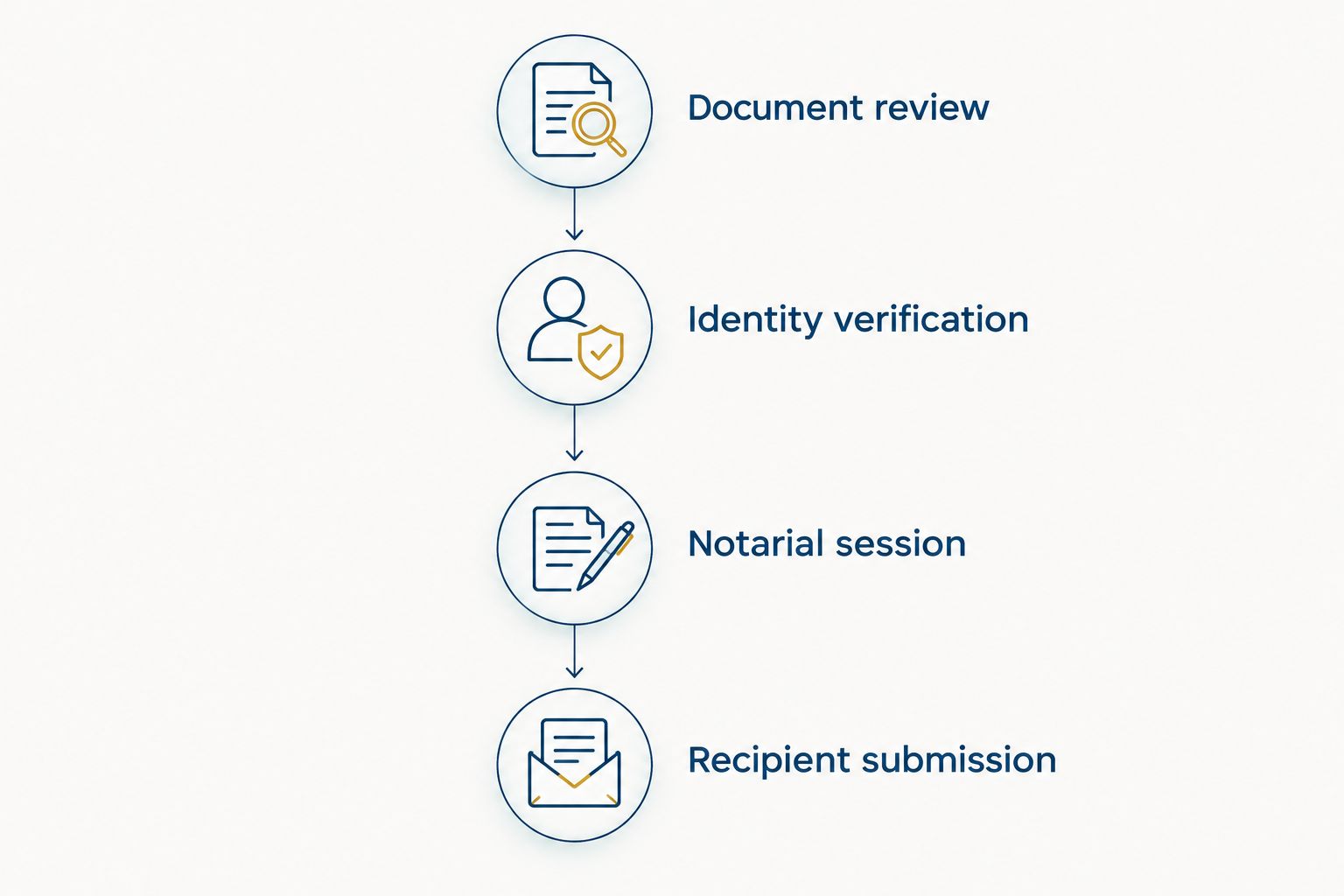
Document review
Describe the document and provide the recipient's instructions through the requested appointment process. State whether you need copy certification or notarization of your own statement. Do not send an unexplained attachment and assume the required act is obvious.
Identity verification
Follow the Proof identity-verification instructions provided for your appointment. Prepare the identification requested and ensure that information you enter accurately reflects your identity. Uploading a document alone does not complete identity verification or establish eligibility.
Notarial session
Follow the notary's instructions for presenting the document, signing, and taking an oath or affirmation when required. Do not assume a previously signed statement can be handled in the same way as one requiring a signature during the session.
Recipient submission
Submit the completed document in the format the recipient accepts. An electronically notarized document and a printed version are not automatically interchangeable for every recipient. Confirm electronic acceptance before choosing the remote process.
Remote or mobile: which appointment fits the request?
Start with remote online notarization when the document and requested act are eligible and the recipient accepts the electronic result. Consider a mobile appointment when in-person examination or signing better fits the requirement. Neither method removes the need for document review.
| Appointment method | Best for | Practical benefit | Limitation to resolve |
|---|---|---|---|
| Remote through Proof | Eligible electronic notarizations | Allows the appointment to take place remotely | Requires identity verification, suitable technology, and recipient acceptance |
| In-person mobile | Requests suited to physical document presentation | Allows physical records to be presented in person | Baltimore County availability must be confirmed before booking |
For a 2026 mobile request, ask about Baltimore County availability before making plans around an appointment. Do not treat an inquiry or preferred time as confirmation.
Request an eligibility review
Describe your document and the recipient's requirements before arranging an appointment.
Why copy-notarization requirements vary
The document's appearance does not determine the required process. These factors change what you need to prepare:
- The recipient's instructions. The receiving organization determines which form of certification it will accept.
- The requested notarial act. Certifying a reproduction differs from notarizing a signature on a copy statement.
- The record's source. An official-record request can direct you to the issuing office rather than a notary.
- Access to the underlying record. The notary needs an adequate basis for the requested comparison or certification.
- The submission format. Electronic acceptance and paper submission requirements affect appointment planning.
- The statement's legal purpose. Questions about legal effect or drafting belong with an attorney, not the notary.
What should a business prepare for repeat requests?
Create a recipient-specific instruction sheet rather than a single rule for every notarization. Record the document type, accepted certificate, submission format, and contact responsible for answering questions. Keep those instructions with the relevant business process.
Separate document preparation from appointment confirmation. Your staff should know who holds the underlying record, who will sign any statement, and which identification instructions apply. A recurring business relationship does not eliminate the requirements for each notarial act.
CraigVet Notary Services offers remote online and mobile notary services, but repeat requests still require eligibility review. Do not reuse a prior certificate as proof that a different document qualifies.
Can I bring only a photocopy to the appointment?
A photocopy alone does not establish that it matches the underlying record. For copy certification, ask what the notary must examine before the appointment; for a copy statement, confirm what the recipient requires you to declare.
Do not assume another photocopy or an image on your phone supplies everything needed. Describe the available record accurately and let the notary explain the applicable procedural requirements.
Does notarization make the original document valid?
No. Notarization does not establish the truth of every statement in the original or resolve its legal effect. Copy certification addresses the reproduction, while a signature-related act addresses the signer and the applicable notarial requirements.
Craig is not an attorney and cannot provide legal advice. Ask an attorney about enforceability, ownership, legal rights, or the wording of a substantive declaration.
FAQ
Can a Maryland notary certify a copy of an original document?
Yes, Maryland permits a notary to certify or attest a copy after determining that it accurately reproduces the record. Confirm that the receiving organization accepts that certification and that the requested procedure is appropriate.
Can I notarize a scanned copy online through Proof?
A scanned copy is not automatically eligible for online copy certification. The document, requested notarial act, identity verification, and means of examining the underlying record must fit the applicable requirements.
Is a notarized copy the same as a certified birth certificate?
No, a notarized photocopy is not automatically equivalent to a certified birth certificate issued by the responsible records office. Obtain the issuer-certified record when the recipient requires it.
Can I sign a statement saying my copy is accurate?
You can use a copy statement when the receiving organization accepts that approach and the requested notarial act is appropriate. Notarizing your statement is different from the notary independently certifying the reproduction.
Do I need to sign my copy statement before the appointment?
Follow the notary's instructions before signing. The required procedure depends on the notarial act, and a statement requiring an oath or affirmation must be handled accordingly.
Can my business arrange repeat remote notarizations?
Businesses can request remote online notarization for eligible documents through Proof. Each request still requires the appropriate document review, identity verification, and appointment confirmation.
Are Baltimore County mobile appointments automatically confirmed?
No, Baltimore County mobile availability must be confirmed before booking. A request does not establish a confirmed appointment before CraigVet contacts you.
One last thing
Before your 2026 appointment, ask the recipient one precise question: Do you require the notary's copy certification, my notarized statement, or a certified record from the issuing office? That answer determines the next step more reliably than the phrase notarized copy.
Keep the recipient's written response with your appointment materials. It gives you a clear requirement to discuss without asking the notary to interpret your legal needs.


