

Yes, a notary can meet you at a coffee shop or another public place when the notary agrees to the location and can complete the required identity checks and notarial procedures there. For eligible documents, Maryland remote online notarization through Proof is another option; neither a public meeting nor a remote session removes document eligibility, privacy, or identity-verification requirements.
- Can a notary meet me at a coffee shop or public place? Yes, with advance agreement and suitable conditions.
- Craigvetnotary offers Maryland remote online notarization through Proof for eligible documents; mobile appointments require availability confirmation.
- A public meeting needs enough privacy, a workable signing area, and satisfactory identity verification.
- Submitting an appointment request does not confirm an appointment; wait for direct confirmation.
Why this matters
Agreeing on a place is not the same as confirming that your document can be notarized there. A café table solves the meeting-location question, but not questions about identification, witnesses, document instructions, or privacy.
For Maryland appointments in 2026, Craigvetnotary offers remote online notarization through Proof for eligible documents and in-person mobile notary appointments. Baltimore County mobile availability must be confirmed before booking, and an appointment is not confirmed until the business contacts you.
Start with the document and its receiving organization. Then choose the appointment format that fits the requirements, rather than choosing a coffee shop first and discovering a problem at the table.
Can a notary meet me at a coffee shop or public place?
Yes. A coffee shop, library meeting area, or another mutually agreed public location can serve as a meeting place, subject to the venue's rules and the notary's ability to perform the requested act properly. Public access alone does not make a location suitable.
You have 2 appointment formats to consider: remote online notarization and an in-person mobile meeting. For Maryland clients in 2026, the practical comparison is document eligibility, identity verification, and the environment—not simply whether a café is nearby.
| Appointment format | Best for | Practical benefit | Limitation to resolve |
|---|---|---|---|
| Maryland remote online notarization through Proof | Eligible documents when you prefer to meet online | Avoids arranging a shared physical meeting place | Requires remote eligibility, identity verification, and a suitable device and connection |
| In-person mobile appointment at an agreed public location | Documents and circumstances suited to an in-person meeting | Lets you propose a convenient meeting place | Requires location agreement, sufficient privacy, and confirmed mobile availability |
Neither format guarantees that every document can be notarized. Tell the notary what you need before making travel arrangements or asking other participants to attend.
What makes a coffee shop suitable?
A suitable location lets the notary communicate clearly with you, inspect the document and identification, and carry out the requested notarial act without interference. You also need a stable surface and enough room to keep papers organized.
A crowded counter or shared table can create avoidable problems. If nearby customers can read sensitive pages or overhear private details, choose a different setting rather than relying on the public location's convenience.
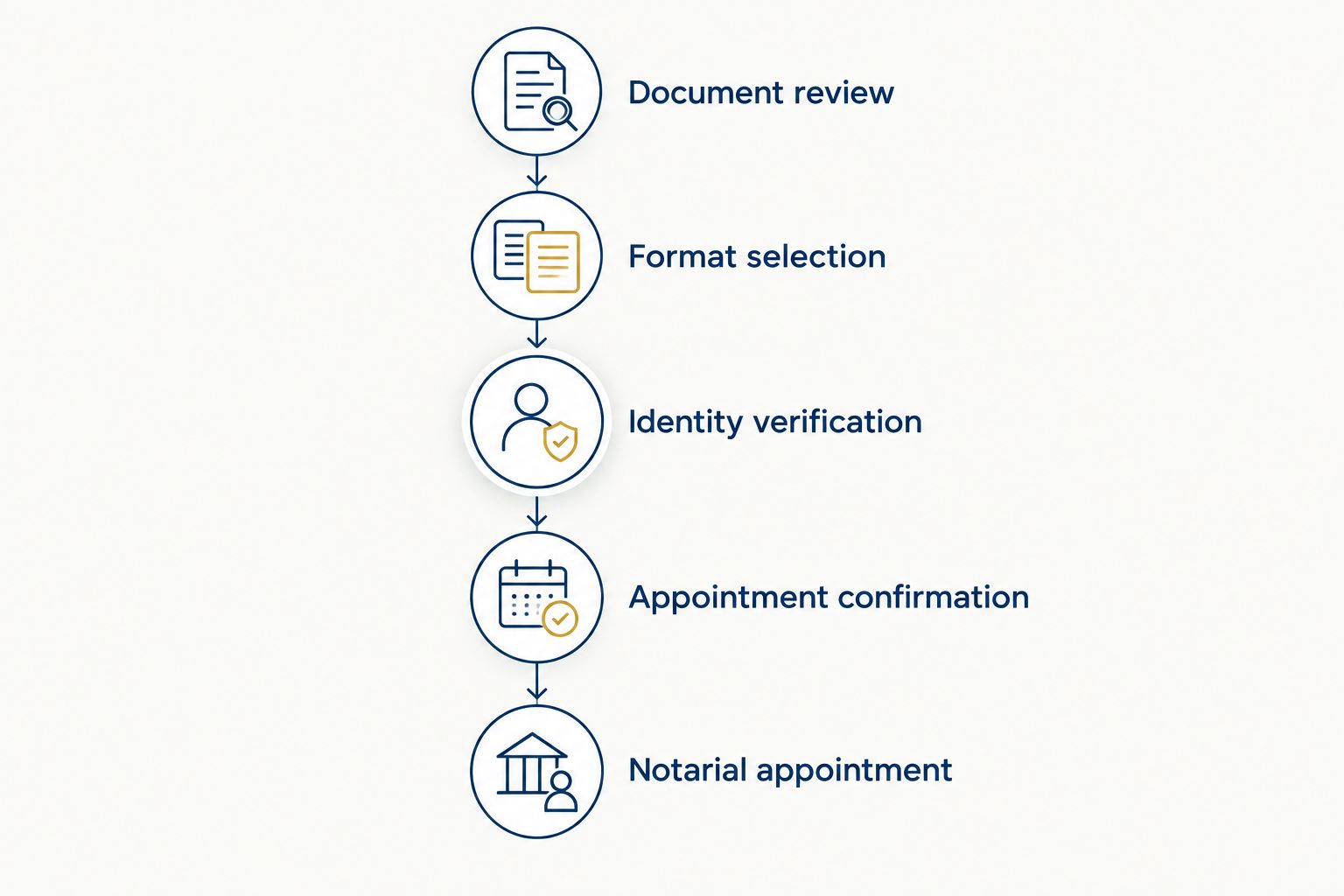
Arrange your appointment in 5 steps
Ask about Maryland remote online notarization through Proof first if you want to avoid travel. If the document or your circumstances require an in-person meeting, propose a public location and wait for an explicit response about suitability and availability.
- Document review. Describe the document, its intended recipient, and any notarization instructions. Flag references to witnesses, original paper documents, or a particular signing procedure so those details can be addressed before scheduling.
- Format selection. Ask whether the document is eligible for remote online notarization or whether an in-person appointment is appropriate. If you prefer a mobile meeting, provide the proposed address and explain the setting.
- Identity verification. Ask what identification and verification steps apply to your appointment format. For a remote session through Proof, follow the platform's instructions; for an in-person meeting, bring the identification the notary instructs you to present.
- Appointment confirmation. Wait for direct contact confirming the arrangements. A request form, suggested time, or proposed coffee shop does not by itself create a confirmed appointment.
- Notarial appointment. Follow the notary's instructions about reviewing, acknowledging, signing, or making any required sworn statement. Do not assume that every document follows the same signing sequence.
If someone else must participate, explain that before the appointment is arranged. Do not assume a companion can serve as a witness, translate, or answer on your behalf; ask what the document and the notarial procedure require.
Why public-place suitability varies
The issue is not whether a business serves coffee. It is whether the specific setting supports the document, the participants, and the required procedure.
- Privacy: Documents can contain information you do not want nearby customers to see or hear. Assess both the tabletop and the surrounding conversation space.
- Noise and interruptions: Music, queues, and frequent interruptions can make communication difficult. Choose a setting where everyone can hear and respond clearly.
- Document instructions: Requirements supplied by the receiving organization can affect appointment preparation. Share those instructions rather than summarizing them from memory.
- Participants: Signers and any required witnesses need to be accounted for before the meeting. An available seat is not a substitute for an eligible participant.
- Venue permission: A publicly accessible business still controls the use of its premises. Check whether the proposed activity and seating arrangement are permitted.
- Appointment availability: The notary must agree to the location and timing. For Baltimore County mobile appointments, confirm availability before booking.
If the proposed setting prevents the notary from completing the required procedure, change the setting. Convenience should not determine whether identity checks, communication, or document handling receive proper attention.
What should I confirm before a public-place appointment in 2026?
Use 4 questions to turn a general meeting request into a useful appointment inquiry. Give clear answers where you can, and ask the notary to resolve procedural questions before you travel.
- What is the document, and who will receive it?
- What identification and participants are required?
- Is the proposed location suitable and permitted by the venue?
- Has the notary directly confirmed the appointment details?
Keep the document accessible, but avoid displaying it while you wait. Bring the receiving organization's instructions with the document so you can refer to the actual wording rather than a recollection of it.
Ask before signing. Some notarial acts require signing in the notary's presence, while others involve acknowledging a signature; the appropriate procedure depends on the requested act. If the document is already signed, disclose that rather than altering it yourself.
For remote appointments, prepare a quiet, private space and follow the platform's device and connection instructions. Remote does not mean informal: identity verification and the notary's directions still apply.
Is remote online notarization better than meeting at a café?
Remote online notarization is better suited to an eligible document when avoiding a shared physical meeting place is your priority. An in-person appointment fits situations where the document or circumstances call for physical attendance, provided a suitable location is agreed.
Craigvetnotary is best suited to Maryland individuals and businesses seeking remote online notarization through Proof for eligible documents. Mobile notary appointments are a secondary option, with Baltimore County availability confirmed before booking.
The remote format has a practical limitation: you need to complete the required identity-verification process and participate using appropriate technology. The public-place format has a different limitation: travel and a convenient address do not guarantee a private, workable signing environment.
Choose based on the actual document requirements. If the receiving organization has not clearly stated whether it accepts the proposed document format, ask it before arranging the appointment.
A repeat-notarization checklist for Maryland businesses in 2026
For recurring business needs, make the appointment inquiry repeatable without assuming every document is identical. A familiar form can still arrive with different signers, recipient instructions, or witness requirements.
Keep a short internal checklist covering the document type, intended recipient, signer contact details, proposed appointment format, and any accompanying instructions. Record which questions remain unresolved before asking staff or customers to attend.
Separate administrative coordination from the signer's participation. A colleague can help organize the request, but the signer still needs to complete the required identity checks and communicate as directed during the appointment.
Do not treat a previous successful appointment as blanket approval for future documents. Ask about eligibility when instructions change, and obtain confirmation for each appointment rather than assuming a recurring time or location is reserved.
Can I use a library instead of a coffee shop?
A library can be proposed as a meeting location, but you must check its room-use rules and obtain the notary's agreement. A quiet setting helps only if the specific space permits the meeting and supports the required communication.
Do not assume a room is private simply because it is quieter than a café. Check whether other people can enter, see the paperwork, or overhear the appointment.
Can someone come with me to the appointment?
You can ask about bringing someone, but explain that person's role before the appointment. A companion, witness, interpreter, and additional signer are different roles with different procedural implications.
Tell the notary if you need an accommodation or help communicating. Arranging this in advance is more useful than arriving with an unexpected participant and assuming the appointment can proceed unchanged.
FAQ
Can a notary meet me at a coffee shop in Maryland?
Yes, a notary can agree to meet you at a coffee shop if the location supports the required notarial procedures. Confirm venue permission, privacy, identification requirements, and the appointment before traveling.
Can I notarize my document online instead of meeting in public?
Eligible documents can be handled through Maryland remote online notarization via Proof. Ask about eligibility and identity verification before choosing that format; not every document is suitable for remote notarization.
Is my appointment confirmed when I submit a request?
No, submitting a request does not confirm an appointment. Wait until the notary contacts you and confirms the arrangements before relying on the proposed time or location.
What identification should I bring to a coffee shop notary appointment?
Bring the identification the notary instructs you to present for your appointment. Confirm requirements beforehand rather than assuming a photograph, photocopy, or expired document will be sufficient.
Should I sign my document before meeting the notary?
Ask the notary before signing because the required procedure depends on the notarial act. If you have already signed, disclose that and follow the notary's instructions rather than changing the document yourself.
Can a coffee shop employee witness my signature?
Do not assume a coffee shop employee can serve as your witness. Confirm whether witnesses are required, what eligibility requirements apply, and who is responsible for arranging them before the appointment.
Can a mobile notary meet my business in Baltimore County?
You can request a Baltimore County mobile appointment, but availability and the proposed location must be confirmed before booking. For repeat needs, explain the document types and participants when making the inquiry.
Can the notary tell me which legal document I need?
Craig is not an attorney and cannot provide legal advice. Ask the receiving organization about its submission requirements and consult an attorney for legal document selection or legal interpretation.
One last thing
A convenient meeting place cannot fix unclear document instructions. Before choosing a café for your 2026 appointment, ask the receiving organization to clarify any uncertainty about the document, required participants, or accepted format.
Craigvetnotary provides notary services, not legal advice. Craig is not an attorney and cannot provide legal advice; resolving legal questions before the appointment keeps the notarization focused on the procedure the notary is authorized to perform.


