

Yes—a document properly notarized by a Maryland notary can generally be used in another U.S. state, including an eligible document notarized remotely through Proof. The receiving organization still determines whether the document, notarial certificate, and delivery format meet its requirements; notarization alone does not guarantee acceptance or make the document legally effective.
- Can a notarized document from Maryland be used out of state? Generally yes, subject to receiving requirements.
- Maryland remote online notarization through Proof is an option for eligible documents, not every document.
- Ask the recipient about the notarial act, electronic acceptance, witnesses, and original-document requirements before booking.
- Craigvetnotary offers Maryland remote online notarization; mobile appointment availability requires confirmation before booking.
Why this matters
A valid notarization and an acceptable document are separate requirements. A notary performs a specified notarial act; the receiving bank, business, agency, court, or recording office decides whether your submission meets its requirements.
For a 2026 transaction, get those instructions before signing or scheduling. An appointment request with Craigvetnotary is not a confirmed appointment until the business contacts you, so provide the destination and requested document format with your inquiry.
Can a notarized document from Maryland be used out of state?
Generally, yes: crossing a state line does not, by itself, invalidate a properly completed Maryland notarization. The practical question is whether the receiving organization accepts the document and how it must be submitted.
Start with Maryland remote online notarization through Proof for eligible documents. If the recipient requires a paper original or another in-person procedure, discuss whether a mobile appointment fits instead; Baltimore County availability must be confirmed before booking.
| Appointment option | Best for | Main advantage | Limitation to resolve |
|---|---|---|---|
| Maryland remote online notarization through Proof | Eligible documents whose recipients accept the electronic process and resulting document | Allows the notarial appointment to take place remotely | Document eligibility, identity verification, and recipient acceptance require confirmation |
| In-person mobile notarization | Documents or recipients requiring an in-person appointment and paper handling | Provides an in-person route when remote notarization does not fit | Baltimore County availability and appointment details require confirmation |
Neither option replaces the recipient's instructions. If an organization supplies its own form, keep its certificate and submission directions together so the notary can review the requested procedure without guessing.
What does the notarization actually establish?
The answer depends on the notarial act. An acknowledgment concerns a signer's acknowledgment of a signature; a jurat involves an oath or affirmation and signing under the required procedure. These acts are not interchangeable simply because both involve a notary.
Notarization does not establish that every statement in a document is true, that the agreement is enforceable, or that the signer received legal advice. Do not ask the notary to choose a legal document or decide which notarial act your transaction requires. Obtain that direction from the recipient or an attorney.
How do you arrange Maryland remote online notarization?
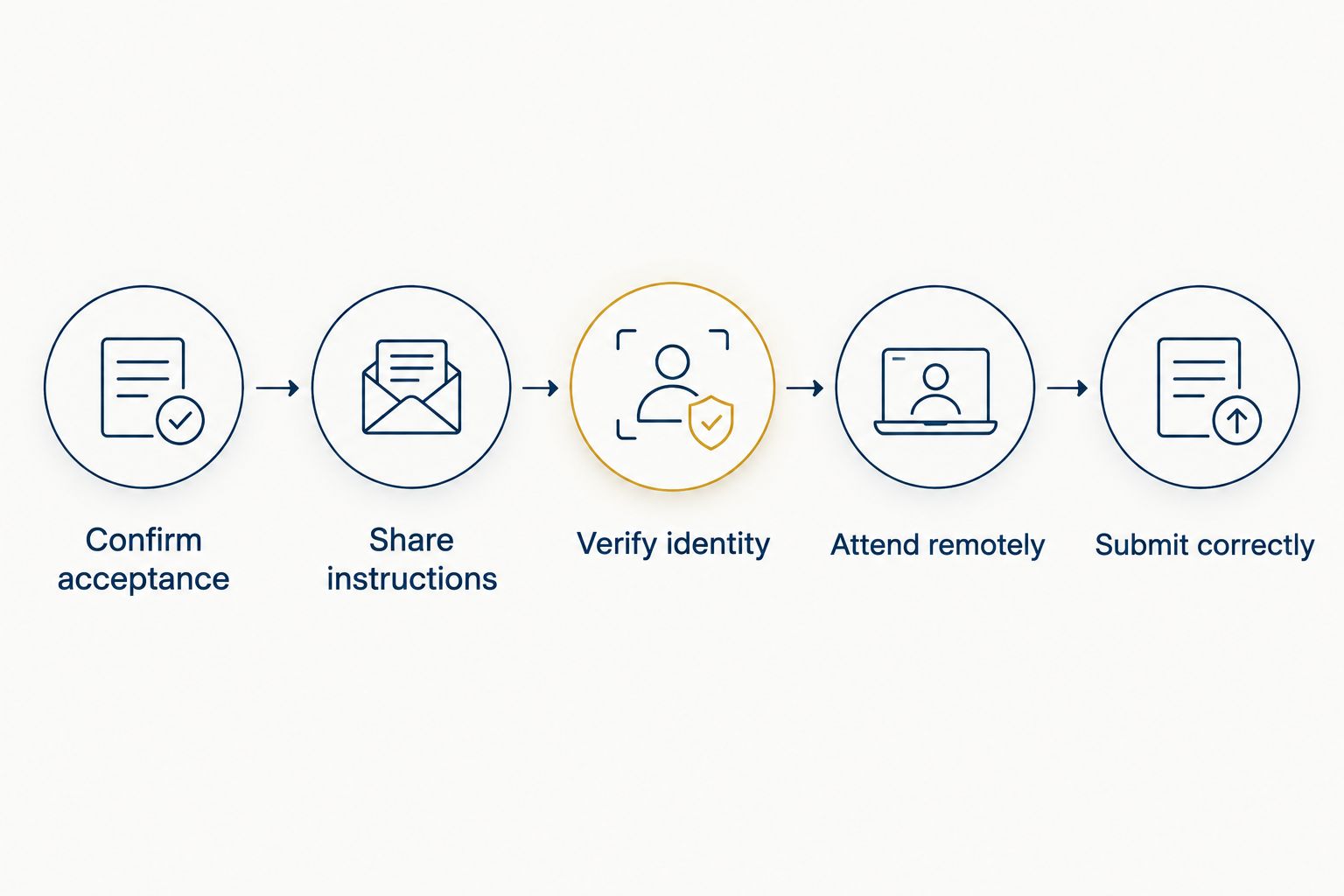
Use this 5-step appointment checklist for an eligible document intended for another state. Resolve acceptance first, then prepare for the session rather than treating the appointment as a test of whether the recipient will accept the result.
- Confirm acceptance. Ask the receiving organization whether it accepts Maryland remote online notarization and the resulting electronic document. Identify the actual office or department processing your submission.
- Share instructions. Provide the document type, destination state, recipient directions, and any witness or original-document requirements. Explain whether the document already contains a notarial certificate.
- Verify identity. Follow the Proof appointment instructions for identification and identity verification. Do not assume that having an identification document automatically satisfies every verification step.
- Attend remotely. Follow the notary's directions during the live session. Leave signatures and certificate fields untouched until you receive instructions appropriate to the required act.
- Submit correctly. Deliver the completed document in the format the recipient requested. Keep the electronic file when the transaction uses an electronic document rather than substituting a printout without approval.
This sequence applies to appointment preparation in 2026; it is not a promise that a particular document qualifies. The notary must still determine whether the requested act can proceed under Maryland notarial requirements.
What should you have ready for identity verification?
Have your identification and follow the specific Proof session instructions. Use a device with a working camera and microphone, a reliable internet connection, and a setting where you can communicate clearly with the notary.
Make sure the notary knows about differences between your identification and the name shown on the document before the appointment. Do not alter your document or identification to make the names appear to match; ask how the issue should be addressed.
Identity verification is part of the process, not a guarantee of completion. The notary must also be able to perform the requested act appropriately, including communicating with the signer and addressing concerns about willingness or awareness.
Why out-of-state acceptance varies
Recipient requirements, document requirements, and notarial requirements answer different questions. These 6 factors determine what you need to confirm before choosing an appointment format:
- Receiving organization: A central customer-service answer is not always the same as the instructions from the department processing your document. Ask the responsible office directly.
- Notarial act: An acknowledgment and a jurat serve different purposes. Obtain instructions when the document does not clearly identify the required act.
- Document format: Electronic delivery, a paper original, and a printed copy of an electronic document are different submissions. Confirm which one the recipient accepts.
- Witness requirements: Witnesses and notarization perform different functions. Ask whether witnesses are required and how they must participate.
- Signing instructions: Some acts require signing in the notary's presence. Do not sign early unless you have instructions appropriate to the document and act.
- Filing requirements: A recording office or agency can require particular document content, attachments, or submission procedures beyond notarization.
For a 2026 filing, obtain the recipient's current instructions rather than relying on an older transaction. A previously accepted document does not establish the requirements for a new submission, even when the destination state is the same.
Can I use Maryland remote notarization while I am in another state?
Yes, a signer can generally participate from another U.S. state in a Maryland remote online notarization, provided the applicable requirements are met. The Maryland notary must be physically located in Maryland when performing the remote notarial act.
Tell the notary where you will be during the appointment. Do not confuse the signer's location, the notary's location, and the document's destination: each describes a different part of the transaction.
For example, a signer outside Maryland can need a document delivered to an organization in another state. That does not remove the need to confirm document eligibility, complete identity verification, and follow the recipient's submission instructions.
Does an out-of-state document need another notarization?
A document does not need a second notarization merely because it will be used in another state. First determine whether the receiving organization objects to the notarial act, the certificate, the document itself, or the delivery format.
If a recipient rejects your submission, request the specific reason in writing. A missing attachment or unacceptable delivery format is not automatically a problem that another notarization fixes.
Do not edit a completed notarial certificate yourself. Contact the notary about a suspected certificate issue and ask the recipient or an attorney about document changes that affect legal content.
Do I need an apostille for use in another U.S. state?
An apostille is generally not needed solely because a Maryland-notarized document will be used in another U.S. state. Apostilles concern authentication for international use, not ordinary interstate submission.
If someone requests an apostille for a domestic transaction, ask the receiving organization to clarify the destination and exact authentication requirement. Do not order an additional service based only on the phrase “out of state.”
International use is a separate question. A document going to a foreign recipient requires destination-specific instructions that this interstate guidance does not replace.
What should businesses confirm before repeat appointments?
For repeat notarizations in 2026, build a recipient-specific checklist rather than a single rule for every document. Record the document type, required notarial act, electronic acceptance, witness instructions, and submission method.
Keep legal decisions outside the administrative checklist. Staff can collect instructions and coordinate appointments, but the recipient or an attorney should resolve questions about legal wording or the appropriate act when it is unclear.
Craigvetnotary's Maryland remote online notarization service is best for individuals and businesses with eligible documents whose recipients accept remote notarization. The service fits a remote appointment process; it does not remove recipient restrictions or make every business document eligible.
For recurring work, use these 3 questions before each booking:
- Is this the same document version and receiving department as the previous submission?
- Has the recipient confirmed acceptance of the proposed electronic or paper format?
- Are the signer, identification, and any required witnesses ready for the requested procedure?
A repeat customer still needs a document-specific eligibility check. Familiarity with the business does not replace identity verification or Maryland notarial requirements.
Request an appointment review
Share the document type, destination, and recipient instructions. Your appointment requires confirmation.
When should you discuss a mobile appointment instead?
Discuss an in-person mobile appointment when the receiving organization requires a paper-based process or the document is not suitable for remote notarization. Mobile service is an alternative appointment format, not a way around document or identification requirements.
Before booking, confirm Baltimore County availability and explain where the appointment would take place. Also disclose any witness requirements, signing restrictions, or instructions about original documents.
A mobile appointment does not automatically resolve a legal question about the form. If the problem is unclear document language or an unspecified notarial act, get the necessary direction before arranging travel.
FAQ
Can a bank in another state accept a Maryland-notarized document?
A bank in another state can generally accept a properly notarized Maryland document, subject to its requirements for the transaction. Ask the department handling your document about the required act, electronic acceptance, and original-document instructions.
Can I print a remotely notarized document and mail it?
Do not assume that a printout of a remotely notarized electronic document will satisfy the recipient. Ask whether it requires the electronic file, accepts a printout, or requires another authorized paper-submission process.
Should I sign my document before the remote appointment?
Leave the document unsigned until you receive instructions appropriate to the required notarial act. An acknowledgment and a jurat have different signing procedures, so signing early can create an avoidable problem.
Does notarization replace witnesses required by another state?
No, notarization does not replace separate witness requirements. Obtain the recipient's witness instructions and discuss participation arrangements before the appointment.
Can a Maryland notary tell me which certificate I need?
A notary cannot choose a notarial act for you when doing so would require legal advice. Ask the receiving organization or an attorney to identify the required act when the instructions are unclear.
Is my appointment confirmed when I send a request?
No, your appointment is not confirmed until Craigvetnotary contacts you. Mobile appointment availability in Baltimore County also requires confirmation before booking.
Does a valid notarization guarantee my document will be accepted?
No, a valid notarization does not guarantee acceptance or establish the document's legal effectiveness. The recipient can have separate requirements for the document's content, witnesses, format, and submission.
Can a Maryland notary provide legal advice about my document?
Craig is not an attorney and cannot provide legal advice. Ask an attorney about legal effect, document selection, or wording that affects your rights or obligations.
One last thing
Before your 2026 appointment, separate your review into 2 checks: whether the notary can perform the requested act and whether the recipient accepts the resulting document. Passing the first check does not automatically satisfy the second.
Ask the recipient to confirm the exact submission format in writing. That instruction gives you something concrete to share before booking and helps prevent an otherwise completed notarization from reaching the destination in the wrong form.


