

Yes, a minor can have a document notarized in Maryland when the notary can establish the minor’s identity and determine that the signer understands the act and is signing willingly. For remote online notarization through Proof, the document and signer must also meet the applicable requirements; notarization does not establish that a minor has legal capacity to enter an agreement.
- Can a minor have a document notarized in Maryland? Yes, subject to identification, understanding, willingness, and document requirements.
- Proof remote online notarization requires a separate eligibility check; do not assume a minor qualifies.
- A parent’s identification does not establish the identity of a minor signing a document.
- CraigVet Notary Services offers Maryland remote online notarization for eligible documents; request review before arranging a minor’s appointment.
Can a minor have a document notarized in Maryland?
Maryland does not impose a blanket prohibition on notarizing a minor’s signature solely because of age. The important questions concern the individual signer, the requested notarial act, and the document’s requirements. Being younger than 18 years does not, by itself, answer all those questions.
For a 2026 appointment, ask CraigVet Notary Services about eligibility before choosing remote or mobile service. Identify who must sign, whether that person is a minor, and what the receiving organization requires. An appointment request is not a confirmed appointment; wait until CraigVet contacts you.
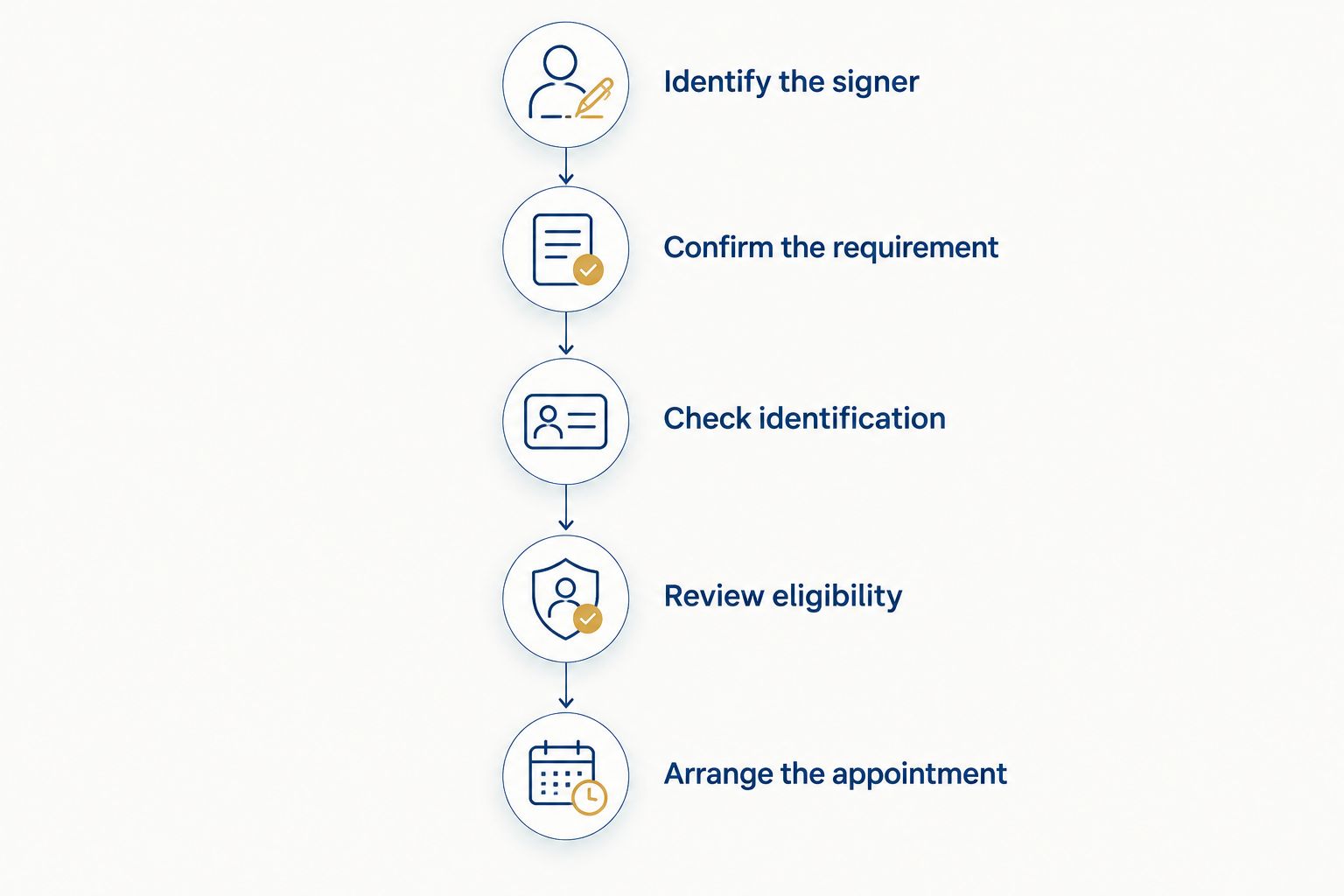
Use this sequence to separate the issues that often get combined:
- Identify the signer. Establish whether the document requires the minor’s signature, a parent’s signature, or signatures from both.
- Confirm the requirement. Ask the receiving organization what notarial act, certificate, witnesses, and submission format it requires.
- Check identification. Have the notary review the proposed identification method rather than assuming that a parent’s ID will suffice.
- Review eligibility. Confirm whether the signer and document qualify for remote online notarization through Proof.
- Arrange the appointment. Proceed only after the service details and appointment arrangements are confirmed.
A document concerning a child does not necessarily require the child’s signature. That distinction belongs at the beginning of the conversation, not after everyone has joined an online session.
Why this matters
A notarization concerns a particular signature and notarial act. It is not a legal opinion about the document, a substitute for parental authorization, or a guarantee that the receiving organization will accept it.
Maryland generally treats a person under 18 years as a minor, but legal capacity depends on the transaction and applicable law. Do not use notarization as a way to resolve a legal-capacity question. If an agreement raises that issue, consult a Maryland attorney before arranging the signature.
The Maryland Secretary of State’s notary guidance and Maryland notarial law are the relevant authorities for a notary’s duties. Requirements imposed by a school, business, court, or other recipient need separate attention. The recipient’s instructions and the notary’s responsibilities are different checks; neither replaces the other.
Start with remote online eligibility through Proof
CraigVet Notary Services provides Maryland remote online notarization through Proof for eligible documents. For a minor, request an eligibility review before treating an online session as the solution. A document that can be notarized in principle is not automatically suitable for a particular remote workflow.
CraigVet Notary Services is best for Maryland individuals and businesses seeking eligibility review before arranging remote online notarization. The practical advantage is arranging an eligible notarial act remotely; the limitation is that document requirements, signer eligibility, and identity verification still control whether the session can proceed.
For your 2026 inquiry, explain that a minor is involved rather than submitting only the document’s title. Ask how identification will be handled and what information is needed to assess the request. Do not assume that a parent’s participation removes the platform’s verification requirements.
Remote service also requires the signer to participate in the session. A parent cannot complete the minor’s appearance merely by holding the device, answering the questions, or presenting the parent’s own identification.
How to prepare a minor’s notary appointment
Identify the signer
Read the signature instructions before scheduling. If a parent must sign a consent form, the parent is the signer whose identity and participation matter for that signature. If the minor must sign, the notary must assess the minor’s own participation.
Do not add or substitute a signature because it seems easier. Ask the document’s issuer or receiving organization to clarify ambiguous signature instructions. Questions about whether someone has legal authority to sign for another person belong with an attorney, not with a scheduling request.
Confirm the requirement
Ask the recipient whether it accepts remote online notarization and an electronically notarized document. Also ask whether it requires a particular notarial certificate or separate witnesses. These details should be settled before the appointment.
A notary cannot choose a legal arrangement for you. If the document does not identify the required notarial act and you do not know what is needed, obtain instructions from the recipient or an attorney rather than asking the notary to select it.
Check identification
Tell the notary what identification the minor has, including whether it is current. A school card, birth certificate, or parent’s identification should not be assumed to satisfy the requirements for the chosen appointment method.
A parent’s ID identifies the parent, not the minor. Ask which identification method is acceptable before sending sensitive records. Follow the instructions provided for the appointment rather than emailing extra identity documents without being asked.
Review eligibility
Have the document’s requirements and the proposed signer reviewed before committing to a remote session. Explain any separate witness requirement or instructions about original paper documents. Those details affect appointment planning.
The eligibility review should also distinguish a technology problem from a legal or procedural problem. A working camera does not resolve unsuitable identification, an unclear signature requirement, or uncertainty about the signer’s willingness.
Arrange the appointment
Wait for direct contact confirming the arrangements. Keep the document, acceptable identification, and any recipient instructions ready, and ask when the document should be signed. Some notarial acts require signing in the notary’s presence; do not guess which procedure applies.
Prepare the minor to answer straightforward questions personally. Explain that the notary needs to speak with the signer and that it is acceptable to say when something is unclear. Preparation should support understanding, not supply rehearsed answers.
Remote online or mobile: which appointment fits?
Start with remote online notarization for eligible documents, then consider whether an in-person appointment is appropriate. Neither format removes the notary’s responsibility to identify the signer and assess willingness and understanding.
| Appointment option | Best for | Practical advantage | Limit to check |
|---|---|---|---|
| Remote online through Proof | Eligible signers and documents accepted electronically by the recipient | The signer participates remotely | Platform eligibility, identity verification, and recipient acceptance must be checked |
| In-person mobile appointment | Requests suited to an in-person notarial act | The signer meets the notary in person | Identification and document requirements still apply; Baltimore County availability requires confirmation |
A mobile appointment is not a workaround for a signer who cannot understand the act or is being pressured. Likewise, an online appointment is not appropriate simply because family members live in different places.
For mobile service, confirm Baltimore County availability before booking. Do not treat a requested location or time as accepted until the appointment arrangements have been confirmed directly.
Why a minor’s notarization requirements vary
The right preparation depends on the request, not just the signer’s age. These factors explain why separate families or businesses can receive different appointment instructions:
- Who actually signs. A parent signing a consent form presents a different request from a minor signing a statement.
- Identification method. The notary needs an acceptable way to establish the actual signer’s identity.
- Requested notarial act. An acknowledgment and an oath or affirmation involve different procedures.
- Understanding and willingness. The signer must participate meaningfully rather than rely on another person to answer.
- Recipient instructions. Electronic acceptance, certificates, and separate witnesses require advance clarification.
- Appointment format. Remote platform requirements and in-person arrangements create different preparation steps.
For repeat business requests in 2026, record these requirements by document type. A repeatable intake process is useful, but each signer and document still needs individual review. Do not carry an earlier eligibility decision over to every future request.
Can a parent sign instead of the minor?
A parent cannot substitute a signature merely because the intended signer is under 18 years. Whether a parent has authority to sign depends on the document and applicable law; ask the recipient for signature instructions and consult an attorney about legal authority.
There is a separate, common situation: the document itself calls for a parent’s consent and signature. In that case, notarizing the parent’s signature is not the same as notarizing the minor’s signature.
Can a minor use a parent’s ID for notarization?
A parent’s ID does not establish the identity of a signer under 18 years. Tell the notary what identification the minor actually has and ask whether an acceptable identification method is available for the requested service.
Do not assume that a shared address, matching surname, or family relationship settles the issue. Parent involvement and signer identification are separate matters.
Does notarization make a minor’s agreement enforceable?
Notarization does not establish the enforceability of an agreement signed by someone under 18 years. It records the notarial act performed; legal capacity and enforceability require separate legal analysis.
A notarial seal does not replace that analysis. Resolve questions about contractual obligations with a Maryland attorney before asking the minor to sign.
Practical guidance for businesses handling repeat requests
Businesses should separate document approval from appointment scheduling. Your staff can gather the recipient’s instructions and identify the proposed signer without deciding whether the agreement is legally enforceable.
Use a short intake record for 2026 requests:
- Document title and receiving organization.
- Person or people required to sign.
- Whether any signer is a minor.
- Requested notarial act and separate witness instructions.
- Proposed identification and preferred appointment format.
- Recipient instructions for submitting the completed document.
Keep sensitive identity information out of general scheduling notes unless it is specifically requested through an appropriate process. A useful intake record explains the request; it does not need to become a collection of identity-document copies.
CraigVet Notary Services can review a notary appointment request, but Craig is not an attorney and cannot provide legal advice. Your business remains responsible for obtaining legal guidance about its documents and the authority of the people signing them.
FAQ
Can a minor have a document notarized in Maryland in 2026?
Yes, a minor can have a document notarized in Maryland when the notary can establish identity and determine that the signer understands the act and is signing willingly. Remote online eligibility and the document’s requirements need separate review.
Can my child complete an online notarization through Proof?
Do not assume that your child qualifies for a Proof session. Request an eligibility review covering the signer, identification, document, and recipient requirements before arranging remote online notarization.
Does a parent have to sign every notarized document involving a child?
No, a document involving a child does not automatically require a parent’s signature. Follow the document’s signature instructions and obtain legal advice when signing authority is unclear.
What identification should a minor bring to a notary appointment?
Ask the notary to confirm an acceptable identification method before the appointment. Do not assume that a school card, birth certificate, or parent’s ID satisfies the requirements for the chosen service.
Can I answer the notary’s questions for my child?
You cannot replace the minor’s own participation when the minor is the signer. The notary needs to assess the signer’s understanding and willingness directly.
Does a notarized signature mean my child’s contract is legally binding?
No, notarization does not determine whether a minor’s contract is legally binding. Ask a Maryland attorney about legal capacity and enforceability.
Can I request a mobile notary appointment in Baltimore County?
You can request an in-person mobile appointment, but Baltimore County availability must be confirmed before booking. An appointment request is not confirmed until CraigVet contacts you.
Can the notary tell me which document my child should sign?
A notary cannot provide legal advice about which document your child should sign. Ask the receiving organization for procedural requirements and a Maryland attorney for legal advice.
One last thing
Before asking whether a minor can be notarized, ask whose signature the recipient actually needs. A parent’s consent form and a minor’s sworn statement are different requests, even when both concern the same child.
For your 2026 appointment inquiry, send a clear description of the document and signature requirement before making travel or scheduling arrangements. Resolving that distinction first gives the notary a specific request to assess and helps you prepare the right signer.


