

Yes. A Maryland notary authorized to perform remote online notarizations can notarize an eligible document for someone in another U.S. state while the notary is physically in Maryland. For a 2026 appointment, the signer must complete the required remote appearance and identity verification; document eligibility and the receiving organization’s requirements still apply.
- Can a Maryland notary notarize documents for someone in another state? Yes, through an eligible remote online notarization.
- The Maryland notary must remain physically in Maryland; the signer can be in another U.S. state.
- CraigVet Notary Services offers Maryland remote online notarization through Proof, subject to document and identity verification requirements.
- Confirm recipient requirements before booking; requesting an appointment does not confirm it.
Can a Maryland notary notarize documents for someone in another state?
Yes—the signer’s location in another U.S. state does not, by itself, prevent a Maryland remote online notarization. The notary’s location, remote authorization, document eligibility, and required procedures determine whether the appointment can proceed.
For eligible documents, CraigVet Notary Services offers Maryland remote online notarization through Proof. This is different from asking a Maryland notary to travel across state lines and use a Maryland commission there.
| Appointment arrangement | Best for | What it allows | Main limitation |
|---|---|---|---|
| Maryland remote online notarization | Eligible signers appearing from another U.S. state | Remote appearance using the required communication technology | The notary must be physically in Maryland and authorized for remote acts |
| In-person notarization in Maryland | Signers who can meet the notary in Maryland | Physical appearance before the Maryland notary | The signer must attend in person; mobile availability requires confirmation |
| In-person notarization outside Maryland | Signers seeking a local physical appointment elsewhere | An appointment with a notary authorized in that jurisdiction | A Maryland commission alone does not authorize in-person acts in another state |
A document’s connection to another state is a separate question. A Maryland notary can generally notarize an eligible document intended for use elsewhere, but the recipient decides what documentation and execution requirements it will accept.
Why this matters
An out-of-state address is not the same thing as an out-of-state notarial act. Remote notarization separates the signer’s physical location from the notary’s physical location, while preserving the requirement that the signer appear before the notary through the authorized process.
That distinction helps families and businesses avoid arranging travel unnecessarily. It also prevents a common mistake: assuming that any video call, electronic signature, or emailed identification document counts as remote online notarization.
For a 2026 appointment, start with the Maryland Secretary of State’s guidance on remote notarization and the receiving organization’s instructions. Permission to perform a notarial act does not guarantee that a particular recipient will accept the document in that form.
How do you arrange an out-of-state remote appointment?
Start with document eligibility, then complete the appointment and identity verification process. Do not sign simply because you have opened the file or received a meeting invitation; follow the instructions for the particular notarial act.
- Document review. Explain what document needs notarization, where you will be physically located, and who will receive it. Provide the recipient’s signing instructions so the appointment request can be assessed against the document’s requirements.
- Recipient confirmation. Ask the receiving organization whether it accepts remote online notarization for this document. Identify any requirements concerning witnesses, certificate wording, electronic delivery, or original paper documents before proceeding.
- Appointment confirmation. Submit your request and wait for direct contact. An appointment is not confirmed until CraigVet contacts you; submitting a request alone does not reserve a confirmed session.
- Identity verification. Follow the Proof instructions for identification and any required verification steps. Have the requested identification ready, and address name differences or access problems before the notarial act begins.
- Remote appearance. Join the session as instructed, communicate with the notary, and complete the signing or acknowledgment steps appropriate to the document. Afterward, follow the delivery instructions and check that the recipient has what it needs.
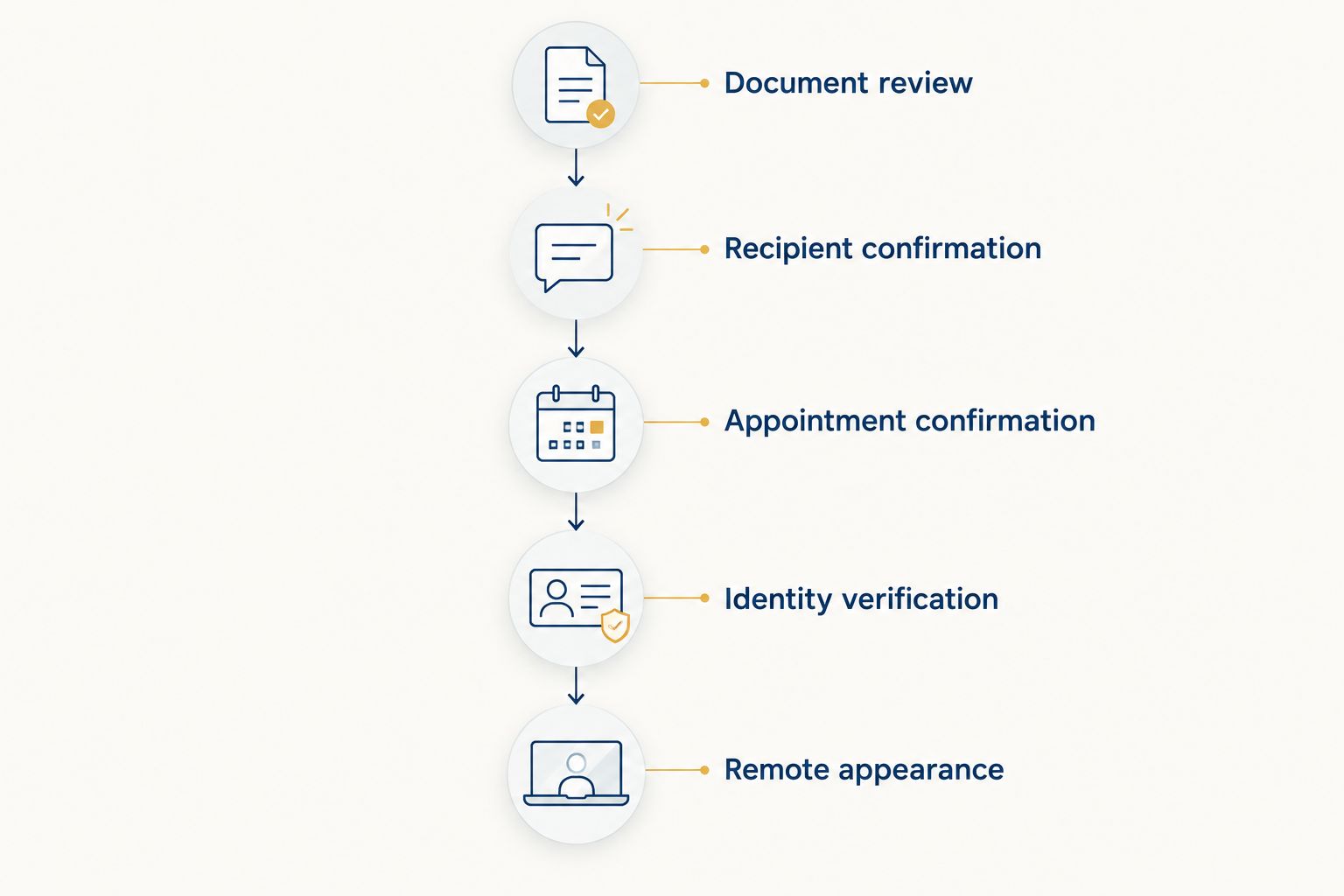
The order matters. Discovering a witness requirement or a paper-original requirement during the session can interrupt completion, even when the signer’s location is otherwise acceptable.
Request a remote appointment
Share your document needs and location. Wait for direct contact before treating the appointment as confirmed.
Why an out-of-state notarization depends on the document
An eligible remote appointment requires more than a Maryland notary and a willing signer. These factors determine the practical route:
- Notary location and authority. The Maryland notary must be physically in Maryland and authorized to perform remote online notarizations. A Maryland commission is not nationwide permission to conduct physical appointments.
- Document eligibility. Not every document or transaction is suitable for remote completion. Share the document type and execution instructions before requesting a session.
- Identity verification. The signer must satisfy the applicable identification requirements. An unreadable identification document or an unresolved verification problem prevents the process from proceeding as planned.
- Recipient requirements. The receiving organization can require a particular execution method or supporting documentation. Ask about acceptance before signing rather than after delivery.
- Witness and signing instructions. A notary does not automatically replace a required witness. Identify who must attend, in what role, and how attendance must occur.
- Technology and participation. The signer must be able to use the remote process and communicate during the session. A connection or device problem needs resolution before the notarial act can be completed properly.
Choose the appointment method from the document’s requirements, not from convenience alone. Remote access is useful only when the completed document meets the requirements of its intended use.
Does the document have to be from Maryland?
No. A document intended for another state is not automatically excluded from notarization by a Maryland notary. The notary must still perform an authorized act using the applicable Maryland procedures.
For example, the state named in a document’s underlying transaction is not necessarily the location of the notarization. Do not change a notarial certificate’s location wording yourself to make it match the signer’s address or the property location; ask the notary to address the certificate requirements.
If the receiving organization supplies special instructions, share them before the appointment. If those instructions raise a legal question about which notarial act is needed, obtain an answer from the document’s issuer or an attorney rather than asking the notary to choose for you.
Can a Maryland notary travel to another state to notarize?
A Maryland commission alone does not authorize a notary to perform an in-person notarization in another state. The notary would need authority that permits the act in that jurisdiction; the signer’s Maryland connection does not change this limit.
For in-person service, the physical meeting must occur where the notary is authorized to act. A signer who lives elsewhere can attend an eligible in-person appointment in Maryland; Maryland residency is not the deciding factor.
Mobile appointments are a secondary option when physical attendance is appropriate. For Baltimore County mobile service, confirm availability and the meeting arrangement before booking; do not assume a requested location or time has been accepted.
What should businesses check before repeat notarizations?
CraigVet Notary Services is suited to Maryland businesses seeking remote online notarization through Proof for eligible documents. The practical benefit is a remote appointment route; its limit is that each document and signer must still meet the applicable requirements.
For repeat notarizations in 2026, give staff a consistent intake process rather than treating every request as an informal scheduling task. Keep document preparation separate from the notary’s role.
Before requesting an appointment, have the responsible employee confirm:
- The document version is final and the recipient’s instructions are attached.
- Each signer’s name and physical location are identified.
- Any witness requirements have been clarified.
- Each participant understands the remote attendance instructions.
- The person receiving the completed document has confirmed the required format.
- Staff know that a submitted request is not an appointment confirmation.
For business documents, also distinguish identity verification from authority to sign. Establishing who a signer is does not, by itself, establish that the signer has authority to bind a company or act for someone else.
Keep internal approvals with the business, document issuer, or legal adviser. The notary’s role is not to decide whether a transaction is advisable or whether a contract protects your interests.
What should you prepare before your appointment?
Prepare the document and participation details before joining the session. Follow the appointment-specific instructions rather than assuming a previous notarization used the same procedure.
Have the requested identification available, check that you can access Proof, and test your camera, microphone, and internet connection. Choose a setting where you can hear questions clearly and participate without unnecessary interruptions.
Do not email sensitive identity documents or account information casually as a substitute for the instructed verification process. Use the submission and identity verification instructions provided for your appointment.
Ask about an existing signature before making changes. An acknowledgment and an act requiring signing in the notary’s presence do not follow identical signing procedures, so an already signed document needs individual assessment rather than an automatic assumption that it is acceptable or unusable.
If your name differs across the document and identification, raise the issue beforehand. Do not alter the document’s legal content merely to make the appointment easier.
FAQ
Can I use a Maryland online notary if I live in another state?
Yes, an eligible signer in another U.S. state can appear before a Maryland notary through an authorized remote online notarization process. The notary must be physically in Maryland, and document and identity verification requirements still apply.
Does the Maryland notary have to be in Maryland during the video appointment?
Yes, a notary performing the remote act under Maryland authority must be physically in Maryland. The signer’s permitted remote location does not move the notary’s jurisdiction.
Will every organization accept a remotely notarized document in 2026?
No, do not assume every receiving organization accepts remote online notarization for every document in 2026. Confirm the required execution and delivery format with the recipient before arranging the appointment.
Can I use an ordinary video call instead of Proof?
An ordinary video call is not a substitute for the required remote online notarization process. Follow the Proof appointment and identity verification instructions provided for your session.
Do I need to sign my document before the online appointment?
Follow the notary’s instructions before signing because the required procedure depends on the notarial act. If you have already signed, disclose that before the appointment rather than changing or replacing the signature without guidance.
Can an online notary act as my required witness too?
Do not assume the notary can also satisfy a separate witness requirement. Share the document’s witness instructions before scheduling so the attendance requirements can be clarified.
Is my appointment confirmed when I submit a request?
No, your appointment is not confirmed until CraigVet contacts you. Wait for confirmation and follow the instructions provided for the remote session or mobile appointment.
Can Craig tell me which legal document or notarial act I need?
Craig is not an attorney and cannot provide legal advice. Ask the document issuer or an attorney to resolve questions about the document’s legal effect or the notarial act you should request.
One last thing
Check the recipient’s requirements before you check your calendar. A signer’s out-of-state location is often not the obstacle; a mismatch between the signing method and the recipient’s instructions is the issue to resolve first.
For your 2026 appointment request, send a clear description of the document, your physical location, and any witness or delivery instructions. Keep legal questions separate: Craig is not an attorney and cannot provide legal advice.


