

Yes—a business can generally require an in-person notary instead of remote online notarization, subject to applicable law and its contractual obligations. Maryland remote online notarization through Proof is an option for eligible documents, but a valid notarial act does not by itself establish that the receiving business must accept that format. Before scheduling, ask the recipient whether it requires physical presence, a paper original, or both.
- Can a business require an in-person notary instead of remote? Generally yes, subject to applicable law and contractual obligations.
- Maryland remote online notarization through Proof serves eligible documents; confirm recipient acceptance before scheduling.
- Proof identity verification and a recipient’s document requirements are separate checks.
- A paper original requirement and an in-person appearance requirement are not interchangeable.
Why this matters
Confirm acceptance before arranging notarization. A completed notarization does not resolve a recipient’s separate requirements for document format, delivery, or supporting paperwork. Finding that out afterward creates avoidable repeat work.
For eligible documents, CraigVet Notary Services offers Maryland remote online notarization through Proof. The service is best for Maryland individuals and businesses seeking remote notarization after confirming document eligibility and recipient acceptance. Mobile appointments are a secondary option; Baltimore County availability must be confirmed before booking.
For your 2026 appointment, separate convenience from acceptance. An online appointment can eliminate travel, but it does not replace the receiving business’s review of what it will accept.
Can a business require an in-person notary instead of remote?
Generally, yes. Maryland’s authorization of remote online notarization establishes a lawful way to perform eligible notarial acts; it does not create a blanket requirement that every private business accept every remotely notarized document. A particular dispute still depends on the governing law, the document, and any applicable agreement.
Start by identifying the actual restriction. A request for an original signature is not necessarily the same as a requirement to appear physically before a notary. Ask the recipient to explain what it means before choosing an appointment.
| Requirement | What it addresses | What you should confirm |
|---|---|---|
| Physical appearance | Whether signer and notary must meet in person | Whether remote appearance is expressly excluded |
| Paper original | The document format the recipient wants | Whether an electronic document or printed copy is acceptable |
| Particular notarial act | The act required for the document | Whether the document instructions identify the required act |
| Identity documentation | Identification requirements | Which identification the appointment process requires |
| Delivery instructions | How the completed document reaches the recipient | Whether electronic delivery satisfies the instructions |
Legal validity and recipient acceptance are 2 separate checks. Passing the first does not automatically answer the second. A notary also cannot guarantee that a receiving business will approve the underlying transaction.
If a recipient’s demand appears inconsistent with a contract or a legal requirement, ask the recipient for its written basis. Questions about enforceability belong with an attorney, not with the notary performing the appointment.
How to confirm acceptance before your appointment
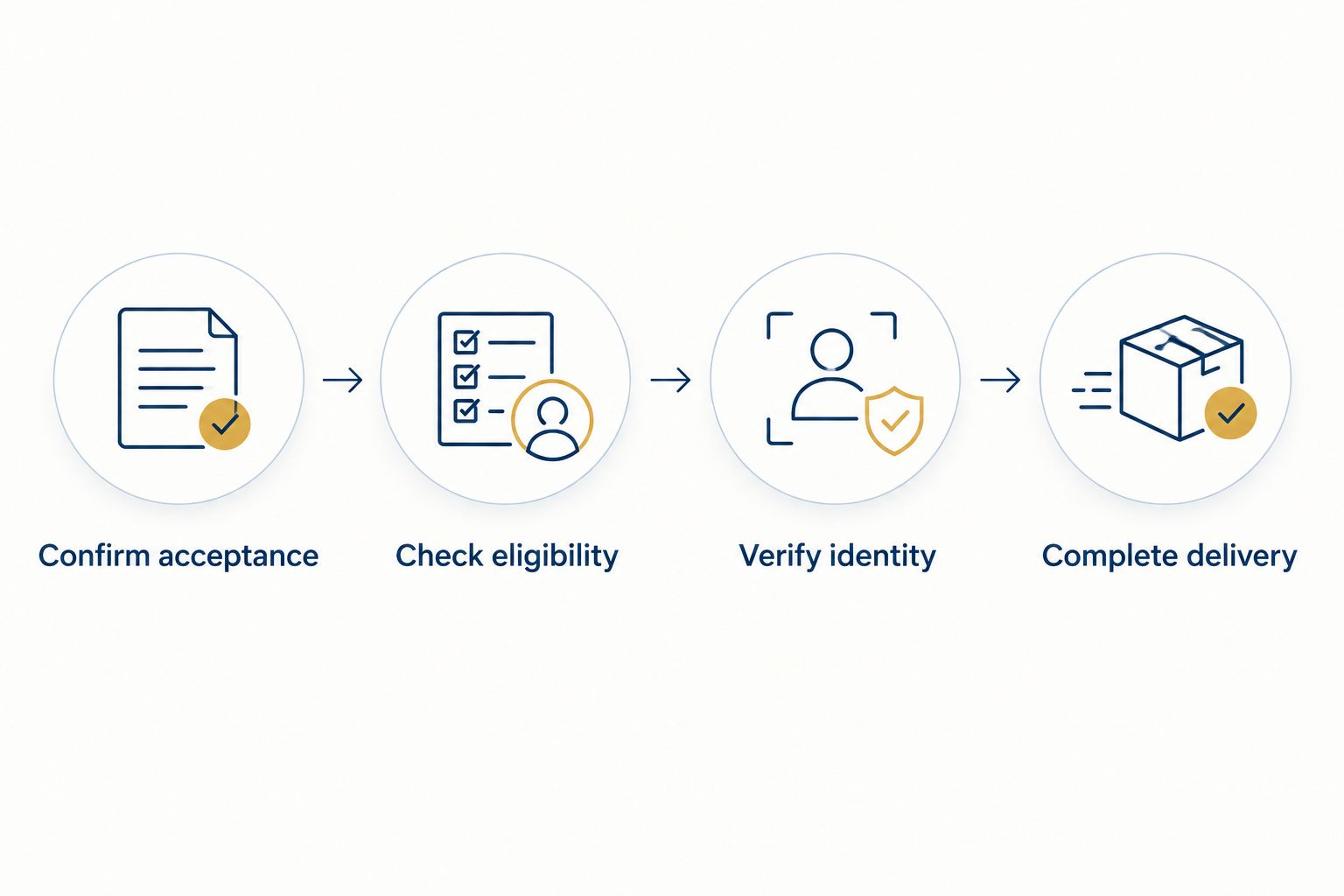
Use these 4 steps for a 2026 appointment. They keep the recipient’s instructions, document review, and identity verification in the right order.
- Confirm acceptance. Contact the person or department that will review the finished document. Ask whether Maryland remote online notarization through Proof is accepted for this specific document and transaction. Request a written answer rather than relying on a general statement about electronic signatures.
- Check eligibility. Explain the document type and any recipient instructions when requesting service. Do not assume that every document, signer, or transaction qualifies for remote notarization. Resolve questions about the required notarial act before the appointment.
- Verify identity. Follow the Proof identity-verification instructions provided for the remote process. Prepare the identification and technology those instructions require. Tell the notary about a name discrepancy or verification difficulty before attempting to complete the session.
- Complete delivery. Follow the recipient’s instructions for submitting the completed document. Keep the acceptance instructions with your records. If the recipient requests a different format afterward, clarify the change before arranging another notarization.
The order matters. Completing identity verification first does not settle whether the recipient accepts the document, and recipient approval does not eliminate the notary’s obligation to determine whether the act can proceed.
Remote online notarization: Best for accepted electronic workflows
Maryland remote online notarization through Proof is best for eligible documents whose recipients accept the remote process. It lets you appear before the notary using the authorized remote process instead of traveling to meet in person.
That convenience has boundaries. You must complete the required identity verification and participate in the session as instructed. Document eligibility, signer circumstances, and recipient requirements still control whether the appointment is appropriate.
For a repeat business workflow, confirm acceptance for the document category you actually use. Approval of one transaction is not a reliable substitute for instructions covering a different document, recipient, or signer.
Do not treat a platform’s ability to receive a file as approval of the legal document. Technical readiness, notarial eligibility, and recipient acceptance answer different questions.
In-person notarization: Best for confirmed physical-presence requirements
An in-person appointment is best when the recipient expressly requires physical appearance or the remote process is unsuitable. Ask whether the requirement concerns the signer’s presence, a paper original, or an additional transaction-specific condition.
The trade-off is coordination. An in-person appointment requires an agreed location and schedule, and choosing it does not remove identification, document, or recipient requirements.
CraigVet Notary Services also offers mobile notary appointments. Baltimore County availability must be confirmed before booking, and submitting an appointment request does not confirm an appointment; confirmation follows contact from CraigVet Notary Services.
| Appointment option | Best for | Main benefit | Main limitation |
|---|---|---|---|
| Maryland remote online notarization through Proof | Eligible documents with confirmed recipient acceptance | No physical meeting with the notary | Requires remote eligibility and successful identity verification |
| In-person mobile notarization | Confirmed physical-presence requirements or an unsuitable remote process | Signer and notary meet physically | Requires location coordination and confirmed availability |
Neither option guarantees acceptance of an incomplete document or approval of the transaction. Choose the appointment format after clarifying what the recipient requires, not as a substitute for that clarification.
Why recipient requirements vary
A business’s answer can depend on more than whether remote notarization is lawful. For your 2026 document, ask which of these factors actually controls the decision:
- Applicable law. A document or transaction can be subject to legal requirements beyond the rules governing the notarial act. Ask an attorney to resolve legal uncertainty rather than asking a notary to interpret it.
- Contract terms. An agreement can specify execution or delivery requirements. Identify the relevant language before assuming a general company policy answers the question.
- Document format. A recipient might need an electronic document, a paper original, or another specified submission format. Clarify the format separately from the appearance method.
- Receiving-party instructions. The business requesting the document is not always the final reviewer. Confirm whose instructions determine acceptance.
- Signer and session eligibility. The remote process requires appropriate identification and compliance with applicable notarial requirements. Recipient approval alone cannot cure an eligibility problem.
- Additional participants. Witness requirements, when applicable, need separate coordination. Do not assume the notary serves as a required witness or that a remote appointment automatically supplies witnesses.
These are questions to resolve, not reasons to guess that remote notarization will fail. A clear written response from the recipient gives you a more useful starting point than a general discussion of online signatures.
What should your business ask before repeat notarizations?
Use 3 questions to establish a repeatable 2026 process: Which documents qualify, who approves the format, and what must each signer prepare? Keep the answers in your internal instructions, with a named contact responsible for updating them.
For businesses with recurring notarizations, the most useful preparation is a document-specific checklist. Record the document name, receiving organization, approved appearance method, delivery format, and any witness instructions. Keep sensitive document contents out of shared scheduling notes unless they are necessary and handled appropriately.
Assign someone to resolve acceptance questions before sending employees or customers into appointments. A signer should not have to interpret conflicting instructions while identity verification is underway.
CraigVet Notary Services supports eligible Maryland remote online notarization through Proof. For repeat work, communicate the document category and recipient instructions when requesting an appointment; do not assume a previous appointment establishes eligibility or acceptance for the next one.
What should you do if a business rejects remote notarization?
Ask the business to identify the exact reason for rejection. Distinguish a remote-appearance restriction from an incomplete document, an incorrect submission format, or another issue with the transaction.
Then take the next step that matches the reason:
- If physical presence is required, clarify any remaining document instructions before requesting an in-person appointment.
- If the submission format is wrong, ask what format the recipient requires before changing or reproducing the document.
- If instructions conflict, request review by the department responsible for acceptance.
- If the dispute concerns legal rights or contractual obligations, consult an attorney.
Do not alter a completed notarial certificate yourself to satisfy new instructions. Explain the issue to the notary and ask what procedural steps are appropriate. A different document or requirement needs review, not an improvised correction.
Does an electronic signature mean remote notarization is accepted?
No. An electronic signature and remote online notarization are different parts of a document workflow. A business can accept electronic signatures while maintaining separate instructions for notarized documents.
Ask specifically about Maryland remote online notarization, not just whether the recipient accepts digital paperwork. Name the document and identify the receiving department so the answer addresses your actual submission.
Can the notary decide whether the business must accept it?
No. The notary’s role is to perform the authorized notarial act when the requirements are met, not to decide a business’s legal obligations or approve the underlying transaction.
Craig is not an attorney and cannot provide legal advice. Ask the recipient about acceptance; ask an attorney about a disputed legal requirement.
FAQ
Can a business refuse a remotely notarized document in Maryland?
A business can generally set acceptance requirements, subject to applicable law and contractual obligations. Confirm whether it accepts Maryland remote online notarization for your specific document before scheduling.
Is Maryland remote online notarization through Proof an option for every document?
No. Remote online notarization is available for eligible documents and requires compliance with identity-verification and Maryland notarial requirements. Recipient acceptance must also be checked separately.
Does a paper original requirement mean I need an in-person notary?
Not necessarily. A paper-original requirement concerns document format, while an in-person requirement concerns physical appearance. Ask the recipient to clarify both before arranging service.
What should I ask a business before booking an online notary?
Ask whether the business accepts Maryland remote online notarization through Proof for the specific document and transaction. Also confirm the required delivery format and any witness instructions.
Can I use an in-person mobile appointment instead?
An in-person mobile appointment is an alternative when appropriate for the document and recipient requirements. Baltimore County availability must be confirmed before booking; an appointment request is not confirmation.
Can a notary tell me which legal document or notarial act I need?
A notary cannot provide legal advice about which document or notarial act you need. Craig is not an attorney; obtain instructions from the document recipient or legal guidance from an attorney.
Should a business recheck acceptance for repeat notarizations?
Yes. Recheck acceptance when the document, recipient, instructions, or transaction changes. A previous accepted notarization does not establish that a different submission meets the current requirements.
One last thing
For your 2026 appointment, ask the recipient this precise question: Does in-person mean physical appearance before the notary, a paper original, or both? That distinction determines what you need to arrange.
Get the answer before notarization, not after rejection. Keep it with the document instructions so the signer, notary, and receiving department work from the same requirements.


