

Best overall for eligible trust documents: Maryland remote online notarization through Proof with CraigVet Notary Services. Best for a Maryland will: an attorney-guided signing with the required witnesses. Best for eligible paper documents at your location: a mobile notary appointment, with Baltimore County availability confirmed before booking. This 2026 guide separates notarization from the execution requirements that make estate documents effective.
- For 'notarize will trust maryland,' distinguish will execution from trust-document notarization before choosing an appointment.
- CraigVet Notary Services offers Maryland remote online notarization through Proof for eligible documents, not wills.
- An ordinary Maryland written will requires two credible witnesses; a notary does not replace them.
- Mobile appointments support eligible paper-document notarization, with Baltimore County availability confirmed before booking.
Why this matters
A notarial certificate and a valid estate document are different things. A notary performs a specified notarial act; an attorney advises you about the document’s legal effect, execution requirements, and suitability for your estate plan.
For Maryland wills, choosing an online notary first is the wrong starting point. Maryland’s remote-notarization statute excludes wills, and ordinary written wills have separate signing and witnessing requirements. A trust document needs its own review rather than an assumption that the same rules apply.
Start with CraigVet Notary Services for eligible remote or mobile notarial services. Craig is not an attorney and cannot provide legal advice, determine whether your estate plan meets your needs, or promise that every document qualifies for remote notarization.
What makes the best Maryland notarization route?
Choose a route by the document’s requirements, not by convenience alone. These five criteria determine the recommendations in this 2026 guide:
- Document eligibility: Establish whether the document is a will, a trust instrument, or a separate supporting document. Maryland prohibits remote notarial acts with respect to wills.
- Execution requirements: Identify the necessary signatures, witnesses, and notarial act before arranging the appointment. Notarization cannot replace a required witness.
- Recipient acceptance: Ask the attorney, financial institution, or other intended recipient which document format and execution method it requires.
- Identity verification: Confirm the identification process before the appointment. Remote and in-person notarization use different procedures.
- Practical readiness: Make sure the signer can participate, the document is ready, and any required witnesses have been arranged separately.
The best route is the one that satisfies the document’s requirements before the signing begins. A convenient appointment is not a substitute for correct execution.
Maryland signing options at a glance
| Option | Best for | Standout feature | Key limitation |
|---|---|---|---|
| Remote online notarization through Proof | Eligible trust-related documents | Online appearance before a Maryland notary | Maryland wills are excluded; document eligibility and recipient requirements need confirmation |
| Attorney-guided witnessed signing | Executing an ordinary Maryland written will | Legal guidance and coordination of execution requirements | Legal services and witness arrangements are separate from a notary appointment |
| Mobile notary appointment | Eligible paper documents at your location | In-person notarization without traveling to the notary | Baltimore County availability requires confirmation; notarization does not replace witnesses |
These are different routes, not interchangeable versions of the same service. The first addresses eligible remote notarial acts, the second addresses will execution, and the third addresses eligible in-person notarial acts.
1. Remote online notarization: best for eligible trust documents
CraigVet Notary Services offers Maryland remote online notarization through Proof. For an eligible trust-related document, this route lets you appear before the notary online rather than meet in person.
The document still needs to be suitable for the requested notarial act. Ask the document preparer or receiving organization to confirm the execution instructions and acceptance of the electronic format before scheduling.
Remote online notarization pros:
- Lets you participate without traveling to an in-person notary meeting.
- Includes an identity-verification process before the notarial act.
- Provides an online route for eligible documents when the recipient accepts that format.
Remote online notarization cons:
- Maryland wills are excluded from remote notarial acts.
- You need the technology and identification required for the online process.
- An online notary appointment does not supply legal advice or resolve unclear document instructions.
Best for: Individuals, families, and businesses with eligible trust-related documents and confirmed electronic execution instructions.
For 2026 planning, do not treat the word trust as automatic approval. A trust instrument, certification, amendment, and supporting affidavit can have different execution requirements. Describe the exact document and requested act when asking about eligibility.
Verdict: Choose remote online notarization for an eligible trust-related document after confirming the instructions and recipient requirements. Skip this route for a Maryland will.
2. Attorney-guided signing: best for executing a Maryland will
An attorney-guided signing addresses the question that matters most for a will: whether you are executing it correctly. The attorney can explain the document, identify the applicable requirements, and help coordinate the signing procedure.
For ordinary written wills, Maryland Code, Estates and Trusts § 4-102 requires the testator’s signature and attestation and signatures by at least two credible witnesses in the testator’s presence. A notarial seal does not replace those witnesses.
Attorney-guided signing pros:
- Provides legal advice about the will and its execution.
- Keeps witness requirements distinct from any separate notarial act.
- Gives you a place to resolve questions about changes, unusual circumstances, or conflicting instructions before signing.
Attorney-guided signing cons:
- Requires coordination with the attorney and the necessary witnesses.
- Is a legal-service arrangement, not a service supplied by booking a notary.
- Does not remove the need to follow the document’s execution requirements.
Best for: Maryland residents executing a will, especially when the document or signing circumstances require legal guidance.
A will and an accompanying affidavit are not automatically the same document for notarization purposes. If your signing packet includes a separate affidavit, ask the preparing attorney to identify its purpose and instructions. Do not assume that an affidavit makes online notarization of the will permissible.
Verdict: Choose attorney-guided execution for a Maryland will. Skip any approach that treats notarization alone as sufficient.
3. Mobile notarization: best for eligible paper documents
A mobile appointment brings the notary to an agreed location for an eligible in-person notarial act. This is the secondary service offered by CraigVet Notary Services, with Baltimore County availability confirmed before booking.
Choose this route when the document requires an in-person notarial act or the recipient requires a paper format. For a will-signing packet, have the attorney distinguish the will’s execution from any separate document requiring notarization.
Mobile notarization pros:
- Supports eligible paper-document notarization at an agreed location.
- Avoids the signer’s need to travel to the notary’s appointment location.
- Provides an alternative when the online process is unsuitable for the document or signer.
Mobile notarization cons:
- Location and appointment availability require confirmation.
- Witnesses are not automatically included with the notary appointment.
- A mobile notary cannot provide legal advice or correct an estate plan’s legal defects.
Best for: Signers who need an eligible paper document notarized in person and have confirmed the location, instructions, and appointment.
Before requesting a mobile visit, identify every signer and any separately required witnesses. Explain whether the document is a trust-related instrument, an affidavit, or another part of an estate-planning packet. That distinction prevents an appointment request from being mistaken for a complete will-execution arrangement.
Verdict: Choose mobile notarization for eligible paper documents after confirmation. Hold the signing if witness arrangements or legal instructions remain unresolved.
How to prepare for a remote appointment in 2026
For eligible documents, use this sequence to separate legal preparation from the notarial appointment. Do not sign in advance unless the instructions for the specific notarial act permit it.
Document review
Identify the exact document and ask its preparer which signatures, witnesses, and notarial act it requires. Confirm that the intended recipient accepts the proposed electronic format. For a will, stop here and arrange the appropriate execution process rather than a Maryland remote notarial act.
Appointment request
Describe the eligible document, who will sign, and any special execution instructions. A request is not a confirmed appointment. Wait for CraigVet Notary Services to contact you and confirm the next steps before treating the signing as scheduled.
Identity verification
Follow the Proof identity-verification instructions provided for your appointment. Have the requested identification ready and use a device suitable for the online session. Identity verification establishes who is appearing; it does not establish that the document is legally sufficient.
Online signing
Follow the notary’s instructions during the session. The notarial act determines whether you acknowledge an existing signature or sign as part of a required procedure. Do not guess which process applies from the document’s title alone.
Document delivery
Follow the provided instructions for accessing and delivering the completed document. Send it in the format requested by the recipient. Retain your copy according to the guidance from the document preparer or attorney.
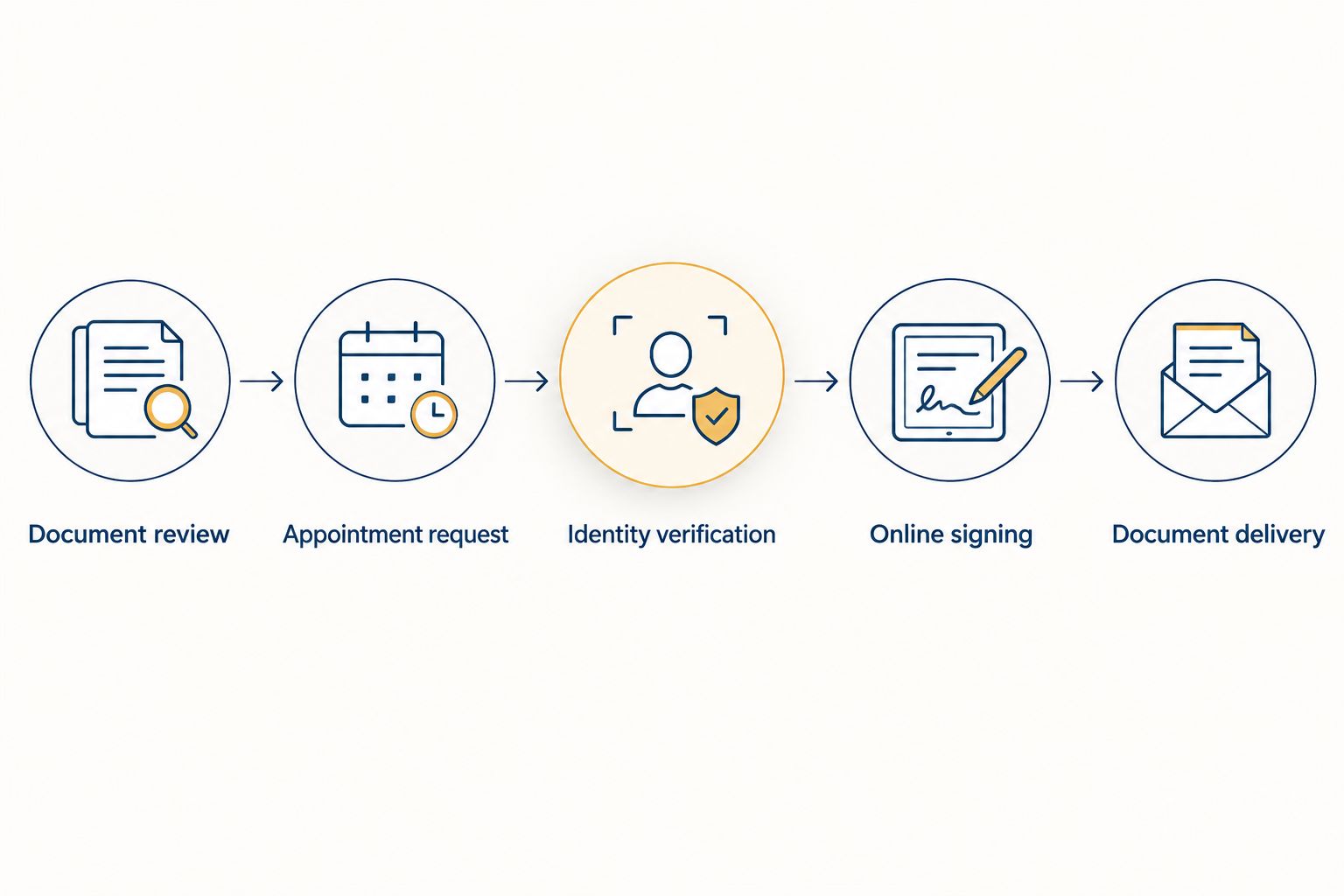
A smooth session starts with a ready document and clear instructions. Technical preparation helps, but it cannot fix missing witnesses, an excluded document, or an unresolved legal question.
Request an eligible document appointment
Describe your document and preferred format. Wait for contact before treating the appointment as confirmed.
Practical guidance for businesses and repeat appointments
Businesses handling repeated trust-related or supporting-document notarizations need a consistent intake process. Reusing a checklist is sensible; assuming that every document has identical requirements is not.
For each appointment, record:
- Document type: Use the actual title and explain its purpose.
- Signer details: Identify who will appear and whether the person signs individually or in a representative capacity.
- Execution instructions: Obtain the required notarial act and witness instructions from the preparer.
- Recipient requirements: Confirm electronic or paper format before arranging the session.
- Appointment status: Keep requested and confirmed appointments distinct in your records.
For your 2026 workflow, appoint one internal coordinator to collect these details. Do not ask the notary to select legal language, determine a trustee’s authority, or decide whether the document creates the intended legal result. Those questions belong with the appropriate attorney.
How these routes are ranked
The ranking follows document eligibility, execution requirements, recipient acceptance, identity verification, and appointment readiness. It does not rank convenience above legal requirements or claim that any route fits every estate document.
The legal distinctions come from Maryland Code, State Government § 18-214, concerning remote notarial acts and the will exclusion, and Estates and Trusts § 4-102, concerning ordinary written-will execution. These provisions are the reference points for this 2026 guide; your attorney should address exceptions and document-specific questions.
Which Maryland signing route should you choose?
For an eligible trust-related document, start with remote online notarization through Proof. For a Maryland will, start with execution instructions from an attorney. Use mobile notarization when an eligible paper document needs an in-person notarial act and the appointment has been confirmed.
If you are undecided, ask the preparer two questions: What exactly must be signed, witnessed, or notarized? Does the recipient accept the proposed format? Those answers determine the route more reliably than searching for a notary before reviewing the document.
FAQ
What's the best way to notarize a trust document in Maryland?
Remote online notarization through Proof is a practical choice for an eligible trust-related document when the recipient accepts the electronic format. CraigVet Notary Services offers this service, but you should confirm the document’s execution instructions before requesting an appointment.
Can I notarize my Maryland will online in 2026?
Maryland prohibits remote notarial acts with respect to wills. Arrange the will’s execution separately, including the applicable signature and witness requirements, rather than treating an online notary session as a substitute.
Does a Maryland will need a notary or witnesses?
An ordinary Maryland written will requires the testator’s signature and at least two credible witnesses who attest and sign in the testator’s presence. Notarization does not replace those requirements; ask an attorney about any separate affidavit or exceptional circumstances.
Is a mobile notary better than an online notary for a trust?
A mobile notary is the better route when an eligible document requires an in-person notarial act or a paper format. Remote notarization suits eligible documents with confirmed electronic execution instructions; neither route replaces legal review.
What do I need for identity verification through Proof?
Follow the identification and technology instructions provided for your Proof appointment. Have the requested identification ready, and resolve verification questions before the signing session rather than assuming any identification document will qualify.
Can the notary tell me how to write or change my will?
No. Craig is not an attorney and cannot provide legal advice, draft your estate plan, or determine whether a proposed change achieves your legal goals. Take those questions to a qualified attorney before signing.
Is my appointment confirmed when I submit a request?
No. Wait for CraigVet to contact you before treating the appointment as confirmed. For mobile service, Baltimore County availability must also be confirmed before booking.
What should a business prepare for repeated notarizations?
Prepare the document type, signer details, execution instructions, recipient format requirements, and appointment status for each request. Repeat work does not make every document eligible for remote notarization or remove identity-verification requirements.
One last thing
A notarized signature does not, by itself, make a will valid or a trust legally effective. Keep legal preparation, witnessing, notarization, and recipient acceptance separate in your 2026 checklist. Before booking, identify the exact document and the exact act required; that is the most useful step you can take to avoid choosing the wrong signing route.


