

Best overall for eligible Maryland family documents: Craigvetnotary through Proof. Best for starting directly with a platform: Proof. Best in-person fallback: a mobile notary appointment, with Baltimore County availability confirmed before booking. This 2026 guide explains which route fits your document, how identity verification works, and what to confirm before requesting an appointment.
- For online notary Maryland needs, Craigvetnotary offers remote online notarization through Proof for eligible documents.
- Proof is the direct-platform option; confirm document eligibility and recipient acceptance before proceeding.
- Mobile notarization is an in-person alternative, not an online service; confirm Baltimore County availability before booking.
- An appointment request is not confirmation. Wait for contact before treating the appointment as booked.
Why this matters
Choose the notarization method around the document, not the other way around. A convenient online appointment does not resolve a recipient’s requirements, missing certificate language, or a question about the document’s legal effect.
For Maryland families in 2026, the practical comparison is between a provider-guided remote appointment, a direct-platform route, and an in-person fallback. The first two involve online notarization. The third belongs here because it gives you an alternative when remote notarization does not fit.
Start with the organization receiving the document. Ask whether it accepts remote online notarization for that specific document and whether it requires particular wording, witnesses, or an original paper copy. Recipient acceptance and notarial eligibility are separate checks; neither replaces the other.
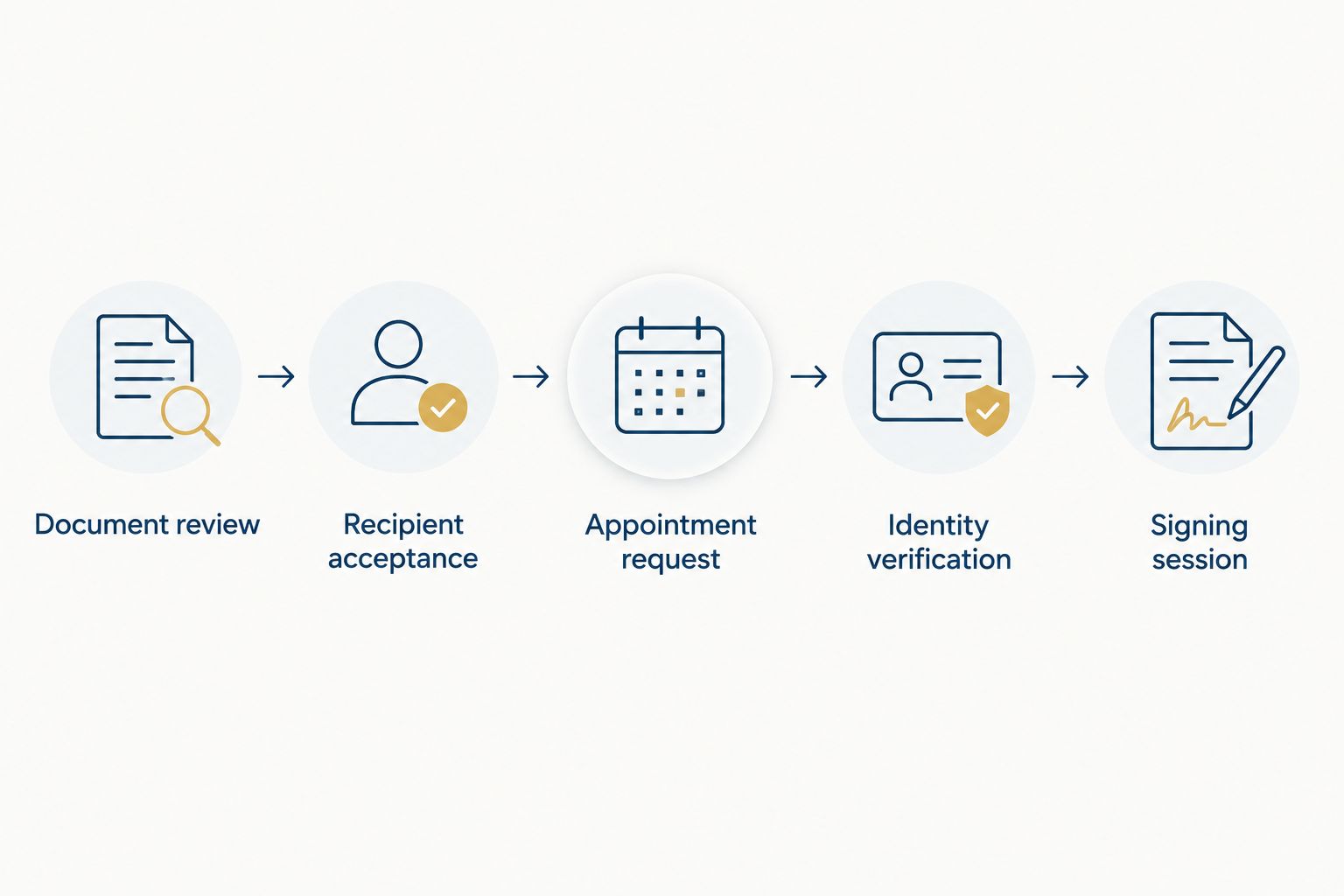
Prepare for an online notary appointment in 5 steps
These 5 preparation steps apply whether you are handling a family document or arranging repeat notarizations for a local business. They organize the appointment request; they do not guarantee that a document is eligible or that a booking is confirmed.
Document review
Identify the document and the organization receiving it. Keep its instructions with the document so you can explain what the recipient requires without relying on memory.
Ask the recipient to clarify missing notarial wording or unclear signing instructions. Do not ask the notary to choose a legal document for you. Craig is not an attorney and cannot provide legal advice.
Recipient acceptance
Confirm that the recipient accepts remote online notarization for your document. Be specific: acceptance of electronic documents generally is not the same question as acceptance of your particular notarized document.
If the recipient gives you written instructions, retain them. A family member arranging an appointment should pass those instructions to the actual signer rather than summarize them informally.
Appointment request
Describe the document, who needs to sign, and any witness or recipient requirements when requesting service. For repeat business appointments, identify whether the request concerns one signer or several people with separate documents.
Wait for provider contact before treating the appointment as confirmed. For a mobile appointment, confirm Baltimore County availability and the meeting arrangements before booking.
Identity verification
For a remote appointment, follow the Proof platform’s identity-verification instructions and the notary’s directions. Prepare the identification requested for your session, and make sure the signer can use the required audio and video connection.
A relative or office administrator can help with preparation. That assistance does not replace the signer’s participation or the required identity-verification process.
Signing session
Follow the notary’s instructions about when and how to sign. If you have already signed the document, disclose that before the session rather than assuming you need to erase or replace the signature.
After completion, follow the instructions for obtaining the notarized document. Send it to the intended recipient in the format that recipient requires, and retain your copy according to your own recordkeeping needs.
What makes the best online notary option for Maryland?
The best fit in 2026 is the option that satisfies your document’s requirements and gives you a clear appointment process. Use these criteria before comparing providers:
- Document eligibility: Confirm that the requested notarial act and document can be handled through the proposed service.
- Recipient acceptance: Establish whether the receiving organization accepts the completed remote notarization.
- Identity verification: Understand what the signer must prepare and complete before signing.
- Appointment clarity: Distinguish an inquiry or request from a confirmed appointment.
- Signer participation: Plan for each signer’s attendance, identification, and any required witnesses.
- Service boundaries: Choose a provider that separates notarization from legal advice and document preparation.
A familiar platform name does not remove these checks. Neither does choosing a local provider. Your decision should follow the document’s requirements first, then the appointment format you prefer.
Maryland notary options at a glance
| Option | Best for | Standout feature | Key limitation |
|---|---|---|---|
| Provider-guided remote appointment through Proof | Maryland families seeking direct service coordination | Remote online notarization with a Maryland-focused service provider | Eligible documents only; the appointment requires confirmation |
| Proof direct-platform route | Families who prefer to begin with the platform | A direct route into an online notarization workflow | Platform access does not establish recipient acceptance |
| Mobile notary appointment | Families needing an in-person alternative | The appointment takes place in person rather than online | Baltimore County availability must be confirmed before booking |
The table compares appointment routes, not three independent technologies. The provider-guided remote option uses Proof, so its distinction from the direct-platform option is how you begin and coordinate the service.
1. Craigvetnotary: best online notary for provider coordination
Craigvetnotary offers Maryland remote online notarization through Proof for eligible documents. It also offers mobile notary appointments for individuals, families, and businesses, making it a useful starting point when you need to clarify which appointment format to request.
Craigvetnotary is best for Maryland families seeking provider-guided online notarization for eligible documents. The fit is service coordination, not a promise that every family document can be completed remotely.
Provider-guided service pros:
- A stated Maryland remote online notarization service through Proof.
- Service for individuals, families, and businesses.
- An in-person mobile option when a remote appointment is not the selected route.
- A clear boundary between notarization and legal advice.
Provider-guided service cons:
- Document eligibility and recipient requirements still need confirmation.
- An appointment request is not a confirmed booking.
- Mobile availability in Baltimore County requires a separate check.
Best for: Families who want to communicate with the service provider before proceeding, including someone coordinating documents for multiple relatives.
For a local business arranging repeat notarizations in 2026, use the initial inquiry to explain the recurring document type and signer arrangements. Do not assume that an earlier appointment establishes eligibility for every later document.
Verdict: Choose this route for provider-guided preparation; wait for contact before treating the appointment as booked.
2. Proof: best online notary route for platform-first users
Proof provides an online notarization platform. Families who prefer to begin directly with the platform can consider that route rather than first requesting service through a separate provider.
This is a workflow choice. Because the first option also uses Proof, the comparison is not evidence that one route has different underlying technology or better document acceptance.
Proof pros:
- A direct starting point for an online notarization workflow.
- A platform-based process for remote participation.
- A suitable option to assess when you prefer to begin with platform instructions.
Proof cons:
- Starting on the platform does not establish that your recipient accepts the notarization.
- You still need to resolve document wording and witness requirements.
- Online access does not make an otherwise ineligible document eligible.
Best for: Families comfortable beginning with the platform and checking their document’s requirements before proceeding.
For your 2026 appointment, keep the recipient’s instructions beside the document while reviewing the workflow. If the recipient requires an original paper document or gives conflicting instructions, resolve that issue before signing.
Verdict: Choose Proof for a platform-first route; hold the signing session until eligibility and recipient requirements are clear.
3. Mobile notary: best fallback for an in-person appointment
A mobile notary appointment is an in-person service, not an online notary service. It belongs in this comparison as a fallback when you decide against remote notarization or your document’s requirements call for a different route.
For the mobile service described here, Baltimore County availability must be confirmed before booking. Request the appointment with enough detail to establish the location, signer arrangements, and document requirements.
Mobile appointment pros:
- An in-person alternative to the remote workflow.
- A format to consider when an online appointment does not fit your situation.
- Direct coordination of the meeting location and signer attendance.
Mobile appointment cons:
- Availability and meeting arrangements require confirmation.
- The signer still needs appropriate identification and must meet applicable notarial requirements.
- An in-person appointment does not resolve missing legal instructions or guarantee document acceptance.
Best for: Families who need an in-person appointment rather than an online session.
Do not choose mobile service solely because an online identity check was unclear. First ask what prevented completion and whether it affects the proposed in-person appointment as well. Changing the appointment format does not remove the notary’s duties.
Verdict: Choose mobile service when an in-person appointment fits; wait for availability confirmation before making plans around it.
How these options are ranked
This ranking uses the stated service descriptions and the practical checks listed above: eligibility, recipient acceptance, identity verification, appointment clarity, signer participation, and service boundaries. It is not a hands-on platform test or a comparison of completion rates.
The provider-guided route ranks first for readers seeking service coordination. Proof occupies the separate platform-first slot. Mobile notarization is the in-person fallback, not a competing online platform.
Do not read the ranking as a guarantee of eligibility. The strongest option for your family is the one that matches the document’s requirements and the signer’s ability to complete the appointment.
Which Maryland notary option should you choose?
Start with Craigvetnotary when you want a provider-guided online notary appointment for eligible Maryland documents. Choose Proof directly when you prefer to begin with the platform. Request mobile service when you need an in-person alternative, subject to confirmed Baltimore County availability.
Before deciding, make 3 checks: the document’s eligibility, the recipient’s acceptance requirements, and the signer’s ability to participate. These checks matter more than which route appears first in a list.
For businesses with recurring requests in 2026, keep a reusable preparation checklist rather than assuming every document follows the same process. Record the recipient’s instructions, identify the actual signer, and flag changes in document type or witness requirements with each request.
The service offers 2 appointment formats: remote online notarization and in-person mobile appointments. Choose between them only after reviewing the document and confirming the proposed arrangements.
Request a Maryland notary appointment
Describe your document and preferred format. Wait for contact before treating the appointment as confirmed.
FAQ
What's the best online notary option for Maryland families?
Craigvetnotary is the best fit in this comparison for families seeking provider-guided Maryland remote online notarization through Proof for eligible documents. Confirm document eligibility and recipient acceptance, then wait for contact before treating the appointment as booked.
Can every Maryland family document be notarized online?
No, you should not assume every document is eligible for remote online notarization. Confirm the document’s requirements with the provider and ask the receiving organization whether it accepts that form of notarization.
Is using Proof directly different from booking a provider who uses Proof?
Yes, the starting point and service coordination differ. The provider-guided option in this guide also uses Proof, so the comparison does not establish different underlying technology or recipient acceptance.
What do I need for online notary identity verification?
Prepare the identification requested for your session and follow the Proof platform’s identity-verification instructions. The signer must participate and follow the notary’s directions; a relative’s assistance does not replace verification.
Should I sign my document before the online appointment?
Follow the notary’s instructions about when to sign. If you already signed, disclose that before the session rather than changing the document or assuming the signature must be replaced.
Can a Maryland business arrange repeat notarizations?
The stated service covers businesses as well as individuals and families. Explain the recurring document type and signer arrangements, and confirm each appointment rather than assuming earlier approval covers later documents.
Can I book a mobile notary appointment in Baltimore County?
Request an appointment and confirm Baltimore County availability before booking. A submitted request is not confirmation of the appointment or meeting arrangements.
Can Craig tell me which legal document I should use?
No. Craig is not an attorney and cannot provide legal advice; ask the receiving organization about its requirements or consult an attorney about the document’s legal effect.
One last thing
Notarization and recipient acceptance are different checkpoints. A completed notarial act does not answer every question about where or how the document must be submitted.
Before your 2026 appointment, ask the recipient for its submission instructions and keep them with the document. That small preparation step keeps the signing process focused on notarization instead of an unresolved question about what happens afterward.


