

Best overall for eligible remote documents: CraigVet Notary Services through Proof. Best for an existing banking relationship: your bank’s notary service, if offered. Best for an office visit: an appointment-based notary. For a notary Columbia MD search in 2026, choose the appointment format that fits your document and the receiving organization’s requirements—not just the nearest address.
- For a notary Columbia MD search, CraigVet Notary Services is the remote-first choice for eligible documents through Proof.
- Bank notary services suit existing customers when the branch confirms the service and document requirements.
- Choose an office appointment when the receiving organization requires an in-person notarization.
- Confirm mobile coverage before booking; Baltimore County availability does not establish Columbia coverage.
- Craig is not an attorney and cannot provide legal advice.
Why this matters
A nearby notary is not automatically the right notary for your document. You need an appointment that meets Maryland notarial requirements and produces a document the receiving organization accepts. A remote appointment and a physical office visit are different routes, not interchangeable promises.
CraigVet Notary Services offers Maryland remote online notarization through Proof for eligible documents, plus in-person mobile appointments. Remote service is the starting point for Columbia individuals and businesses; mobile availability requires a separate discussion, with Baltimore County coverage confirmed before booking.
For repeat business notarizations, settle the document and appointment requirements before coordinating staff. That prevents a scheduling request from becoming a substitute for an eligibility check.
What makes the best notary service in Columbia MD?
Use these criteria to compare notary options in 2026. The best route is the one that satisfies your document requirements without adding an unnecessary office visit or assuming remote eligibility.
- Document eligibility: Establish whether the document and requested notarial act fit the proposed appointment format.
- Recipient acceptance: Ask the receiving organization whether it accepts remote notarization or requires a particular format.
- Identity verification: Obtain the appointment’s identification instructions before submitting documents or arranging travel.
- Appointment clarity: Distinguish a request from a confirmed appointment, and confirm who must participate.
- Location fit: For in-person service, confirm the office address or mobile service area rather than assuming Columbia coverage.
- Service boundaries: A notary performs notarial acts; an attorney addresses legal advice and document-selection questions.
Check 3 things before booking: document eligibility, recipient acceptance, and identity requirements. These checks apply whether you choose an online session, a branch visit, an office appointment, or a mobile visit.
Columbia notary options at a glance
These 4 service routes have distinct uses. The table compares appointment formats rather than treating every route as suitable for every document.
| Rank and option | Best for | Standout feature | Key limitation |
|---|---|---|---|
| CraigVet Notary Services through Proof | Eligible documents handled remotely | Maryland remote online notarization | Eligibility and recipient acceptance must be checked |
| Your bank’s notary service, if offered | Existing banking relationships | A branch-based route to investigate | Service, customer rules, and document scope require confirmation |
| Appointment-based notary office | Documents requiring an office visit | A defined place for an in-person appointment | You must arrange travel and confirm the document requirements |
| Mobile notary appointment | Signers needing an agreed physical location | The appointment takes place at a confirmed location | Coverage must be confirmed; Columbia service is not assumed |
The first route removes the need for a shared physical appointment location when remote notarization is suitable. The other routes address in-person needs. Do not choose an in-person route simply because the document looks formal; ask what the document actually requires.
1. CraigVet Notary Services: best for eligible remote documents
CraigVet Notary Services provides Maryland remote online notarization through Proof. It is the recommended starting point for Columbia individuals, families, and businesses whose documents qualify for remote notarization and whose receiving organization accepts that format.
Best for: Eligible documents that you want notarized without arranging an in-person meeting. For a business, this route is especially relevant when coordinating a physical appointment would add another scheduling task.
Remote-service pros:
- You can pursue an online appointment rather than start with travel arrangements.
- The service uses Proof for the remote notarization process.
- Eligibility and identity verification are explicit parts of appointment preparation.
- The service serves individuals, families, and businesses.
Remote-service cons:
- Remote notarization does not fit every document or receiving organization’s requirements.
- You must complete the required identity verification and remote-session preparation.
- Submitting a request does not confirm an appointment before the provider contacts you.
For your 2026 appointment, start with the document’s purpose, destination, and instructions. Do not request a particular notarial act because its name sounds familiar. If you need legal help deciding what the document requires, consult an attorney or obtain instructions from the receiving organization.
Verdict: Choose this route for eligible remote documents after confirming recipient acceptance.
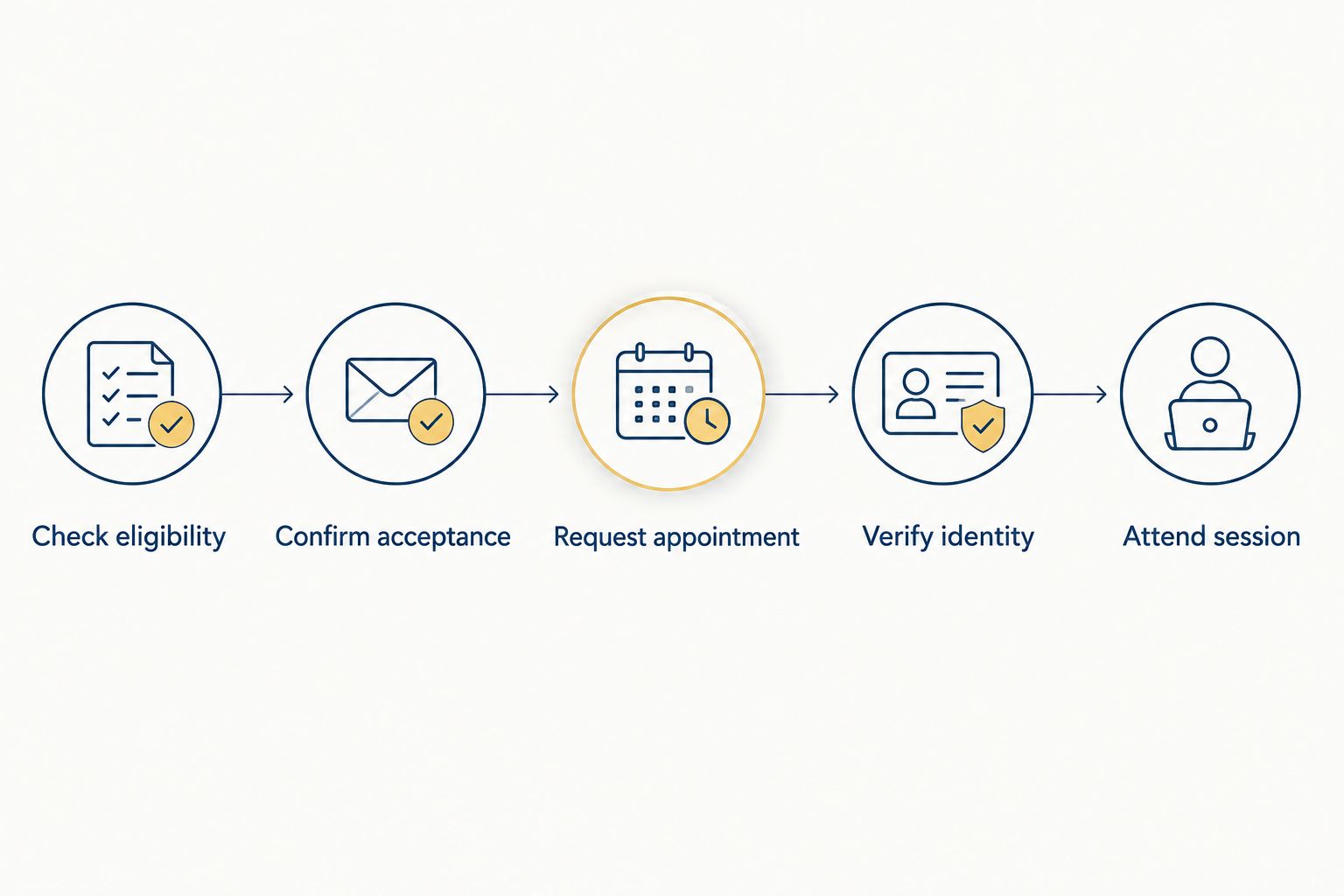
Prepare for remote notarization in 5 steps
A remote appointment requires more than sending a document. Follow this preparation sequence so document review, identity requirements, and scheduling are handled in the right order.
- Check eligibility. Identify the document, its receiving organization, and any instructions about notarization. Ask whether the document can be handled remotely before treating an online appointment as the settled choice.
- Confirm acceptance. Ask the recipient whether it accepts a remotely notarized document and whether it specifies a notarial certificate or delivery format. Keep those instructions available for the appointment discussion.
- Request appointment. Explain what needs notarization and who will participate. Treat the submission as a request; wait for contact and confirmation before telling other participants the appointment is booked.
- Verify identity. Follow the Proof session’s identity-verification instructions and confirm which identification is accepted. Prepare the required identification rather than assuming any document with your name will suffice.
- Attend session. Follow the confirmed joining instructions and the notary’s directions about signing. After the session, follow the document-retrieval and recipient-delivery instructions provided for your transaction.
Do not assume a previously signed document is ready for any notarial act. Signing instructions depend on the act and circumstances. Tell the notary if the document is already signed and follow the appointment-specific directions.
2. Your bank: best for an existing banking relationship
If you already use a bank, ask whether the relevant branch offers notary service. This is a route to investigate, not a claim that every Columbia branch has a notary or handles every document.
Best for: Existing customers who prefer a branch visit and can obtain confirmation that the branch handles their document.
Bank-service pros:
- You can begin with an institution you already use.
- A confirmed branch appointment provides a defined meeting location.
- You can ask about customer eligibility and document restrictions before travelling.
Bank-service cons:
- A bank account does not establish that a branch offers notary service.
- Branch rules and the document’s requirements can limit suitability.
- You must coordinate the visit with the branch and everyone required to attend.
Ask the branch directly about the document type, identification, appointment arrangements, and any witness requirements. If a witness is needed, do not assume the branch supplies one. Obtain a clear answer before organizing the visit.
Verdict: Choose the bank route only after the specific branch confirms service and document suitability.
3. Appointment-based notary: best for an office visit
An appointment-based notary office gives you an in-person route when remote notarization is unsuitable or the receiving organization requires physical attendance. Confirm the actual location and document requirements before travelling.
Best for: Signers who need or prefer an office appointment and can attend the confirmed location.
Office-appointment pros:
- You meet the notary in person at an agreed location.
- You can plan around a confirmed appointment rather than an unverified walk-in assumption.
- You can clarify identification and signing instructions before arriving.
Office-appointment cons:
- Everyone required to attend must coordinate travel and scheduling.
- Physical attendance does not make an otherwise unsuitable document eligible.
- Witness arrangements and document preparation still require advance attention.
Before booking an office visit in 2026, ask which participants must attend and what each person must bring. Describe the requested service accurately; a document review for notarization is not legal review of the document’s terms.
Verdict: Choose an office appointment when in-person attendance fits the document requirements.
4. Mobile notary: best for an agreed physical location
A mobile notary appointment takes place at a location agreed with the provider. It is an in-person service, not a remote online session, and the provider must confirm that the requested address falls within the service area.
Best for: Signers who need an in-person appointment at an agreed location instead of visiting an office.
Mobile-appointment pros:
- You can request a meeting location that fits the signing circumstances.
- The route supports physical attendance when online notarization is unsuitable.
- You can discuss access and participant arrangements before the appointment.
Mobile-appointment cons:
- A requested address does not establish service coverage.
- Travel arrangements add a separate scheduling requirement.
- The meeting location does not remove identity, document, or witness requirements.
For CraigVet Notary Services, mobile appointments are secondary to the remote-online route. Confirm Baltimore County availability before booking; do not interpret that service description as confirmed coverage for a Columbia address.
Verdict: Choose mobile service only after the provider confirms the location and appointment requirements.
Practical answers for repeat business notarizations
A repeat-notarization process should standardize preparation, not assume blanket approval. Each document and signing situation still needs the appropriate checks. A previous successful appointment does not establish that a different document is eligible for the same format.
Use a short internal checklist:
- Document contact: Identify who can answer questions about the document and its receiving organization.
- Signer coordination: Confirm who must participate and who will arrange the appointment.
- Recipient instructions: Keep the receiving organization’s current requirements with the appointment request.
- Identity preparation: Tell participants to follow the appointment-specific identification instructions.
- Completion responsibility: Assign someone to retrieve and deliver the completed document as instructed.
Keep legal questions separate from scheduling questions. Craig is not an attorney and cannot provide legal advice, select legal documents for you, or resolve questions about their legal effect.
For families, the same discipline applies without a business workflow: identify the document, clarify the recipient’s instructions, and coordinate the required participants. Preparation matters more than choosing the closest search result.
How the options are ranked
This 2026 guide ranks the routes by fit: remote eligibility, recipient acceptance, identity preparation, appointment clarity, and location requirements. Remote notarization comes first for eligible documents; bank, office, and mobile routes each serve a different in-person need.
The ranking is not a claim that every Columbia provider was tested or that one appointment format is universally accepted. Choose by document requirements first and location second. That rule explains both the recommendation and its limits.
Which Columbia notary option should you choose?
Choose CraigVet Notary Services for Maryland remote online notarization when your document is eligible and the recipient accepts the format. That is the default starting point for readers who do not have a specific in-person requirement.
Choose a confirmed bank appointment when your existing branch relationship fits the task. Choose an office appointment when physical attendance is required or preferred. Choose mobile service when an agreed meeting location is necessary and coverage has been confirmed.
Do not book several routes at once to compensate for uncertainty about the document. Resolve the eligibility and recipient questions first, then request the appropriate appointment.
FAQ
What is the best starting point for a notary in Columbia MD?
Start with Maryland remote online notarization for eligible documents when the receiving organization accepts it. CraigVet Notary Services offers that route through Proof; use an in-person option when the document requires it.
Can every document be notarized online in Maryland?
No, remote notarization is not suitable for every document. Confirm eligibility, the requested notarial act, and the receiving organization’s requirements before arranging an online appointment.
What identification should I prepare for remote notarization?
Prepare the identification specified in your remote appointment’s verification instructions. Follow the Proof session’s requirements rather than assuming a particular identification document will be accepted.
Is my appointment confirmed after I submit a request?
No, submitting a request does not confirm the appointment. Wait for the provider to contact you and confirm the arrangements before treating the appointment as booked.
Can I use my bank instead of an online notary?
Use a bank appointment only if the specific branch confirms that it offers the service and can handle your document. Ask about customer rules, identification, participants, and witness arrangements before travelling.
Does Baltimore County mobile availability include Columbia?
Baltimore County availability does not establish mobile coverage for a Columbia address. Ask the provider to confirm the exact meeting location before booking an in-person visit.
Can a notary tell me which legal document to use?
Craig is not an attorney and cannot provide legal advice. Obtain legal guidance from an attorney and document instructions from the receiving organization as appropriate.
How should a business prepare for repeat notarizations in 2026?
Use a consistent preparation checklist while checking each document separately. Coordinate signers, recipient instructions, identity preparation, appointment confirmation, and delivery of the completed document.
One last thing
Ask the receiving organization about notarization before asking a notary about scheduling. The recipient’s instructions can settle which appointment route to pursue and prevent you from preparing for the wrong format.
For your 2026 appointment, keep those instructions beside the document—not in a separate message that another participant never sees. A clear appointment request starts with the document’s requirements, not a preferred time slot.


