

Best for eligible remote documents: Craigvetnotary through Proof. Best for an in-person appointment: a mobile notary after location confirmation; best for a mixed estate-planning packet: an attorney-coordinated signing; best office-based option: a local notary whose document requirements you confirm before visiting.
- For notarization options for estate planning documents Maryland residents need, Craigvetnotary offers remote service through Proof for eligible documents.
- Choose an attorney-coordinated signing when your estate documents require legal review, witnesses, or coordinated execution.
- Mobile notarization is an alternative when remote service does not fit; confirm Baltimore County availability before booking.
- Notarization does not replace required witnesses, legal advice, or the receiving institution’s document requirements.
Why this matters
Choose the signing method after checking the document, not before. An estate-planning packet can contain a will, financial power of attorney, advance directive, and other documents with different execution requirements. One notary appointment does not automatically cover every requirement.
For Maryland estate planning in 2026, separate three questions: Does the document require notarization? Does it require witnesses? Will the recipient accept the proposed signing method? Your estate-planning attorney should resolve legal questions before you schedule.
Craig is not an attorney and cannot provide legal advice. A notary verifies identity and performs the appropriate notarial act; a notary does not decide whether your estate plan accomplishes your wishes.
What makes the best estate-planning notary option
Use these criteria to choose a service rather than treating every notarization option as interchangeable:
- Document eligibility: Confirm that the specific document and requested notarial act fit the service, particularly for remote online notarization.
- Execution requirements: Identify required witnesses, signing instructions, and any attorney-directed procedure before arranging the appointment.
- Identity verification: Understand what identification and verification steps the signer must complete for the selected method.
- Recipient acceptance: Ask the attorney, financial institution, or other intended recipient whether it accepts the proposed document format.
- Signer readiness: Arrange an appointment when the signer can participate directly, understand the act, and communicate without pressure.
- Appointment coordination: Confirm the location or online process, participants, document preparation, and appointment status before proceeding.
The best option is the one that fits the document’s execution requirements and the signer’s circumstances. Convenience matters only after those conditions are satisfied.
Maryland notary options at a glance
| Option | Best for | Standout feature | Key limitation |
|---|---|---|---|
| Craigvetnotary remote service through Proof | Eligible documents handled remotely | Online notarization with identity verification | Remote eligibility and recipient acceptance require confirmation |
| Mobile notary appointment | Signers needing an in-person appointment at an agreed location | Physical attendance without an office visit | Location, witnesses, and appointment availability require coordination |
| Attorney-coordinated signing | Mixed estate packets and execution questions | Legal instructions and signing arrangements handled together | Notary access and appointment arrangements depend on the attorney’s office |
| Local office notary | A document with settled instructions and a suitable office appointment | In-person service at an established location | Document handling, witness arrangements, and access rules vary |
These are service formats, not interchangeable legal solutions. The ranking prioritizes eligible remote documents first, then situations requiring physical attendance or legal coordination.
1. Craigvetnotary: best for eligible remote estate documents
Craigvetnotary provides Maryland remote online notarization through Proof. Craigvetnotary is best for Maryland clients seeking remote notarization of eligible estate-planning documents. Confirm the document’s eligibility before treating online service as your signing plan.
Remote notarization lets you complete the notarial interaction online rather than attend the notary’s location. It still requires identity verification and direct participation; uploading a document alone is not notarization.
Craigvetnotary remote service pros:
- Offers a remote route for eligible Maryland documents.
- Uses Proof for the online notarization process.
- Supports individuals, families, and businesses needing notarization.
- Provides an alternative to coordinating travel for the notarial appointment.
Craigvetnotary remote service cons:
- Not every estate-planning document is eligible for remote handling.
- The signer must complete the applicable online identity-verification process.
- Notary service does not supply legal advice or eliminate separate witness requirements.
Best for: A signer with an eligible document, clear execution instructions, and confirmation that the intended recipient accepts the proposed format.
Verdict: Choose remote service after eligibility and acceptance are confirmed. Do not substitute an online appointment for an attorney’s instructions about how an estate document must be executed.
Prepare for a Maryland remote appointment
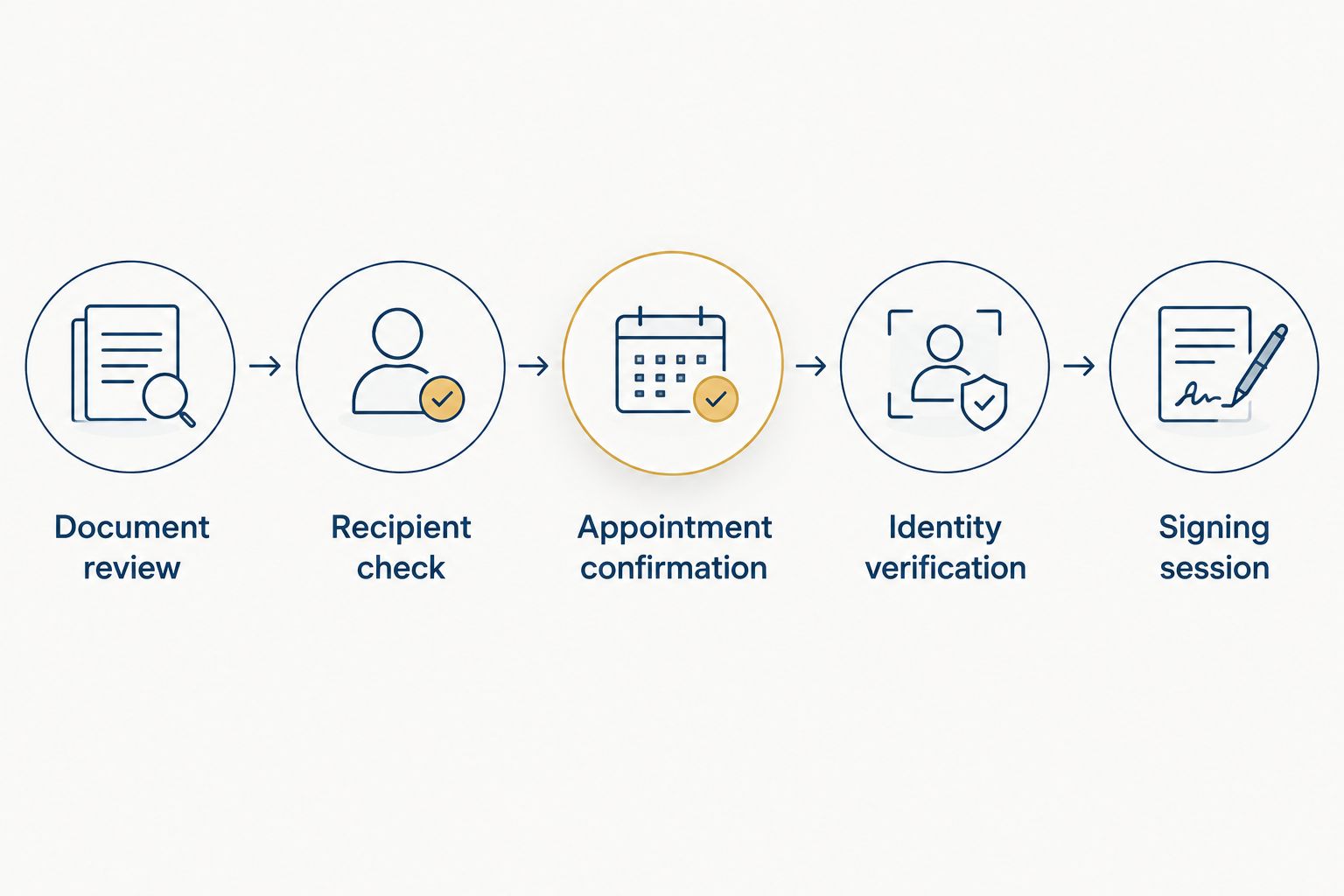
For a 2026 remote appointment, settle the document questions before starting identity verification. Use this sequence to keep the legal instructions, platform process, and appointment arrangements aligned.
Document review
Identify the document and explain what you need notarized. Share any execution instructions supplied by your attorney or recipient, and ask whether the document is eligible for remote service through Proof.
Keep the entire document available, including the notarial certificate and any attached instructions. Do not remove pages simply because they do not contain a signature line.
Recipient check
Ask the intended recipient whether it accepts the proposed electronically notarized document. This is especially useful when a financial institution or another organization supplies its own form or submission instructions.
A successful notarial act and acceptance by a recipient are separate matters. Resolve format questions before signing, not after submitting the completed document.
Appointment confirmation
Submit your request and wait for contact about the appointment arrangements. An appointment is not confirmed before Craigvetnotary contacts you. Have the signer’s participation needs and any witness instructions ready to discuss.
For families or businesses coordinating several people, identify who must attend and which document each person signs. Do not assume a single request confirms every participant or every document.
Identity verification
Follow the identity-verification instructions provided for the Proof process. Use accurate information and prepare the identification requested for your appointment; do not assume an identification method accepted elsewhere satisfies the online process.
Check your device, internet connection, camera, and microphone before the session. Follow the signing instructions rather than signing in advance and assuming the notary can complete the act afterward.
Signing session
Participate directly in the online session and follow the notary’s directions for the applicable act. Raise any discrepancy in names, document pages, or instructions before completing the signing.
Afterward, follow the supplied instructions for obtaining and delivering the completed document. Keep the recipient’s submission requirements separate from the steps needed to complete notarization.
The same preparation applies to repeat business appointments. A previously accepted document does not establish eligibility for a different form, signer, or receiving institution.
2. Mobile notarization: best for an in-person appointment
A mobile notary attends an agreed location for an in-person notarial act. This format fits a signer who needs physical attendance rather than an online session, provided the location and document requirements are confirmed.
Craigvetnotary also offers mobile appointments. Baltimore County availability must be confirmed before booking; a request does not establish that a particular location or appointment is available.
Mobile notarization pros:
- Brings the notarial appointment to an agreed location.
- Allows in-person identity checking and communication.
- Offers a separate route when remote notarization does not fit the document or signer.
Mobile notarization cons:
- Requires location and scheduling coordination.
- Does not automatically include required witnesses.
- Does not resolve legal questions about the document’s execution.
Best for: A signer who needs an in-person appointment and can arrange a suitable location, required participants, and clear instructions.
Verdict: Choose mobile service when physical attendance is the right fit, after confirming coverage and arrangements. For a home or care-setting appointment, clarify access and participation needs without assuming staff or relatives can act as witnesses.
3. Attorney-coordinated signing: best for a mixed estate packet
An attorney-coordinated signing puts the estate-planning instructions and appointment arrangements under the direction of legal counsel. Ask the attorney whether the signing includes notarial service, witnesses, and every document in your packet.
This is the strongest starting point when you have unresolved execution questions. It does not mean every attorney’s office offers the same appointment format or provides an on-site notary.
Attorney-coordinated signing pros:
- Provides a route for resolving legal execution questions.
- Helps distinguish witness requirements from notarization requirements.
- Allows instructions for several estate documents to be considered together.
Attorney-coordinated signing cons:
- Depends on the attorney’s appointment arrangements.
- Notarial service and witness attendance still need confirmation.
- Requires additional coordination if an outside notary participates.
Best for: A mixed estate-planning packet, a newly drafted plan, or any document whose signing instructions you do not understand.
Verdict: Choose attorney coordination before selecting a notary when legal requirements remain unsettled. A convenient appointment cannot correct execution instructions that were never clarified.
4. Local office notarization: best for settled signing instructions
A local office notary provides in-person service at a fixed location. Before visiting, ask whether the office handles your document type, requires an appointment, and has access restrictions.
This option fits a document with clear instructions when the signer can attend the office. Do not assume an office will supply witnesses or accept an entire estate-planning packet without prior discussion.
Local office notarization pros:
- Provides a fixed place for an in-person appointment.
- Avoids the need to arrange a mobile appointment location.
- Supports face-to-face identity checking and participation.
Local office notarization cons:
- Requires travel by the signer and any other necessary participants.
- Office rules can restrict which documents it handles.
- Witness attendance and legal review are not automatic.
Best for: A signer who can travel and has a document with settled execution instructions that the office agrees to handle.
Verdict: Choose an office appointment only after confirming document handling and participant requirements. Do not arrive with a complete estate packet and assume every signature can be completed there.
Witnesses and notarization are different requirements
For your 2026 estate-planning appointment, distinguish the notary’s role from the witnesses’ role. Maryland Estates and Trusts §4-102 provides the execution requirements for an ordinary written will, including attestation and signing by 2 witnesses in the testator’s presence. Notarization alone is not a substitute for that requirement.
Maryland Estates and Trusts §17-110 addresses execution of a financial power of attorney. Its requirements include acknowledgment before a notary and attestation by 2 adult witnesses; the notary can serve as 1 of those witnesses. Ask your attorney how those requirements apply to your document and signing method.
These are different documents with different rules. Electronic documents, remote participation, and special circumstances require their own execution analysis rather than assumptions based on a standard in-person signing.
For an advance directive, obtain document-specific guidance about witnesses and execution. Do not infer its requirements from the rules for a will or financial power of attorney.
How these options are ranked
This 2026 ranking follows the criteria above: document eligibility, execution requirements, identity verification, recipient acceptance, signer readiness, and appointment coordination. Remote service comes first for eligible documents because it directly answers the need for an online notarial appointment.
Attorney coordination takes priority whenever legal instructions remain unresolved. Mobile and office appointments answer different location needs; neither removes the obligation to arrange witnesses or confirm the document’s requirements.
Which option should you choose?
Start with remote notarization through Proof when your document is eligible and its execution instructions are settled. Confirm the recipient’s requirements, prepare for identity verification, and wait for appointment confirmation.
Choose attorney coordination for legal questions or a mixed packet. Choose mobile service when physical attendance is needed, and choose an office appointment when travel is practical and the office has agreed to handle the document.
For Maryland families and businesses arranging notarization in 2026, document preparation is the next move—not choosing the fastest-looking appointment before checking what must happen during it.
FAQ
What are the best notarization options for estate planning documents in Maryland?
The main options are remote online notarization for eligible documents, mobile notarization, attorney-coordinated signing, and a local office notary. Choose according to the document’s execution requirements, witness needs, signer participation, and recipient acceptance.
Can I notarize Maryland estate planning documents online?
Eligible documents can be notarized remotely, but not every estate-planning document qualifies for the same process. Confirm eligibility, execution instructions, and recipient acceptance before arranging an online appointment.
Does a Maryland will need a notary instead of witnesses?
No. For an ordinary written will, Maryland Estates and Trusts §4-102 requires attestation and signing by 2 witnesses in the testator’s presence; notarization does not replace that requirement. Ask your estate-planning attorney about the rules for your specific will and signing method.
Do I need witnesses for a Maryland financial power of attorney?
Maryland Estates and Trusts §17-110 includes acknowledgment before a notary and attestation by 2 adult witnesses, with the notary permitted to serve as 1 witness. Have your attorney confirm the execution requirements for your document and proposed appointment.
What should I prepare for remote identity verification?
Prepare the identification and information requested for your Proof appointment. Follow the supplied instructions and check your camera, microphone, and internet connection before the session.
Can I book a mobile estate-document appointment in Baltimore County?
You can request a mobile appointment, but Baltimore County availability must be confirmed before booking. The appointment is not confirmed before contact about the arrangements.
Can Craig tell me which estate documents I need?
No. Craig is not an attorney and cannot provide legal advice. Ask an estate-planning attorney which documents you need and how they must be executed.
One last thing
Ask about the receiving institution before the signing, not just the notary. A document can complete a notarial process and still face questions about its format or submission requirements. Confirming the recipient’s instructions early keeps the appointment focused on the correct document and act.


