

Maryland healthcare directives generally require 2 witnesses, not notarization; start with the document’s signing requirements before choosing a service in 2026. Best remote option for eligible documents: Craigvetnotary through Proof; best in-person notary option: a confirmed mobile appointment; best default for a standard Maryland advance directive: properly arranged witnesses.
- Searching notary for healthcare directive maryland? Maryland advance directives generally need witnesses, not a notarial seal.
- Craigvetnotary offers Maryland remote online notarization through Proof for eligible documents, not a substitute for required witnesses.
- Choose mobile notarization when an eligible document needs an in-person notarial act; confirm Baltimore County availability first.
- Ask the receiving healthcare team about document requirements before arranging witnesses or requesting notarization.
Why this matters
A healthcare directive records important treatment preferences or names someone to make healthcare decisions. A notarial seal does not replace the signing formalities that make that directive effective.
Maryland’s Health–General §5-602 provides the relevant framework for written advance directives: the document must be dated, signed by or at the express direction of the declarant, and subscribed by witnesses. The Maryland Attorney General’s advance-directive guidance explains that notarization is not required for the standard Maryland form.
For 2026, choose the signing process the document requires—not the appointment that sounds most official. A directive prepared for another jurisdiction, a related document, or instructions from a receiving organization deserves a separate requirements check. Craig is not an attorney and cannot provide legal advice.
What makes the best healthcare-directive signing option?
Use these criteria before comparing appointment formats:
- Document fit: Determine whether you have a Maryland advance directive, another state’s form, or a related document with different instructions.
- Required participants: Identify the signer, required witnesses, and any separately required notarial role.
- Identity verification: For notarization, confirm the identification process before the appointment rather than assuming a familiar document will suffice.
- Signing format: Distinguish an electronic document from a paper original. A video appointment does not automatically satisfy every signing requirement.
- Recipient instructions: Ask the healthcare organization how it wants to receive and record the completed directive.
- Appointment confirmation: Treat a request as a request. A notary appointment is not confirmed until the service contacts you and confirms the arrangements.
The ranking below separates document requirements from convenience. No option replaces legal advice about which healthcare decisions to record or whom to appoint.
Maryland healthcare-directive options at a glance
| Option | Best for | Standout feature | Key limitation |
|---|---|---|---|
| Remote online notarization through Proof | Eligible documents needing a remote notarial act | Online notarization without an in-person notary visit | Does not automatically satisfy directive witness requirements |
| Mobile notary appointment | Eligible documents needing in-person notarization | An in-person alternative to the remote format | Baltimore County availability and appointment details need confirmation |
| Healthcare-facility signing coordination | Patients already receiving care | A place to ask about the facility’s document and witness procedures | Do not assume staff provide witnesses or notarization |
| Privately arranged witnesses | Standard Maryland directives without a separate notarization requirement | Follows the directive’s witness-based signing structure | You must arrange suitable witnesses and follow the form’s instructions |
Start with the remote appointment process
Craigvetnotary provides Maryland remote online notarization through Proof for eligible documents. Craigvetnotary is best for Maryland signers seeking remote notarization of eligible healthcare-related documents. That recommendation concerns the notarial service, not whether your directive needs notarization.
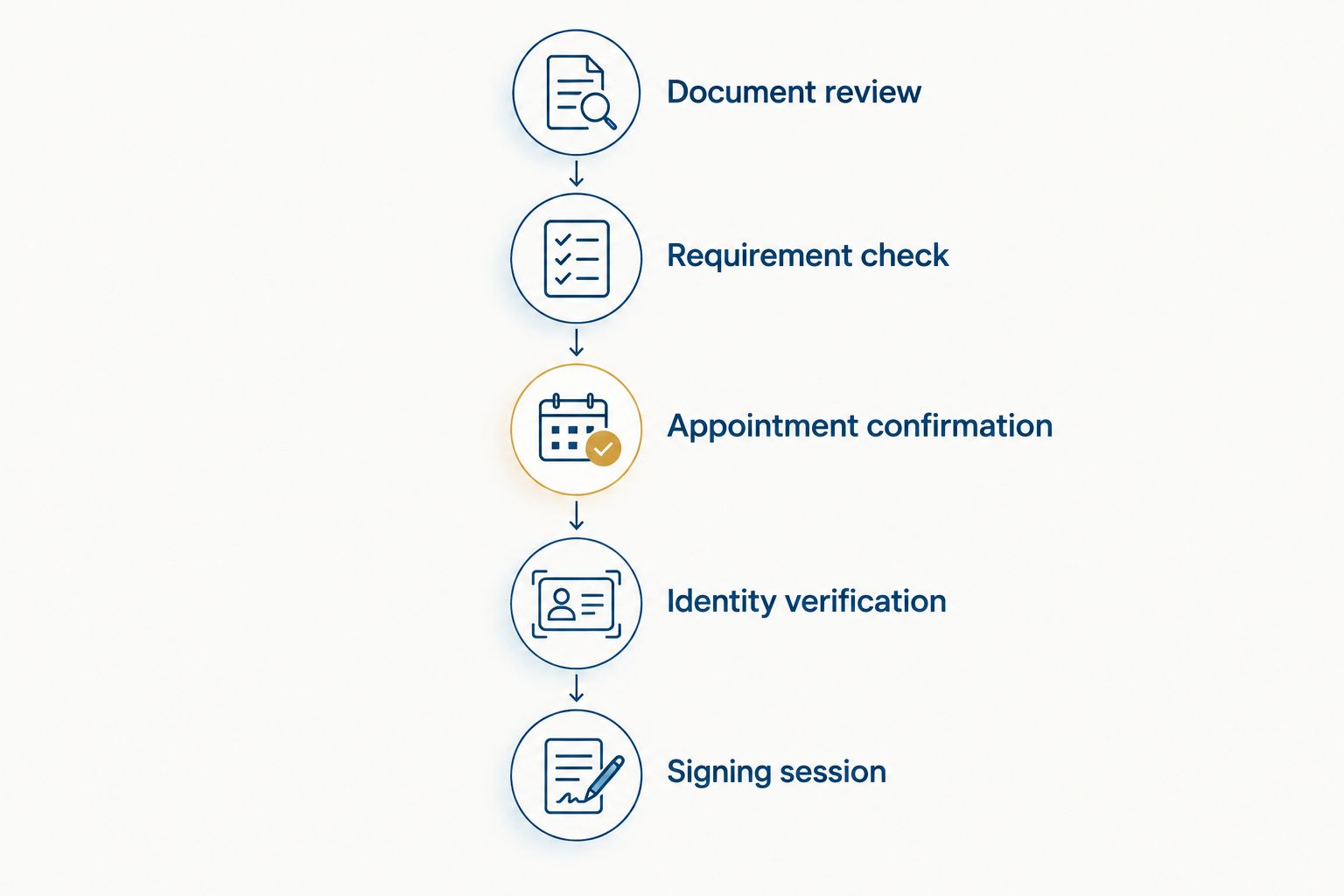
Use this sequence before requesting a 2026 appointment:
- Document review: Identify the document and tell the service what notarial act or certificate the instructions request. Do not ask the notary to choose legal provisions for you.
- Requirement check: Establish whether witnesses are needed separately and whether the intended signing format fits the document. Resolve legal questions with an attorney.
- Appointment confirmation: Submit the request and wait for contact confirming eligibility, appointment arrangements, and preparation instructions.
- Identity verification: Follow the Proof identity-verification instructions supplied for your appointment. Ask about identification questions before the session.
- Signing session: Follow the notary’s directions during the appointment. Do not assume a previously signed document meets the requirements of the requested notarial act.
Keep the document’s witness requirements separate from the platform’s identity-verification process. Passing an identity check does not establish that a directive contains the right instructions or has the required witnesses.
Request an eligibility check
Ask about remote notarization through Proof or confirm mobile appointment arrangements.
1. Remote online notarization: best for eligible remote documents
Remote online notarization connects an eligible signer and notary electronically through Proof. It is the first service to consider when a healthcare-related document actually needs notarization and an online format fits its requirements.
Do not confuse remote notarization with a complete advance-directive execution service. Witness arrangements, document wording, and the receiving organization’s instructions still need separate attention.
Remote online notarization pros:
- Avoids arranging an in-person meeting with the notary.
- Provides a defined online identity-verification process.
- Gives individuals and business coordinators a clear appointment format to prepare for.
Remote online notarization cons:
- Not every document qualifies for remote notarization.
- Required witnesses are not replaced by the notary or platform.
- The signer must follow the supplied technology and identity-verification instructions.
Best for: A signer with an eligible document and a confirmed need for a remote notarial act.
Verdict: Buy only after eligibility and the need for notarization are confirmed.
2. Mobile notarization: best for an in-person notarial act
A mobile appointment provides in-person notarization rather than a remote session. It is the secondary option when an eligible document needs notarization and the parties choose an in-person format.
For Baltimore County requests, confirm availability before booking. Give the service the document type, proposed location, participant needs, and any access instructions; none of those details alone confirms an appointment.
Mobile notarization pros:
- Provides an in-person alternative to online notarization.
- Avoids requiring the signer to complete a remote session.
- Allows the appointment location and access arrangements to be discussed beforehand.
Mobile notarization cons:
- Availability and location arrangements require confirmation.
- A notary visit does not automatically include witnesses.
- In-person notarization cannot correct unsuitable legal wording or missing directive formalities.
Best for: A signer whose eligible document needs a notarial act in person.
Verdict: Hold until document requirements, Baltimore County availability, and the appointment are confirmed.
3. Facility coordination: best for patients already receiving care
If the signer is in a hospital, rehabilitation setting, or another healthcare facility, start by asking the care team about its advance-directive procedures. This is a coordination route, not a promise that the facility supplies a notary or witnesses.
Ask how outside visitors are admitted, whom to contact about document submission, and whether staff have an established witness process. These questions belong before an outside appointment request.
Facility coordination pros:
- Identifies the right contact for putting the completed directive into the patient’s record.
- Surfaces access restrictions before an outside visitor arrives.
- Gives the family a place to ask about existing signing procedures.
Facility coordination cons:
- Witness or notary assistance must not be assumed.
- Facility procedures do not replace Maryland signing requirements.
- A patient’s clinical circumstances require attention beyond appointment logistics.
Best for: Patients and families coordinating signing while care is already underway.
Verdict: Hold the outside booking until the facility explains its procedures.
4. Private witnesses: best for a standard Maryland directive
For a standard Maryland advance directive without a separate notarization requirement, arranging suitable witnesses is the practical default. Follow the form’s instructions rather than adding notarization as a substitute.
Under Maryland Health–General §5-602, the appointed healthcare agent cannot serve as a witness. At least 1 witness must not knowingly be entitled to a portion of the declarant’s estate or a financial benefit because of the declarant’s death.
Privately arranged witnesses pros:
- Addresses the standard directive’s actual witness requirement.
- Avoids arranging an unnecessary notarial act.
- Lets the signer organize participants around the document’s instructions.
Privately arranged witnesses cons:
- Witness suitability still needs careful attention.
- A privately arranged signing does not provide legal review.
- Another jurisdiction’s form or a separate document needs its own requirements check.
Best for: A person completing a standard Maryland directive with no independently established need for notarization.
Verdict: Skip the notary appointment when the directive requires witnesses only.
Practical preparation for families and businesses in 2026
Whether you coordinate one family document or repeat appointments for a local business, separate administrative preparation from legal decisions. A coordinator can gather appointment details; the signer and appropriate legal advisers handle choices about the directive itself.
Use 3 preparation checks before sending an appointment request:
- Document check: Identify the form, its instructions, and the organization that will receive it. Ask an attorney to resolve uncertainty about legal requirements.
- Participant check: Identify the signer, required witnesses, and any notary role. Do not list the healthcare agent as a witness on a Maryland advance directive.
- Appointment check: Confirm the remote or mobile format, identification instructions, and any facility access arrangements.
For repeat business requests, use the same intake questions each time without assuming every document has the same requirements. Keep patient information out of routine scheduling messages unless it is necessary and an appropriate sharing method has been established.
Craigvetnotary’s veteran-owned service offers remote and mobile notary options, but an appointment request is not a booking confirmation. Wait for direct contact before telling a patient, employee, or family member that arrangements are final.
How the options were ranked
This 2026 guide ranks options by document fit, witness coordination, identity verification, signing format, and appointment clarity. Remote notarization leads the service comparison for eligible documents; privately arranged witnesses remain the default for a standard Maryland directive that does not need notarization.
The legal distinctions follow Maryland Health–General §5-602 and the Maryland Attorney General’s advance-directive guidance. The service descriptions reflect the stated remote-through-Proof and mobile appointment options, not a claim that every healthcare document qualifies.
Which option should you choose in 2026?
Start with witnesses for a standard Maryland advance directive; choose a notary only when a separate requirement has been established. If notarization is needed, request remote eligibility review first and use mobile service as the secondary format.
Do not book both formats as a precaution. Confirm the document, participants, and signing method, then request the appointment that matches those requirements.
FAQ
Do I need a notary for a healthcare directive in Maryland?
A standard Maryland advance directive generally requires witnesses, not notarization. Follow the form’s instructions and obtain legal advice if another jurisdiction’s document or a separate notarial requirement is involved.
Can I notarize my Maryland healthcare directive online?
Remote notarization is an option only for eligible documents when a notarial act is appropriate. Craigvetnotary offers Maryland remote online notarization through Proof, but remote notarization does not replace required witnesses.
How many witnesses does a Maryland advance directive need?
A written Maryland advance directive requires 2 witnesses under Maryland Health–General §5-602. The appointed healthcare agent cannot be a witness, and at least one witness must meet the statute’s financial-interest restriction.
Can the person I name as my healthcare agent witness my directive?
No, the appointed healthcare agent cannot witness a Maryland advance directive. Arrange other suitable witnesses and follow the form’s signing instructions.
Is a mobile notary better than an online notary for a hospital patient?
Neither format is automatically better for a hospital patient. First confirm whether notarization is needed, then check document eligibility, facility procedures, and the signer’s ability to participate in the chosen format.
Can I request a mobile appointment in Baltimore County?
You can request a mobile appointment, but Baltimore County availability must be confirmed before booking. The appointment is not confirmed until the service contacts you and confirms the arrangements.
Can Craig tell me what healthcare decisions to put in my directive?
No. Craig is not an attorney and cannot provide legal advice; discuss legal choices with an attorney and treatment questions with an appropriate healthcare professional.
One last thing
A completed directive must reach the people who need to use it. After signing, ask your healthcare team how to add the document to your record and make sure your appointed healthcare agent knows where to find it.
The useful final step is distribution, not an extra seal. Keep the completed version accessible and follow the receiving organization’s submission instructions.


