

Best overall for eligible documents: Maryland remote online notarization through Proof. Best for an in-person visit at your location: mobile notarization. Best for a planned trip: a fixed-location notary appointment. For a financial affidavit in 2026, choose the format only after checking the receiving organization’s instructions and the document’s notarial requirements.
- For notary for financial affidavit maryland searches, Craigvetnotary offers remote online notarization through Proof for eligible documents.
- Choose mobile notarization when an in-person appointment at your location fits the document’s requirements; confirm Baltimore County availability first.
- Check document eligibility and recipient acceptance before selecting remote online notarization or an in-person appointment.
- An appointment request is not a confirmed appointment; wait for direct contact from Craigvetnotary.
Start with document eligibility, then arrange the appointment
Craigvetnotary offers Maryland remote online notarization through Proof, with mobile appointments as a secondary option. Start with the notary service information and explain that you need a financial affidavit notarized, rather than requesting a generic signature appointment.
A financial affidavit contains sworn statements about financial information. The notary handles the required notarial act, not the accuracy of your calculations or the legal effect of your answers. Craig is not an attorney and cannot provide legal advice.
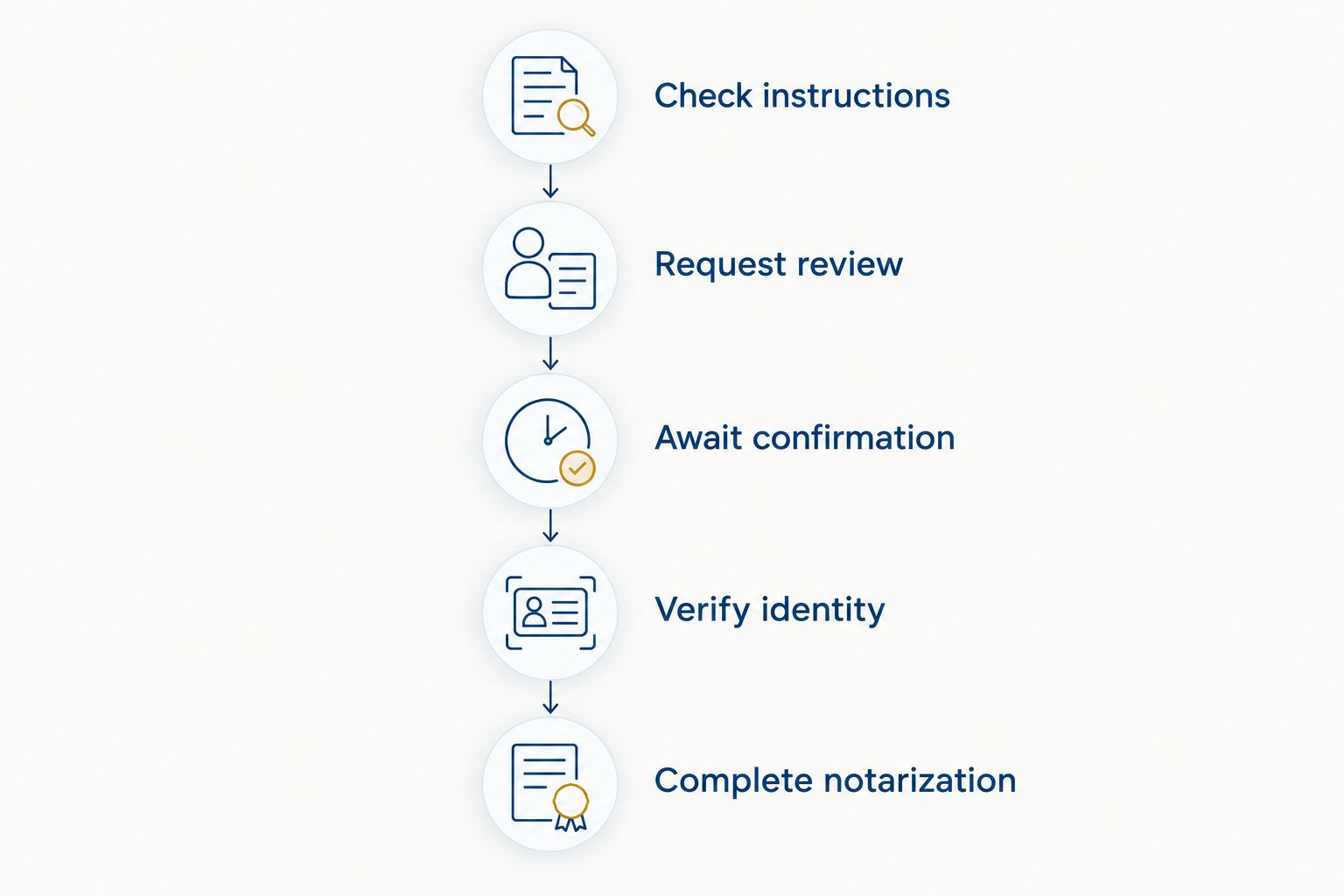
Use these steps to prepare your request:
- Check instructions. Identify who will receive the affidavit and whether that organization accepts remote online notarization for this document. Read any directions about signatures, attachments, witnesses, and submission format.
- Request review. Describe the affidavit, its destination, and any deadline. Ask whether the document is eligible for the requested appointment format; do not assume that every financial affidavit qualifies for remote notarization.
- Await confirmation. Wait for direct contact about eligibility, appointment details, and preparation. Submitting a request does not confirm an appointment.
- Verify identity. Follow the identity-verification instructions for the appointment. For a remote session, follow the Proof process and the notary’s directions; do not assume that uploading a document completes identity verification.
- Complete notarization. Attend the appointment, follow instructions about signing and any required oath or affirmation, and check the completed document against the recipient’s submission directions.
Keep document preparation separate from appointment booking. If you do not know which affidavit to use, how to answer a financial question, or which notarial certificate is appropriate, obtain direction from the receiving organization or an attorney as appropriate. Booking a notary does not resolve those questions.
Why this matters for financial affidavits
The right notary appointment addresses the document’s requirements and your practical needs. Convenience alone is not enough: a remotely completed affidavit still needs to meet the receiving organization’s applicable instructions.
For your 2026 appointment, make 2 checks before choosing a format: document eligibility and recipient acceptance. These are separate questions. A notary’s ability to perform a remote act does not establish how a particular recipient wants the affidavit submitted.
Businesses arranging repeat notarizations should use the same distinction. Standardize the information collected before booking, but review each document’s instructions instead of treating every affidavit as interchangeable.
What makes the best notarization option?
These criteria determine which appointment format belongs first for your situation:
- Document fit: The service must accommodate the required notarial act and the document’s applicable instructions.
- Identity verification: You need to complete the identity-verification process for the chosen format, not simply present a signed file.
- Recipient acceptance: Confirm how the receiving court, lender, agency, or other organization accepts the completed affidavit.
- Appointment practicality: Consider travel, access to a suitable device, privacy, and the signer’s ability to participate.
- Clear boundaries: The notary should distinguish notarization from document drafting, financial advice, and legal advice.
- Reliable coordination: For repeat business appointments, clear requests and explicit confirmation matter more than assumptions about availability.
For 2026, use these criteria before selecting a familiar location or requesting a particular format. A convenient appointment is useful only when it fits the document.
Maryland financial affidavit notarization at a glance
These 3 appointment formats serve different needs. The ranking favors remote access for eligible documents, then an in-person visit at your location, then a visit to an arranged office location.
| Option | Best for | Standout feature | Key limitation |
|---|---|---|---|
| Remote online notarization through Proof | Eligible affidavits when remote completion is accepted | Participation without an in-person meeting | Requires eligibility review, identity verification, and a suitable technical setup |
| Mobile notary appointment | Signers needing an in-person visit at their location | The appointment comes to an agreed location | Location and appointment availability require confirmation |
| Fixed-location notary appointment | Signers who prefer to visit an office | An arranged place to attend in person | Requires travel and confirmation that the office handles the document |
The fixed-location option is an appointment category, not a claim that a particular office accepts financial affidavits. Contact the office directly before traveling.
1. Remote notarization: best for eligible digital appointments
Maryland remote online notarization allows eligible documents to be notarized through an online process rather than an in-person meeting. Craigvetnotary provides this service through Proof, subject to document eligibility and Maryland notarial requirements.
Craigvetnotary is best for Maryland financial affidavit signers seeking remote online notarization through Proof for eligible documents. This is the first option to consider when the recipient accepts the format and you can complete the required process.
Remote notarization pros:
- Removes the need to travel to an in-person appointment.
- Fits signers who can participate privately using the required technology.
- Gives businesses a remote appointment option to consider for repeat notarizations.
Remote notarization cons:
- Not every document is eligible for remote notarization.
- Technical access and successful identity verification remain necessary.
- The receiving organization’s submission instructions still need separate attention.
Before requesting a session, ask what identification, device setup, and document preparation are required. Do not send sensitive financial material through an unconfirmed communication channel; obtain the document-handling instructions first.
For business use, identify the person who will sign and the person coordinating the appointment. Those roles are not interchangeable: an administrator can organize the request, but the signer must participate as required.
Best for: Eligible financial affidavits when you want remote completion and the receiving organization accepts it.
Verdict: Buy — choose remote notarization after eligibility, acceptance, and appointment details are confirmed.
2. Mobile notarization: best for an in-person visit to you
A mobile notary appointment brings the in-person meeting to an agreed location. It is the secondary option when remote notarization does not fit the document or the signer’s needs and a suitable in-person arrangement is available.
For Craigvetnotary mobile appointments, confirm Baltimore County availability before booking. Do not treat a submitted request, a preferred date, or a suggested address as a confirmed visit.
Mobile notarization pros:
- Avoids the signer’s trip to a separate notary location.
- Supports an in-person appointment when that format is needed.
- Lets a business request a meeting at an agreed workplace location.
Mobile notarization cons:
- The location and appointment time require direct confirmation.
- Travel coordination adds another detail to arrange.
- An in-person meeting does not resolve an incomplete affidavit or unclear instructions.
Provide the proposed location, signer details, document type, and any receiving-party directions when requesting the appointment. Ask about identification and signing instructions before the visit, not after the notary arrives.
Choose a setting where the signer can participate without unnecessary interruption. For a business affidavit, arrange access to the relevant document and attachments while keeping unrelated financial records out of the appointment materials.
Best for: Signers who need an in-person appointment at their location rather than a trip to an office.
Verdict: Hold — proceed only after location coverage, document suitability, and the appointment are confirmed.
3. Fixed-location notarization: best for a planned office visit
A fixed-location appointment means visiting a notary at an arranged office or other established meeting location. Consider this format when you prefer an in-person meeting and can travel to it.
Do not assume that a nearby office handles every financial affidavit or accepts walk-in requests. Ask about the specific document, the required notarial act, identification instructions, and appointment arrangements before leaving.
Fixed-location notarization pros:
- Provides an agreed place for an in-person meeting.
- Fits signers who prefer to keep the appointment outside their home or workplace.
- Offers an alternative when remote participation is unsuitable.
Fixed-location notarization cons:
- Requires the signer to travel.
- Document handling and appointment arrangements vary by provider.
- A convenient location does not establish suitability for your affidavit.
If you already use an office for other services, still describe the financial affidavit explicitly. Familiarity with the location does not replace checking whether the notary can handle the request.
Best for: Signers who prefer an office visit and have confirmed that the location can handle their document.
Verdict: Buy — choose a fixed-location appointment when travel is practical and the document requirements are confirmed.
Practical guidance for repeat business notarizations
For recurring requests in 2026, standardize the appointment handoff rather than assuming every financial affidavit follows the same process. Use a short internal checklist that records the recipient, signer, document status, requested format, and submission instructions.
Keep scheduling and document completion as separate tasks. An appointment confirmation is not confirmation that a financial statement is accurate, legally sufficient, or accepted by its recipient.
A useful request describes:
- The document’s name and receiving organization.
- Whether the recipient has provided notarization or submission instructions.
- Who will sign and how to reach that person for coordination.
- Whether you are requesting remote notarization or an in-person appointment.
- Any deadline that affects scheduling, without assuming the deadline can be accommodated.
For example, a request involving 1 affidavit should still identify any related attachments and signing instructions. Counting files alone does not explain the notarial work required.
How these options rank
This 2026 ranking follows document fit, identity verification, recipient acceptance, appointment practicality, and clear service boundaries. It compares appointment formats; it does not claim that an individual provider has been tested against competing businesses.
Remote notarization ranks first for eligible documents because it removes the in-person trip. Mobile notarization serves the distinct need for an appointment at the signer’s location. Fixed-location notarization fits a signer who prefers an arranged office visit.
Which notarization option should you choose?
Start with Maryland remote online notarization through Proof for an eligible financial affidavit. Confirm that the recipient accepts the format, then obtain preparation instructions and explicit appointment confirmation.
Choose mobile notarization when you need an in-person visit at your location, subject to confirmed Baltimore County availability. Choose a fixed-location appointment when traveling to an office fits your needs and that office confirms it can handle the document.
FAQ
What’s the best notary option for a Maryland financial affidavit?
Remote online notarization is the first option to consider for an eligible financial affidavit when the recipient accepts it. Choose mobile or fixed-location notarization when an in-person appointment better fits the document and signer’s needs.
Can every Maryland financial affidavit be notarized online?
No, remote notarization is not appropriate for every document. Confirm the affidavit’s eligibility, the required notarial act, and the receiving organization’s instructions before arranging a remote appointment.
How does identity verification work for an online appointment?
For a remote appointment through Proof, follow the platform’s identity-verification process and the notary’s instructions. Obtain preparation directions before the session; uploading an affidavit is not the same as completing identity verification.
Should I sign my financial affidavit before the appointment?
Follow the notary’s instructions before signing. If the required act involves signing in the notary’s presence and an oath or affirmation, signing beforehand does not replace those steps.
Can Craig tell me what financial information to put on the affidavit?
No. Craig is not an attorney and cannot provide legal advice. Direct questions about legal obligations or the meaning of the affidavit to an attorney or the receiving organization as appropriate.
Does submitting a request confirm my appointment?
No, submitting a request does not confirm an appointment. Wait for direct contact from Craigvetnotary about document eligibility, preparation, and appointment details; mobile requests also require confirmation of Baltimore County availability.
Can a business arrange repeat financial affidavit appointments?
A business can request repeat notarization appointments, but each document still needs the appropriate eligibility and instruction checks. Identify the signer, recipient, requested format, and deadline when coordinating each request.
One last thing
Ask how the completed affidavit must be delivered before arranging notarization. Permission to notarize remotely and instructions for submitting the finished document answer different questions.
For your 2026 appointment, keep the recipient’s directions with the affidavit and check them again before submission. That final check connects the notarial appointment to the actual task: delivering the document in the required form.


