
Best for eligible supporting documents: CraigVet Notary Services through Proof. Best overall for a routine Maryland title assignment: follow Maryland MVA instructions without adding an unnecessary notarization. Best for required paper originals: an in-person notary. This 2026 guide helps you choose the right process before signing vehicle-transfer paperwork.
- For notarize auto title transfer maryland searches, first distinguish the title assignment from supporting documents.
- CraigVet Notary Services offers Maryland remote online notarization through Proof for eligible documents, subject to acceptance requirements.
- Routine Maryland title assignments generally do not require notarization; separate documents can carry different requirements.
- Choose mobile or office notarization when the receiving agency requires a notarized paper original.
Why this matters
A vehicle transfer and a notarization are different procedures. Maryland MVA processes vehicle titles; a notary performs a requested notarial act on an eligible document. A notary stamp does not complete a title transfer or fix missing ownership paperwork.
Maryland MVA’s vehicle titling and registration instructions distinguish the assigned title from supporting paperwork, including bills of sale. Routine Maryland title assignments generally do not require notarization, while some supporting documents do. Read the instructions for the actual transaction rather than assuming every vehicle sale needs a notary.
For your 2026 transfer, start with the document’s issuing jurisdiction and the receiving agency’s requirements. An out-of-state title, a representative signing for an owner, or a separate supporting form needs its own review. Do not apply the routine Maryland-title process to every transaction.
What makes the best Maryland title-transfer option
The best option satisfies the document requirements without adding an avoidable appointment. Use these criteria before choosing a service:
- Actual necessity: Confirm whether the specific signature requires notarization, not simply whether the transaction involves a vehicle.
- Receiving-agency acceptance: Establish whether an electronic notarization is acceptable for that exact document.
- Original-document requirements: Separate paperwork that needs a paper original from documents eligible for electronic handling.
- Signer readiness: Check identification, participation requirements, and any authority to sign for another person or business.
- Appointment practicality: Choose remote, mobile, or office attendance around the required format and signer’s circumstances.
- Service boundaries: A notary cannot select legal language, resolve ownership disputes, or guarantee that MVA will accept a transfer.
For 2026, document acceptance comes before convenience. Remote notarization belongs first in the service discussion for eligible supporting paperwork, but it is not a substitute for checking whether the title itself needs a notarial act.
Maryland title-transfer options at a glance
| Option | Best for | Standout feature | Key limitation |
|---|---|---|---|
| MVA-directed transfer without notarization | Routine Maryland title assignments without a notarial requirement | Avoids an unnecessary notarial step | Does not remove separate supporting-document requirements |
| CraigVet Notary Services through Proof | Eligible supporting documents accepted electronically | Maryland remote online notarization | Eligibility and receiving-agency acceptance must be checked |
| Mobile notary appointment | Required paper originals when travel is difficult | In-person attendance at an agreed location | Baltimore County availability must be confirmed before booking |
| Established local office notary | Required paper originals when you can travel | In-person signing at an office | You must confirm service scope and appointment arrangements |
These are different routes, not interchangeable substitutes. Choose the route that fits the document, then arrange the appointment if one is required.
1. MVA-directed transfer: best for routine Maryland title assignments
For a routine Maryland title assignment, follow the title instructions and Maryland MVA requirements rather than automatically arranging notarization. The buyer and seller still need to complete the required transfer paperwork correctly. Skipping an unnecessary notarial act does not mean skipping signatures, ownership information, or supporting forms.
MVA-directed transfer pros:
- Keeps attention on the paperwork that actually establishes the transfer.
- Avoids arranging notarization when the title assignment does not require it.
- Separates the title process from any additional notarized documents.
MVA-directed transfer cons:
- Does not cover every out-of-state title or special transaction.
- Does not eliminate notarization requirements on separate forms.
- Cannot resolve conflicting ownership claims or incomplete authority documents.
Best for: Buyers and sellers completing a routine Maryland-title transaction whose applicable instructions do not require notarization of the assignment.
Before signing in 2026, check the title’s printed directions and the MVA instructions for your transaction. If a separate form requests notarization, handle that form separately. Verdict: Skip unnecessary title notarization; follow the required transfer procedure.
2. CraigVet Notary Services: best for eligible remote supporting documents
CraigVet Notary Services provides Maryland remote online notarization through Proof. This option fits eligible supporting documents when the receiving agency accepts the electronic document and notarization. It does not establish that a paper vehicle title can be transferred electronically.
Remote online notarization includes identity verification and a live audiovisual session. You need to participate in the required process, not just email a signed document. The document, signer, and requested notarial act must satisfy applicable Maryland notarial requirements.
Remote online notarization pros:
- Removes travel for an eligible remote appointment.
- Includes identity verification as part of the online process.
- Gives individuals and businesses an electronic route for accepted supporting paperwork.
Remote online notarization cons:
- Does not fit a requirement for a notarized paper original.
- Requires suitable technology and completion of identity verification.
- Does not guarantee acceptance by MVA or another receiving agency.
Best for: Maryland individuals and businesses with eligible supporting documents whose electronic format is accepted by the recipient.
Review documents to notarize online in Maryland before requesting service. Describe the document and its intended recipient when you inquire; a general statement that you need a title transfer notarized is not enough to establish eligibility. Verdict: Choose remote notarization for eligible supporting paperwork after acceptance is confirmed.
3. Mobile notary: best for required paper originals without office travel
A mobile appointment brings the in-person notarial process to an agreed location. This route fits a document that requires a notarized paper original when attending an office is impractical. The signer still needs to satisfy identification and participation requirements.
CraigVet Notary Services also offers mobile appointments. Baltimore County availability must be confirmed before booking, and submitting an inquiry does not confirm an appointment. Wait for contact and agreed arrangements before planning around a visit.
Mobile notary pros:
- Supports in-person handling of paper documents.
- Avoids requiring the signer to travel to an office.
- Allows you to discuss the location and document requirements before the visit.
Mobile notary cons:
- Depends on confirmed scheduling and location availability.
- Does not remove signer-identification or document requirements.
- Does not make an incomplete or otherwise unsuitable document ready for notarization.
Best for: Signers who need an in-person notarial act on paper and cannot conveniently attend an office.
For a 2026 mobile appointment, disclose the document type, location, and whether multiple signers must participate. Confirm any witness arrangements separately rather than assuming the notary supplies them. Verdict: Choose mobile service when paper is required and the location is confirmed.
4. Local office notary: best for paper documents when you can travel
An established local office offering notarial services is another route for paper documents. Contact the office before visiting to confirm that it handles your requested notarial act. Do not assume that every bank, shipping office, or other location offering notarization accepts every vehicle-related document.
Bring the required identification and document, following the office’s preparation instructions. Confirm whether the signer must wait to sign in the notary’s presence. Requirements differ between notarial acts, so a signature completed beforehand is not universally acceptable.
Local office notary pros:
- Provides an in-person option for paper documents.
- Fits signers who can attend an established location.
- Allows advance confirmation of the office’s document-handling requirements.
Local office notary cons:
- Requires travel and coordination with the office.
- Service restrictions must be checked before arrival.
- Does not replace MVA review or legal advice.
Best for: Signers with required paper notarization who can travel and have confirmed that the office will handle the document.
Ask about the document before asking only about appointment openings. A suitable appointment is one where the office can perform the required act, not simply one that fits your calendar. Verdict: Choose an office appointment after confirming document acceptance and signer requirements.
How to prepare for a remote appointment
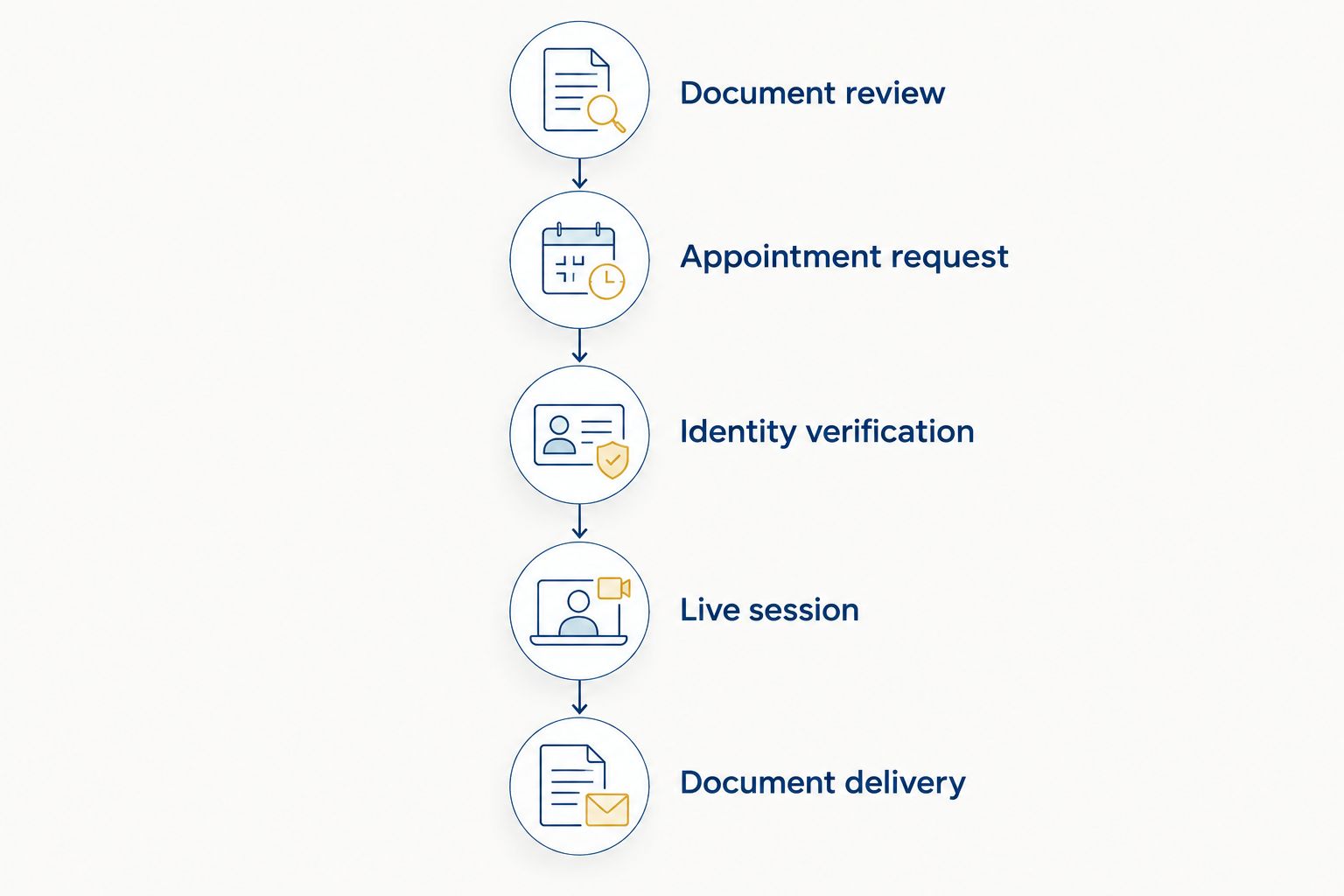
Use this sequence for eligible supporting documents. Do not sign or alter the document until you understand the instructions for the required notarial act.
Document review
Identify the exact document and the agency or organization that will receive it. Confirm whether it requires notarization and accepts an electronically notarized version. Keep the paper-title question separate from any supporting-document question.
Appointment request
Explain what needs notarization and whether anyone is signing as a business representative or under other authority. An inquiry is a request, not a confirmed appointment. Wait for CraigVet to contact you about eligibility and arrangements.
Identity verification
Follow the Proof identity-verification instructions for the appointment. Prepare the identification requested and a device suitable for the required audiovisual session. Complete the verification process rather than assuming possession of identification alone guarantees completion.
Live session
Participate in the session and follow the notary’s instructions for the required act. Ask procedural questions if a step is unclear. The notary must be able to complete the applicable Maryland requirements.
Document delivery
Follow the instructions for receiving and submitting the notarized electronic document. Preserve the electronic file as instructed. Do not assume that printing it creates a substitute for a required notarized paper original.
Before requesting service, settle the format question with the recipient. That answer determines whether remote notarization is appropriate or whether you should arrange an in-person appointment.
Request an eligible-document appointment
Describe the document and recipient. Eligibility and appointment arrangements require confirmation.
Practical guidance for repeat business notarizations
For businesses handling recurring vehicle transactions in 2026, separate document preparation from notarial scheduling. Repeating the same transaction type does not prove that every document in the next file has identical requirements. Different issuing states and receiving agencies can change the process.
Keep a written preparation checklist:
- Identify the document’s issuing jurisdiction and recipient.
- Record whether notarization is required and which format is accepted.
- Identify the signer and the capacity in which that person will sign.
- Confirm required identification, participation, and any witness arrangements.
- Wait for appointment confirmation before coordinating the other participants.
Do not treat one accepted remote document as blanket approval for future files. Maintain the recipient’s instructions with the transaction paperwork so staff can distinguish a confirmed requirement from an assumption.
Craig is not an attorney and cannot provide legal advice. Questions about ownership disputes, inheritance, authority to sign, or the legal effect of a document belong with the appropriate agency or an attorney, not inside a notarial appointment.
How these options are ranked
The order follows necessity, document format, receiving-agency acceptance, and appointment practicality. It is a process comparison, not a claim that every provider or document has been tested.
The routine MVA-directed transfer comes first because an unnecessary notarization does not improve the transfer. Remote service comes next for eligible electronic supporting documents; mobile and office appointments serve distinct in-person needs.
Which option should you choose?
Default to the required Maryland MVA process, then arrange notarization only for documents that need it. For eligible electronic supporting documents, choose remote service through Proof after confirming acceptance. For required paper originals, choose mobile service when travel is difficult or an office when you can attend.
For a 2026 transaction involving an out-of-state title, use the issuing jurisdiction’s assignment requirements and Maryland’s submission instructions together. Do not substitute a general Maryland notarization rule for the directions printed on that title.
FAQ
Do I need to notarize an auto title transfer in Maryland?
A routine Maryland title assignment generally does not require notarization. Separate supporting documents can have notarial requirements, so check the title and current Maryland MVA instructions for your transaction.
Can I notarize Maryland vehicle-transfer paperwork online?
Eligible supporting documents can be notarized online when the receiving agency accepts the electronic format. Do not assume that remote notarization replaces a paper title assignment or satisfies a paper-original requirement.
Is remote notarization better than a mobile appointment?
Remote notarization is the better fit for eligible electronic documents; mobile service fits required paper originals when travel is difficult. Document requirements determine the choice before convenience does.
Can a notary complete the title transfer for me?
Notarization does not complete the vehicle title transfer. You still need to satisfy the applicable title, supporting-document, and submission requirements.
What should I prepare for an online notary appointment?
Prepare the eligible document, requested identification, and a device suitable for the audiovisual session. Follow the platform instructions and wait for direction about signing.
Does submitting an appointment request confirm my booking?
No, submitting a request does not confirm an appointment. Wait for CraigVet to contact you about document eligibility and arrangements; Baltimore County mobile availability must be confirmed before booking.
Can the notary tell me how to transfer an inherited vehicle?
Craig is not an attorney and cannot provide legal advice about inheritance or ownership. Obtain the applicable agency instructions and seek legal advice when the transaction raises legal questions.
One last thing
A notarial certificate and a title assignment serve different purposes. Before your 2026 appointment, identify the exact signature that requires notarization and the accepted document format. That distinction prevents you from arranging the wrong service for an otherwise straightforward transfer.


