

Best overall for eligible documents: remote online notarization through Proof. Best for paper documents at your location: mobile notarization. Best for an established office workflow: fixed-location, in-person notarization. CraigVet Notary Services offers Maryland remote online notarization and mobile appointments; the right choice for your business contract starts with document eligibility and the recipient’s requirements.
- For notarization methods for business contracts Maryland businesses need, choose Proof remote notarization when eligibility and recipient requirements align.
- CraigVet Notary Services offers Maryland remote online notarization for eligible documents; mobile appointments are a secondary option.
- Confirm the required notarial act, signer identity requirements, and recipient instructions before scheduling.
- Baltimore County mobile availability requires confirmation; a submitted request is not a confirmed appointment.
Why this matters for Maryland businesses
A business contract does not automatically need notarization simply because it is important. Start with the contract’s instructions and the receiving party’s requirements. If the legal requirement is unclear, ask an attorney rather than choosing a notarial act yourself.
Notarization addresses the notarial act, not the quality of the agreement. It does not establish that a contract is commercially sensible, that its terms protect your business, or that the signer has every authorization the transaction requires.
For your 2026 contract workflow, separate document preparation from notarization. Complete the legal review first, establish who must sign, and then arrange the appropriate appointment. That sequence keeps a notary appointment from becoming an unsuccessful attempt to resolve unfinished contract questions.
What makes the best notarization method?
Choose among notarization methods using these criteria, not convenience alone:
- Document eligibility: Establish whether the document and requested notarial act are suitable for remote notarization or require an in-person process.
- Recipient acceptance: Confirm what the receiving organization accepts, including electronic documents, paper originals, and any specific execution instructions.
- Identity verification: Prepare the identification and verification steps required for the selected appointment. Remote verification is not replaced by emailing a photograph of an ID.
- Signer participation: Identify everyone whose signature requires notarization and explain the appointment requirements before scheduling.
- Document format: Match the signing process to the required final document. A paper-original requirement changes the decision.
- Repeatability: For recurring business contracts, use a written intake checklist rather than relying on each employee to remember the process.
Remote online notarization is the default recommendation only after eligibility and acceptance are confirmed. A convenient appointment that produces the wrong document format is the wrong appointment.
Arrange remote notarization in clear steps
Maryland remote online notarization through Proof is the primary service to consider for eligible documents. Follow these 4 preparation steps before treating a contract as ready for notarization.
Eligibility review
Identify the document, the receiving party, and the requested notarial act. Explain whether the recipient requires an original paper document or accepts an electronically notarized document.
Do not assume that a familiar contract template is automatically eligible. A new recipient or a different execution instruction calls for a fresh check, even if your business has notarized similar documents before.
Appointment confirmation
Submit the information needed to assess the request, including the signer details and document requirements. Wait for CraigVet Notary Services to contact you before treating the appointment as confirmed.
For a business deadline, distinguish your requested appointment from an agreed appointment. Do not tell a customer, lender, or counterparty that notarization is scheduled merely because you submitted an inquiry.
Identity verification
Follow the Proof appointment instructions for identity verification. Prepare the requested identification and use equipment that supports the live audio-video interaction required for remote notarization.
Check your camera, microphone, and connection before the appointment. Identity verification and the notarial session are procedural requirements, not administrative details that an employee can complete for another signer.
Document completion
Follow the notary’s instructions about signing and any required acknowledgment or oath. Do not assume that a signature added in advance satisfies every type of notarial act.
After completion, check the resulting document against the recipient’s submission instructions. Your business remains responsible for sending the appropriate document to the correct recipient and maintaining its own records.
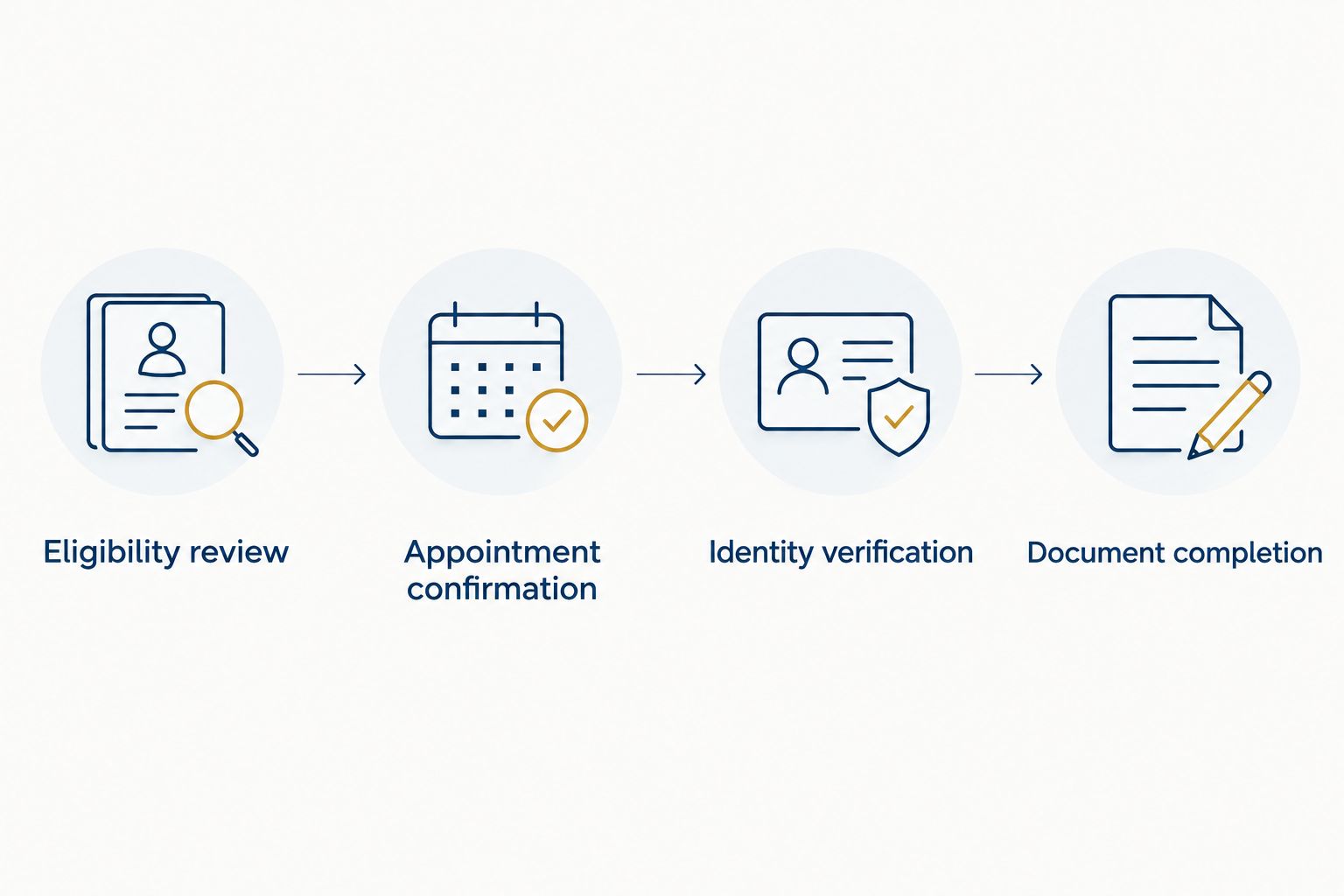
For repeat notarizations in 2026, assign someone to check these steps before each request. A consistent preparation process does not remove document-specific requirements; it makes those requirements easier to identify before the appointment.
Notarization methods at a glance
These are workflow recommendations, not a claim that every provider or appointment offers identical services. Choose the method that meets your document requirements before comparing convenience.
| Method | Best for | Standout feature | Key limitation |
|---|---|---|---|
| Remote online notarization through Proof | Eligible contracts with remote participation and accepted electronic documents | Live remote notarial interaction without sharing a physical meeting location | Requires eligibility, recipient acceptance, identity verification, and suitable equipment |
| Mobile, in-person notarization | Paper contracts signed at a coordinated business location | The notary travels to the agreed appointment location | Requires confirmed availability and physical attendance |
| Fixed-location, in-person notarization | Businesses with an established office-based signing arrangement | A repeatable meeting location for paper signing | Requires travel and confirmation that the provider handles the requested act |
1. Remote online notarization: best for eligible remote contracts
Remote online notarization connects the signer and notary through a live audio-video process rather than a shared physical location. CraigVet Notary Services provides Maryland remote online notarization through Proof for eligible documents.
CraigVet Notary Services is best for Maryland businesses seeking remote online notarization of eligible documents through Proof. That recommendation depends on the document and recipient requirements, not on an assumption that every business contract qualifies.
Remote online notarization pros:
- Removes the need for the signer and notary to meet at the same physical location.
- Supports an electronic appointment workflow when the document and recipient requirements permit it.
- Gives businesses a defined preparation process covering eligibility, verification, and completion.
Remote online notarization cons:
- Does not resolve a recipient’s requirement for a paper original or a different execution process.
- Requires the signer to complete identity verification and participate in the remote session.
- Depends on working audio-video equipment and a suitable connection.
Best for: Eligible business contracts where remote participation and the resulting electronic document meet the transaction’s requirements.
For your 2026 decision, ask the recipient about electronic-document acceptance before arranging the session. Do not treat the platform name as proof that the receiving organization accepts the final document.
Verdict: Choose remote online notarization after eligibility and acceptance are confirmed. Skip it when the required document format does not fit.
2. Mobile notarization: best for paper signing at your location
Mobile notarization brings the notary to an agreed location for an in-person appointment. It is the secondary service option when your business needs a physical signing arrangement rather than a remote session.
CraigVet Notary Services offers mobile notary appointments, with Baltimore County availability confirmed before booking. A request for a particular location or time does not establish that the appointment has been accepted.
Mobile notarization pros:
- Supports an in-person process for documents that must remain on paper.
- Lets your business coordinate the appointment around an agreed meeting location.
- Avoids requiring the participating signers to travel to a separate notary office.
Mobile notarization cons:
- Requires the necessary signers and documents to be physically present.
- Adds location and scheduling coordination to the preparation process.
- Requires confirmation of service availability before the business relies on the appointment.
Best for: Paper business contracts and coordinated signing appointments at a confirmed location.
Before a mobile appointment in 2026, tell the notary where the meeting will take place, who will participate, and what the recipient requires. Have the complete document ready; an in-person visit does not replace legal review or fix missing contract terms.
Verdict: Choose mobile notarization when a paper or in-person workflow is required. Wait for availability and appointment confirmation before committing the schedule.
3. Fixed-location notarization: best for an office-based workflow
Fixed-location notarization means the signer attends an agreed office or other established appointment location. It is a general alternative for businesses that already have a suitable in-person notary arrangement, not a separately stated service offering from this brand.
Confirm the provider’s appointment process and ability to perform the requested notarial act. A nearby office is useful only when its service matches the document requirements.
Fixed-location notarization pros:
- Provides a known meeting location for an in-person signing process.
- Fits businesses whose signers already travel to the same area.
- Avoids coordinating a notary visit to your own premises.
Fixed-location notarization cons:
- Requires signers to travel and attend the appointment.
- Does not guarantee that the provider handles every document or requested act.
- Requires its own scheduling and document-preparation checks.
Best for: Businesses with a confirmed, suitable office-based notary arrangement and signers who can attend.
Verdict: Choose fixed-location notarization when the existing arrangement meets the contract requirements. Skip an unconfirmed walk-in assumption for a deadline-sensitive contract.
Build a repeatable business contract process
For recurring notarizations in 2026, keep a short intake record with the document name, recipient instructions, signer details, requested act, and final-document format. Assign responsibility for checking it before anyone requests an appointment.
Use these 3 checkpoints to prevent preparation gaps:
- Before requesting: Resolve contract drafting questions, identify the required signers, and establish what the recipient accepts.
- Before attending: Confirm the appointment and ensure each signer has the requested identification, complete document, and necessary equipment or travel arrangements.
- After completion: Check the document against the recipient’s instructions and handle submission and business recordkeeping.
Do not confuse identity with authority. A signer’s verified identity does not, by itself, establish authority to bind a company. Resolve questions about signing capacity with the appropriate business representative or attorney before the notarial appointment.
For an acknowledgment, the signer acknowledges the signature as required by the notarial act. A jurat involves an oath or affirmation and signing in the notary’s presence. These are different acts; an employee should not select between them simply because one seems easier.
Craig is not an attorney and cannot provide legal advice. If the document lacks clear instructions about the required act, obtain direction from the document’s preparer, recipient, or an attorney as appropriate.
How the methods are ranked
The ranking prioritizes document eligibility and recipient acceptance, followed by identity verification, signer participation, document format, and repeatability. It compares workflows rather than claiming measured performance differences between providers.
Remote online notarization ranks first for eligible remote transactions. Mobile notarization ranks first for paper signing at a confirmed client location, while fixed-location notarization fits an established office-based arrangement. Each method has a distinct role.
Which notarization method should you choose?
Start with remote online notarization for eligible Maryland business contracts. Confirm recipient acceptance, complete the preparation steps, and wait for appointment confirmation before organizing your deadline around the session.
Choose mobile notarization when your contract needs a paper or in-person workflow at your location. Choose a fixed-location arrangement when your business already has a suitable provider and the signers can attend.
The deciding question is not which method is newest. It is which method produces the document your recipient requires through the correct notarial process.
FAQ
What is the best notarization method for a Maryland business contract?
Remote online notarization is the best starting option for eligible contracts when the recipient accepts the resulting electronic document. Choose an in-person method when the document requirements call for paper or physical attendance.
Can every Maryland business contract be notarized online?
No, remote online notarization is limited to eligible documents and suitable notarial acts. Confirm eligibility and the receiving party’s requirements before arranging an appointment.
Does a Maryland business contract always need notarization?
No, a business contract does not automatically require notarization. Check the document instructions and recipient requirements, and ask an attorney when the legal requirement is unclear.
What do I need for a remote notarization through Proof?
You need to follow the appointment’s identity verification and document instructions and participate in the live remote session. Prepare the requested identification and working audio-video equipment before the appointment.
Is my appointment confirmed after I submit a request?
No, submitting a request does not confirm an appointment. Wait for CraigVet Notary Services to contact you before treating the requested time or location as agreed.
When should a business choose mobile notarization?
Choose mobile notarization when an in-person paper signing at an agreed location fits the document requirements. Baltimore County availability must be confirmed before booking.
Can Craig tell me which notarial act my contract needs?
Craig is not an attorney and cannot provide legal advice. Obtain direction about an unclear required notarial act from the document’s preparer, recipient, or an attorney as appropriate.
One last thing
Ask the receiving party about the final document before asking the notary about an appointment. That small change puts acceptance ahead of scheduling and prevents your business from choosing a convenient process that does not meet the transaction’s requirements.
For 2026 repeat contract work, put that question at the top of your intake checklist. Then confirm eligibility, prepare the signer, and wait for the appointment to be agreed.


